Tuesday, May 22, 2012

Poetry and Buried Treasure


Today, after teaching poetry to kids at Alexander Valley School, I trolled the Lytton Station Salvation Army refuse bins, I uncovering odd bits of treasure, I found an old 1985 audio tape, The Scotsman, signed by Alex Beaton. Not that I needed the tape. Who plays audio tapes anymore? I have the digital downloads of the album, but still I bought it for the music jacket.

It must date back to the days when the Caledonian Club Highland Games were held in in Santa Rosa, I said to no one in particular, feeling nostalgic for the past. Before his career took off, Alex hand-made those audio tapes, and slept in the back of his truck during the games to save money. A thrifty one, our Alex.

We saw Alex perform at the Las Vegas Games in 2011 before the freak accident that left him all but paralyzed. We didn't realize that would be the last time we'd see him sing. First the cancer, then this. Rotten luck. After 22 years, the SFCC Games left Santa Rosa for Pleasanton in 1994. I saw Alex perform many of the songs on that tape during the early 1980s. So I was holding a bit of the past in my hands.

The Lytton Station Salvation Army is the motherlode of all thrift stores. Those bins under the awnings really are the last call bins before the junk heads out to the dumps. One man's junk os another man's treasure. It's not for the faint of heart. We were a determined bunch, intent on a thorough search and rescue in the wake of other people's detritus. Trinkets of the dead. You never know what you'll find. The past, certainly.

As I rummaged, I realized I was being stalked by a bright, mousy-eyed lassie of about seven years of age. We talked over melted records (it was a hot day), old paintings, and broken toys. Then we discovered I had taught her poetry in a Kindergarten class at Alexander Valley School last year! Which for her, was the distant past. Clearly I was her prize find of the day. She was so excited to find her old poetry teacher scrounging with the best of them.

I didn't play the audio tape as I knew it would be a rough rendition of what it once was. But I hummed Skye Boat Song to Alex, as I drove down the road home to the Bay Area, thinking of the day's treasures—both old and new.


added and revised 7/24/2016


First draft (two fragments)

So chuffed, found an old audio tape, The Scotsman, signed by Alex Beaton at the Healdsburg Salvation Army. Must date back to when the Caledonian Club games were in Santa Rosa.

Today as I trolled the Salvation Army refuse (last call bins) uncovering odd treasure, I realized I was being stalked by a bright, mousy-eyed girl of about 6 or 7. We talked over melted records, and we discovered I taught her poetry in Kindergarten at Alexander Valley School!

Sunday, May 20, 2012

Annular Eclipse, May 20, 2012


When I was young, I remember watching an eclipse in the schoolyard at Lagunitas School with the naked eye. But then, we also watched the skyline when they set off an atomic bomb at Jackass Flats, NV.

I can still see fine (maybe little auras here and there) but I've no idea what damage it caused. But then, I'm also long past the crossroads of denial that I need reading glasses.

During the 1990s, I got more sophistocated and used stacks of UV sunglasses for filters and even a stint with mylar anti-static hard drive bags (see my 2009 post).

Someone took a photo of me wearing funny mylar eclipse glasses for the total Hawaiian eclipse in 1991. I actually bought a square of mylar for my camera too—for $20. Number 14 welding glasses were not a practical option.


But simple pinhole cameras are the safest and easiest way to view an eclipse. A cylindrical Quaker cardboard oatmeal mush box is the easiest to make. Punch a hole at the bottom end with a pencil at one end, and use the lid to project the light.

Your lens aperture—the width of a pencil seems to work fine—but you can use other objects to create lens size. The smoother the hole, like with a knitting needle, the crisper the edge. But you don't need a perfect lens to view the eclipse.

No oatmeal box? A paperback book cover will work. Punch a hole in the middle, use other cover underneath to focus it. Pulp fiction never looked so good.


Your crossed fingers will make eclipses. A colander works fine too. The holes are just the right size. Even those reading glasses will project an image onto paper—and quite possibly start a fire.

I'm sure the ancients discovered that trees also make great spontaneous pinhole cameras—especially long-needled eucaluptus. Oak trees too. The dappled light between the leaves will make images of myriad eclipses on the ground. You just have to know what you're looking at. And how to bring it into focus.

You can use cardboard or paper to "focus" the parallax position of the image. Move it up and down between ground and tree leaves to focus it until you find the sweet spot.

How I know this: In 1979, I was in my kitchen in Cotati, and I noticed strange crescents crawling on the wall in the shadow of my hanging plant—a succulent.

At first I thought they were ants or an outburst of spiders and tried to swat them away and then I thought I was having a really weird flashback or completely losing my mind as I had no idea there was an eclipse happening.

I put two and two (or sun and moon) together and ran outside, camera in hand—but the wall was more interesting. I scurried all over the yard tracking little myriad eclipse shadows. The photos weren't all that interesting but I was thrilled beyond belief by my "new" discovery.


Enjoy today's eclipse but safeguard your eyes. They're the only ones you got. And check the local time. Not Mountain Time like I did in 2009 when I was madly staring into the midday sun an hour after the eclipse had come and gone.

Further reading: I delved indepth on the process of chasing eclipses in another post: Partial Eclipse, 7/21/2009. I even invoked Sir Isaac Newton's "Opticks."

ScienceCasts: Solar Eclipse in the USA 


How to make a pinhole camera from the Exploratorium.

Timeline via The Daily Mail. It'll pass over Reno & Redding at 5:12 to 5:15 PM. The full annular eclipse will last about 5 minutes. The rest of us will see a partial eclipse. I've never seen an annular eclipse and unfortunately I'll be at work today...so I don't hold much hope of glimpsing it on paper, or otherwise.


NB: as it turned out, my "lunch" break was during the height of the eclipse and many of my coworkers abandoned ship for the parking lot. So I was able to get many photos of shadows. 


Interesting, the shadows were all blurry as the light was coming from two different sources/directions—the moon split the light. Also, as the sun went into the eclipse, the wind picked up, like during the total eclipse in Hawaii. Then it died completely during totality. The birds definitely went to sleep early, so it was eerily quiet, and our skin was cold to the touch as there was very little heat coming from the sun. 


I had several blurred people photos, not realizing that though there was plenty of light for the eye to see, the camera was not fooled. I didn't realize this until I uploaded the jpgs and then noticed in the images that all the parking light and the security night lights were on—at 6 PM!


UMBRA, CITY OF REFUGE, HAWAII, 7/11/91

Ken Kesey

Ken Kesey once sent me rather unusually inscribed checks to purchase some new age tarot cards I was selling. My job at Western Star Press, located in the basement of Alice Kent's big Victorian house in Kentfield, was sorting old tarot decks. 


My best friend's mother, artist, Rosalind Sharpe Wall and Alice Kent's brother, Bohemian, John Starr Cooke made a New Age Tarot deck, The New Tarot: a deck for the Aquarian Age (1969).


(See poet-librarian Jim Carmin's Facebook post and photo, about unpacking a VCR tape from Ken Kesey for the Multnomah Library Special Collections. Shall we say, it was, um, an acid-colored and tie-dyed VCR tape? Jim's post was the source of inspiration for this blog post. Once again, thanks Jim!)


There's not much on the internet about Alice Kent's brother, John, or the The New Tarot for the Aquarian Age, for that matter, which is odd, as John, friend of Timothy Leary, William S. Burroughs, and Paul Bowles, a disciple of Aleister Crowley, was revered as a sufi, he had the shakti. But I found this second-hand description of interest:
The New Tarot aka The Tarot for the Aquarian Age 
This deck is very different from most Tarot decks. The Majors have all been renamed and the suits are Blades, Serpents, Pears and Stones, which represent air, fire, water and earth respectively. The Majors are radically different; The Fool is called Nameless One, The High Priestess becomes The Mother, The Lovers becomes Unity and The World becomes The Virgin. All of the trumps are like this with the exception of The Hanged Man. The court cards have the normal names (Page, Knight, Queen and King), but the pictures do not show people. The Minors do not show scenes, rather they show the number and the requisite number of pears, serpents etc. The deck comes with 3 books, a 150-page guide which explains the reasoning and symbolism on each card followed by a short question and answer section for each card. The symbols were supposedly given to the designer during Ouija board readings in 1962 and 1963 and the deck was purportedly predicted by Madame Blavatsky in her magazine Lucifer. The second book describes a spread called The Game of Destiny, and the third book is a small booklet, similar in size to most deck booklets which describes a game to be played with the deck called The Royal Maze. The deck has its own box and the boxed deck and the books come in a larger box. © 1997 by Michele Jackson (the link is dead).
During the early 60s, John was living in Carmel. The Ouija board medium who/that channeled the deck to John, was called the One. So they called the deck The word of One. In 1964, a posse of psychedelic rangers traipsed down to John's place in Cuernavaca, at the foot of Popocatapetl, in Mexico, to work out the details. 

The New Age brujos delved into the occult with a little help from LSD, datura and magic mushrooms, to shepherd in the New Age. And then they brought it back to the Haight Ashbury. Which, in turn, led to the Human Be-In...that's where I come into this story, as I was there with my mother, who knew Timothy Leary....

And Ken Kesey and his Merry Pranksters were fed LSD treats courtesy of the US Army. Which led to electric kool-aid acid tests where other pranksters could “turn on, tune in, and drop out.” And the incarnation of Further in her day-glo splendor (and, yes, I boarded the bus when Ken stopped).

John and Rosalind designed the Tarot deck, Roz did the artwork. She wasn't very good at drawing or painting people as I recall... But she persisted with her painting throughout her life. I inherited a big box of her brushes, paints and tools when she died. The odor of rancid linseed reminds me of her.


My job was sorting and making up the decks to make them whole. And I do mean sorting—the printer had a serious mishap or played 52-card pick up with hundreds of decks during the final print run. Wheee! Talk about not having a full deck....

Though the cards were officially out of print, orders were still coming in. After all, this was THE tarot deck for the Aquarian Age. My tedious job was to send people missing cards, and  make up new complete decks—which required finding all the cards, and sorting them into major arcanas. Those images inhabited my waking and sleeping moments. Especially the burning ouroboros. Ad infinitum.

I didn't dare tell my mom about this rather particular job as my mom and Rosalind were arch-enemies on the highest wiccan order—they had a falling out over this deck. My mom had designed her own deck. They traded notes, then realized that they didn't see eye-to-eye on intellectual matters of the occult.


Ken and I struck up a correspondence of sorts. I told Ken that my mom, whom he likely knew, made me read his books. (She got around—and perhaps unofficially qualified as a Merry Prankster, as she probably dropped acid with Timothy Leary whom Nixon dubbed "the most dangerous man in America").


When the Beatnik scene died out, my mom embraced the next wave. She became a well-tuned psycho-delic card-carrying member of the "turn on, tune in and drop out" crowd. She made me read One Flew Over the Cuckoo's Nest when I was young, in order to better understand what her manic-depressive illness was like. 


Ken must've been impressed with that story, as a consolation prize, he sent me a signed complete set of a poetry & prose journal he was editor of, called "Spit in the Ocean." Much of it was beyond my comprehension. But I was a late bloomer. I do remember pausing over a grainy photo of the original Further, the magic bus I had once hitched a ride on coming home from high school—driven by Ken Kesey himself. What a strange trip that was.


Ken wrote me that the bus broke down and was rotting in the lower south forty pasture on his farm in Pleasant Hill, Oregon. It was the original Further. Maybe even during the Summer of Love. Who remembers, who cares? It was then. And this is now. It's always now but memory has a way of sneaking in and curling up on a sunspot when you're not thinking about it.


Further, the 2nd (painted in the late 1980s), proof that you can go back home again.
I was also distracted by Ebbe Boregaard outside my window, who was stripped down, a bronzed Viking god, rebuilding the front steps of the old house, telling me stories of restoring his Egyptian scow and poetry. Little did I know that the gods of poetry were beginning to develop the plot on my becoming a writer. I was 17. What did I know?


I didn't save Ken Kesey's letters or the books. Or rather, my first boyfriend Sweet old Bob Hamilton, ran off with a redhead named Dulcie, and all my books—he was the "literate" one who got me into this mess to begin with. Someone out there has them and is probably wondering who this "Maureen" was and why Ken Kesey sent them to her. 


Perhaps they'll turn up in a special collection somewhere. Perhaps it's just a spit in the ocean after all.


See my post: Hitching in Marin during late 60s, early 70s

Saturday, May 19, 2012

Falling off the wagon


What I learned yesterday during a meeting: at TJs when sitting on 2 milk crates in lieu of a tall stool, make sure they're properly stacked and snapped together. When the milk crate slid off its mate, I rolled off the back as if I was on horseback—old skills may have saved me from a bad fall onto unforgiving cement but it was still a long way down to the ground—in slow-mo. My workmates surprised faces in silent frozen Os mimicking mine. Not one made an attempt to help in either direction. My ass hurts. It hurts. My wounded pride will survive.

May 19, 2012

riding a packhorse in the Andes fragment

Addendum to falling off the wagon post...

Once I was riding a packhorse up Dead Woman Pass in the Andes, and she swung around on the incredibly steep hill into a massive madrone limb, so I did the leg flip to dismount uphill. Now I was used to riding up steep hill as our hill in Forest Knolls nearly defies the angle of declination—but I forgot about the weight of my camera bag/backpack, so I rolled off the OTHER side, ass over teakettle as he swung back around. I was admiring his legs from his belly. Same instinct saved me then.

I might add that the pack horse had NEVER been ridden before in his life—he really was a pack horse with a wooden frame and blanket. But he was the only horse in "town" (wide spot in the Inca Trail) as we got off the train late—so I fashioned a crude hacamore out of stiff leather that was next to useless—He ran away with me earlier—into the wall of a chicha bar—the Andean men scattering like flies. I merely lifted my leg over his withers as he slammed sideways into the adobe wall at 30MPH. The hut shook, sounded like s drum! So he was more inclined to pay me very careful regard—though I didn't speak Quechua, I did speak horse well enough.

From a Facebook post

Saturday, May 12, 2012

RIP Canice Reilly 3/30/1937 - 5/12/2012 (photo)

M y aunt Canice Reilly holding me on the back steps, 3rd Avenue, San  Francisco, 1953. Lori, the boxer, coming in for a snuggle. Look at how light my hair is—the same color as the dog. A redhead too. Then my hair turned dark. Woof. Look at the cuffed jeans. So very 1950s! She was a teenager here. Clearly, my main babysitter. Yeah, she babysat me when I was young. and I, in turn, took care of her kids when I was young—Full circle. So, her daugher is one of my best friends too. But Canice also drove me crazy too. RIP Canice Reilly (Dinsmore/Santos) 3/30/1937 - 5/12/2012.

I was changing my Facebook cover photo to the  Funeral Mountains, Death Valley—when my cousin Dave posted the link. You couldn’t get more literal than that. I was up all night. Couldn't sleep. That dream of the bowl of scorpions haunted me. Portent of things to come. Now I understand all the disturbing dreams. But we do have this weird death ESP in our family. Her death sentence was not commuted. She measured her demise in days, not months. she gave up the ghost. (Alas, she got only two weeks notice. She died on a Saturday. It was mercifully quick.) My aunt is gone. Blessed be.

Added 5/20

Wednesday, May 9, 2012

Alexander Valley from Lytton Station Road, looking north toward Geyserville, photo

Alexander Valley from Lytton Station Road, looking north toward Geyserville I had forgotten my cameras but I had my MacBook! Yep this is a MacBook facecam photo. The camera you have on you is the one you’ve got.© Maureen Hurley

Sunday, May 6, 2012

GEALACH

GEALACH
                         —Tá an ghealach lán anocht.
               To Canice Reilly-Santos 1937-5.12.2012


I dreamed someone handed me a bowl of scorpions.
Then the news came, the report wasn't good.
They said my aunt lit up like myriad moons
in the MRI chamber, her body riddled with light.
Super moon of the year, Scorpio moon.
Beltaine's bone fire announcing the birth of summer.
Someone says it's also the Buddha moon.
They say he was born, achieved enlightenment,
and died all during the full May moon.
My aunt's days are numbered in weeks, maybe months.
She is watching the approach of her own death.
For some reason I am remembering
the names of the moon in Irish.
An ghealach, the bright shining one.

5/6/12


(Alas, she got only two weeks notice. She died on Saturday. It was mercifully quick.)

Cinco de Mayo supermoon

Cinco de Mayo supermoon over Oakland ©Maureen Hurley 2012 

The Cinco de Mayo supermoon rose in the sky like a vast blind eye and seemed to dance and bobble in an indigo velvet sky as I drove down Highway 24 to the curve of 580. I didn't have my big Nikon camera, and the new point and shoot Canon only took blurred white dots. 

Between three point and shoot cameras I was only able to get four shots that show the face of the moon—all with my otherwise useless big camera pretending to be a DSLR camera, using night shot and 15X zoom—I took it all the way out and used the interpolated magnification too. A truck side mirror was m tripod.

The other cameras—even the Nikon P60—were a wash. I'd previously taken great eclipse shots with it. Most digital cameras don't handle low light well, extreme pixellation, or rather, artifacts, is the main problem. They overcompensate for the darkness of the night sky and overexpose the image so you get a pixellated halo. You'd be better off setting the camera on a night shot and covering the flash with your hand.

This is full frame, unretouched. It's soft, but the moon kept moving! The hard part is gauging (or tricking) the pseudo-ASA and shutter speed on cameras that have almost no manual aperature functions.

I should have shot it at moonrise, on the horizon, when it was at its biggest magnification, but I was stuck inside at work. I also should've taken a photo against a backdrop, a tree, or cityscape, but my lower back hurt so much I could barely stand. So a few quick shots was all I could withstand. That, or nothing.

Besides, we get a supermoon once a year. But it was noticeably brighter. Maybe I'll attempt a shot tonight as it wanes. But I still don't get off work 'til 9 PM. Argh. Sucks.

The digital age has left most of us in the tyranny of autofocus camera programming. They have their place, don't get me wrong. But we've forgotten photography basics—how to bracket our photos. Forget about the holy trinity of photography: the F-stop, shutter speed and film speed. 

Then there's the other tyranny of digital cameras that do have manual overide capacity—the hefty price tag. I expected the price to come down ages ago. Yet the good DSLR cameras are still prohibitively expensive—a decade later. Will I ever be able to afford a DSLR?

What would Ansel Adams do?

Shoot the moon with what ya got.

Thursday, May 3, 2012

Lagunitas Vernal Pools


What I miss this morning: tri-colored blackbirds trilling in the sedges that once grew near vernal pools strung along Sir Francis Drake Blvd. from White's Hill at the Woodacre turn-off to Forest Knolls at Lagunitas School.


The name Lagunitas means "little lagoons." My grandmother said that in the 1920s-40s, the San Geronimo Valley was strewn with myriad pools all the way to the hamlet of Lagunitas. The fog always remembers where the pools once were, and lankers down for a visit.


The few surviving pools were lost in my lifetime, destroyed by well-meaning folks turning those fragile, ephemeral marsh wetlands into drained pasturage for horses and cattle. The County of Marin had grandiose plans to develop the San Geronimo Valley with 5000 more houses, a shopping mall, and in anticipation, they built a ziggurat embankment for a high school at the base of White's Hill at the Flanders ranch, and bulldozed all the marshes on the east side of the road.

All that's left of this pool is the teasel.
The Dixons, converted their ranch over to horse boarding stables, built a jumping course, and wiped out another pool. Someone ran cattle in the vee at the first Woodacre turnoff (the old road), where it joins the straight, new roadbed of Sir Francis Drake. Under their hooves, the last and most pristine vernal pool in the San Geronimo Valley disappeared forever.

Friday, April 27, 2012

Edgewood Preserve


The empty fire trail is always a siren call, pulling me deeper into the hills. I never want to turn back, I want to keep on going, walking faster and faster, delving deeper into the hills. A swath of meadow gold & tidy tips, always on the next horizon, teasing me on.


I am allergic to the concept of putting nature under lock and key barring the path. No trespassing is not  a concept I adhere to. The cyclone fence between me and my desire was plastered with myriad no parking, no trespassing, no loitering signs. That's a new one: loitering!


I loitered long and I lingered even longer. I loitered and looked long and hard and took hundreds of photos, though the light was low. I defied someone to arrest me for loitering amid the wildflowers. The land should not be held prisoner. However, I begrudgingly have to admit that this rare wildflower meadow is in pristine condition because of the lockdown stewardship of the San Francisco Water Board. Cattle and humans impact the fragile serpentine soil and disrupt the wildflowers.

So I skirted the cyclone fence looking for openings—this one was too tall to hop over, and I stumbled upon a footpath. I had no idea where it went but it skirted the object of my desire. Access to the wildflowers on the serpentine ridge. A half mile later, the trail led me to the Edgewood Preserve. Imagine my delight. The way was carpeted with wildflowers leading me ever onward into the hills.


The paradox is that the farther (and faster) I delve into the hills, the closer I approach civilization. There are few places left where you can escape the ravages of civilization. Reminders everywhere. Distant hum of Highway 280, like the ocean's roar. The flower-painted ridges marred by flight markers and tall pylons carrying electricity to Half Moon Bay over the next ridge. I am always honing my eye like a split lens to see the landscape how it might have looked a century before.


A brooding storm front was building. The air was charged with the acrid odor of negative ions. The sky spitting. The bluebirds flew low to the ground, landing it front of me as if to tease me with their color. Escaped bits of larkspur petals let loose into the air.


The park volunteer I met near the trailhead was pulling out invasive weeds—Hawk's beard, or something. Looks lke a dandelion, but bigger. He said it was a pity that I wasn't at the preserve on Earth Day as the flowers were all ablaze—they've closed up because of the storm. Sure it would have been lovely being here on a clear day when the riot of flowers rivaled the sun in yellow and orange cadence. But oh, what a sky! If it was clear, would it have been this dramatic?


Besides, if I had been here on Earth Day there would have been scores of people there, crawling all over everything. I prefer my landscape neat, straight up and unpeopled. This way, I had the entire valley to myself.


I spent my childhood in coastal hills like these, also on the San Andreas Fault. They're an admixture of Franciscan strata, serpentine ridges and limestone reefs—creating a mecca for wildflowers where nothing else will grow. Sort of like the Burrens in Ireland—a limestone reef. The serpentine is inhospitable or toxic to most plants and grasses, creating an oasis for a few hardy wildflowers that have adapted to the unique soil, if you can call it soil. Serpentine soil is celadon green. Franciscan soil is burnt sienna. Seeing patches of the two side by side makes your eyes blur.

The clouds grew ominous. They began to spit. I hurried down the trail and around the corner, I disturbed a young rabbit at his dinner. Not a jackrabbit, but a cottontail I noted to myself, as he disappeared in a flash, his white tail, a flag of surrender. We only had jackrabbits in West Marin—they are large hares, not rabbits.


On the Pacific Plate on the other side of the reservoir lake, full climax forest. Granite enriched soils give way to oak and pine. Like San Geronimo, or Inverness Ridge. On the exposed serpentine escarpment, there was even a pygmy oak forest where the San Andreas Fault discects the rift.


The photos were taken at the half way point where I couldn't see the beginning or the end of the trailhead. So I was at my happiness point.


Sunday, April 22, 2012

Earth Day & Squirrel


OMG! I can't believe I missed international squirrel day. Look what I found perched in the lemon tree for Earth Day! She kept clutching her paw to her chest, and flicking her tail. The tail, a sign of aggression? The paw, appeasement? In some pix, she's twitching her tail so fast, it's a blur.

The squirrel and I, were not quite seeing eye to aye. She was jealously guarding her fairy coach pumpkin that I had bought for Halloween, so it was a turf war thing. I had kept the enormous red striped squash intact through the winter and planned to plant the seeds. She drilled a hole in its tough hide, and was mining pumpkin seeds from within the cavity.

Whenever I approached her to try and save some seeds, she kept gesturing at/to me. It was a soft, self protecting hand gesture. She did it over and over again. Probably means something like: "I'm harmless, please don't eat me." Damned cute. Clearly, I don't speak squirrel sign language. So she kept repeating the gesture, thinking I'd eventually get it. The tail thrashing needed no translation.

added & rev. 4/22/2016

Fresh snow, Earth Day, Mt. Charleston, Clark Co., NV (photo)


Mt. Charleston, Clark Co., NV © Maureen Hurley 2012 

Monday, April 16, 2012

Sunrise Mountain


Sitting at the base of Sunrise Mountain
watching the last light leave the peak,
everything all rose and dusk.

Sunrise Mountain, part of the Great Unconformity, is above east Las Vegas, toward Lake Mead. I can see the strip in the distance. The Needle like a drill captain leading the band. Las Vegas is better this way, seen from a distance. Such extremes. We went up Mt. Charleston. Alpine landscape. Snow!

Friday, April 13, 2012

Musician's Special

I'm stealing wifi, poolside at the Golden Nugget (can't get on via their room wifi). Remodeled rooms are a darned sight better than 4 years ago. They stuck us in a time capsule of a dingy corner room off an old mezzanine, that was built in the 40s, replete with sagging mattress, chenille bedspread, in battleship gray decor redolent with the odor of stale cigarette smoke and spilled beer left over from the days of Bugsy Malone. The lone window overlooked Fremont Street, it was like a bad movie set. We were horrified, I slept on the balcony, rather than spend one night in that room. We couldn't complain. The contract said a room, It didn't say what kind of room. A real Musician's Special.

4/13/2012
rev. 4/2016

We're at the very bottom of Fremont Street. No sign of the flying Elvises—but the sling-line's as close as we're gonna get to flying. Last year, men in kilts on the (zip) sling-line, was a sight to behold. Talk about galloping bollockitis! The weekend is young.

Thursday, April 12, 2012

Enroute, Las Vegas


We went up the Tehachepe train circle at Keene and saw the incredible train grade—the engineer tooted to us as he went round and round two times. Carpets of flowers everywhere. 

The Mojave Desert is in full bloom—a riot of color every which way you look. As if God had painted yellow, orange and purple carpets between the creosote and sage. I'm SO allergic, I thought I was sick. The air is heavy with honey.


Enroute to Las Vegas, we went down Zyzzyx Road bear Baker, and I showed Neil the remnants of Lake Mojave. A millenium later, blackbirds still whistle in the remnants of bull rushes—growing out of salt pan. Tule rushes and cattails have adapted too. Incredible white cone asters. Tiny chub acting all pupfish. 

We walked out on the evaporating lakebed, squishing alkaline mud between our toes. They moved the old boat to the CSU research center. Coots clacked at us, patrolling the oasis pond with fierce attention. The rock walls were turquoise and desert varnish. Incredible.

Wednesday, April 11, 2012

TORNADO


Last night it snowed on the Tehachepes
but the Grapevine was open.
Driving down I-5, we saw vast
angel wings of hail and snow falling from the sky,
and a massive cloud column or tower—
I joked that it looked like a budding tornado.
not that I have ever seen a tornado.
It had lightning, and a rainbow! A real tornado.
From the heights of Hwy 33, 
you could see how the cloud tower
came all the way down to the ground 
in a wide pillar, pulsing and swirling.
A cloud show of biblical proportions
suckling everything in, 
including the last remnants of daylight.

4/11/12
rev. 4/11/19

Monday, April 9, 2012

Anti-virus wars

Last night was rough. Fever & sweats left me wrung out. Canceled art teaching today. A good thing too. Still hoarse as a debarked dog but I've got small islands of voice coming back. Woof! Er, meow? Occupational hazard withing with kids, and at a market too. Extreme sports viruses. I've learned not to touch their pencils in poetry, but in art classes, I do need to collect my art supplies! People assume we have weak immune systems—not accounting for the sheer volume of people we see (and handle their items) each week. At the retail job, money, items, and customer trash—huge germ pool. Nurses must have it worst of all. I had to cancel. I'm a much more interesting art teacher when I'm not fighting a virus! The kitties don't seem to mind that I'm sick. They're piled all over me. Fur jacket nurses.

Kitty & Turtle-sitting Journal

Kitty & turtle-sitting journal: Turtle wars! I gave the big fellah a broccoli stalk after his avocado bit, as the little one is not culinarily adventurous and won't come out of his pond. Rattle and commotion—two turtles banging against the glass fighting over a broccoli stalk. Shredded broccoli florets all over the tank. They fought like two dogs over a large bone. Hysterical. It was all about the bright green stalk. Forget the good bits. Never seen turtles that active. They also like bananas. Apparently broccoli is the new banana. They're red-eared sliders. Serious personalities on those two. Who knew? They're jealous, greedy, ambitious, attention-hungry, and curious. I gave them a 2nd stalk of broccoli—they're so over it. Turned their noses up at it. They did. It was about the turf. Surf & turf wars?


Housesitting for Leah on Cleveland Ave

Wednesday, April 4, 2012

Daddy-longlegs and woolybears

Growing up in rural Forest Knolls, I had few friends my own age, but I befriended many odd crawly pets. My favorite insects included purple rolypoly pillbugs (or sowbugs) that dwelled in the cracks of the cement slab that served as our front porch. I'd get them to tuck up and used them in tiny rolling games on the tiled floor until they got tired of it and staggered off into the garden.

There were big black stinkbugs that trekked across the hardpan driveway at dusk (the cats found out that they're best viewed from afar after they've hoisted their butts skyward). Ladybugs and manbugs (the green beetles) were super good luck—and you could make a wish on them if they landed on you. Potato bugs were just too weird. I tried to like them but they looked like little babies rooting in the compost heap.

Of course, I loved the hoppers—when I could catch them in the grass. Crickets could tell us how hot the night was by how quickly they rasped their hind legs together. As if you couldn't tell if it was hot or not by yourself.

Grasshoppers were easier to catch. They would stare at you with their strange big eyes, and sometimes took a nip out of you to see if you were edible. Beautiful dragonflies darning the stems down by the creek also bit you.

The squat furry black & russet jumping spiders that inhabited the lower field by the oak tree, never, ever bit you. I didn't know about the scorpions. I kept clear of the massive, shaggy grey wolf spider that lived in the basement. He was too big—the size of your hand—and far too scary. Like a tarantula. But we didn't have them in Forest Knolls.

I didn't know about the scorpions in the crawl space in the basement until much later, either. A case of blissful ignorance as I often crawled up there to catch the cats who ran away, dressed to the nines in my doll clothes.

To my grandmother's dismay, I adopted all silverfish I found on the bathroom floor or under the newspaper lining the bureau drawers—that made them practically literate eating all those words. I was busy making similes, creating my own world order.

The silverfish reminded me of small metallic seals with long horns. Silverfish can hop amazing heights relative to body size. Sometimes called silverfish moths, these long-lived wingless pests (who knew that they lived 5-8 years). They didn't bite but loved to eat old books, wool and silk. My idea of a bookworm was a silverfish.


I especially liked the orange & black woolybears, and other caterpillars that dwelled on the cherryplum tree at the corner of the shed each spring. Someone said woolybears were like groundhogs—they could predict the winter by their color—a wider black band meant we had to stack more wood.

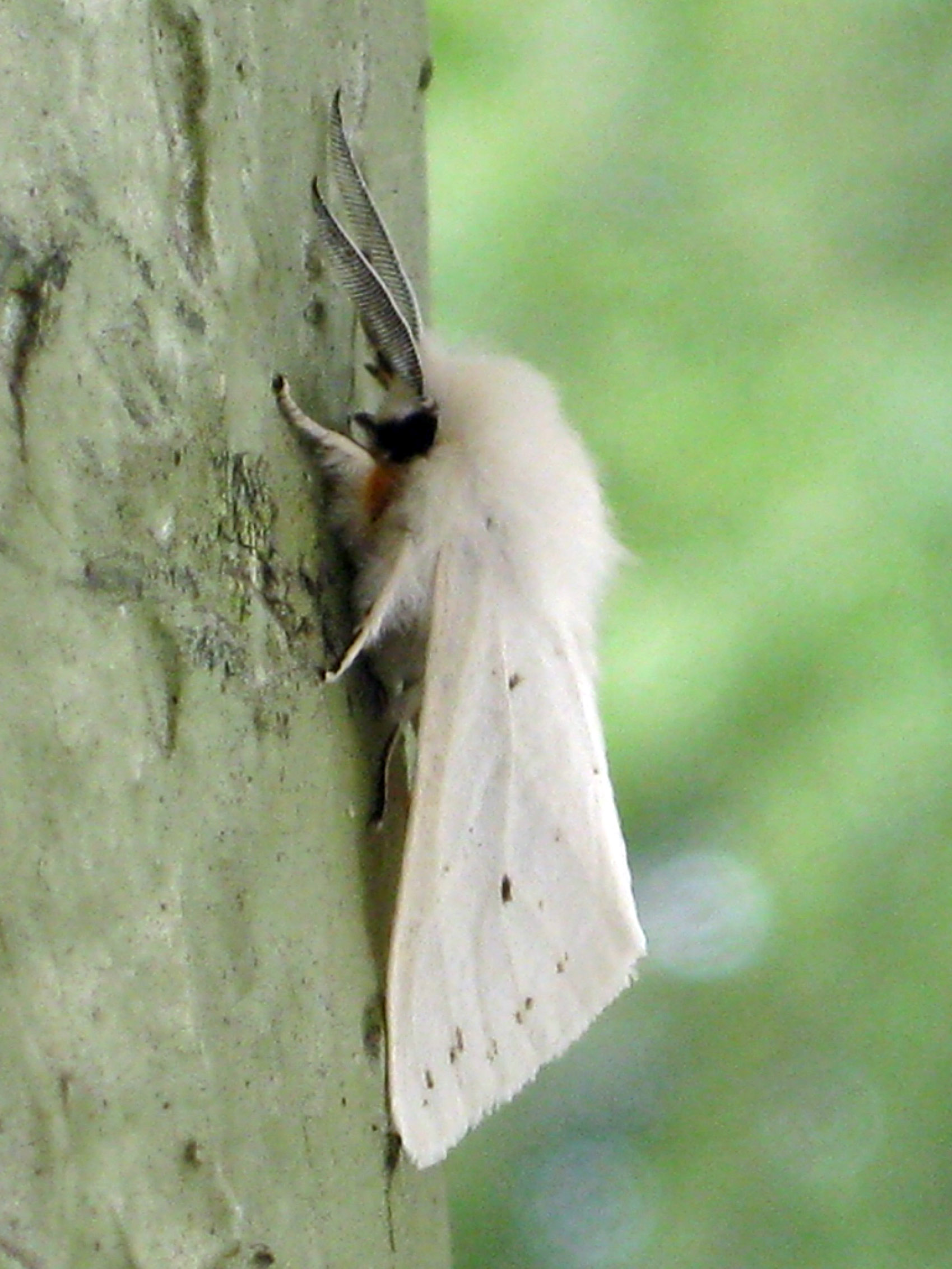
Ornate Tiger moth, Nicasio. CA
What I didn't know was that their relatives hatched into mosaic-striped tussock moths, or tiger moths that favored the back bedroom in summer, and their rarer cousins: striking white moths with black spots, black eyes, feathery black antennae; with a red bib and underwing near the thorax, black legs covered in little furry red pantaloons—sort of like this fellow pictured here.

I hated the tent caterpillars. One year they ate every leaf off our wild cherryplum. Destructive little buggers. No fruit that year. But they were fascinating to watch, always busy following the caterpillar in front of them like little runaway trains going clackety-clackety down the branches, hellbent for the ends of the earth.  Or the end of the branch. Talk about terminal. Their tents were death shrouds for the fruit trees.

My favorite pests were the daddy-longlegs that inhabited the living room corner by the swank '50s pole lamp. Sometimes a cluster of daddy-longlegs would face the light, link legs, then hover and bounce in unison in the corner of the ceiling near my grandmother who was reading on the couch. She'd mutter and swat at them with a newspaper if an adventurous one got too close, but she never killed them (or mosquitohawks either). That was bad luck.

I tolerated the skeeterhawks—often distinguished by their droning tap when they were trapped in windows and corners (but definitely from afar—they could, and did bite). From my grandmother, I learned that beneficial creatures came in small stinging sizes too.

When I was in my late teens, I was in bed reading, one adventurous daddy-longlegs, that I dubbed Trackstar would come scurrying over for a daily visit. Sometimes he'd observe me with his two beady eyes that can't form a coherent image, tapping at my skin like a blindman with front legs that double as arms, tongue and feelers. Then he'd bounce on his long legs like a trampoline—clearly he was communicating something. But what? Not like a bluebelly lizard doing pushups and strutting for a female.

This weird behavior went on for months. I was fascinated by the 'spider." He was probably feeding on crumbs and dead skin cells. I was his veritable banquet hall. If he found a tidbit, he'd wash his legs like a cat.

Daddy-longlegs are fragile creatures, we learned to let them roam on us at will, but we had to be careful because their sensitive legs (that serve as eyes, ears, nose and mouth), will fall off and then twitch away like decoy lizard tails—long after the creature has hobbled off to safety.

Alas, one day I jumped out of bed too quickly and stepped on him. I didn't realize he made his daily trek across the floor from the area of the closet. I mourned that silly "spider." An impossible pet to keep.

He was definitely not a cellar spider. Daddy-longlegs aren't spiders at all. They're opiliones. Arachnids, yes, like scorpions, but not spiders.

Opiliones are sometimes called harvestmen—because they congregate en masse during the fall. According to fossils found in Scotland, they haven't changed very much in 400 million years. They have oval bodes. Like a dark little pill with geometric brown markings. Up close, you can see that they're very unspidery looking creatures, other than their legs. More like a tiny crab. The male has a much larger body than the female.

Someone, perhaps jealous of my fascination with daddy-longlegs, once told me that they were one of the most poisonous spiders in the world, but their fangs were too short to bite humans. The venom thing is utter rubbish. However, I was pretty disgusted with my friend for believing such nonsense.

Maybe they meant the long-legged wood, or, cellar spiders, that really are spiders, and are often mistaken for daddy-longlegs, were poisonous. I gave them wide berth as spiders like me a little too much as fodder. These delicate daddy-longlegs have no venom or fangs or silk glands. Just tiny little arms they use to ferry crumbs to their impossibly small mouths.