Sunday, July 14, 2013

Ocean Going Ships Timeline


Fabio Paolo Barbieri (on Facebook) wrote that Vikings invented the first ocean-going ships. I think not. Ocean-going ship, or sea-going boat? There's a fine line of distinction. What is the difference?

A working definition of ships (vs boats) is based on their ability to carry cargo, or people, and operate independently for extended periods of time. (They also had sails and oars, usually a keel, but not always.) And length, too. Any vessel over 100 feet was a ship. Or, a ship had a fitted deck above the water line, a boat may have a cockpit or it may be completely open. (Which brings us back to the matter of ballast and cargo definition of ship—as it was stored under the deck.)

But ancient boats too were definitely ocean-going, carried cargo, and were self-sustaining for long periods of time. That got me a-Googling.
The earliest known reference to an organization devoted to ships in ancient India is to the Mauryan Empire from the 4th century BC. It is believed that the navigation as a science originated on the river Indus some 5000 years ago. Maritime trade began with safer coastal trade and evolved with the manipulation of the monsoon winds, soon resulting in trade crossing boundaries such as the Arabian Sea and the Bay of Bengal. —Ancient Maritime History . Wikipedia
One simple answer was: a ship can carry a boat, but a boat cannot carry a ship. Did Viking ships carry boats? Nope. Another definition is "A vessel with only one deck is a boat, more than one deck—it's a ship." Again, that rules out Viking boats. 

I also found this: "A ship is a vessel with no fewer than three masts." Well, that rules out all vessel until the iconic sailing ships of the 1800s!  BTW, there is no evidence of sails on Viking boats until 700 AD; in contrast, St. Brendan (c. 484-577) was sailing far and wide in his wee báidín replete with 12 apostles. In fact, the Norse word for ship, lung is borrowed from the Irish word long." And the Irish word for boat, báta, is a loanword from...the Latin.  Bark (ship) (barque, barca.


Old Norse
Irish
English
French
Spanish
Danish
Norwegian
bátr
bád
boat
bateau
barco, 
barca, 
embarcación
båd; fartøj
båt, fartøy


                —from Loanwords in the Irish language

The one I loved was: You can row a boat, you can't row a ship. A ship is propelled by sail (or power only). Oars make vessels into boats?

Another answer: The difference between a ship or a boat has to do with function. On a boat, the function is on its deck, the function of a ship is inside it. That definitely rules out those Viking boats. A boat leans into a turn—a ship leans out.  But these are modern definitions.

We are rather slovenly with our terminology as to the differences between ships (also a verbal noun). and boats, and tend to use them interchangeably, and when in doubt we revert to the word vessel. 

I suspect in the ancient world, any seaworthy vessel capable of sailing far distances, was a ship, either with upper deck, or open boat. I suspect our friend was using this definition for a Viking ship: A ship is an ocean-going vessel. A boat is a coastal vessel, it hugs the shoreline and inland waters. You can ship things on boats.


boat (n.) Look up boat at Dictionary.com
Old English bat "boat, ship, vessel," from Proto-Germanic *bait- (cognates: Old Norse batr, Dutch boot, German Boot), possibly from PIE root *bheid- "to split" (see fissure) if the notion is of making a boat by hollowing out a tree trunk; or it may be an extension of the name for some part of a ship. French bateau "boat" is from Old English or Norse. Spanish batel, Italian battello, Medieval Latin batellus likewise probably are from Germanic.
ship (v.) Look up ship at Dictionary.com
c.1300, "to send or transport (merchandise, people) by ship; to board a ship; to travel by ship, sail, set sail," also figurative, fromship (n.). Old English scipian is attested only in the senses "take ship, embark; be furnished with a ship." 
c.1300, "a ship," from ship (n.). Meaning "act of sending (freight) by a ship, etc." is from late 15c. As "ships generally or collectively" from 1590s.
vessel (n.) Look up vessel at Dictionary.com
c.1300, "container," from Old French vessel "container, receptacle, barrel; ship" (12c., Modern French vaisseau) from Late Latinvascellum "small vase or urn," also "a ship," alteration of Latin vasculum, diminutive of vas "vessel." Sense of "ship, boat" is found in English from early 14c. "The association between hollow utensils and boats appears in all languages."
skipper (n.1) Look up skipper at Dictionary.com
"captain or master of a ship," late 14c., from Middle Dutch scipper, from scip (see ship (n.)). Compare English shipper, used from late 15c. to 17c. in sense "skipper." Transferred sense of "captain of a sporting team" is from 1830.

At the very least, I had a good time assembling this timeline and learned gobs about vasculitii (from Latin vasculum "a small vessel," diminutive of vas "vessel"), to all types of boats, in the process. The haphazardness of this timeline (still in flux) has much to do with the order in which I found the information, sometimes, literally, boat by boat.
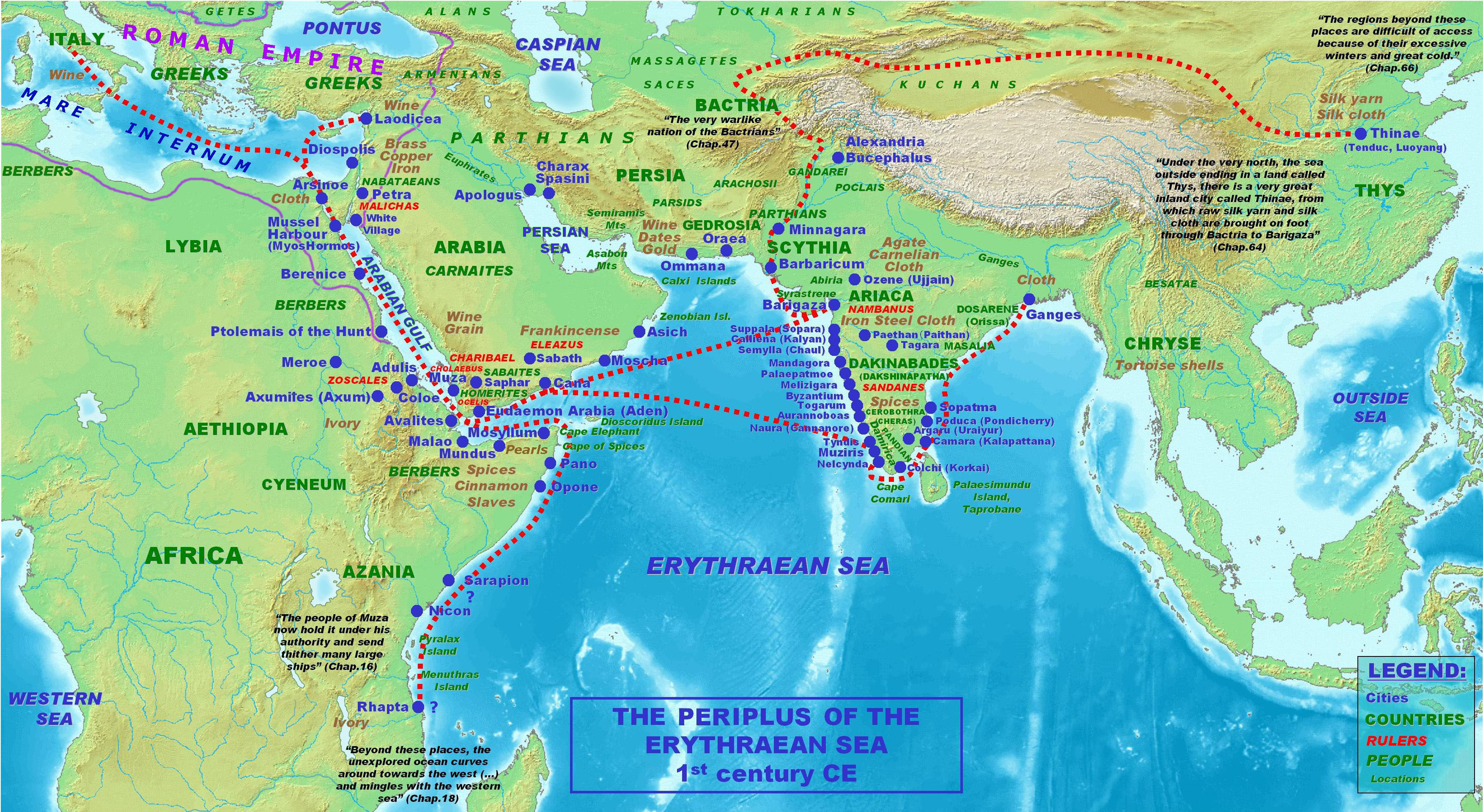


My very ad hoc timeline:

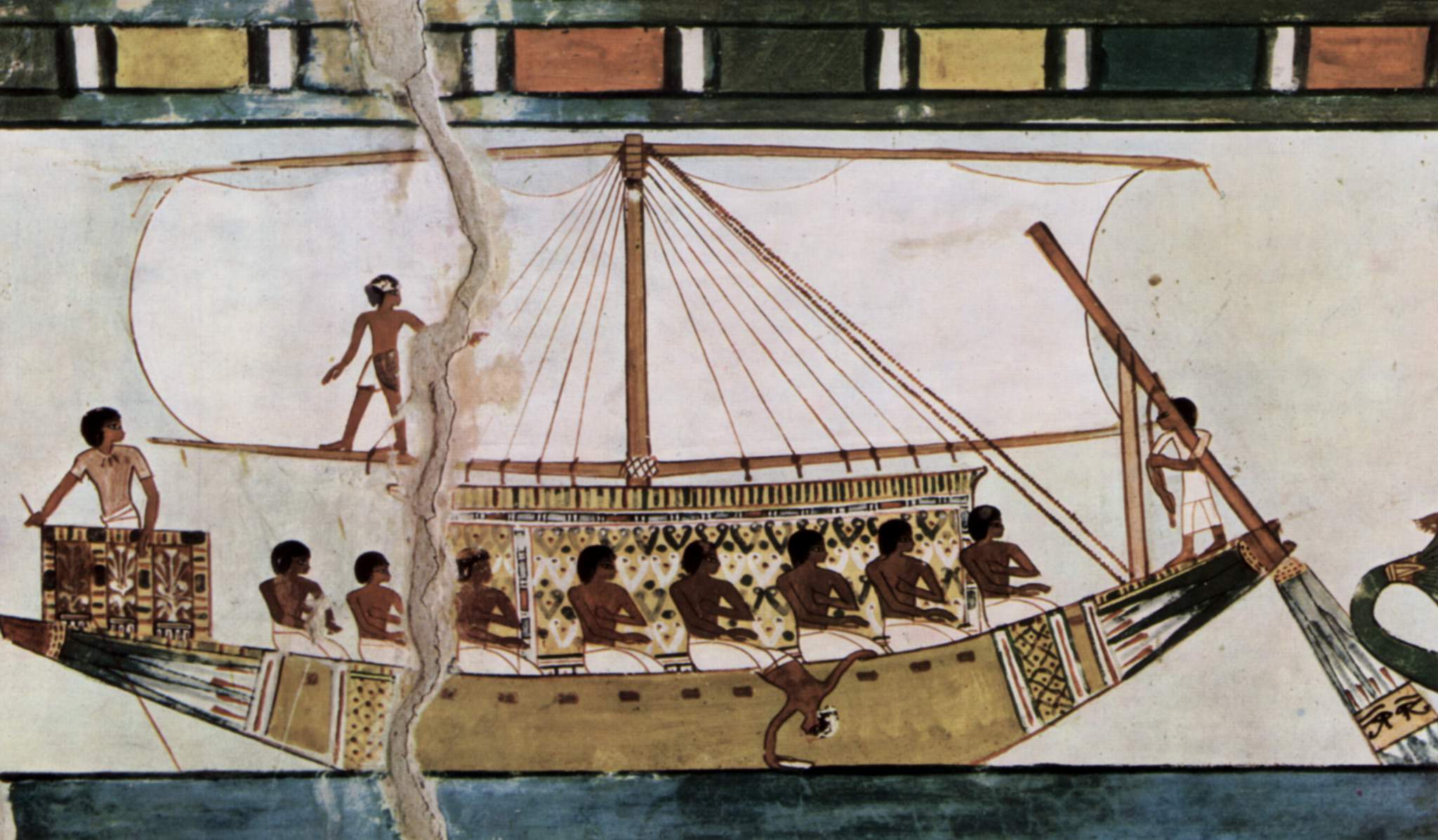
3000 BC—Ancient Egyptians assembled wooden planks into a hull using woven straps to lash planks together, and reeds for caulking to seal the seams. (Q: is this a river boat or sea boat?—The Mediterranean Sea is much calmer than the ocean. So we take this with a grain of salt. We're thinking river barge or rafts. But here's the thing, many had sails. Some had 16 oars. Ship or boat? You decide.

ca. 2600 BC—The Mohenjodaro had extensive technical ship-building texts.

By 2500 BC, the Egyptians were building wooden vessels capable of sailing across oceans. 

2500 BC—Somalis were trading with the Arabian Peninsula; Swahili & Mali were part of huge maritime cultures of Central Africa. 

2030 BC—Ferriby Boat 3, Humber River, Yorkshire, Britain, probably was ocean-going, but because it was a flat-bottomed boat, there's considerable debate.

2000 BC—Minoan naval power controlled the Mediterranean.

1940 BC—Ferriby Boat 2, Humber River, Britain.

1900 BC World's Oldest Sea Vessels Discovered in Egypt ca. 4,000 years ago, capable of voyages 1,000 miles away.

1880-1680 BC—Ferriby Boat 1, Humber River, Yorkshire, Britain, 43 feet long and nearly six feet wide, and fitted with 18 paddles, it probably was ocean-going, but it was a three-strake (sallow keel—like a canoe) flat-bottomed boat, so there's considerable debate. The Ferriby boats are the earliest known sewn-plank boats in Europe. A big technological step from the dugout Hanson Log Boat.

The Dover boat  at the Dover Museum is sewn together. No nails.

1500 BC The Dover Bronze Age Boat, hewn from oak planks, wedged with hazelwood, moss, and sewn with yew withies, is the world's oldest known intact seagoing boat Yes, it's a large boat, it seated two abreast, but we don't know actually how long the boat was because modern buildings and roads were plunked atop it. It looks like a large modern sailboat with a central cleat-rail. However, the narrower Ferriby boats are older; Ferriby boat 3 dates back to 2030 BC—and they may have been seaworthy. The Dover boat navigated the English Channel, long before Tutankhamun became Pharaoh of Egypt. (The oldest intact boat, is the Khufu ship, built in ancient Egypt and was used in burial rituals).  —see The Dover Boat and its amazing rescue from mud and brine. And How significant is the Dover Bronze Age Boat?

1550 BC—to 300 BC The Phoenicians, the first to sail completely around Africa, (and to Cornwall and Ireland for tin). Now, that's ocean-going.

Egypt,1420 BC —Wiki
Egypt, 1250 BC —Wiki

1000 BC—Ocean-going Polynesians settled Oceania 3,000 years ago. Easter Island, NZ, Hawaii. They covered huge distances—repeatedly. And the Pacific Ocean ain't so pacific.

Nubia/Axum traded with India, ships from Northeast Africa sailed between India/Sri Lanka—no small distance.

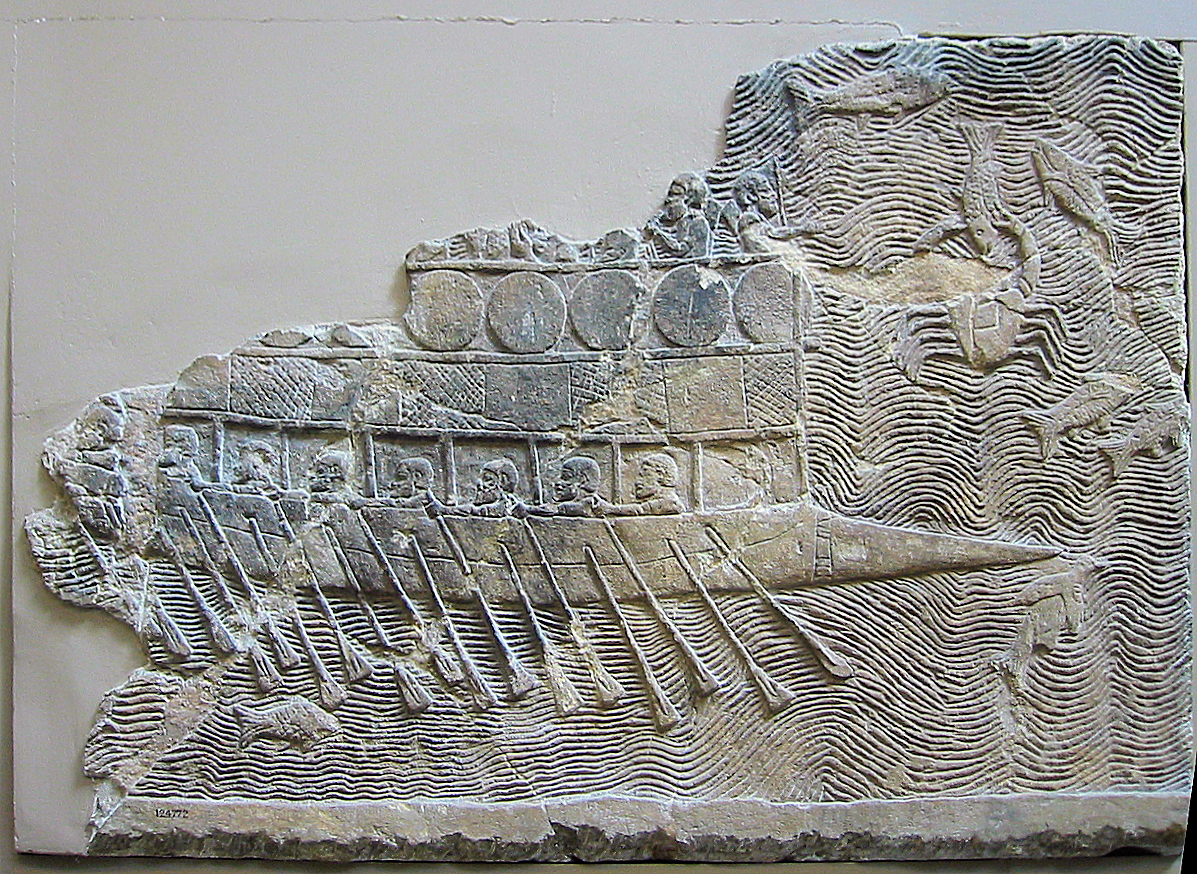
Phoenician warship with two banks of oars, (definitely two decks) relief from Nineveh, ca. 700 BC —Wiki 

Ca. 700 - 500 BC—Then there were uniremes, biremes, used for Caesar's invasions of Britain; triremes and quadriremes. (Latin: triremis "with three banks of oars;" Ancient Greek: τριήρης triērēs, literally "three-rower") was a type of galley.
Herodotus mentions that the Egyptian pharaoh Necho II (610–595 BC) built triremes on the Nile, for service in the Mediterranean, and in the Red Sea, but this reference is disputed by modern historians, and attributed to a confusion, since "triērēs" was by the 5th century used in the generic sense of "warship", regardless its type. The first definite reference to the use of triremes in naval combat dates to ca. 525 BC...  —Wiki
Lenormant Relief from the Acropolis, depicts 54+ oarsmen on an Athenian aphract or trireme, ca. 410 BC; there would be 60 (if they were carrying horses), to 200 oarsmen, that's definitely a warship. —Wiki 

Trade routes from Greece to the Crimean and Sevastopol were not carried out in puddle-jumping rowboats, I guarantee. Sails were involved.

The world according to Herodotus, 440 BC. He didn't think Phoenicians sailed around Libya. —Wiki

ca. 325 BC—Greek navigator Pytheas sailed to Great Britain.

Greek navigator Eudoxus of Cyzicus in 118 BC, sailed a galley, a man-powered sailing vessel. With 300 Greek ships a year sailed between Roman Empire and India, annual trade 300,000 tons.

The Broighter boat an Iron Age Irish boat from 100 BC, had 18 oars and rowlocks—Wiki

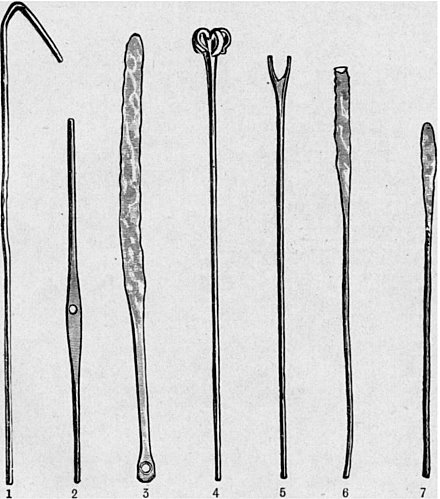
The Irish Broighter boat is a gold model of an Iron Age Irish boat from 100 BC, replete with 18 golden oars, rowlocks, benches, a paddle rudder for steering, boathook, a yardarm, tools, and a mast for a sail. By contrast, there is little evidence of sails being used in Norway until 700 AD. The Norse word for a ship lung is borrowed from the Irish word long."

Broighter boat tools: 1.Boat hook 2.Mast yard 3.Steering oar 4.Small grappling iron 5.Forked implements 6.Square ended oars 7.Oars. —Wiki

ca. 400-700 AD— The Irish sailed (and settled) the Faroe Islands and Iceland BEFORE the Vikings—who followed them. Possibly sailed to the New World as well. Njal's Saga? Neil, the redheaded Irishman—with a temper.

Metal replica of original stone plaque (Wild Goose Studio, Kinsale, Co. Cork); there would've been a sail, and at least four more oarsmen. The Broighter boat had 18 oars.

ca. 500 AD—St Brendan the Navigator set sail on the Atlantic Ocean with 14, 16, or 60 men. Old Irish Immrama (from iomramh-voyage), are voyage tales. Celts had sailing ships long before the Vikings.

800 AD—Viking sailing knörr. Most Viking ships were 15 - 70 feet; earlier vessels seem to be burial boats but then they were not sailboats either. The masted Irish Broighter boat is a model of an Iron Age Irish sailboat from 100 BC.

1000-1300 AD—Viking longboats (warships). One of the biggest Viking ships was made in Ireland. Irish oak. Not Viking, but Norse-Irish.

1100 AD—Chinese junks sailing boats with a rudder (war and transport vessels).

1300 AD—Arabic sources describe New World visit by a Mali fleet in 1311.
This seemingly simple timeline took far longer to create than I care to admit. But then, I always use the rovings to learn something new.


Sources:

Ship - Wikipedia, the free encyclopedia
Ancient Maritime History . Wikipedia, the free encyclopedia
Check this link out by vessel type at the Patrick Foundation (it has key texts and displays): CROSSING THE SEAS
Shipbuilding And Navigation - Hindupedia, the Hindu Encyclopedia
Ancient technology - Wikipedia, the free encyclopedia
Mohenjo-daro - Wikipedia, the free encyclopedia
SEA VEHICLES: Ships
Pytheas - Wikipedia, the free encyclopedia


Who is this not so Fabio, and why are my knickers in such a twist? From what I can glean off the internet, this dude studied social anthropology at School of Oriental and African Studies, the University of Oxford and The King's School, Canterbury. It's not like he didn't have access to the facts supping at the grand halls of academe. Pah! He probably doesn't even know the meaning of his hometown name: Milan.

Saturday, July 13, 2013

West County Girl


I'm glad there's not much by way of info on West County on the internet. Where I came of age as a writer, and an artist in the schools. I was always a west county girl—it was a very different reality than the more civilized parts of SonoMarin. We reveled in our weirdness. Because there were no boundaries, we flourished. We did.


Not much by way of info on West County. We reveled in our weirdness. Where I came of age as a writer, and an artist in the schools. I was always a west county girl—it was a very different reality than the more civilized parts of SonoMarin.

Friday, July 12, 2013

PROTESTING AT THE GROVE (prose poem)

PROTESTING AT THE GROVE

Hot July on the Russian River. Bathers and Bohemians. Encampment. We posed as hookers as Bohos slaked their thirst on our side of the river. Northwoods Lodge: FBI agents, Bohos and us. Only there were no cameras. Maybe stealth ones.

Rose refreshed her lipstick in the mirror, looked me in the eye, said: I don't know if you gals are working tonight, but there's a bust going down. Tonight. Was I undercover, or under the covers?

Poet Karla Anderdatter was talking to the river on the Monte Rio Bridge. That's where we bonded. Beauty queen-activist Mary Moore rallied us. Things got ugly at the protest. I was clubbed on the back as I outran the law, camera in hand. Snap!


Did we cross the river? We went skinny-dipping, and the Bohos came to us to slake their thirst. The famous optometrist returning from Russia. Nothing wrong with his eyes. Leering at our flesh, he fed us the news.

Simone got her story on Helmut Kohl. I hardly knew who he was. I took photos. No need for words. Judy Bari also wrote for The Paper (Now The North Bay Bohemian). Newspapers and Bohemians. Full circle! These wild wolf women. Somewhere I have the negatives. Somewhere.

While we angled for more stories at the oasis, someone said sneak into the Grove? So I dropped my cover and we blew the joint. A US Olympic swimmer, he broke a world record for the backstroke. He also could've been lying. Somewhere I have notes. Somewhere. He took me in after midnight. Not much to see in the dark. A large parking lot. Lights in the distance. Maybe atomic ghosts. We howled at the moon.

Not much else to tell, so I took him home. He was sleek as a seal. We did the backstroke and the butterfly and the breaststroke. Dropped him off at the gates at dawn. Was I sleeping with the enemy? All that water under the bridge. Tide coming in. Moon falling into the arms of the sea.

7/12/2013

PROSE POEM

GUNS, not tampons!


Apparently the new Texas Senate 
anti-abortion motto is: 
GUNS, not tampons! 

or maybe it should be:

When tampons are outlawed, 

only outlaws will have tampons. 

Ergo, all women are outlaws
wielding weapons of mass menstruation.

I say, tampons, not guns.
I support a woman's right to bare tampons.
Or there will be blood.

False syllogisms aside (the bread and butter of all politicians), women entering the Texas Senate gallery were frisked for lethal weapons such tampons and Maxi-pads. I won't even ask about the ones in use. Will women on the rag pop tampons out like wine corks and lob them onto the Senate floor?

Holy ogres and onions, are we—like—being totally punked here, or is this the work of America's finest news source, The Onion

OK, so where's the hidden camera? 

Noooooo, things are just looney in Texas. (And they call us the Left Coast). Must be The Big Oil Guns. They planted a bunch of Cadillacs nose-first in the wheatfields, of Amarillo, remember? This is where they shot Jack. Remember? We won't mention the scourge of invasive shrubbery. Makes me want to vomit over three wheatfields.


What, you wanted tampons? American Carhenge, Cadillac Ranch. TX —Wiki

Carhenge and tampon-gates aside, even diabetes kits were confiscated by the Texas Department of Public Safety—sugar packets as lethal weapons. Now, I'm pretty sure withholding diabetes medication is breaking a federal law. Texans breaking the law is an oxymoron. Or maybe onanism. Whatever comes first. But to do in the Senate?


What about the douche bags? You might well ask. Apparently men were allowed to keep their loaded weapons on them at all times. In fact, they were given an expedited CHL (concealed handgun license) entrance by the DPL to bypass the long lines of those packing concealed vaginas—who were detained and frisked for contraband—tampons—for before they were allowed to enter the Senate gallery. 

No mention of special entrances for pregnant, or menopausal women—who don't pack tampons. That's another classification of heat.

What is it with Texas legislators and their preoccupation with women's vaginas, anyway? Have they all lost their bleedin' minds, are they experiencing mass PMS hysteria, or what? Shades of raging hormones and low blood-sugar. You, little lady, you packin' a concealed cooter box? A cock holster? A twat? A womb with a view? We'll need to legislate and register it. Stand down, please. An' gimme that chocolate bar, real slow now, ya hear?

And they call this whole uterine she-bang pro-choice? Next, they'll be banning wanking and onanism. Nah, they wouldn't touch a cocked pistol like that, would they? Ya go a license for that thang? Why yes, I have special concealed handjob permit. To be fair: condoms also were not allowed in the gallery.

Meanwhile, How to Build a tampon gun sites are proliferating on Google.

Maybe we should just drop Texas from the Unites States. Before they make complete jackasses of themselves. Wait, they already did that. Bless Wendy Davis's filibusterin' shoes.

Maybe the Lone Star State's motto should become the Lone Sphincter State. Somebody, take Tex-ass, please. Except for Austin. We'd like to keep Austin. Just to the city limits, of course.

Maybe it's time to break out the Midol. Make that Oxycodone on the rocks. With sugar on top.

Not tonight, dear, I have a headache.


BREAKING: And, it looks as if the women of Texas have lost the right to say Our Bodies, Ourselves is a woman’s right to choose. What business do politicians have to legislate what goes on between a woman's legs? So much for constitutional rights. What's next, will the women of Texas lose the right to vote as well? Ya can't keep breeders down on the farm. There will be blood. Mark my words.


Stand With Texas Women


Tampons Confiscated, Guns Allowed as Texas Senate Debates Abortion news.yahoo.com State troopers confiscated tampons and maxi pads from people entering the Texas Senate gallery on Friday afternoon as senators began debating a controversial new abortion regulations that are almost certain to pass. However, folks with conceal-and-carry permits are allowed in with their guns... State troopers said they were taking anything that could be thrown at legislators, which included tampons, maxi pads, sugar packets, and condoms. But guns are still a go. 


And a send-up: Texas Weighs Ban on Women AUSTIN (The Borowitz Report)—Republican lawmakers in the Texas State Senate are proposing a precedent-setting new bill that would make it illegal for women to live in the state. Senator Harland Dorrinson, one of the many pro-life lawmakers backing the woman ban, crafted his bill after witnessing Senator Wendy Davis filibuster an anti-abortion bill last month. “That was our moment to say, ‘Enough is enough,’ ” he said. “This comes down to a choice between life and women, and we choose life.”

Texas Officially Loses It, Bans Tampons and Diabetic Supplies from Senate Chamber, Guns OK I don’t even know where to start with this pathetic display of nonsense from the Texas Legislature and Department of Public Safety. It seems so much like something ripped from The Onion, but sadly, it’s not.  The Texas Department of Public Safety forced women to hand over their tampons and pads before entering the Senate chamber today. Not only that, but they were also forcing diabetics to hand over sugar packets and other diabetes supplies which are lifelines when dealing with low blood glucose levels


SPEAKING OF BLOOD: these accretions are either the baby, or bathwater—I initially wrote these before I tucked into the main piece—which keeps changing. They no longer fit, so I tossed them out with the bathwater in the ongoing revision process, but didn't want to loose them completely.

Flustered when my gorgeous British professor, a bit of a Hotspur, himself, leaned in a little too close after class, I whipped a tampon out of my bag instead of a pen to take a note. We both looked at it non-plussed. Written in blood, perhaps? Though I liked Shakespeare, and blood is mentioned 42 times in Hamlet, I bled, I hemorrhaged, I dropped the class.

My ex-boyfriend's ex-wife (it's complicated), Shameless Hussy poet, Alta once posed nude for a poster wearing nothing by a tampax. Caused quite the scandal. Brought men to their knees. I double-dare you with chocolate on top to find that on the internet. 

Note bene: Shameless Hussy Press published friends & lovers, John Oliver Simon, their daughter Kia Simon, Paul Mariah, Mimi Albert, and people I knew—Susan Griffin, Ntozake Shange, Mary Mackey, Opal Nations.

Protesting at the Grove


Hot July on the Russian River. Land of bathers and boaters. Land of barbecues and Bohemians. Resort towns and summer homes abound on the river from Forestville, Rio Nido, Guerneville, Monte Rio, Duncan's Mills, to Jenner.

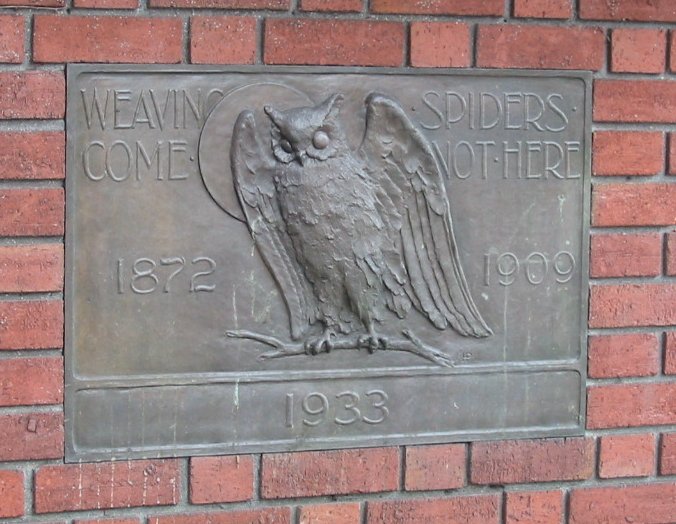
The Russian River is also summer home to the Bohemian Grove encampment, sponsored by San Francisco's Bohemian Club, a private men's enclave, founded in 1872. The club's mascot is an owl, and their motto is "Weaving Spiders Come Not Here." The idea is that you leave your cares behind.

Imagine upwards of 3,000 big-wig male guests descending upon an old sawmill and camping out. That's the Bohemian Grove encampment. The Bohemian Club guest list has included every Republican and some Democratic presidents since 1923, and myriad cabinet officials. Add CEOs of large corporations, oil magnates, financial institutions, banks, military contractors, utilities commissions, and the national media. Let's just say a whole lot of in-bed friendships are forged at the Grove.

Weaving spiders come not here—inscription with an owl mascot on a bronze plaque at Taylor & Post Streets, San Francisco
Members of the once arty Bohemian Club were comprised of journalists, painters, pianists, and poets. Now, membership is comprised of local and global leaders, politicians, and businessmen—who are entertained by the Bohemians—those self-same artists and musicians who originally founded the club.

Bohemian tent, 1900s, Porter Garnett, George SterlingJack London —Wiki

Summer camping in the North Bay is a fine old San Francisco tradition. In fact, most city folks moved en masse to the river for the summer. (Probably trying to escape the fog.) Grand hotels like the Monte Rio, were vast summer palaces. The river was jammed from shore to shore, from beginning to end, with campers.

The first Bohemian Club campout was at Taylorville (Samuel P. Taylor State Park), in West Marin, a little over a hundred years ago, in 1878. That's right down the creek from where I grew up on the Lagunitas/Forest Knolls border.

The Bohemian Club campout began as a rousing thespian send-off for founding member, Henry "Harry" Edwards, a stage actor (and entomologist) headed for the New York stage. The liquor flowed wild and free, men flubbed their lines, a rousing good time was had by all, and a hundred drunken men slept it off under the redwoods. It's amazing the Japanese paper lanterns didn't burn the place down. Harry went east, but such a good time was had by all, thespian camping became an annual tradition without Harry.

Why Camp Taylor, you might ask? The name of the creek should give you a broad hint: Papermill. Rags from the city arrived by train, watermills pulped them into paper, which was sent back to the city for the newspapers, mint currency and so on. The Bohemian Club was founded by newspapermen.

Because of train access, Camp Taylor was also a popular summer destination and so many folks camped all along the length of Papermill (or Lagunitas) Creek during the summer, it was a zoo. (And a cesspool, too, I would imagine.)

When the Bohemian Club's camp outgrew Camp Taylor, it moved south to Muir Woods in the 1900s, where it picked up the moniker Bohemian Grove. (There's a plaque for that.) The Bohemian Club scouted out new locations along the Russian River, and moved summer camp to a redwood stand at Duncan's Mills, near the mouth of the Russian River, before settling permanently in the Meeker Sawmill in Monte Rio in 1893. 

The Bohemian Grove, is a 2700-acre encampment with permanent dwellings. It's also the screening site for potential new members nominated during Spring Jinks, in June. Forty-year members, called "The Old Guard," are the gatekeepers.

What began as Midsummer High Jinks, the Bohemian Club's cultural centerpiece, where poems were once recited, songs sung, and dramatic readings given under the redwood trees, has, over the decades, devolved into the spawning ground of global politics.
The Owl Shrine and the lake— a man-made pond. —Wiki

The Bohemian Grove's annual commencement ceremony, a theatrical production, the Cremation of Care, commemorates the burning of an effigy of "Dull Care" on an altar of a 40-foot stucco owl, by hooded Druids, kicks off the encampment. Instead of allegorically banishing worldly cares, and the informal "Lakeside Talks," have fostered an abuse of political power. Guest speakers have included Henry Kissinger to Helmut Kohl. The virtues of lyric poetry was the farthest thing from their minds.

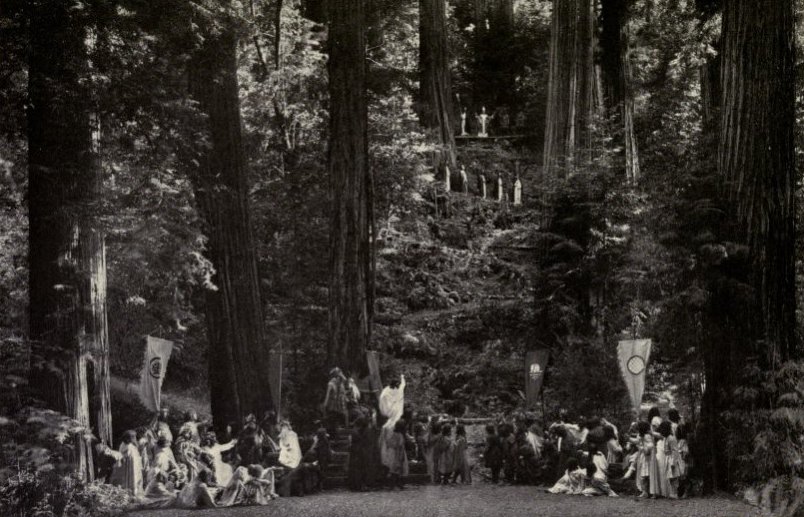
A dress rehearsal for the 1909 Grove PlaySt. Patrick at Tara —Wiki
Maynard Dixon's illustration of the 1909 Grove Play St. Patrick at Tara, the spirit of Irish hero Cuchulainn appears to Saint Patrick among the Redwoods. —Wiki

The Grove is a place where many political webs are spun, and it's the birthplace of warmongering projects from the Manhattan Project, to the Gulf War, and the invasion of Iraq. Policies made inside the Grove affect the outside world. The decision to drop the A-bomb on Hiroshima was made at the Grove.

Cremation of Care in 1907 -Wiki
The twin Bohemias: I grew up in Forest Knolls, and came of political age in Forestville. I traded one forest for another, but unlike many a frequent Grove camper, peeing on the trees—like Governor Reagan who famously quipped, "If you've seen one redwood, you've seen them all," I could see the forest and the trees. Some pretty tall Paul Bunyon tales got their bullish start at the Grove by leaving the Babe home. Some say more like Moloch.

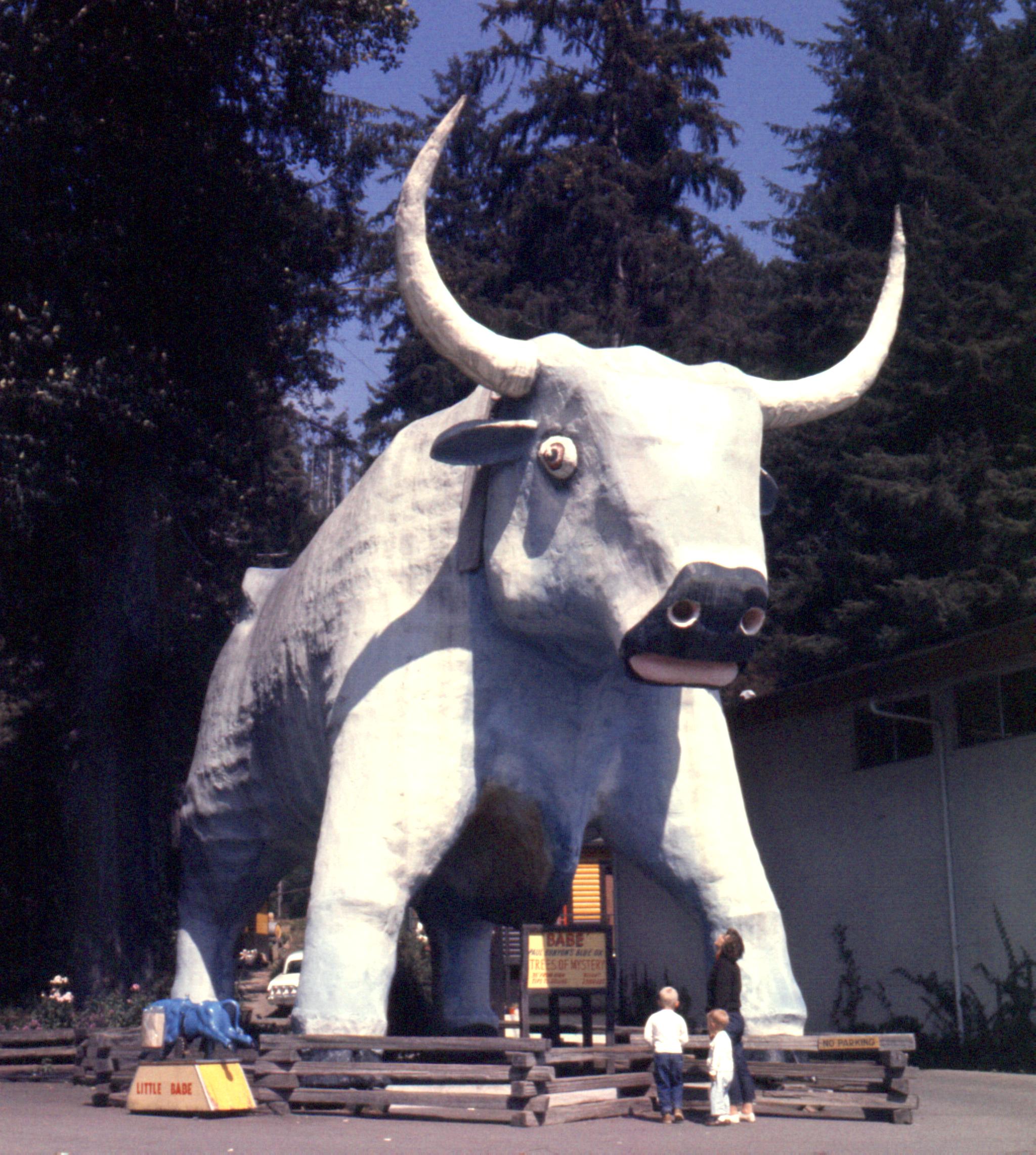
Babe the Blue Ox, Trees of MysteryKlamath, CA —Wiki

Fishing for stories, Paper reporter, Simone Wilson and I once posed as hookers at the Northwoods Lodge as the Boho campers furiously slaked themselves on our side of the river. There were FBI (replete in pencil pants and white socks, just like in the movies) and infamous San Francisco hookers. Only there were no cameras that night. Stealth cameras, maybe.

Frowsy redheaded Rose, the madam, carrying on the Barbary Coast tradition of prostitution during the 1980s, refreshed her lipstick in the mirror, looked me in the eye and said: I don't know who you gals are working for, but there's a bust going down tonight. 

I was oddly flattered that Rose thought I was the real deal, but then, my mom once worked for Sally Stanford at The Valhalla —as a cocktail waitress. I had the best models.

Margo St. James of COYOTE spoke to our Women's Studies class at College of Marin in the early 70s, and I've read poetry with Carol Leigh AKA Scarlot Harlot, who coined the term, sex worker. So I could namedrop and not blow my cover.

Should I have confessed to Rose that I was working undercover, not under the covers? (The S&L bust was coming to a head at Manu Khomeini's lodge. Yes, a nephew. The family jewels reached that far.)


Earlier that day, Marin poet Karla Anderdatter of The Butterfly Tree, drove up from Muir Beach and met us on the  Monte Rio Bridge for a protest staged outside the Grove as the campers drove in. 

Camp Meeker's Mary Moore, a former beauty queen, and founder of the Bohemian Grove Action Network, and SoNoMore Atomics, rallied us on the bullhorn, declaring it a "Weapons-Free Zone" as the Bohemians barrelled through the gate.

Mary's encampment (founded ca. 1980) outside the gates to the Grove, and counter-ceremony was called the "Resurrection of Care," as a foil to the Cremation of Care. It was a reverse exorcism of the Demons. Mary rightly surmised that club members with corporate interests adversely influenced government.

The year when the Chancellor of West Germany Helmut Kohl was guest speaker (I'm still trying to anchor the date—ca, 1982-85), rent-a-cops were brought it. Things quickly got ugly. With camera in hand, I documented the event for The Paper, but they came for me too. As I outran the law, I was clubbed from behind between the shoulder blades. 

Judi Bari of Earth First! fame, was one of the eco-activists who worked for the alternative newspaper, generically called The Paper, (later dubbed The West County Paper, then the Sonoma County Independent. Now it's The North Bay Bohemian). Talk about full circle! 

They're mostly all gone now, these wild wolf women. Somewhere I have the negatives to prove it. Somewhere.

Someone asked: did we cross the river? We did the next best thing, we went skinny-dipping, and Bohos came over to our side of the river to slake their thirst. The famous optometrist returning from Russia. Nothing wrong with his eyes. Leering at our young flesh, he fed us the news in drips and drabs.

There were many allegedly said's in Simone's news story on Helmut Kohl's Lakeside Chat. Me—I hardly knew who he was. I was always finding out the facts after the fact. But I was the photographer. No big deal.

That night, while we were angling for more story at the oasis, someone asked: would you like to go into the Grove? A US Olympic swimmer, friend of Mark Spitz, was working there as a Camp Valet. (I don't remember which camp. Owl?) So, I dropped my cover and we blew the joint.

What was his name: Mike Stamm? He broke a world record for the backstroke. He also could've been lying. Pre-internet. Somewhere I have notes. Somewhere. He took me quite a ways into the grove after midnight. Not much to see in the dark. A large parking lot. Lights in the distance. Some passionate kissing in the back seat.

Manhattan Project —Wiki

Perhaps the lights I saw were of the Clubhouse designed by Bernard Maybeck the site of the 1942 Manhattan Project planning meeting. The top secret project that would lay claim my mother's first cousin's personal life, and then, later, her life, via cancer. Certainly, they were ghosts.

Not much to tell, it was during the early 1980s, AIDS was still undercover, so I took my Olympic swimmer home. He was sleek as a seal. We did the backstroke and the butterfly and the breaststroke. No speedos were harmed in the process. I dropped him off at the gates at dawn. Was I sleeping with the enemy?

All that water under the bridge.

Thursday, July 11, 2013

On Dyslexia


My grandfather had an eidetic memory, and on the other side of the family, we also had math geniuses—My mother's cousin Marie Walsh worked on the Manhattan Project—and died from it too.

But most of us are wildly dyslexic and exceptionally gifted—it takes a lot more brain power to unravel what most people get right away and take for granted.

I wish someone had told me, that my intellect was intact and that I'd continue to bloom long after high school—those of us with dyslexia take a long time arriving. Enistein, Charles Schwab—so many brilliant dyslexics.

I discovered that by talking out loud, I could problem-solve—bypassing the clogged neural circuitry using aural perception. I do a lot of—if this is to this, then, that is to that—type of equations. Seems to work.

I was 30 before I discovered I had dyslexia, (a car accident—neural testing) and yes, like your daughter, teachers told me I was dumb, stupid—yet my IQ is quite high.

The secret is how to access your brain. Finding the right path. Art was my saving grace, I can draw something to learn/understand its structure. How I go through biology! OK, enuf already! Disclosures to relative strangers—chewing your ear off, or rather your eyes.

LOL! Gotta format and swap out a SSD-HD to save my elderly MacBook from obsolescence. TTFN!

Wednesday, July 10, 2013

Lost Car Keys


After too many beers in the hot sun at Shafter's swimming hole,  my uncles and aunts, and various friends would gather up at my grandmother's house. Eventually someone needed to leave—perhaps they were planning to go back to the City, or head on down to Speck McAulliffe's Lagunitas Lodge, to quaff a few, when they discovered they couldn't find the car keys. Anywhere. They looked under pillows, in the couch cracks. In the dirt driveway. Nada.

So they all hoofed it on down to Speck's. Had another beer or two. The lost car keys were a mystery. They never showed up next morning. But sometimes extra beer bottle caps did. Quarters went missing. They blamed each other. Then there was the matter of the cars sans keys to deal with, not to mention the hangover. Luckily there was always hot-wiring—something my uncles were very good at. And they were on their way.

All those lost car keys remained a mystery. Until my brother and I came along and kicked apart an abandoned woodrat nest in the upper garden by the old bottle dump. We found a time capsule of coins, church keys, and car keys galore. By that time those old cars were history, as were a couple of my uncles. Useless keys to another time. Nothing to unlock, except this fragment.

7/10/2013
rev. 10/22/2015

Old Photo Found in the Woodrat Nest

Saturday, July 6, 2013

ReVisioning the 1992 Biljmer Plane Crash, Amsterdam (& the Asiana Crash at SFO)


This morning, as I was outside in the garden, I thought I heard or felt something—more like a percussion than a sound—and I said to myself, Jeez, it feels like a bomb just went off—or a plane crash. I live near the Oakland Airport which is across the bay from the San Francisco airport. I laughed at my silliness and chalked it up to an overactive imagination.

But I was uneasy, sensing that some disaster had occurred. I came inside to check the news only to find my Twitter feed going crazy.

What I saw on my screen: a tweet from Samsung executive, David Eun: "I just crash landed at SFO. Tail ripped off. Most everyone seems fine. I'm ok. Surreal..." And he posted a photo of the crippled jet. Asiana Airline accident today at SFOOh no! So I wasn't imagining things.

There were 290 to 350 passengers on board from Seoul to SFO. Someone said: it's a hard landing, no landing gear. Another eye-witness said the plane struck the seawall, then the tail ripped off, and it cartwheeled off Ramp 28. (I think it just slid off the tarmac). The fuselage also caught fire as people fled the plane, sliding down the inflatable emergency ramps. Suitcases were scattered everywhere like flotsam. Or maybe it was a herd of Goats R Us weed-whacker goats rubbernecking.

As I followed the grisly news reports, an image I thought I had forgotten, came to mind. Another plane crash, from long ago, in another country. So, I let my fingers do some web walking as I waited for the news to unfold.

In 1992, I witnessed an Israeli cargo airplane crash in Amsterdam. An El Al Boeing 747 plane circling from Schiphol Airport was flying unusually low over the IJsselmeer, when I heard a pop overhead, and then a big splash right next to me.
We walked along the Durgerdam, admiring the sunset. —Wiki

My friend Vinz said we were just outside the village near the Durgerdam bus stop. Durgerdam is 7 km east of Dam Square. We were walking along the dyke of the IJsselmeer, admiring the colors on the water, the October sunset in North Holland. Everything on fire. Beauty everywhere.

We were walking on that peninsula above the red dot at Durgerdam —Wiki

I thought the splash I heard was an improbable seal or an even more unlikely whale breaching—not even remotely possible in the artificial enclosed lake, that is the IJssel, which is a branch, or tributary of the Rhine. I laughed at my foolish notion. OK, one helluva big fish, then.

But as the events unfolded, I quickly put it together that the pop I heard was the El Al Boeing 747 plane's right wing engine exploding, and the splash—the engine falling into the water. That was awfully close, that engine could've fallen on us, had the plane been over land (as the flight map I posted below suggests—but it's wrong). 

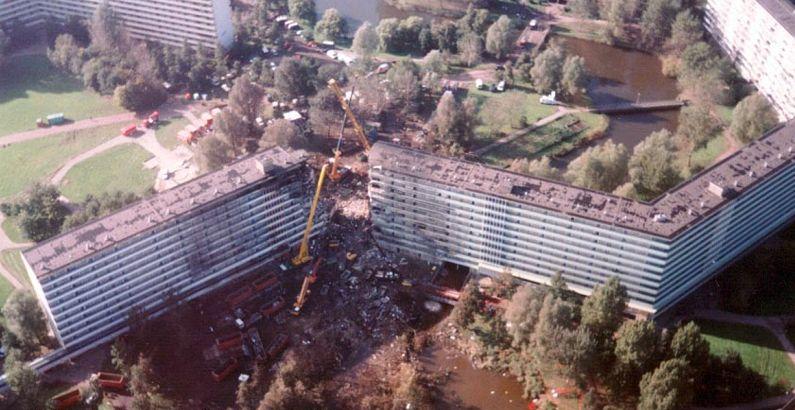
Then, we watched, stunned, as the eastbound plane veered hard right over land and plowed into two high rise buildings of BijlmerThe fireball as it struck the apartments was like an atomic blast—we could hear and feel it from miles away. I took photos of the fireball but I couldn't override the automatic camera flash—and so, I got nothing on film.  

We made our way back to the crash site. The Boeing 747 crashed into the Bijlmermeer, near the Elsrijkdreef- Bijlmerdreef T-intersectionI remember looking up in a linden tree to see an airplane seatbelt, a melted Barbie doll, and fuel dripping from the leaves like rain. I took more photos and there was no way home but to walk. All transport from Biljmer was cut off. All busses were being used as ambulances.

Why did the El Al pilot bank 90° right, into the housing project instead of flying over the IJsselmeer (formerly the Zuiderzee) where he could've crash-landed on the water? Surely the pilot knew he was in trouble long before he reached land.

At 6:35 pm, the first officer radioed to ATC: "Going down, #1862, going down, going down, copy, going down." In the background, the captain was heard instructing the first officer in Hebrew to raise the flaps and lower the landing gear. —Bijlmerramp, Wiki

They say 48 people died a the Bijlmerramp—but we saw busloads of bodies leaving. There was a huge population of undocumented illegal immigrants living there as well—and everyone was at home in time for Sunday dinner.

We were walking along the shore to the north of the final green line. Pilot was flying over the water when the right engine fell off. He banked and turned. Everything in slo-mo. This map is wrong, as we were near Durgerdam, walking east, the plane passed me on the right, not the left side.

Then came the cover-up. What was in the plane: fertilizer, petro-, and bio-chemicals? Bomb fixings? No news, no answers anywhere. I was interviewed by Amsterdam Underground Radio—the reporter was positive it was some sort of conspiracy but I didn't feed the beast of paranoia. Merely reported what I saw, and deduced. Too well trained by my editor, Nick Valentine, to let the crazed reporter lead me.

From GoogleEarth

Today's crash at SFO brought the memory of the Biljmer crash back in startling clarity. Another Boeing. Two people have been confirmed dead & at least 130 injured, with 41 in critical condition. Such a tragedy. Amazing that so many survived. We should not be witnessing things like this. It brings back the vivid images of 9/11 as well. The things we can never erase form our minds, leaving us shellshocked.

Will the final verdict also be metal fatigue as well? Or pilot error? Or both? My cousin is a mechanic for United at SFO. Maybe we'll get another picture from the mechanics who will be working on the plane. I'll post later, if we do. Meanwhile, if you landed at this blog in error, I've posted some Asiana links below.

Friday, July 5, 2013

ALARMED AND DANGEROUS


What happens when
unsupervised English majors
roam the hallowed halls of academia
with a plenitude of Post-its in hand.
If the door is alarmed,
then, the window must be startled,
and the floor, somewhat taken aback.
It could've been worse.
Students could've been armed
with rapier Sharpies.

July 5, 2013

Found poem fluffed up a bit and added 7/5/2016, thanks to FB memories.
Obviously this is a kindred photo.

Wednesday, July 3, 2013

Heatwave

I got heat exhaustion on Saturday—cleaning the house. Lobster faced, dripping, and delicious thrilling chills, Not the right combo. Into the cold shower, fully clothed with knee brace. Dropped body temperature with a pint of chilled h20 and a big smoothie to restore electrolytes. Started hallucinating, the girl with kaleidoscope eye. OMG, I have a brain tumor—no, just brain freeze followed by an ocular migraine for my troubles. Never rearrange the housedust during a heatwave.