Saturday, September 8, 2007

CPITS poems, Warner Springs

Poems from our annual CPITS gathering, at Warner Spring Ranch, a truly magical place replete with hot pools and native California Palms, nestled at the foot of Mt. Palomar.


ANCESTOR TONGUE
       —from Simon Ortíz's class

Conas tá tu. Mo anim Mairín
I am called Maureen, she of the sea,
Sometimes I am the Morrighan of the Battlefield
She who stood on the shoulders of CúChulainn
as he slumped tied to the Lía Fail
to the Stone of Destiny
as darkness descended
behind the corneas of his eyes.
She, who became the enemy
when he spurned her love—
she was steadfast in death.
I am not little Mary, the mother of God
as the Jesuits were wont to say.

To be the great three-fold goddess
the raven, forever associated with death
has me worried
because I was given the owl nametag
no raven, but still the same messenger.
Why it worries me is because of what follows.
Sometimes I dream of things no one should see
but the witness is an afterthought.

They say it's the Second Sight
a gift from my mother's family.
They say that in dreams begins responsibility.
but my mother's craziness chased me toward sanity
and I ran from that responsibility.

I'm supposed to be writing a poem
going deep inthe the verbness of am and is-be.
Instead, I'm skittering on the surface of fíos
of what I know, knowledge stacked like facts
cords of wood to hold us against the winter
instead of an airy dance
of water skeeters on a glassy pond.
I'm skittering on the brink 
of imagination into the precipice.

I have been the standing stone,
the Oghan writing on its edge
the raven, and the washer at the ford.
We wre uncertain of where we stand
the boundaries of self and will,
the anarchy of culture.

Ta me go maith. I learned some Irish at the knee.
I am the broken vessel, the carrier of a dead language.
I had to change my mother tongue in school
because Irish syntax didn't fit the American way.
We were like Simon Ortiz's Aco-ma
where the preposition does the work of language
the harbinger of direction and time.

Our mind works mysteriously, circuitously
and it remembers in spite of ourselves.
What is hidden, the hidden places
we all write it into our selves
our own way of being guided by the ancestral tongue.
Naming is a language event
that moment when you're presented to the sun, an Grian.
We write it into our selves, in stone.
We may have lost our language
but we have not lost ourselves.
We have not lost ourselves.
Hoh.

Maureen Hurley 9/7/2007 Warner Springs Ranch

NATURAL SELECTION
—from Maggie Anderson's class

Straddling a bridge of indecision
I face two paths, two beds of the same stream
one runs hot, the other is cold.
California Fan Palm is rooted deep into the fault
and grows as close as it can to the fire
where boiling water burbles out of the earth
while stinging nettles of the northern latitudes
lean into the perpetual shade on the cold bank
and remembers an age of ice and perpetual winter
the willow guards both sides of the bridge
but the datura of oblivion chooses
the wash of the desert wadi as its dream
Maybe I should seek its counsel or go mad
should I stay or go? 
A decade or two and then what?
I test each stream with my feet
my left foot in the cool creek bed
the other dips into hot water
but the voices of both streams gurgle in unison
they offer no solace, no sage advice
nor do they drown the stinging words.
The moment of change is the only poem.

Maureen Hurley 9/7/2007 Warner Springs Ranch


NATURAL SELECTION, II
—from Maggie Anderson's class

Desert willows guard the footbridge to another world
with a cacophony of graygreen leaves
while the honey locust spreads
its ordered palmate structure in lacy patterns.

California Fan Palm is rooted deep into the faultline
and grows as close as it can to the fire
where boiling water burbles out of the earth
while stinging nettles of the northern latitudes
lean into the perpetual shade on the cold bank
and remember an age of ice and perpetual winter.

But the datura of oblivion chooses
the wash of the desert wadi as its dream.
Maybe I should seek its counsel or go mad.

Where am I today with one foot in each stream
I can't decide whether to stay or go
whether to write poetry or prose
Am I done with poetry or is it done with me?

I let the next thing to cross my path
guide me and offer instructions.
The first is a bluebird flitting after flies,
the other is a pileated woodpecker
jackhammering holes into the pulpwood
drilling deeper, do it again.

But the voices of both streams gurgle in unison
they offer no solace, no sage advice
nor do they drown the stinging words.

A red dragonfly bleeds against the thermal pool
algae plants itself in vermillion & verde
three cottonwood leaves float, sun yellow
a raft of two crow feathers eclipses them.

Murmur of voices in a room, a steady stream of words.
Fear of change keeps me rooted here.
The moment of change is the only poem.
Maggie says that exact moment of change
that moment when we're neither here nor there
that is where the poem lies.

Maureen Hurley 9/7/2007
Warner Springs Ranch

UNTITLED SOUND POEMS
-from Dan Levinson's class

knock, knock, anyone there?
In the alley, broken glass questions
the soles of my shoes
again and again
Willful destruction of a window
an eye of the wind
Someone lived here once
He sweeps the glass across the cement floor
with his shoe, cleaning up
centuries of sand and glass
I'm shattering the surface of what I know
skimming the depths of what I am
ascending to the teatime level of the noon whistle

Maureen Hurley 9/8/2007 Warner Springs Ranch

UNTITLED SOUND POEM, II
-from Dan Levinson's class

bowl of sound
the tubes warming up
electronic buzz
a TV after hours
Frankenstein bellying up to the bar
for another shot of juice
birds twittering
or an old radio
can't pull in the station
Hello? tap the mike, blow on it
then inanely ask if you can hear me
too torturous to tell what the message is
morse code written by mice
I'm searching for an old SOS on the upright Royal
a gumshoe ganglion of words
staccato of bullets
an air raid of words
end of a song
an old 78 record hissing in the grass

Maureen Hurley 9/8/2007 Warner Springs Ranch

SIMMER RITUAL
-from Joe Milosch’s class

Nestled at the foot of the Palomar mountains
the thermal pools at Warner Springs Ranch
ripple with myriad prisms. Refracted light
bends our legs into sevens and elevens.
Palm leaves clatter in the desert breeze
like a film projector at the end of a reel
the audience waits while the spliced leader
flashes crosses and numeric bulls-eyes: 1, 2, 3, 4, 5...
The Cupeños, Bing Crosby & the Duke
once soaked their weary bones here.
Joe asks us to write about a time when we were young.
I can't think of anything. I'm pushing 55, and I think
soon I'll be able to get into the movies cheap.
But the price of admission has more than tripled
since I was a kid. Yesterday I was the Baba, the baby.
Time is zooming by art the speed of regret.
I may have passed the half century mark,
but behind the long distance of these eyes,
behind this crepe thin skin, I am still young.
My hair is a raft of chestnut light
floating behind me like a horse's tail
and I'm remembering the ritual
of the first pool dip of the season.
Sometimes we'd sneak into the water
before the sun had done her job
as if to rush the coming of summer
and a glove of icy fear gripped our hearts.
We were left gasping for breath.
When I was young, I spent the entire season
swimming myself into aqua exhaustion
the healing plunge into a pool where pale bubbles
rose up to challenge the endless sky.
A crimson leaf floats in the pool.
Stains the retina.
For a moment time had stopped.

Maureen Hurley 9/9/2007
Warner Springs Ranch


UNTITLED
—from Kim Shuck's class

Walk into the red morning
set your intentions of the day
What is the difference between prayer and poem?
I have been fighting that religion since I was six.
Things to be said, that should be said
transforming the noun of self into the verb of being.

Honor the tongue
drinking deep from the stream
drinking both hot and cold
drinking the ancient artesian water
drinking fire from the earth
to get to the heart of things.

Words from the Cherokee:
this woman's soul has come to rest
on the edges of your body
Let it linger there a while.

Poems have a specific time of morning
Four things that need to be said.
You breathe a poem, you don't recite it.
Simon's Mai Lai May Lai, letting it out
letting the breath out.

Small summit reaching the sky
reaching, reaching, reaching the blue
the blue granite, holes in the rock, mortar and pestle
winnowing, winnowing, winnowing, winnowing on granite
buckwheat and artimesia
granite reaching its stubby fingers to the sky
mountain mother milking the sky
cloud milk in deep blue (thin spring milk)
hangliding buzzards and sky hawks circle
ravens gossiping in the cottonwoods
buckwheat fingers accusing the sky
cabbage moths sucking nectar from tiny flowers
beneath the desert sun, a spittling pine,
cooling rain of tree sap on the skin
two dragonflies the color of blood, knot the air, red, red.
The crow and raven clans have come to an understanding
they each stay on their side of the creek.

Maureen Hurley 9/9/2007 Warner Springs Ranch

UNTITLED SOUND POEM, I


UNTITLED SOUND POEM
-from Dan Levinson's workshop


knock, knock, anyone there?
In the alley, broken glass questions
the soles of my shoes
again and again
Willful destruction of a window
an eye of the wind
Someone lived here once
He sweeps the glass across the cement floor
with his shoe, cleaning up
centuries of sand and glass
I'm shattering the surface of what I know
skimming the depths of what I am
ascending to the teatime level of the noon whistle

Maureen Hurley 9/8/2007 
Warner Springs Ranch

UNTITLED SOUND POEM, II


UNTITLED SOUND POEM, II
-from Dan Levinson's workshop

bowl of sound
the tubes warming up
electronic buzz
a TV after hours
Frankenstein bellying up to the bar
for another shot of juice
birds twittering
or an old radio
can't pull in the station
Hello? tap the mike, blow on it
then inanely ask if you can hear me
too torturous to tell what the message is
morse code written by mice
I'm searching for an old SOS on the upright Royal
a gumshoe ganglion of words
staccato of bullets
an air raid of words
end of a song
an old 78 record hissing in the grass

Maureen Hurley 9/8/2007 
Warner Springs Ranch

Friday, September 7, 2007

ANCESTOR TONGUE


ANCESTOR TONGUE
from Simon Ortiz's workshop

Conas tá tu. Mo anim Mairín
I am called Maureen, she of the sea,
Sometimes I am the Morrighan of the Battlefield
She who stood on the shoulders of CúChulainn
as he slumped tied to the Lía Fail
to the Stone of Destiny
as darkness descended
behind the corneas of his eyes.
She, who became the enemy
when he spurned her love—
she was steadfast in death.
I am not little Mary, the mother of God
as the Jesuits were wont to say.

To be the great three-fold goddess
the raven, forever associated with death
has me worried
because I was given the owl nametag
no raven, but still the same messenger.
Why it worries me is because of what follows.
Sometimes I dream of things no one should see
but the witness is an afterthought.

They say it's the Second Sight
a gift from my mother's family.
They say that in dreams begins responsibility.
but my mother's craziness chased me toward sanity
and I ran from that responsibility.

I'm supposed to be writing a poem
going deep inthe the verbness of am and is-be.
Instead, I'm skittering on the surface of fíos
of what I know, knowledge stacked like facts
cords of wood to hold us against the winter
instead of an airy dance of water skeeters on a glassy pond.
I'm skittering on the brink 
of imagination into the precipice.

I have been the standing stone,
the Oghan writing on its edge
the raven, and the washer at the ford.
We wre uncertain of where we stand
the boundaries of self and will,
the anarchy of culture.

Ta me go maith. I learned some Irish at the knee.
I am the broken vessel, the carrier of a dead language.
I had to change my mother tongue in school
because Irish syntax didn't fit the American way.
We were like Simon Ortiz's Aco-ma
where the preposition does the work of language
the harbinger of direction and time.

Our mind works mysteriously, circuitously
and it remembers in spite of ourselves.
What is hidden, the hidden places
we all write it into our selves
our own way of being guided by the ancestral tongue.
Naming is a language event
that moment when you're presented to the sun, an Grian.
We write it into our selves, in stone.
We may have lost our language
but we have not lost ourselves.
We have not lost ourselves.
Hoh.

Maureen Hurley 9/7/2007 
Warner Springs Ranch

NATURAL SELECTION


NATURAL SELECTION
—from Maggie Anderson's workshop


Straddling a bridge of indecision
I face two paths, two beds of the same stream
one runs hot, the other is cold.
California Fan Palm is rooted deep into the fault
and grows as close as it can to the fire
where boiling water burbles out of the earth
while stinging nettles of the northern latitudes
lean into the perpetual shade on the cold bank
and remembers an age of ice and perpetual winter
the willow guards both sides of the bridge
but the datura of oblivion chooses
the wash of the desert wadi as its dream
Maybe I should seek its counsel or go mad
should I stay or go? 
A decade or two and then what?
I test each stream with my feet
my left foot in the cool creek bed
the other dips into hot water
but the voices of both streams gurgle in unison
they offer no solace, no sage advice
nor do they drown the stinging words.
The moment of change is the only poem.

Maureen Hurley 9/7/2007 
Warner Springs Ranch
Poem published in Memories of Southern California: Poetic Recollections, Four Feathers Press, Don Campbell, Editor, 2022

NATURAL SELECTION, II


NATURAL SELECTION, II
—from Maggie Anderson's workshop


Desert willows guard the footbridge to another world
with a cacophony of graygreen leaves
while the honey locust spreads
its ordered palmate structure in lacy patterns.

California Fan Palm is rooted deep into the faultline
and grows as close as it can to the fire
where boiling water burbles out of the earth
while stinging nettles of the northern latitudes
lean into the perpetual shade on the cold bank
and remember an age of ice and perpetual winter.

But the datura of oblivion chooses
the wash of the desert wadi as its dream.
Maybe I should seek its counsel, or go mad.

Where am I today with one foot in each stream
I can't decide whether to stay or go
whether to write poetry or prose
Am I done with poetry or is it done with me?

I let the next thing to cross my path
guide me and offer instructions.
The first is a bluebird flitting after flies,
the other is a pileated woodpecker
jackhammering holes into the pulpwood
drilling deeper, do it again.

But the voices of both streams gurgle in unison
they offer no solace, no sage advice
nor do they drown the stinging words.

A red dragonfly bleeds against the thermal pool
algae plants itself in vermillion & verde
three cottonwood leaves float, sun yellow
a raft of two crow feathers eclipses them.

Murmur of voices in a room, a steady stream of words.
Fear of change keeps me rooted here.
The moment of change is the only poem.
Maggie says that exact moment of change
that moment when we're neither here nor there.
That is where the poem lies.

Maureen Hurley 9/7/2007
Warner Springs Ranch

Friday, August 24, 2007

IN THE MOUNTAINS OF CHINA

IN THE MOUNTAINS OF CHINA

In the mountains of China
An apricot holds
the architecture of sunrise
in the rosy blush of its flesh.

Last in line, photographs,
a doorway from the past,
breaking the silence.

Architecture of sunrise
the firebird of the alps awakens.

8/24/2007 Writers' Group

The wild northwind


When the wild north wind blew, my horses would dance and skedaddle down the fire roads as if death were on their heels. They became unpredictable in flight with leaps of fancy and sudden swerves that left in my heart and stomach abandoned by the side of the road, or caught in my throat. They imagined fierce creatures chasing them, they took the bit between their teeth and ran harder still. Their hooves beating a staccato on the hardpan earth by the lake. Inevitably gravity was around the corner in the form of a cliff, or low hanging branches. I don't know how we survive childhood. But those horses, once they had run their course, were weary with a savage grace and they had a lightness of step, a new glint their eyes. And I realized it invigorated them. Perhaps they felt more alive at that moment, having run a race with imagined death, and won. Descendants of the tireless Arabian, hey held their tails up high to the wind and pranced more like swallows them horses, with nostrils flared, and breaking a sweat and solidly alive. 

(A Bedouin escaping his enemies threw off his cloak in order to let his mare run faster but her tail was raised so high it caught the cloak and he still escaped.)

8/24/2007 Writers' Group

ARCHITECTURE OF SUNRISE (short takes)

ARCHITECTURE OF SUNRISE (short takes)

An apricot holds
the architecture of sunrise
in the rosy blush of its flesh.

Last in line, photographs, 
a doorway from the past, 
breaking the silence.

Architecture of sunrise 
the firebird of the alps awakens.

8/24/2007 Writers' Group

The architecture of sunrise


A faint haze across the sun colors the evening light into orange and amber. A shaft of light paints the curbs so red that Niel's afraid to park there for fear of tickets. But the sun's about to set, no police will come. It's as if the fading sun were leaving us with a phoebian gift, painting a picture to be rebuilt in the rosy-fingered dawn. The architecture sunrise splashes against the slopes of the mountains and leaves sinewy beads in the canyons of its absence.

8/24/2007 Writers' Group

A nature of the mountains of China

An apricot holds 
the architecture of sunrise 
in the Rosie blush of its flesh.

Last in line, photographs, 
a doorway from the past, 
breaking the silence.

Architecture of sunrise 
the Firebird of the alps awakens.

8/24/2007 Writers' Group

Friday, August 17, 2007

A 9/11 survivor

Today I met a 9/11 survivor, an artist, Jeanette McKinley, who told me tales of what it was like being at Ground Zero. She talks of  huroncito depression, of how the material world accounts for little. She can’t make her art.. she is mute. She and Jane Bark trade conspiracy theories, but when it got interesting was when she told her personal story. I had no notebook, no camera, so this will be a story told in spurts, in no particular order. I will write until my wrist tires. I took a spill on a month ago and I am gimpy in both knee and wrist. But 911 is on everyone’s minds, subtext, and context. No time to write, but then the story dissipates. Unlike Allan Beavans, she was given a few more years’ worth of life to contemplate being a survivor. (She died a few years later of lung cancer, having breathed in lungfuls of toxic smoke.)

Wednesday, August 1, 2007

At the No Name Bar

We are at the No-Name bar in Sausalito, once my mother’s favorite haunt. Tonight it’s a different crowd, there’s a whole lot of hog-washing and posturing going on before this event. Sign up for open mic was at 8:30. Everyone’s late. First one up is a drone, drowning on in his own voice. Whole herds of hopeful guitarist enter the doors. Women aredressed for poetry readings. There’s a couple deep throating it. Yuck. This is a very tolerant audience. Anything goes. He drones on and on. I’m doing the math, at 15 minutes per person, we will be here all night. The emcee is lame. Number two plays a classical piece. I’m scanning the crowded room for people I might know but everybody I knew is long gone. The next one is a mouth harp piece, dude is on LSD. And now it’s 10 PM. It’s turning into an endless Neil Young kind of night.  I’m taking photos in the dark where people are ghosts, moving faster than light. I am bored. It’s all relative, we talk of those neutrinos moving faster than the speed of light. My camera is demonstrating the principle now. A truck passes, it’s transparent in the camera —only the lights show where it has been. I am nameless in the dark at the No-Name with Neil and Jack McElroy who is knocking it back on heaven’s door. Jack, an Irishman, is passive aggressive. I can never figure out his game. It’s like sliding your hands up and down a guitar neck seeking the right fret. At this rate, Neil’s turn will never come. I haven’t hung out in a bar in ages. I did this open mic thing for 20 years and I’m antsy. Luckily the photography is a good distraction. I am literally shooting to keep my sanity. Hostile boredom is a lethal combination. Am I shooting through photographer Jan Bogaert’s eyes, or is it in my own composition emerging through the lens? Will this night never end?

No date

Friday, July 20, 2007

Mice in the garden, freewrite

I felt a sense of wonder as I watched the mice families appear in the garden, mowing down my parsley. Irritating, were they Italian mice? But house mice, like rats come from the far east, they are non-native species. 

Did the Chinese watch the mouse mothers bringing their pups out into the light, into the garden with the same awe, or were they jaded? I watch the pups sniff the flowers and taste everything—knowing that I will have to be the one that puts an end to their reverie. Death too is sacred and so I spend the day watching them, documenting their every move, even when they gleefully eat the poison oats or fall into my trap. 

For though they are cute, I cannot coexist with this vermin bloom, promulgated by a neighbor, who feeds all the birds and squirrels in the neighborhood. The mice line up beneath her feeders and propagate until there they are myriads. There are tiny foot paths everywhere. Gleefully they eat the poison or and run across my traps.

I take photos of mice, the size of quarters and admire them for their sleek beauty. But last night, the traps went off, and I caught Mickey Ratoncito, the stage left character, but the trap caught him by the paws. I t released him from the trap, and he looked right into my eyes and then blinked and screamed. There was no longer a division between mouse and human, we were both on the same with wave length. I put him in a glass house and made him as comfortable as I could. He washed his face and perched up, cute as could be. I promised that I would let him go if he survive the poison and the trap. But he was dead by the time the earthquake struck. 

7/20/2007 Writers’Group

The sacred, a sense of wonder, freewrite

A jaded sense of wonder arises when the sun glints on the bay on late afternoon when the mountains turned indigo, separated by marine mist, and the gunmetal colored bay is a mirror to the sky. When the color of morning feeds to the thick care of afternoon, but at dusk, it’s as if the contrast was sharpened, a clear vision restored from the afternoon, Hayes. This clarity that comes just before dusk is like a sudden inside of wisdom on the eve of death.

7/20/2007 Writers’Group

Finding the rhythm of the universe, freewrite


In that all things are recycled, finding the rhythm of the universe is a waiting game. It’s merely a matter of time before meteors and stardust are recycled through the planet and into us. For one particle, the anecdotal nanosecond, a star shines through each one of us—a millisecond of fame, a moment of enlightenment, or the great Aha! Breathe in and out. Constellation shine within. That’s assuming light is still attached to the particle, but the fire has long since gone out, so we are left with counting a quantum of dust motes in the slatted early morning light. Observe, be observed. Observe and change the outcome. Change the rhythm of the universe.

7/20/07 Writers’ Group

Friday, June 1, 2007

Teaching Artist Toolbox: Integration Notes


“The Teaching Artist Toolbox: Connecting Your Art and the School.”

I wrote this essay for a book that never made it to print. Or, editor Faye Stanley never bothered to tell me that my piece was rejected. Either way, I waited with baited breath for a long time. Time to post it. I think waiting seven years for a rejection letter is long enough. —7/1/2014


INTEGRATION NOTES

The success of an artist’s school residency depends upon receptive teachers, administrators and support staff who are advocates of the arts. I’ve found that working with parents—especially the PTA—is the most effective method to develop a long term, in-depth arts residency. In post Prop 13 California, despite recent funding, we are still ranked at the bottom of the national list on public arts and education funding. Most school communities are grateful to be offered any arts programming as credentialed K-7 teachers are not trained to teach art with their students. Many feel stymied by art, and they feel pressured because there’s not enough time in the day to teach the basics, let alone art. That’s where offering to integrating the arts into school curriculum comes into play. I tell them that Art is the fourth “R.” If an administrator mandates that all teachers MUST participate in a project, then I ensure that we have enough common ground so the teachers are supportive of the residency.

With school advocates, I often develop and co-write grants to fund arts residencies. I will also explore areas where we can utilize school site and discretionary funds. There are sometimes obscure pockets of funding that can be used for the arts—especially if the grantor’s goals is developing self-esteem, then the arts become the tool or vehicle to develop self esteem. It’s a matter of mirroring language.

When I develop an arts residency, I meet with teachers on campus to get a sense of their classroom environment and teaching philosophy. If I can arrange a phone conversation beforehand, I will ask what they are planning to teach during the next few weeks. Then I explain my areas of expertise. I show teachers a portfolio of my work and student work. I explain ways we can integrate the arts into existing curriculum. From there we develop a curriculum based arts project. I encourage teachers to actively partner and develop new lesson plans with me so it doesn’t become an art la carte, or a catered event where the teacher uses my time slot for extra prep time. I encourage teachers to sit down with the students to create art too—sometimes it takes a few sessions before they feel brave enough, but many do, and are as delighted as the students with their art.

Developing an integrated arts curriculum is in addition to my teaching philosophy of experiencing art for art’s sake. Foremost in my teaching philosophy, is that art is a process and from that process, we create a product. My goals are to teach students to learn to use new mediums, to develop new skills, to learn artistic terms, to appreciate each other’s work, to gain a sense of the history of art, and most important to create a portfolio of their own art—not make copies of the masters. I don’t want them to produce 20 van Gogh’s “Sunflowers” all in a row.

Before I approach the school site, I refresh myself with typical grade level specific curriculum in the California State education frameworks: the Visual and Performing Arts-, the Language Arts-, the ESL, and Science frameworks. Then I look for areas where my art residency will naturally intersect with the frameworks. Often the curriculum vocabulary is different in each framework, but the goals and objectives are similar. I have a stock of visual arts and language arts lesson plans I’ve developed over the years, so I am familiar with tailoring my lesson plans to meet specific site needs.

For example, I often integrate science with visual arts. The Science Framework—to observe and record the physical world—are really the same skills in the visual arts framework, only the language is different. I find it helpful to use a yellow highlighter and highlight anything that catches my attention, and taking the disparate parts, and specific vocabularies, to reshape my lesson plans. In some ways, we are decoding and translating the frameworks for the teachers. Drawing and painting from nature is easy to adapt to the science framework, whether it be the study of geology, of land forms, or water/weather/plant cycles.

I like to begin residencies invoking the ancient Greeks, I explain to students that the ancient philosophers (scientists) who were also artists and poets, divided the world into what they considered the four basic elements: air earth fire and water. This is the ancestor of our periodic tables. By 5th grade, most kids have had a brush with the periodic tables. This idea also ties in well with the Chinese way of reckoning the world, so I use this as a way to show convergent systems.

I write on the white/blackboard a list of the four basic elements. We each vote as to which element we think we are and we write/draw from that perspective. Because the list creates categories, I’m introducing thematic based art. I demonstrate to the students how to use a particular medium, but I want them to tap into their own creative ideas too, not just copy and regurgitate my examples. As models I use artists from around the world so kids are exposed to art in many forms. We often talk about what we see, what we like, etc., before I introduce the lesson.

For example, when I introduce tempera paints and color mixing, I use large calendar landscape photos for models. What the images all have in common is a plethora of triangular and rectangular shapes. Even kindergarteners can find and identify those shapes. We trace the basic shapes with our fingers, and then we make do simple “baby” drawings on a small piece of paper. (I demonstrate this on the board). Usually it’s only 5-7 simple contour lines, but it’s recognizably a landscape. Because I choose mountain with reflecting water images, it’s easy for kids to find the horizon line or water line and they build drawings from the middle out. In this exercise I’m teaching them to see land forms with a geometric basis, sometimes with the older kids I talk about fractals and math. The shape of coastlines and oak tree limbs.

Sometimes we even draw landscapes with our arms, incorporating kinesthetic movement, big sweeping ranges, tall mountains, swirling water. Then I reintroduce how to use the art materials and we paint gorgeous landscapes in tempera using only the three primary colors (cyan/yellow/magenta). I use an ice cube tray as a palette and I explain that all the colors of the world live in that ice tray. When they look skeptical, I ask them if they’ve ever seen an inkjet printer.

With a stockpile of ideas based on the basic elements to develop art lessons, I have kids design templates for silk hoops based on the four elements. Or they might write poetry as an element. I use a special medium—silk, silk dye, and gutta, but it could be adapted to painting too. Painting on silk especially lends itself to exploration in the scientific realm. Osmosis, surfaction, absorbtion….once you find the right vocabulary, the possibilities for integration are endless.

Another neglected area in the care and feeding of an arts residency is increasing community awareness. Sending students home with an arts portfolio isn’t enough. I coordinate my flashier arts projects such as silk painting, to coincide with public events including Open House or thematic school events. I also invite the press. This led to the uncovering of a new arts funding source, our local PBS television station! We’ve received arts funding from KQED’s SPARK arts education fund.

Another area of integration is to create an arts specific event. A new tradition at one school I work at in Oakland, CA, is our annual PTA Fall Art Auction/Spaghetti Feed. We showcase student art, produce poetry readings and we have a silent auction of student art and silk hoops and group banners displayed on the walls. The art auction raises enough money to pay for food and art supplies. Parents are more willing to directly contribute to specific fund drives, join the PTA, and generally support the arts when they too are part of the arts process.


(Faye Stanley, I have jpgs too… I could go on, explaining specific lesson plans, or I could conclude with a synopsis on how to integrate a residency…)

Tuesday, May 29, 2007

Helgar the Horrible

Hliods bid ek allar helgar kindir,
Listen to me all sacred people,
—from “The Poetic Edda”

Brenda Fullick’s dun-colored Icelandic pony, Helgar the Horrible, was unlike the other horses. He wasn't wily as my bandit Shetlands, dubbed the “Little Shytes” by irate neighbors, as there wasn’t a fence made that could contain the ponies. Nor was he prissy like the dainty Welsh ponies pretending to be grown-up horses at a gymkhana, their manes in need of imaginary smoothing.

Helgar was more akin to the dour donkeys—but the similarities ended with the dorsal stripes. Helgar didn't carry a grudge the way they did. Bent on carrot revenge, one donkey named Joshua, clamped down on my finger like a bulldog as I flailed on her forehead with my free hand. Luckily I had strong bones.

Helgar was an anomaly. How an Icelandic pony, descendent of Viking horses, came to northern California in the early 1960s, was an enigma. He couldn’t tell us his story. He was alone in a strange land, no kindred herd to cling to.

One quirk offered a faint clue to Helgar’s mysterious past, he was afraid of water tanks. Once he slammed Brenda against a redwood wine vat full of spring water. It resounded like a huge drum. The tank must have reminded him of rough seas. Unlike Leif Ericksson, who sailed to America in an open longship, maybe Helgar was imprisoned inside the belly of a freighter on that long dark voyage from Iceland.

If we offered Helgar a ladle-full of water, he’d rear up, with eyes rolled up inside his head, like a rabid dog at the sight of water. But he ferociously crossed streams and attacked his feed trough, a cast-iron bathtub, with impunity. Our tuna fish sandwiches were fair game as well.

This Icelandic pony was thick-headed—both metaphorically and literally. Physics wasn't his strong suit. Sometimes his brakes didn't work quite right. Hence the moniker, “Helgar the Horrible” (after Hägar, a Viking cartoon character). Helgar was otherwise very sweet.

Brenda was more than willing to trade mounts after he skidded off an embankment or two, or when he ran into the side of a barn that materialized out of nowhere. Why he was named after Hägar's wife, Helga, we'll never know. If the name Helgar is from Old Norse heilagr, a girl's name meaning the “holy, or blessed one”, then Helgar was a holy terror. Riding Helgar was a baptism by fire: we all rode him with a wing and a prayer.

Poor Helgar was an exile seeking companionship among Shetlands, donkeys and calves, he really didn’t like horses. We grew up with a circus collection of ungulates including a plains bison, (we called them buffalo), who peacefully grazed with the Holsteins in front of the Nicasio church—until some dimestore cowboy shot him one hopped-up Saturday night. Or at least that’s how the story went down in our circles. Wildfire gossip. She probably died of old age.

Rancher Mr. Nunes got another bison calf and fed him loaves of dry French bread, Nickel looked like a woolly version of Winston Churchill, replete with cigar. (Old American nickels had an imprint of a bison on one side with an Indian on the obverse side.) Nickel was a gentle, if massive presence, grazing on the slopes of Mt. Barnabe with the Herefords and Holsteins.

Helgar was fleet-footed—except for whenever he had a momentary lapse with physics. He could manage a spanking trot along the thinnest of goat tracks as if it were a groomed bridal path. He never needed shoeing, his hard hooves were like flint. We could ride him all day long and he would never tire, no matter how steep the terrain.

At daybreak, we’d traverse along the steep coastal ridges of West Marin, north of San Francisco, from Tomales to Bay, to Bolinas Ridge, or the slopes of Mt. Tamalpais, “the Sleeping Lady”—all were a good day’s ride from home. Helgar was a tank, he always wanted to be first to climb to the top of a peak. He was like a kid playing “King of the mountain.”

Occasionally the stunted bull calf, Mr. Smitts, tagged along. (We called him Mr. Smitts because he was smitten by the Shetlands. They were exactly his size). He didn't know he was bovine which was downright embarrassing in spring when his hormones began to rise. At an inopportune moment, he’d roll his eyes up and hop up right behind us, lowing and drooling; we were more in danger of being impaled in the back by his budding horns (and libido) than by getting lost.

Mr. Smitts kept his distance from Helgar who gave him a swift, well planted kick if he ventured too near. We often rode back from our adventures in darkness, sometimes under a full moon, the ponies always knew the way home.

When it came to speed, Helgar preferred to amble or trot, he had at least three gears, and he could trot almost as fast as a cantering thoroughbred. But it was like riding a jackhammer. We would sing, our voices revving “uh-uh-uh” like a car ignition, in time with his vigorous gait.

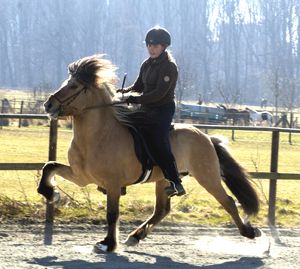
It was nearly impossible to get Helgar to canter or gallop (drumming our heels into his felted side was useless). At best it was a rough valhopp—with one end of the horse cantering and the other end trotting. If we were lucky, he would break into a high-stepping tölt (a smooth running gait), or a flugskeið, (flying pace) and when the horses left him in the dust, he'd come up from behind, all worried, nostrils flaring, as if to say, “Hey, what’s the big rush?”

An Icelandic horse’s rapid ambling gait known as the tölt (Wiki)

There was an ornery jugheaded sorrel Standardbred named Brandy I sometimes rode (I had to get past his teeth to mount him. I didn’t have my own horse at the time, so I got the ones nobody else wanted to ride). Brandy, a retired racing harness horse, heavier than a thoroughbred, must've stood at 18 hands, while Helgar was a mere 12 hands tall. Brandy was no legendary Dan Patch—who never lost a race, but he could really trot. The two horses looked ridiculous earnestly pacing side by side.

Helgar's fierce pacing was very distinct. I can still see him in my mind's eye with his head thrown back, fetlocks flashing out like hairy pistons, matching Brandy stride for stride. However, it wasn’t a comfortable ride, not like being on a Peruvian Paso Fino.

Helgar really had a thick skull, not refined like the modern Welsh pony who might carry an Arabian gene or two—though they had the same ancestor, the extinct Celtic pony, of which, the Exmoor pony is said to be the closest relative. (See also the endangered Iberian Sorraia—with distinctive DNA—ancestor to the Spanish mustang, the Galician, the Garrano/Minho and the Austurcón ponies).

Helgar also had long guard hairs on his fetlocks and jaw, and an unruly mohawk mane —like the prehistoric horses in the Cro-Magnon cave art of Altamira and Lascaux. When winter set in, he looked like a hefty hamster, his coat was so thick—he never adapted to mild California winters.

Cave painting of a dun horse from LascauxFrance ca. 15,000 BC (Upper Paleolithic). Wiki

Helgar refused to go in a barn or paddock shelter, preferring to stand in the downpour. From beneath a shaggy dun coat, he’d peer our at us with bright beady eyes, rain running right off him. We thought he was a little daft as we got 45 to 60 inches of rain, and frost too. Not like in Iceland, of course, but cold enough to freeze the ground.

Helgar was a summer camp pony, so he was probably picked up at an auction somewhere during the early 1960s. Gregg's Forest Farm Summer Camp leased out their horses to us locals from September until June. Brenda, who lived right below Gregg’s Camp, had first pick. It was always Helgar. When the Fullicks move into in the Sutton's old house on Arroyo Road, I lost my playmate, Pete. My world crumbled. But I gained a good riding friend.

Brenda was a couple of years younger than me and a bit mercurial. But her foster mom, the tall willowy blonde Judy Fullick, who was badly burned in a fire, and my mom were once good friends. I don't remember the story about how Judy got burned, there was a bit of a mystery to it. I do remember that there were two Judys in the Valley, the other Judy was Steve's mom, Judy Tristano. In those day, Pete and Steve were best friends. They wouldn't always play with me because I was a girl but when they went to the treefort up the hill, I traipsed behind them.

I ignored Brenda (who was younger than me) for ages, but my enduring love of horses led me down many diverse roads. Brenda and I became friends, united by our love of horses. She was somebody to ride with. Each fall, Brenda always got Helgar from Forest Farm Camp, so he was her de facto horse, except for during the summer months when inner city kids rode him—or tried to.

Helgar got a kick out of bucking those city slickers off, so come September, Brenda had to show him who was boss all over again. His buck, more like a rocking horse than a bronco’s, was all for show. I suspected his bouts with precipices were also for show. He was some kind of pony. A real wing borrower.

Tuesday, May 1, 2007

ODE TO SNAILS


For you crawl on your belly
like a worm, leaving
a glistening trail of startracks
for others to follow
You leave a trail of light
trapped in slime
rainbows appear in the moonlight
and meadows of color
escape into the air.
O snail, your shell
is like the whirlpool,
a Charybdis sucking us in.
Your raspy beak rotors through
the strongest of boxes and
colored chalk, and prized flowers.
Then in return, you leave behind
small paintings of the sun
on a apple left out overnight
on the table.


Sometimes in the middle of the night
when i'm thirsty
my sleepy feet lead me
to the kitchen sink
where I fidn your kith and kin
barefoot, the sound of eggshell
and the silent moon cry
O snail, your body, 
a small painting on the floor
no one will admire 
or visit in a museum.


CPITS poem written at Cleveland ES, ca 5/07

Monday, April 30, 2007

The Soul of a Poet, Bob Kaufman

I first met the Beat poet Bobby Kaufman when I was a child. Bobby coined that word, "Beatnik," and SF Chronicle columnist Herb Caen made the word famous. My mother was a Beatnik artist and actress, always bringing strange people with cars home—for the ride.

We lived out in the wilds of West Marin in Forest Knolls with my grandmother, and if you missed the one commute Greyhound bus, you had to thumb a lift. So, I met all kinds of stranger folks (it was the '60s). Most of them I don't remember, but I'd never met a poet before. A black man that that. I only remember Bobby Kaufman's presence—we always called him Bobby, not Bob. I liked the way it rolled off the tongue. Filled the mouth and lips with a syncopated rhythm. I am sorry to say, there were no awe-inspiring conversations to record. Just his soft-spoken presence.

I remember the way he tilted his head like a crow, looking up our mountain, and the tall trees—as if in awe. You could see that he moved in a alien landscape, the City streets was his particular jungle. We stood outside leaning on the car as he drank in the West Marin landscape: tawny hills, dark oak and pine, sizzling crickets. I was pretty young and not much of a conversationalist so we just stood there—drinking it in.

*          *           *
In 1983, Bobby moved to the river and attended our Russian River Writers’ Guild weekly reading series, where I was a coordinator. He'd stand up at Open Mike (we were at Leonard Matlovich’s pizza place, Stumptown Annie's) and when Bobby would quote long passages from poems like the Abonomist Manifesto, it left me completely in awe.

I was never too sure how much Bobby Kaufman was taking in, he was pretty far along in terminal burnout, the emphysema, the long distance toll of drugs coming home—but one could still see something within him burning still. The soul of a poet to the end. That image stayed with me.

The impetus of my poem, Mantle, is the results of two separate events converging on the page. One night, I was walking to my car from the BART station through Berkeley Park and I felt some presence following me. I saw Bobby sitting and reaching up to me in every darkened doorway from Martin Luther King Drive to John Oliver Simon's house on California Street, I spun around but there was no one there. The streets were empty. I couldn’t shake the feeling I was being followed. Or haunted. And Bobby Kaufman was heavy on my mind.

It was a week before I heard the news that he died, it was after the Challenger Space Shuttle had just blown up. The two events were synchronistically linked in my mind. I was teaching poetry at Mark West School, in Santa Rosa.

I was standing in the parking lot gathering art supplies for our pocket poem project. I was compelled to look up in the sky, From the corner of my eye, I saw something explode in the sky. It was like a large moon snail or a spaceship. I stared up at it in horror—not knowing what it was, but I knew it was bad, very bad indeed.

I looked up again. But there was nothing there. I wiped my eyes as if to clear my vision. It was just my wild imagination and a vast blue sky in want of a cloudy formation. Then the news came: the Challenger had just blown up. We were all stunned. Christa McAulliff was a cultural icon at our school. We all cried. The kids gathered around me like petals to a flower.

My poem, Mantle, became an open letter to the sky, an elegy to the memory of Bobby Kaufman and to the members of the Challenger Space Shuttle. The day I wrote the poem, I was with Rubén Martínez, a Chicano poet visiting from LA, my then boyfriend John Oliver Simon, and San Francisco's Beat Poet Laureate, Jack Hirschman—we were all sitting around the table knocking back caffe lattes at the Cafe Trieste in San Francisco. I recorded the date in my journal—it was Feb. 2nd, 1986.

I'd had a disturbingly long dream the night before where I was carrying rain across the night sky in rusted buckets, but it wasn't rain, it was the stars. We were talking of communism and of Latin America and all I could hear was the insistent voice of this poem coming through, seeking audience. I furiously scribbled something in my journal. Jack asked me to read it. I was stricken. Raw footage. I read it, Jack mused, and said, "Hmmm, a real poet, you're a real poet."  That was a real compliment—coming from Jack.

© 2007 Maureen Hurley

Sunday, April 1, 2007

Letter to Gail

Dear Gail, 

This is just to say please excuse the handwritten format of poems as my laptop computer, which took an unauthorized flying lesson, has joined the celestial Macs in the sky, or perhaps it is searching for Beatrice in Dante’s Inferno. And my loaner Mac has no floppy drive so every time I finally get networked, it dies, and loses its identity. I totally understand. I won’t mention the fact that when I backed up all my files, my computer destroyed all my floppy disks with many files rendered unretrievable. Murphy’s Law squared and, cubed. So, I don’t even have access to my teaching files and poems. I heard rumor of my computer’s eminent resurrection on or about Easter, but I’m not holding my breath or waving palm fronds. After much surgery and TLC, it may or may not work. Eventually, I’ll be able to retrieve my files from the hard drive, but at present, it is not an option. So, I have this lesson plan, a flyer, a handout that you might want to use, but if I only had a computer or even a typewriter, I’d flush it out more. If you’re interested, I can work on it during ahem, Easter vacation. 

PS Will says you’re doing well in GV. I don’t know if you remember me. I met you a few times in Berkeley you came to Sonoma to read for us for the Russian River Writers’ Guild. 

PPS it’s raining so hard we’re about to float away. Some April Fool’s joke this turned out to be.

Undated, probably around 1980, what Gail, I don’t know. And GV may stand for either grass valley or Guerneville. Will refers to Will Staple. So it must be Grass Valley.