Showing posts with label cows. Show all posts

Friday, January 28, 2022

Watusi cattle of Wilson Hill (photos)


And on Wilson Hill Road, Stubbs Ranch, are some extraordinary African Watusi cattle. Mama bathing her calf, I suspect the older calves are hers too by the way they hang on her every breath. No, she’s not a hermaphrodite. They have weird bellybuttons. Bulls also have dewlaps on their necks, and brahma style humps on their backs. Check out those horns! Those horns are used somewhat like a car radiator to cool their blood, not to gore you. But the Watusi cattle are related to the original longhorns, that is, the Egyptian Hamitic longhorn, also ancestor to Mexican (and Texican) longhorns.

The following article on Watusis was so windy it was practically a hurricane, so I paraphrased it. You’re welcome.

“Ankole-Watusi cattle with their distinctive large-diameter horns, trace their ancestry back more than 6,000 years, and are referred to as "cattle of kings."

Long-horned, humpless domestic cattle were established in the Nile Valley by 4000 B.C. Egyptian or Hamitic Longhorn, appear in pictographs in Egyptian pyramids. Over the next 2.000 years, the Egyptian Longhorn migrated from the Nile to Ethiopia, and to southern Africa.

By 2000 B. C., humped cattle (Longhorn Zebu) from Pakistan and India also reached Africa. When the Zebu reached Ethiopia and Somalia, they were interbred with Egyptian Longhorn to produce the Sanga -- the breed spread to the Sudan, Uganda, Kenya, eastern Africa, becoming the base stock of indigenous African breeds. The Sanga had Zebu characteristics, pendulous dewlap and sheath, upturned horns, and a neck hump. Modern descendants of the Sanga, however, vary greatly in size, conformation, and horns.

Particularly remarkable are the cattle found in Uganda, Rwanda, and Burundi. In Uganda, the Nkole tribe's Sanga variety is known as the Ankole. In Rwanda and Burundi, the Tutsi tribe's Sanga variety is called the Watusi. The Rwanda common strain of Watusi is called Inkuku. 

Friday, January 7, 2022

Eating the bull’s heart


Most storebought food, and especially junk food, including coke and potato chips, never graced our threshold. My granny was too old world (and far too poor) for any modern prepared convenience food, or junkfood. We ate whatever was served. When a neighbor’s bull was slaughtered, or a goat or deer, we pretty much ate everything. But sometimes my grandmother would venture forth, read an exotic recipe and become inspired. Some culinary adventures like the salmon croquettes were lovely, however frozen squid in its own ink, was beyond atrocious. And menudo. Ugh.

I remember watching my grandmother skinning the cow’s tongue after she boiled it. It looked awful on the platter, but it made good sandwiches. Good disguise. I found the beef heart to be more of a challenge. Our neighbors had bumped off Thumbelina, a nasty misnamed stroppy Hereford-Jersey bull calf that grew up to be a menace whenever he escaped the corral, which was often. One time he treed me up a poison oak-infested utility pole. That was the beginning of the end of his demise. So, in compensation, we were gifted the heart and tongue. She boiled, then baked that heart with garlic and rosemary. However, I must admit, we ate his heart with gusto.

1/7/22

Sunday, April 9, 2017

Palm Sunday, Gallagher Ranch, Theo the bull, photos


Theo the Bull, Gallagher Ranch, Palm Sunday ©Maureen Hurley 2017

Theodore the Bull, was no Ferdinand, he was all bull, and that's no bull. When I rounded the bend to the upper pasture, he pulled his pink pecker in, and began to threaten me....I thought he was bluffing, but apparently not. He got all prancy like a horse but I didn't take him seriously until he began to drop his head and paw.... It was sort of like a cartoon two-step as I had just passed the last fencepost, expecting to sneak behind him. Not. It was more like a do-si-dos. He didn't take kindly to my trespass. I didn't know I could dive through barbed wire that fast. Ripped my favorite down vest to shreds. He is rather handsome. Angus cattle are so docile I wasn't expecting Mr. Testosterone to turn me into a Minoan Vapio cup dancer. Threat averted. I submitted, that's all he cared about. He was a bit turfy. And no, I had no designs on his harem. Theo was nothing like the old bulls I knew when I was a kid. They were rather gentle, seasoned hands. When I was a kid, Ole Grandad, the Herfie in the upper pasture on Mt. Barnabe, was friendly, and loved to be itched—not that we wanted to—as he always pizzled on his own head. I guess. Old Grandad was very nonchalant about spring and all. Maybe he was a bit too nonchalant. I suspect he became somebody’s rump steak. I always thought the rampaging bull theme was a bit of a myth. Only one young bull ever treed me up a poison oak laden telephone pole. It could be because we named him Thelma. We ate his heart wrapped in bay leaves.


Monday, September 26, 2016

Summer's End in the Alps

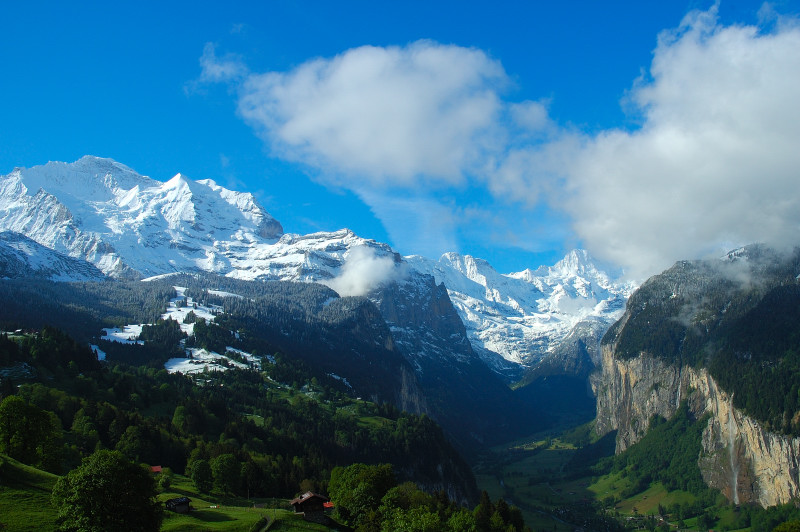
Wengen, overlooking Lauterbrunnen Valley. —Wiki

Summer's end in the Swiss Alps above Wengen, in the Berner Oberland, where I worked one summer, is not marked by the equinox, but by the vagaries of weather. When the grass no longer yields its bounty, the cows are driven down from high mountain meadows to winter pastures in the valleys below. That marks the end of summer.

I got to witness the Alpabzug (Désalpe) in 1972, I was transfixed by transhumance, a tradition that dates back to the ancient Celtic inhabitants—alp is a Celtic word.

Maurus Servius Honoratus, wrote that the mountains were called Alpes by the Celts. Possibly a pre-Indo-European word  for hill, alpe was a name for many mountainous regions besides the Swiss Alps; Albania, the Caucasus, and of course, Alba is another name for Scotland. 

My friend Claire spoke a Gallo-Italic language Romansh, (a "language spoken to kinder and cows"), which retains remnants of Celtic and Raetic languages (once spoken from the Rhine Valley to the Irish enclave, St. Gallen, and Tyrol until the 17th c.; mat/mac = boy).  

Wengernalp, overlooking Wengen, and Lauterbrunnen Valley. —Wiki

And I was told that Wengernalp, where most of the cows are summer-pastured in the shadow of the mighty Jungfrau, means cheek of the alp.

Each fall, after the Grand Cheese festival, after the cow-shareholders have collected their alpkäse shares, the cows are brought down from the alps by their Älpler cowherders dressed in traditional costume. They festively thread their way down the mountain, and parade down Dorfstrasse, the narrow main street of Wengen, a car-free village, which was probably once an ancient drover's road.
 
Hotel Bernerhof, my garret room for the summer was under the eaves on the far right.

The cows' hooves, waxed and shined, their rich cream and russet coats were shampooed, and brushed to perfection. Everyone stops what they're doing to witness the ancient annual passage of the cows. It is a time of celebration. Though I was working as a waitress setting up for lunch in the Hotel Bernerhof, I was unceremoniously shooed outside, in my apron, to witness the traditional passing of the cows. Apparently, some sort of transference of luck was involved.

Thank you Rolf & Wengen Switzerland for permission to use photos.

The queen cow (and her entourage) wear elaborate garlanded crowns made of a pine tree decorated with silk flowers and ribbons, Swiss flags, a cross (for protection from the sky), or mirrors (to ward off the evil eye), and real flowers: alpenrosen (almrausch), edelweiss, daisies, geraniums, even thistles, on their horns. 

The cows' parade finery is replete with a florid embroidered, and embossed leather forehead band, and collar studded with silver rosettes, which holds an enormous ceremonial bell, the size of a man's head, knelling in deep tongues. In spring, the herders themselves must carry the cowbells the last mile up to the alpine pastures. The cows don't wear those enormous bells all summer, only one day a year.  Their summer bells are much smaller.


The larger the treicheln (trychel, or hammered) bell, the richer the sound, and the farmer, so it is said. They're hefty klaxons, so the cows only wear them on parade. The bells are lined up like trophies under the eaves of the summer huts (Scottish: shielings.) The use of cow bells dates back to the Iron Age,  each note represents a specific cow. Some bronze bells are etched with edelweiss, and other floral, or geometric designs.


The queen of queens sets a regal pace, she knows she's Top Bossy. She lows, and aggressively shakes her horns at any interloper that attempts to pass her. If push comes to shove, bovine battles are settled with head-butting contests. In Combats des Reines: there can be only one queen cow, the Kranzkuh, (La Reine des Reines) to rule the collective herd.

Thank you Rolf & Wengen Switzerland for permission to use photos.

I don't know why some cows are also adorned with flowered surcingles, or cinches, as well as headdresses. Some sort of ranking order?  Fighting badges? Social equivalent to The Hulk's wrestling belt?

The heifers, the teenagers, follow up the tail of the herd, their horns sometimes dressed in diminutive greenery, perhaps a single rose, and they were adorned with dainty bells, that rang like silver spoons against bone china teacups. Next year, after they've borne their first calves, in their winter pastures in Lauterbrunnen, if they produce lots of milk, they too will graduate to wearing larger bells and full
headdresses. They too will have a chance to compete on the alpen slopes, and perhaps they too will dream of becoming queens for a day.


Tuesday, January 25, 2011