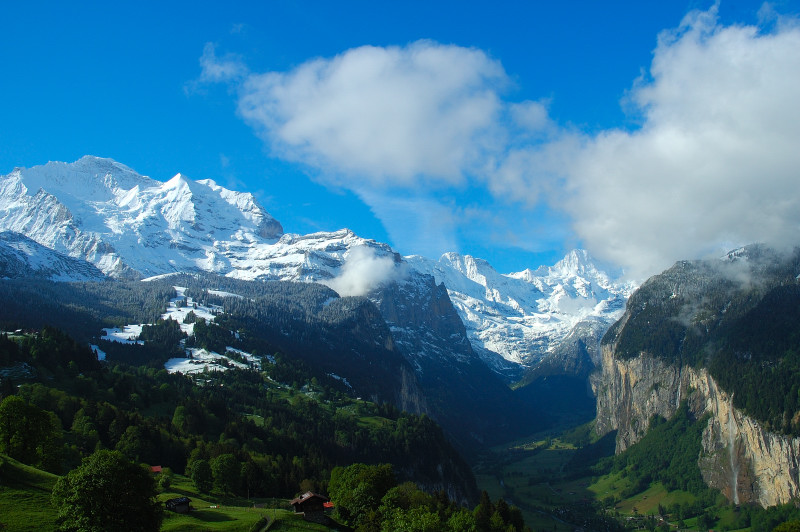
 |
| Wengen, overlooking Lauterbrunnen Valley. —Wiki |
Summer's end in the Swiss Alps above Wengen, in the Berner Oberland, where I worked one summer, is not marked by the equinox, but by the vagaries of weather. When the grass no longer yields its bounty, the cows are driven down from high mountain meadows to winter pastures in the valleys below. That marks the end of summer.
I got to witness the Alpabzug (Désalpe) in 1972, I was transfixed by transhumance, a tradition that dates back to the ancient Celtic inhabitants—alp is a Celtic word.
Maurus Servius Honoratus, wrote that the mountains were called Alpes by the Celts. Possibly a pre-Indo-European word for hill, alpe was a name for many mountainous regions besides the Swiss Alps; Albania, the Caucasus, and of course, Alba is another name for Scotland.
My friend Claire spoke a Gallo-Italic language Romansh, (a "language spoken to kinder and cows"), which retains remnants of Celtic and Raetic languages (once spoken from the Rhine Valley to the Irish enclave, St. Gallen, and Tyrol until the 17th c.; mat/mac = boy).
 |
| Wengernalp, overlooking Wengen, and Lauterbrunnen Valley. —Wiki |
And I was told that Wengernalp, where most of the cows are summer-pastured in the shadow of the mighty Jungfrau, means cheek of the alp.
Each fall, after the Grand Cheese festival, after the cow-shareholders have collected their alpkäse shares, the cows are brought down from the alps by their Älpler cowherders dressed in traditional costume. They festively thread their way down the mountain, and parade down Dorfstrasse, the narrow main street of Wengen, a car-free village, which was probably once an ancient drover's road.
 |
| Hotel Bernerhof, my garret room for the summer was under the eaves on the far right. |
The cows' hooves, waxed and shined, their rich cream and russet coats were shampooed, and brushed to perfection. Everyone stops what they're doing to witness the ancient annual passage of the cows. It is a time of celebration. Though I was working as a waitress setting up for lunch in the Hotel Bernerhof, I was unceremoniously shooed outside, in my apron, to witness the traditional passing of the cows. Apparently, some sort of transference of luck was involved.
 |
| Thank you Rolf & Wengen Switzerland for permission to use photos. |
The queen cow (and her entourage) wear elaborate garlanded crowns made of a pine tree decorated with silk flowers and ribbons, Swiss flags, a cross (for protection from the sky), or mirrors (to ward off the evil eye), and real flowers: alpenrosen (almrausch), edelweiss, daisies, geraniums, even thistles, on their horns.
The cows' parade finery is replete with a florid embroidered, and embossed leather forehead band, and collar studded with silver rosettes, which holds an enormous ceremonial bell, the size of a man's head, knelling in deep tongues. In spring, the herders themselves must carry the cowbells the last mile up to the alpine pastures. The cows don't wear those enormous bells all summer, only one day a year. Their summer bells are much smaller.

The larger the treicheln (trychel, or hammered) bell, the richer the sound, and the farmer, so it is said. They're hefty klaxons, so the cows only wear them on parade. The bells are lined up like trophies under the eaves of the summer huts (Scottish: shielings.) The use of cow bells dates back to the Iron Age, each note represents a specific cow. Some bronze bells are etched with edelweiss, and other floral, or geometric designs.

The queen of queens sets a regal pace, she knows she's Top Bossy. She lows, and aggressively shakes her horns at any interloper that attempts to pass her. If push comes to shove, bovine battles are settled with head-butting contests. In Combats des Reines: there can be only one queen cow, the Kranzkuh, (La Reine des Reines) to rule the collective herd.
 |
| Thank you Rolf & Wengen Switzerland for permission to use photos. |
The heifers, the teenagers, follow up the tail of the herd, their horns sometimes dressed in diminutive greenery, perhaps a single rose, and they were adorned with dainty bells, that rang like silver spoons against bone china teacups. Next year, after they've borne their first calves, in their winter pastures in Lauterbrunnen, if they produce lots of milk, they too will graduate to wearing larger bells and full headdresses. They too will have a chance to compete on the alpen slopes, and perhaps they too will dream of becoming queens for a day.


