Saturday, May 30, 2015

James Dean Memorial on Highway 46


Just outside of Paso Robles, on a lonely stretch of Highway 46, is the James Dean Memorial. The memorial, a strange affair of aluminum, stainless steel and iron, perhaps emulating the Porsche James was driving, was commissioned by an obsessed fan, was made in Japan in 1977. Someone said it represented a broken infinity sign. Whatever it is, it girdles a tree.

Perhaps the late James Dean's biggest fan is Seita Ohnishi, a self-made real estate millionaire, who periodically makes an anniversary pilgrimage to the memorial site every few years.


The prefab memorial was commissioned and shipped across the Pacific Ocean from Japan by Ohnishi. The memorial is a concrete and steel sculpture that envelops a tree in a dusty parking lot outside the Cholame "post office" (a ramshackle collection of metal mailboxes stuck on poles in the parking lot), and the Jack Ranch Cafe. 

Someone said the memorial surrounded the tree of heaven. I looked it up, it's a Chinese sumac, or stinking sumac. It's a prodigious cloner, another nickname is the tree of hell. There is a thick grove of sucker trees on the other side of the road threatening to take over the entire valley.


Two iron slabs below the cenograph, covered in writing, are hard to read, and people have scattered coins on top of them. it's become a dry wishing well of sorts in a place of little rain. It's too hard to read and I have little patience to read around the coins. Concentric rings of copper and nickel and silver. A frozen pond. Chrormium and iron are invoked. Between the two metal slabs, a bronze sparrow rests.
"On Sept. 30, 1981, Onishi dedicated a gleaming $15,000 chromium cenotaph. In the years since, he has added two tablets and a tiny bronze fallen sparrow. He explained his devotion to Dean on a card handed out at the 1981 cenotaph dedication. "James Dean was the brief, living manifestation of a new era," it read. "There are some things, like the hatred that accompanies war, that are best forgotten. There are others, like the love inspired by this young actor, that should be preserved for all time." People 1989


The monument celebrates the life of Dean in three ways: “his agony, his glory and his tragic ending — all existing for eternity,” Ohnishi told The Tribune. “The monument itself forms a circle around the Tree of Heaven … and when viewed from a certain angle it takes the shape of the symbol for infinity. At the back, there is an angled cut for a life tragically incomplete.” From the Vault SLO Tribune
JACK RANCH DINER

Across from the memorial, the walls of the old '50s Jack Ranch diner are covered with photos of James Dean and '50s memorabilia, The generous slabs of homemade pie are pretty good too. It's all about the crust. I passed on my compliments to the cook.

The land surrounding Cholame is still owned by Hearst Ranch, but the old Cholame general store is gone. Now the store is the Hearst Ranch Winery's newest tasting room at $10 a glass. Sign of the times. But, hey, if you want a thimbleful of wine....


THE CRASH SITE

The ad hoc James Dean memorial crash site (different than the memorial itself), is roughly a mile down the road from the diner towards Lost Hills, at the Y junction where Highway 41 joins Highway 46.

Cholame was once known as "Blood Alley" for the sheer number head-on collisions. James Byron Dean, enroute to a race in Salinas, was killed just before sunset at the junction of Highway 41 on September 30, 1955. Dean was 24, he was only a year older than my mother.

Dean, a member of the Acting Studio, only starred in three films during his five-year acting career: East of Eden, the unreleased Rebel Without a Cause, and Giant, for which he received a posthumous Academy Award. His portrayal of the misunderstood and troubled James Stark, in the iconic Rebel Without a Cause, (played close to home), released a month after Dean's death, became a lodestone for teenagers coming of age during post-war America.

THE ACCIDENT

A 23-year-old Cal-Poly student headed home from San Luis Obispo in his 1950 Ford coupe, failed to signal while making a left turn onto Highway 41 and turned in front of Dean's Porsche Spyder 550, dubbed "Little Bastard," headed towards Paso Robles. (There may have been another car involved, read about it here).

Donald Turnupseed was unharmed, a scraped nose and bruises, but James was killed instantly. James' mechanic, Rolf Wütherich, was catapulted from the car, but James was pinned between the steering wheel and tartan seats, his neck broken. Said Turnupseed, "I didn't see him, by God, I really didn't see him." Turnupseed was hounded the rest of his life by the press for interviews.
Many at the time thought the Porsche Spyder was too high-powered for him and, indeed, days before he died Alec Guinness, the actor, had a premonition that he would die behind its wheel.  —The Telegraph


JAMES DEAN MEMORIAL JUNCTION

Fifty years later, in 2005, "Blood Alley" was revamped and renamed the James Dean Memorial Junction.


During the first 20 years after James Dean's death, before the official memorial was erected, makeshift roadside memorials sprung up at the Y. The tradition of the people's impromptu memorial continues to this day. To some it may look like trash, but it's ongoing folklore in the making.


Making my own memorial offering, I wrote James a postcard, a photo of dean and his Spyder, and left it at the site for the wind to read. The barbed-wire fence becomes an aeolian harp of sorts, translating the wind's thoughts.


So many crazy memorial tributes left for the fallen rebel: packs of Chesterfield's, and beer bottles but the labels were worn off. Votive candles, coins in a jar, a nude push-up bra, a mysterious blue binder, a book—his bio, lots of lighters (modern), broken aviator sunglasses, etc. Significance and randomness and holiness. Things found by the side of the road. Hubcaps. Rims. Tail lights. No Eden, this is where he exited the door to his life.


The faux headstone mentioned in other blogs was stolen, but the push-up bra, and a biography on the actor were still there a year later. The bra was in good shape but the book had seen better days. Only the wind was reading it.


I collected some amber road reflectors, placed them in a half-circle, left a bouquet of flowers, and tidied up the site. I imagine a new carload of tchatchkes will appear after September 30, the anniversary of Dean's death.


Every time we drive down I-5, and stop at Love's in Lost Hills, James Dean comes to mind. I'm so very glad I finally got a chance to see the famous Y junction after all these years. An odd pilgrimage of sorts. A legend that has morphed into the fantastic, in a hayfield by the side of the road.


Sunday, May 24, 2015

Eric Rigler (photos)


I had a few minutes time off from being an unpaid booth wench for Neil O'Neill & the CelticTyger at the Costa Mesa Scotfest Games, and I listened to an awesomely stellar uilleann piper, not knowing that he was the great Eric Rigler with his Celtic world fusion band, Bad Haggis.

Eric's playing style reminded me of Paddy Keenan. He's jammed with the stellar Scottish fiddler Alasdair Fraser (Skyedance is one of my fave CDs), Rod Stewart, Josh Groban, Phil Collins, Rubén Blades, and Babs Streisand. Eric played "Amazing Grace" at Ronald Reagan's memorial service, and for Sean Connery's AFI Lifetime Achievement award. 

You've heard him play uilleann pipes and hauntingly beautiful tin whistle tunes in many television shows and movies including The Titanic, Million Dollar Baby, Road to Perdition, Braveheart, Cinderella Man, Robots, The Spy Who Shagged Me, Prince of Egypt, Master and Commander: The Far Side of the World, Jewel in the Palace, and Crossing Jordan.

For a moment I sat in the presence of greatness and was transported by music.

Thursday, May 21, 2015

In Memoriam ‪#‎SantaBarbaraOilSpill‬


Santa Barbara: Gunmetal gray waves. The handiwork of Texas-based Plains All American Pipeline, L.P. The LAND-BASED tar oil spill went from 21,000 gallons to 105,000 gallons. The oil slick is now nine miles long.

The air in Santa Barbara is so toxic, that they're not even letting people volunteer for the cleanup process. People who inhale hydrocarbons get pneumonia. Needless to say, the coast is closed for Memorial Day Weekend. Guess we'll be going down I-5 to Costa Mesa. The coast is closed.

This is the single largest oil spill along the ecologically sensitive Santa Barbara shoreline n 46 years.

In Memoriam for all the dying shore birds and marine life.

Today, I made my first meme: Our weapon of mass reconstruction against Big Oil.
‪#‎SantaBarbaraOilSpill‬.

The original Blue Dawn dishwashing liquid is very mild but cuts oil. Manicurists use it to soak and soften cuticles. Dawn will also clear out a stopped-up toilets and sink drains. According to the International Bird Rescue Research Center, Dawn effectively removes grease but does not cause harm to the skin of the birds. It’s also biodegradable and contains no phosphates.


‪#‎angry‬ With corporate thanks to Texas-based Plains All American Pipeline, L.P. Plains Pipeline, which owns and operates some 18,000 miles of oil pipeliness in several states, has garnered 175 safety and maintenance infractions since 2006, according to federal records. PP has spilled more than 688,000 gallons of hazardous oil products to the tune of more than $23 million in property damage.

Who remembers washing birds in dish soap during the 1969 oil spill? I washed grebes and pelicans. One grebe decided my eye looked edible. Luckily I turned away at the last second. He razored my cheek.

Shore birds affected by the oil spill include: the blue-eyed cormorants, the critically endangered snowy plover, brown pelicans, storm petrels, shearwaters, clapper and black rails, least terns, elegant terns, gull-billed terns, Heermann's gull, long-billed curlew, marbled godwit ,sanderlings, surfbirds, western sandpiper.

(From the Santa Barbara County endangered birds WatchList— 96 birds.
 Audubon is an advocate for the protection of wetlands and other areas important to birds' survival.)

All these birds are endangered, or are on the critical watchlist.

And I haven't even listed the land birds that too will be affected, nor the sea creatures.

PSA: If you see an oiled or injured bird or marine mammal on the Santa Barbara Coast, please call 877-823-6926 for animal rescue.


Wednesday, May 20, 2015

Costa Mesa Highland Games


We're heading down to the Costa Mesa Highland Games tomorrow, Neil plays several gigs Sat & Sun. MAY 23/-24 at the Orange County Fairgrounds, Irvine, CA.

We'll be in LaLaLand all week. Anyone wanna meet up MTW? We will be at Mad Men screening/panel Wed eve. SAG/AFTRA awards event, Director's Guild of America, Sunset/Melrose. Reception & discussion followed by Q & A with the season's 5 directors. We might be able to take two more people.

Wed AM: Cafe Primo for lunch Mark Adler? Virginia Rae-Kane? Marina Gennadievna Verenikina? Fatmir Doga? James Harper? (Or meet up any time Tues?) Also need a place to stay MTW.

Sunday, May 10, 2015

Happy Mother's Day to my Grandmother


Happy Mother's Day to my grandmother Jennie Walsh Reilly who raised me up. She probably made her hat, as she made most of her clothes‚ and the coyote fur may be from the Walsh Home Ranch, in Austin, NV. She once told me how they made fur coats from the coyote skins and when they walked down Market Street in San Francisco in their elegant new coats, all the street curs followed Jennie and her Aunt May, hackles raised, howling, howling at their fur coats.


(At the Cliff House, SF, late 1920s.)

Monday, April 27, 2015

Wupatki (photos)


As I revisited Wupatki Monument, I discovered it was built by the Kayenta Anasazi! Small world. I am still traveling within the culture. Last time I was here was with Celia Woloch in 1992. So it's a homecoming back to the self.


My friend Erik said the culture's "a mixture of SinAgua, Kyenta Anasazi and Cohonina peoples. The northernmost ceremonial ball courts, like Mexico, suggest contact with the Hohokam. Some may have become the Havasupai. 

 Others became Hopi clans. The Bear, Katsina, Lizard, Rattlesnake, Sand, Snow, and Water clans go there to remember their ancestors. There is a blow hole there which probably had sacred meaning. They grew corn and squash, harvested water and traded stuff all the way from the Pacific and Gulf of Mexico and Mexico."

I put my hat over the blowhole below the ball court and let it shoot up into the air. It smells of dankness and limestone and death. The sacred Quiché Maya twins Hunahpu and Hunahpu (or Xbalanque) played ball here too. In the caves of Xibalba, the Lord of the Underworld sighs.


Suddenly I am remembering, and missing John Oliver Simon, who took me to the underbelly of the world, and I am once again straddling parallel lives. Both coming and going. Time telescoping into itself like a Möbius strip. The jaguar sun fell from the sky, pierced to the heart by an arrow. I am counting katuns and facing the end of another relationship. Off with their heads. Let the games begin.


from Facebook notes, revised 4/23/16

Saturday, April 25, 2015

Cloudburst, Route 66


It was raining so hard in the Mojave Desert, the car hydroplaned across the bridges. The cement was smoother on the bridges, the car grew wings. I kept alternately hoping for flash floods and dry roads as I outran the storm across Arizona and California. Funny to see all those bikers forlornly huddled underneath the overpasses outwaiting the storm. Dangerous weather for a biker. Terrible winds, soapy roads, A real nightmare. We crossed the mighty Colorado in a massive hailstorm.  On the floodplain, the ocotillo in bloom was like blood wounds across the sky.

added 4/17

Wupatki, Painted Desert, Arizona (photo)


The pueblo of Wupatki, Painted Desert, Arizona. Wupatki, means "Tall House" in Hopi, but it was built from Moenkopi sandstone by the Sinagua Anasazi people, not the Hopi. With over 100 room dwellings, and two kivas, it's the largest pre-Columbian city in the region. Down by the huge ball court, I blasted my sunhat four feet into the air at the geological blowhole. The underground caverns hosting some fantstical beast. Imagine the stories they told about that one.

from Facebook notes

Friday, April 24, 2015

Four Corners to Tuba City (photos)


Four Corners & Tuba City. Mffft. (Add California City to the mffft list. No there there.) Not impressed. The Navajo Nation have monitized the stateline boundaries and turned Four Corners into a tacky theme park. Define tourist trap. So irritated that there was an admission fee of $5 per person. I preferred the old geodetic marker without all the fanfare, and you could see clearly into all four states. Not that there was a lot to see.

The theme seems to be a build it and they will come mentality. Now the once unfettered view into four states is surrounded by a sea of concrete: a cement plaza, an auditorium, kiosks where native artisans sell trinkets, and portapotties. Tourists just love this stuff. Think they're getting a piece of the action. They need to be officially told with little plaques that they're having an authentic experience.

It's an artificial boundary after all. Really? Do they also charge the San Juan River admission? We parked under the Four Corners sign and argued about going in.


But the day was drawing to a close, and there was no place to stay for us Bilagáana at Four Corners, or at Teec Nos Pos (a circle of cottonwoods) which consist of a trading post a DMV, and a post office (cheap gas!), so we took a miss on Chaco Canyon. We'd just come from Kayenta (Tó Dínéeshzhee), a dry town of many churches, and didn't want to retrace our steps. Besides, there was only the ostentatious pricy Hampton Inn. We didn't know about the only other motel in Kayenta, the Wetherill Inn (no wifi). Notes for next time.


Agathla Peak (Aghaałą́—wool-gathering), or El Capitán, a sacred peak.

According to Wiki, Agathla Peak, at 7,099 ft, is a volcanic diatreme, or an eroded plug that rises more than 1,500' feet above the valley floor. Think of it as the many-chambered heart of the volcano. The breccia, cut by dyke arteries, and an unusual igneous rock, minette, are 25 million years old. Seconded only by Shiprock, these astounding monumental rocks are part of the Navajo Volcanic Field. By contrast, Monument Valley's minaret reefs are comprised of sandstone.

Church Rock, just east of Kayenta, near on the Navajo Trail (US 160), was astoundingly beautiful at sunset. I was not expecting that. I thought Agathla Peak and its sidekick, Chaistla Butte, or Little Capitán, were the the crown jewels. I didn't even know about Church Rock (we entered Kayenta late at night), so its surprise beauty was doubly astounding. No time to stop, we were chasing twilight. Neil wouldn't stop the car for photos, so I watched it whizz by in the rear-view mirror. All I have is a drive-by memory of Diatreme Alley.

Church Rock? or another outcrop on 160. It was a cathedral of a rock.
We followed the Navajo Trail through the canyon all the way to Tuba City. So much for seeing the Painted Desert in the dark.

In Tuba City Hopi and Navajo tension is palpable. Cop presence everywhere. Most of the police in front of Denny's and a monstrous casino/hotel are Hopi. We got questioned by the Navajo Police in a MacDonald's parking lot for sitting in our car. I was trying to find a motel on the iPad, So much for the free wifi at MacDonalds. Don't ever loiter in Tuba City.

Tony Hillerman's memorable character Sgt. Jim Chee, caught straddling two worlds, was a Tuba City Navajo Police officer. He left Tuba City behind—probably for a good reason.

Tuba City was named after Tuuvi, a Hopi leader who converted to Mormonism. He brought the Mormans in. Must explain the third arm of tension here. Tuvi means outcast or rejected one. The Navajo name Tó Naneesdizí means tangled waters, which is a good a metaphor as any. What was the Paiute name? There are two time zones here. Then there's Navajo time.

Speaking on the measurement of time, we also missed out on seeing the dinosaur tracks and visiting the Navajo Code Talkers museum. Tuba City, a boomtown, struck it rich on uranium, is an uneasy city.  I just wanted to get out of Dodge. I don't want to see that kind of glowing desert landscapes.

We gassed up (a full tank is a must, gas stations are few and far between. Gas is also cheaper on the reservations), We pushed onto Flagstaff during the wee hours and were met with hellacious rain! Next morning it was snowing at the pass above Flagstaff so we abandoned our Grand Canyon plans. Road closed. Revisiting Wupatki was our grand consolation prize.

I think this is Chaistla Butte, or Little Capitán.
added, extensively revised 4/17
(I got into it! You never know when a line or two will yield a post.)
from very skimpy Facebook notes

Across Navajolands, (photos)


We've been traveling for travel's sake across Navajolands to see what was there. We took a jeep deep into the back country with a new friend who lives in the canyon where we're staying. Though he's lived here for over a year, he's still discovering new places. Bill was a medic in the army, and serves as a nurse health practitioner at the Diné Health Clinic, so we're in good hands.

The jeep lumbers over rock reefs, and surfs and bucks in deep red sand. We yell Heehaw! Sing Surfin' USA. Myriad tracks braid their way through the bluffs and gullies of Mystery Valley, I worry about getting lost, but Bill's son, young Samuel from Brazil knows the way. He leads us unerringly through the slot canyons to the arches, and holes in the walls.

The sandstone hills are steep. I scramble on hands and knees. My knee braces are only of so much use, so I can't see the inside of the Toilet Bowl. I scoot down cliffs on my butt when all else fails. I cannot crawl on my hands and knees for my knees cannot take any pressure. again with my hands and elbows and drag my body along like a gila monster.  I can't fathom using the handholds etched into cliffs. Not on the descent.

Yesterday we traversed Anvil Mesa where a petrified forest once stood. Downed logs the size of young redwoods, turned to stone, as if they had gazed upon Medusa's eyes. Some trees looked like huge swamp cypresses. Not junipers. The brewing storm had us shrieking as we stood patiently for the obligatory photographs, as an arm of lightning, the size of a vast tree limb, struck behind the photographer. Talk about using a flash.

Last night I dreamed that I ran into an old childhood friend at the ruins. It was an odd telescoping of time. What was Pete Sutton doing in my dream? It was great to see him. We reconnected on Facebook, but I haven't physically seen him in decades. Was a time when I saw Pete almost daily in the ceramics lab at College of Marin. I realized we had a common shared  history. If anyone would understand, it was Pete. A spirit guide of sorts. 

We found makeshift homage altars made of potshards and food offerings of tiny teosinte cobs at the Kayenta Anasazi pueblos. I was explaining to our hosts how the pots were made. How the thin walls were made by hand—by touch, not sight. A I demonstrated the process, I felt the secret fleshy curve of the long dead potter’s thumb. I explain that some pots were formed by pressing them into baskets, or against woven mats, others were pinch pots. I didn't see any evidence of coil pots.

The Anasazi used a slow black reduction firing, the designs were painted on with calcium and iron ore stains, no glaze was used. The pots were burnished with smooth stones to align the silica spicules in the clay. I rub shards thousands of years old, still smooth as skin, against my lip.


The Navajo or Diné people are superstitious, they won't visit the ruins, they say there are ghosts and evil buried within bone. The Anasazi are not their ancestors, however they are the caretakers of the land.  If the Navajo guides do visit, they lay shards as offerings to belay any present danger. Leaving shards in remembrance for the Anasazi ancestors. There are many shards stacked up. The infrequent tourists have followed suit. Better than everyone taking a small shard home. 

Suddenly I remembered our pottery teachers Jim Brown and Thano Johnson telling us how to construct pots when we were young. I explain to young Samuel and Sarah how the pots were made, using the models at hand. In that split-second I realized that I was passing the old knowledge onto the next generation.

Thursday, April 23, 2015

Anasazi ruin, Mystery Valley, Kayenta, AZ (photo)


Anasazi ruin, Mystery Valley, near Kayenta, AZ. (Next door to Monument Valley). At the base, a makeshift altar has developed, filled with pottery shards. To get to this canyon is a journey unto itself. There is a petroglyph story wall on the DeChelly sandstone to the right. I cannot decode it. The pueblo was once inhabited by the Kayenta Anasazi, who also settled Monument Valley. I don't know its name. We call this place Navajolands, but this place wasn't Navajo territory in 1500 AD. 

In Navajo, 'Ana'í means alien, enemy, foreigner, or non-Navajo. A veiled insult. The Navajo became the enemy of the Pueblo people who left piles of small corn husks and broken pots behinds when they fled. Perhaps the story wall is an exodus story, after the rains failed. I am glad we're here alone in this canyon, without a Navajo guide. It seems wrong to bring an ancestral enemy here.

Wednesday, April 22, 2015

Earth Day in Navajolands (photos)


We celebrated Earth Day deep in the outback of Monument Valley, somewhere between Utah and Arizona. In Navajolands, every day is Earth Day. Tsé Biiʼ Ndzisgaii, or Monument Valley, is the "open area between the rocks." There are certainly strange rock formations everywhere.

Earth Day from Rock Door Canyon, mid-earth. View from our cabin at Goulding's Resort. Sentinels or gargoyles? We arrived in the wee hours, on a whim, we made a mad dash from Las Vegas, so the sentinels were a surprise.

We no sooner moved in, then we had to move out. A glitch in the booking system. No room at the inn. Our cabin was rented out from under us. Not a lot of choices for places to stay in Monument Valley. It was either Goulding's or the Navajo luxury hotel monstrosity called The View across the valley. And both were booked up. Apparently because of a glitch, we were lucky to get the one night.

However, we were temporarily homeless, literally with no place to go. We'd come so far... We sadly packed up our gear, and as we drove down Rock Door Canyon, saying our goodbyes to the incredible land, we passed an old woman hobbling hellbent down the deserted road to what looked like the road to nowhere. 

We managed to return the little old lady to her home, despite the fact that she didn't know where she lived. She had dementia, but told us she lived in a house with hay out front. We drove around and eventually found the place, it had a trailer-load of alfalfa hay parked out front. I screamed: hay! Hay! Stop! A bright alfalfa mosaic on the red, red sand. Like Christmas.

We returned the old woman to her family who happen to also run the Dinė Health Clinic. One thing led to another, as we chatted, they asked if we'd like to stay on longer. Like, yeah! It was as if the gods had answered our prayers. We were homeless. We return an old lady to her home, on our way out of "town," and are offered shelter for the night.

We're staying in the clinic, up-canyon, and will play music tomorrow for the elderly Dinė shut-ins. The clinic is built in the shape of a hogan. An octagon. Earth household.

April 23:
We've been staying in the Navajo Dinė Health Clinic behind the cinder-block post office (N 5th St.), where everybody comes to load up on water. There's a pump in the parking lot. The old spring and catchment system dried up, or the spring altered its course. So water is carefully guarded. I found myself waving to everyone. It was kind of like a line party. All the trucks are equipped with permanent water tanks. Everyone waits patiently for their turn.

There seems to be a good water table in Anvil Valley, we passed the main well. It's patrolled every two hours. The well is well guarded. Water thieves everywhere. In a land of little water, water is everything. Drought is an eons-old way of life here. It's been a particularly dry four years on the Colorado Plateau. A land of little rain: 7 to 16 inches, part of a larger 22-year drought cycle. Ironic in that water formed much of this land.

Our host friends bought a trailer-load of hay for his horses, and now everybody comes by to buy hay. An accidental business, but there's not enough forage grazing for horses or cattle. Sheep do OK in this arid landscape. Alfalfa puts puts some fat on the cattle and horses. Many rail-thin horses wander the bluffs around Anvil Mesa. You can tell the feral horses by their haggard stance.

The place where we were staying after we were kicked out of Goulding's Resort, would make a great AirB&B if you've friends who want to visit.  It's behind the USPO. Look for the flagpole at the top of the canyon. But no one has wifi. So It's hard to reach people.  Over 40% of Navajo homes don't have running water, or indoor toilets, let alone, internet or electricity.

Someone said there's also a woman who also rents out a log hogan near Goulding's. Her last name means silversmith in Navajo. She plans to reopen the Oljato trading post. Her mother was a famous weaver.  Was it Salee? We saw a documentary on Salee at Goulding's. But I don't know her last name.

You can see the Anasazi handholds in the cliff.  Near the Artist's Point, I noticed handholds on the mesa cliffs, more handholds at Rock Door Mesa too. Mygawd, they climbed straight up. Handholds on the face of this earth. A ladder to the sky. Colorado means tinged with red, as in to blush. An astonishing embarrassment of riches in an otherwise parched landscape.


Practicing my Navajo:
Hello: Yá'át'ééh
Goodbye: Hágoónee' ("okay/alright then")
Thank you: Ahéhee


I am amazed by the glottal stops in Navajo, the accent marks do it little justice. I've been here just long enough to properly greet people and say thanks, and goodbye, but not much more.  I've shaken more hands in the past two days... 

April 24: Yá'át'ééh! This morning, we met an 89-year-old Dinė elder, Jesse Holiday, and sang for him. He's a shut-in, doesn't get out much, wheelchair not much use in deep desert sands. So the world comes to him. I said something in Irish: Conas ta tu? and he repeated it in Spanish. Jesse Holiday has a modern hogan, sheetrock octagon. A traditional house is attached.


A fan of Bruce Lee, Jesse was an artist/sculptor, and was also in several John Ford movies. Lots of homage to The Duke here. I reckon all the horses here are descendants from the western film days. Last night we watched She Wore a Yellow Ribbon at the Goulding's Theater. It was a noisy movie house. Everybody was exclaiming whenever they recognized a monument. Look! The Mittens! We sat through two showings.

My friend Ken Bullock said those lightning flashes in the chase scene were very real. "The camera crew didn't want to shoot during the storm, but John Ford told them, Do it & I guarantee you an Oscar for cinematography. And they got it."

Another friend, Erik Painter said
"The Searchers was filmed there too. All the native people who are extras are not Comanche but Navajo. They are all telling jokes and insulting the director in the background in Navajo. They all are from around there."  

That afternoon, we went to the Seventh Day Adventist school and sang Celtic songs for the kids, who sang Jesus Loves You right back to us in Navajo.

We were planning to visit Oljato, the place of the "full moon spring" near the eastern tip of Lake Powell, but a fierce storm blew in. The lightning storm was zapping everything so we headed for Anvil Mesa and visited a petrified forest. Downed logs the size of sapling redwoods, turned to stone, as if they had gazed upon Medusa's eyes. Some trees looked like swamp cypresses. Another era redolent of water.

The brewing storm had us shrieking in terror as we stood patiently in line waiting for the obligatory photographs. An arm of lightning, the size of a tree limb, struck right behind the oblivious photographer. Talk about using a flash. He didn't even notice. Thought it was his camera. We were very animated in that photo, I'm sure. We headed home as fast as the jeep could carry us over the deep sandy roads to Rock Door Canyon. The thick odor of ozone and petrachor filled the air. But no rain fell.

Not liking the wind. Angry. Angry. Sand lashing at our every pore. Inside my ears. Between my teeth, in my crotch, everywhere. 

Took off my black bra last night, only to find the cups loaded with red sand (sand found its way through several layers of clothing, I might add.) Erik Painter said: "That kind of storm is called a male one."  It's also COLD! As I packed my bags one last time, I gave my sweaters and leggings to a girl... 

Apparently Wednesday flea market is the place to go in Kayenta. Kayenta is the hub if you want to shop, get money, gas, etc. It's also the way out of Navajolands. Next stop, Tuba City. Maybe next time we'll get a chance to visit the Code talker exhibit at the Kayenta Burger King. The owner's father, King Mike, was a code talker.

Appropriate the wind's howling like a banshee, as there's a funeral in Horse Canyon. Sad story. A young man was killed in a head-on collision on the dirt roads that lace Navajolands, so everybody's been potlucking it. We got caught up in the swirl of neighbors. Almost like an Irish wake. We ate traditional greens last night. Yum. It tasted like dock. They couldn't tell us the names of plants, only in Navajo. So we drank Navajo tea, nodded and smiled. Nodded and smiled.

We didn't get to say goodbye to lots of folks. In retrospect we should've gone to the funeral too, but we were too shy. We abruptly entered into these people's lives, and left them the same way. It felt so wrong.

Erik posted: they believe that when someone dies, no matter how good they were, the residue of what was bad stays with the bones or grave site. This is called a chʼį́įdii (chindi). All the rest of your spirit is made of different parts which go off and become parts of new beings. There is no unitary soul. In older times they did not have graveyards or burial grounds. No one would knowingly visit a grave. It would make you out of hozho, spiritually and physically sick. Most very traditional people would not go to Anasazi ruins. There was no way to know where the dead were. (a little like why Orthodox Jews don't go on the temple mount.) Contact could make you sick. You would need an expensive and lengthy ceremony to be healed.

Nizhónígo háádíílyįh.( have a restful night)
Są́'ah naaghai bik'eh hózhǫ́ (according to the principles implicit in the universal order and the continuous reoccurrence of the completion of the life cycle moving into old age be in harmony/ beauty/ balance/health")
hózhǫ́ náhásdlį́į́ʼ
(harmony/beauty/balance/health has been restored)
hózhǫ́ náhásdlį́į́ʼ
hózhǫ́ náhásdlį́į́ʼ
hózhǫ́ náhásdlį́į́ʼ
Get up at just before sunrise and run to the east for me!


Instead, we ran contrary-wise to the west at sunset. Towards Wupatki.
 

There were lots of horses wandering on the road. No cattle, though. We were lucky. I really had to haul-ass from Teec Nos Pos's trading post. Didn't want to be caught out after dark. The road's an equal opportunity bloodbath alley after dark for both biliganna and Diné alike. I prayed to the four directions, turning soleil, just in case. Perhaps we will also be able to walk in beauty as we walk.

Saturday, April 18, 2015

TECOPA HOT SPRINGS (photo)


Find a natural hot spring entirely by accident
and then slip into the pools accidentally on purpose.
Warm water bubbling from a crevice of calcite
and bentonite clay fringed with tule reeds.
Remember that this oasis was once the Amargosa,
when it was a mighty river. Begin a poem with that last line.
Forget to write it. Now all that’s left is a relic pool
on the Old Spanish Trail in the middle of the Mojave Desert
where water is everything—even bitter water. Amargosa.
Settlers called it Saleratus Creek, with a warning sign:
Never let your animals drink here. The hot spring is but a puddle
remnant of the vast Pleistocene Lake Tecopa.
Think about writing that poem, forget about what you were thinking.
Remember that the Paiute word for water is pah.
Call it a ten out of ten on the bucket list.

4/18/2015
rev. 4/2016, 2020
Poem and photo published in Memories of Southern California: Poetic Recollections, Four Feathers Press, Don Campbell, Editor, 2022

Saturday, April 11, 2015

Widdershins Writing


I don't know why I write, or what I write, but I done writ it anyways. I writ a Russia piece. There went the poem a day shebang. Writing is widdershins, or contrarywise, at best. It wants what it wants When it wants... And that's that. How about them apples?

added 4/17

Friday, April 10, 2015

Dark Winter Days at the Hermitage


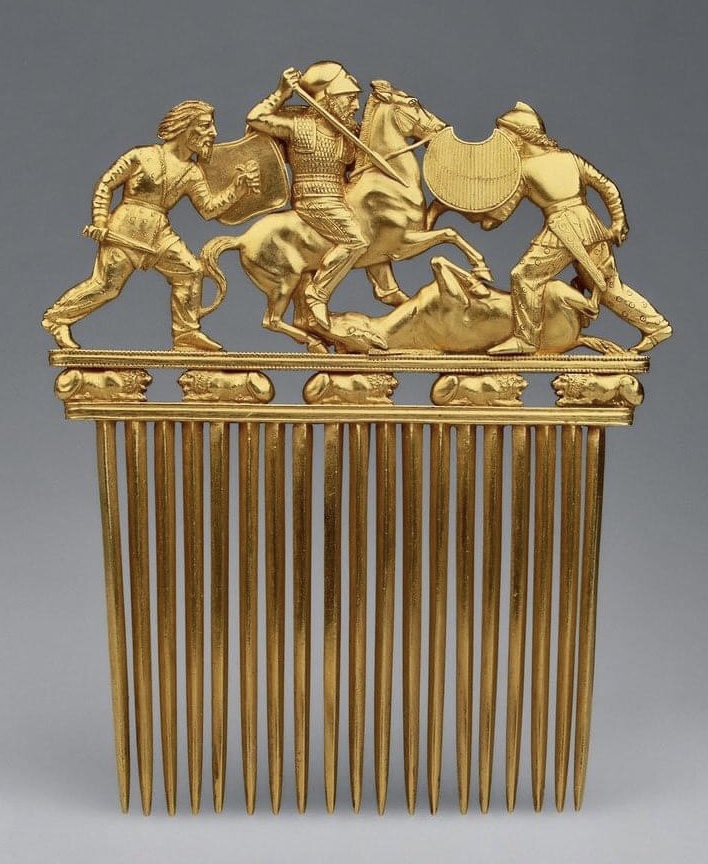
Greek-made Scythian gold comb, Solokha, Ukraine, 4th c. BC, Hermitage —Wiki

During the fall of the former Soviet Union, in the early 1990s, I spent a few seasons living in Leningrad with a noted pop singer. As winter closed in, and light diminished, I became stir-crazy, desperate for outside contact. I was living in isolation with a man from Grozny who spoke no English. But that's fodder for another story. One thing that enabled me to retain my sanity, other, than black market treats, including Earl Grey tea, was art for art's sake. I lived near the largest museum in the world, The Hermitage.

I literally spent my dark winter days in the dreary basement of the Old Hermitage. I discovered that I could waltz in the back door, for free, and avoid the long lines, if I attached myself to a busload of tourists....

Pop singer Valera Stupachenko, my Soviet fiancé, sometimes dropped me off at the museum when he had rehearsals at the Leningrad Rok Opera. I was lonely, isolated by language, or a lack thereof, though I could communicate basic needs in Russian.

I often divided my time between the Scythian, and the Fertile Crescent displays. The winged bull of Nineveh, the bust of the Akkadian king. Mysterious clay seals of Mohenjo-Daru, and cuneiform shards. Thracian gold. 

Of course, everything was explained in Russian, so I had to make do with what I remembered from my distant college art history classes. I painstakingly transcribed the Cyrillic placards into English. The guards did not seem to mind that I spend hours in darkened rooms gazing at these ancient wonders. 

A 2,300 yr-old women's soft red leather boot sewn with pyrite crystals and black beads, found  in an Altai mountain grave, 1948. Hermitage collection.

Having grown up on horseback, I was particularly fascinated by the Scythian horse trappings. Intricately designed saddles, felt applique blankets, bridles, stirrups, bits, and silk rugs—the oldest pile carpets in the world. Soft riding boots with wild roses beaded on the soles. I imagined a woman's feet never touched the earth, except for maybe to sit by the fire pit, dance on a thick carpet at her wedding, or when she was buried.

Oldest pile carpet in the world from an Altai Scythian tomb,.Pazyryk, ca. 4th c. BC. Hermitage

The elaborate gold Scythian pectoral collar made me weep, as did the golden reindeer, with horns so elaborate, they were like shining star-filled trees in a treeless tundra. They were more ancient and mysterious than the elaborate Greco-Scythian synthesized pieces. They were imbued with magic. Nomadic talismans.

Gilded wooden reindeer, Pazyryk, 5th c. BC. Hermitage

Afternoons were best spent in the (Post) Impressionist rooms, often the only direct sunlight I ever saw in winter was in those beautiful rooms with huge warped glass windows so old that I imagined they had somehow survived the Siege of Leningrad. 

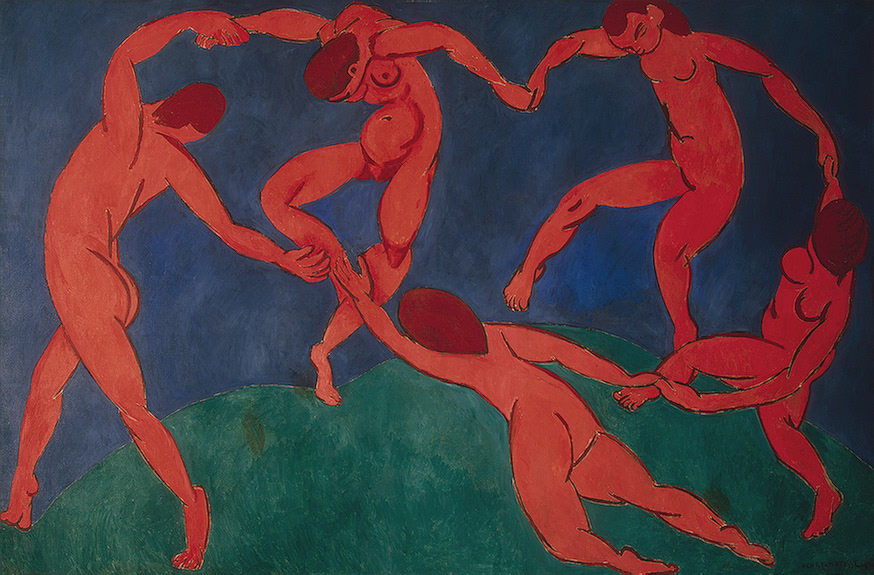
Henri Matisse, Dance, 1910, Hermitage (they aren't that red!)

I didn't know those Scythian finds were the foundation pieces for the genesis of the Hermitage. I had unerringly gone to the heart of the matter. During the early 18th c., Russian explorers brought Scythian gold from burial kurgans to Peter the Great. Catherine the Great, a fierce collector of art, and artifacts, was so amazed by Scythian artifacts that she ordered scholars to systematically research them—this was before modern archaeology got its groove on.

Scythian pectoral, Ukraine, 4th c. BC. Horses torn apart by (Greek) griffins. Hermitage —Wiki

A woman ahead of her horse and time, Catherine the Great had the largest collections of paintings in the world (4000), including hundreds of Impressionist paintings. They had to hang somewhere along with all the other art she had collected—some 3 million pieces. One of the oldest (and largest) museums in the world, the Hermitage, a collection of buildings fronting the Nevsky River, was founded in 1764 to house her treasures. (There was Scythian art in Moscow, Kiev and Budapest museums—but nothing matches the Hermitage collection.)

The Giottos, da Vincis and Raphaels were all wonderful, don't get me wrong, but I lived for Impressionism. The impressionist rooms in the southern wing of the Winter Palace were filled with movement. I clattered up three flights of stairs to see Matisse's Nude Dancers, and the old babushka guarding them said she saw them as messengers. It was not just a job to her. She put her hand over her heart. She had to be there every day to keep them dancing. To keep the world dancing. And so she did.

Both the Hermitage, and Moscow's Pushkin Museum had replicas of the world's greatest statuary (for art students). I stood before the Dying Gaul of Pergamon, and marveled over Greco-Thracian artifacts...another abiding interest. The Celts settled among the Thracians. Albania and Bulgaria retain scant traces of lost Balkan Celtic cultures.

The Dying Gaul, Gladiator, or Galatian, a Roman marble copy of a lost bronze Hellenistic statue, 3rd c. BC. Capitoline Museums, Rome. Livy recorded that the Celts of Asia Minor fought naked. There's a modern copy of the Dying Gaul against a Naples yellow wall at the Hermitage (see a copy here—there's no free Wiki image), in St. Petersburg, and another at the Pushkin Museum in Moscow.

And the Scythians of the steppes probably had contact with the Celts (and Tocharians)—especially along the Silk Road, as some artifacts seemed to have a curious cross-influence. Yellow embroidered silk slippers were found in theLate Hallstatt Celtic Lady of Vix's cart burial mound, and site of the world's largest wine krater (500 BC). She must've been thirsty after death.

Early Irish origin myths named Scythia as the Irish homeland and the Scythians as their kin. Perhaps the Irish scribes were miffed, and maybe it's an accretion, because Old Irish wasn't listed in the Tower of Babel, but the Bible included a reference to the Scythians, followed by barbarians. (Colossians 3:11) Better to be Scythian, than barbarian.

Modern archaeology links Scythia with Iranian (not Turkic) cultures, but I'm not entirely convinced. Satem (Avestan, Old Persian; Thracian may have been a transition language) vs. centum (Old Irish, Hittite, Hellenic, Tocharian). Soft vs hard C/K sound. Herodotus recorded that the tattoed Gelonii, were formerly Greeks; they "use a tongue partly Scythian and partly Greek." Sounds like a centum language.  He also placed the Keltoi homeland in the steppes at the source of the Ister/Danube. Like pots, gold doesn't speak much, other than of beauty.

This belt boss seems to have a Celtic echo. Note the wolfhound (lion?) riding the tail of the horse (deer?) has swirls similar to Hallstatt or La Tène art, as does the distinctive shape of the horse's body. No triskles, but plenty of swirls.

Gold Scythian belt boss, Azerbaijan, 7th c. BC. —Wiki

It was easy for me to spot the Classical influences, and/or Greek imports. I have a prodigious memory for art images. The saying goes: beware of Greeks bearing gifts. But these gifts from antiquity were no Trojan Horse filled with the enemy, or shiny objects to steal, or intended to usurp one's culture, they were bridges, or windows into ancient worlds, lost to time and memory. All we have left of so many cultures are shiny artifacts from another time.

Gold plaques: resurrection of a dead hero; Saka culture, 5th c. BC, Hermitage—Wiki

I never married the singer. My heart wasn't in it. I never danced with him, for he loved God more than me, but my days were filled with wonder and beauty in that dank, dusty basement of the Hermitage. I could not resurrect what was never lost. The lower depths of the Hermitage was my only refuge during that last Soviet winter before the Fall.