 |
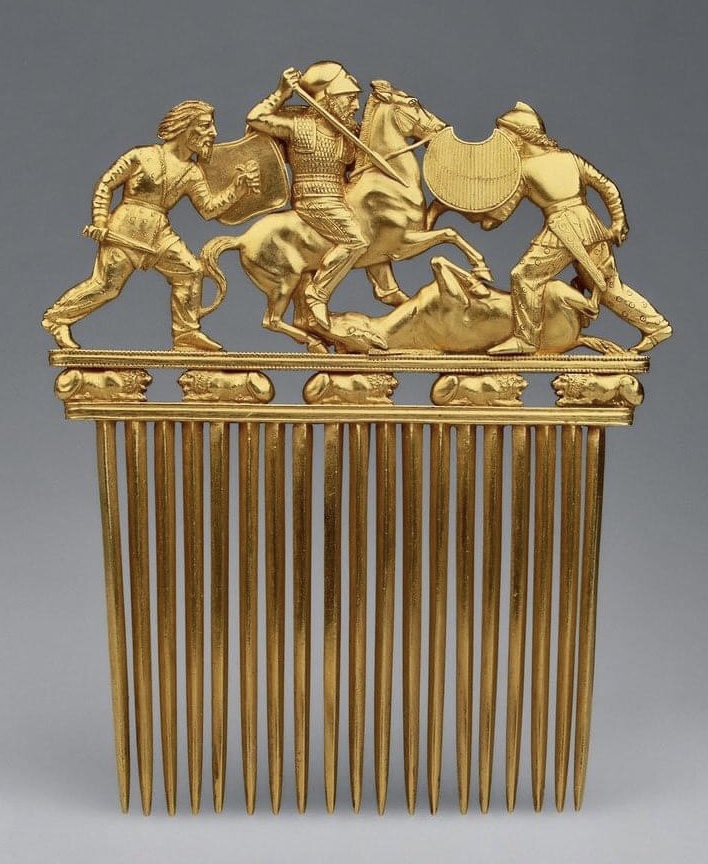
| Greek-made Scythian gold comb, Solokha, Ukraine, 4th c. BC, Hermitage —Wiki |
During the fall of the former Soviet Union, in the early 1990s, I spent a few seasons living in Leningrad with a noted pop singer. As winter closed in, and light diminished, I became stir-crazy, desperate for outside contact. I was living in isolation with a man from Grozny who spoke no English. But that's fodder for another story. One thing that enabled me to retain my sanity, other, than black market treats, including Earl Grey tea, was art for art's sake. I lived near the largest museum in the world, The Hermitage.
I literally spent my dark winter days in the dreary basement of the Old Hermitage. I discovered that I could waltz in the back door, for free, and avoid the long lines, if I attached myself to a busload of tourists....
I literally spent my dark winter days in the dreary basement of the Old Hermitage. I discovered that I could waltz in the back door, for free, and avoid the long lines, if I attached myself to a busload of tourists....
Pop singer Valera Stupachenko, my Soviet fiancé, sometimes dropped me off at the museum when he had rehearsals at the Leningrad Rok Opera. I was lonely, isolated by language, or a lack thereof, though I could communicate basic needs in Russian.
Both the Hermitage, and Moscow's Pushkin Museum had replicas of the world's greatest statuary (for art students). I stood before the Dying Gaul of Pergamon, and marveled over Greco-Thracian artifacts...another abiding interest. The Celts settled among the Thracians. Albania and Bulgaria retain scant traces of lost Balkan Celtic cultures.
And the Scythians of the steppes probably had contact with the Celts (and Tocharians)—especially along the Silk Road, as some artifacts seemed to have a curious cross-influence. Yellow embroidered silk slippers were found in theLate Hallstatt Celtic Lady of Vix's cart burial mound, and site of the world's largest wine krater (500 BC). She must've been thirsty after death.
Early Irish origin myths named Scythia as the Irish homeland and the Scythians as their kin. Perhaps the Irish scribes were miffed, and maybe it's an accretion, because Old Irish wasn't listed in the Tower of Babel, but the Bible included a reference to the Scythians, followed by barbarians. (Colossians 3:11) Better to be Scythian, than barbarian.
Modern archaeology links Scythia with Iranian (not Turkic) cultures, but I'm not entirely convinced. Satem (Avestan, Old Persian; Thracian may have been a transition language) vs. centum (Old Irish, Hittite, Hellenic, Tocharian). Soft vs hard C/K sound. Herodotus recorded that the tattoed Gelonii, were formerly Greeks; they "use a tongue partly Scythian and partly Greek." Sounds like a centum language. He also placed the Keltoi homeland in the steppes at the source of the Ister/Danube. Like pots, gold doesn't speak much, other than of beauty.
This belt boss seems to have a Celtic echo. Note the wolfhound (lion?) riding the tail of the horse (deer?) has swirls similar to Hallstatt or La Tène art, as does the distinctive shape of the horse's body. No triskles, but plenty of swirls.
It was easy for me to spot the Classical influences, and/or Greek imports. I have a prodigious memory for art images. The saying goes: beware of Greeks bearing gifts. But these gifts from antiquity were no Trojan Horse filled with the enemy, or shiny objects to steal, or intended to usurp one's culture, they were bridges, or windows into ancient worlds, lost to time and memory. All we have left of so many cultures are shiny artifacts from another time.

I often divided my time between the Scythian, and the Fertile Crescent displays. The winged bull of Nineveh, the bust of the Akkadian king. Mysterious clay seals of Mohenjo-Daru, and cuneiform shards. Thracian gold.
Of course, everything was explained in Russian, so I had to make do with what I remembered from my distant college art history classes. I painstakingly transcribed the Cyrillic placards into English. The guards did not seem to mind that I spend hours in darkened rooms gazing at these ancient wonders.
 |
| A 2,300 yr-old women's soft red leather boot sewn with pyrite crystals and black beads, found in an Altai mountain grave, 1948. Hermitage collection. |
Having grown up on horseback, I was particularly fascinated by the Scythian horse trappings. Intricately designed saddles, felt applique blankets, bridles, stirrups, bits, and silk rugs—the oldest pile carpets in the world. Soft riding boots with wild roses beaded on the soles. I imagined a woman's feet never touched the earth, except for maybe to sit by the fire pit, dance on a thick carpet at her wedding, or when she was buried.
 |
| Oldest pile carpet in the world from an Altai Scythian tomb,.Pazyryk, ca. 4th c. BC. Hermitage |
The elaborate gold Scythian pectoral collar made me weep, as did the golden reindeer, with horns so elaborate, they were like shining star-filled trees in a treeless tundra. They were more ancient and mysterious than the elaborate Greco-Scythian synthesized pieces. They were imbued with magic. Nomadic talismans.
 |
| Gilded wooden reindeer, Pazyryk, 5th c. BC. Hermitage |
Afternoons were best spent in the (Post) Impressionist rooms, often the only direct sunlight I ever saw in winter was in those beautiful rooms with huge warped glass windows so old that I imagined they had somehow survived the Siege of Leningrad.
I didn't know those Scythian finds were the foundation pieces for the genesis of the Hermitage. I had unerringly gone to the heart of the matter. During the early 18th c., Russian explorers brought Scythian gold from burial kurgans to Peter the Great. Catherine the Great, a fierce collector of art, and artifacts, was so amazed by Scythian artifacts that she ordered scholars to systematically research them—this was before modern archaeology got its groove on.
 |
| Scythian pectoral, Ukraine, 4th c. BC. Horses torn apart by (Greek) griffins. Hermitage —Wiki |
A woman ahead of her horse and time, Catherine the Great had the largest collections of paintings in the world (4000), including hundreds of Impressionist paintings. They had to hang somewhere along with all the other art she had collected—some 3 million pieces. One of the oldest (and largest) museums in the world, the Hermitage, a collection of buildings fronting the Nevsky River, was founded in 1764 to house her treasures. (There was Scythian art in Moscow, Kiev and Budapest museums—but nothing matches the Hermitage collection.)
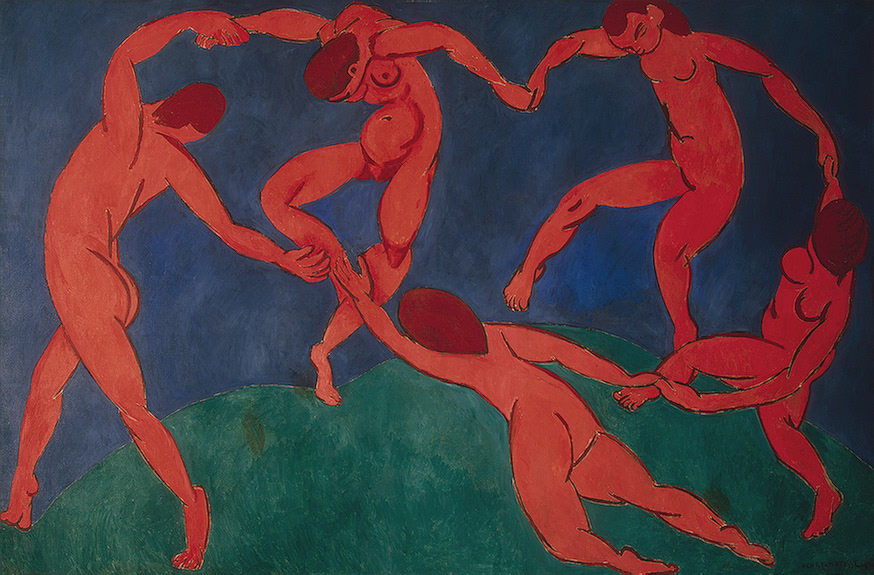
The Giottos, da Vincis and Raphaels were all wonderful, don't get me wrong, but I lived for Impressionism. The impressionist rooms in the southern wing of the Winter Palace were filled with movement. I clattered up three flights of stairs to see Matisse's Nude Dancers, and the old babushka guarding them said she saw them as messengers. It was not just a job to her. She put her hand over her heart. She had to be there every day to keep them dancing. To keep the world dancing. And so she did.
Both the Hermitage, and Moscow's Pushkin Museum had replicas of the world's greatest statuary (for art students). I stood before the Dying Gaul of Pergamon, and marveled over Greco-Thracian artifacts...another abiding interest. The Celts settled among the Thracians. Albania and Bulgaria retain scant traces of lost Balkan Celtic cultures.
.jpg) |
| The Dying Gaul, Gladiator, or Galatian, a Roman marble copy of a lost bronze Hellenistic statue, 3rd c. BC. Capitoline Museums, Rome. Livy recorded that the Celts of Asia Minor fought naked. There's a modern copy of the Dying Gaul against a Naples yellow wall at the Hermitage (see a copy here—there's no free Wiki image), in St. Petersburg, and another at the Pushkin Museum in Moscow. |
And the Scythians of the steppes probably had contact with the Celts (and Tocharians)—especially along the Silk Road, as some artifacts seemed to have a curious cross-influence. Yellow embroidered silk slippers were found in theLate Hallstatt Celtic Lady of Vix's cart burial mound, and site of the world's largest wine krater (500 BC). She must've been thirsty after death.
Early Irish origin myths named Scythia as the Irish homeland and the Scythians as their kin. Perhaps the Irish scribes were miffed, and maybe it's an accretion, because Old Irish wasn't listed in the Tower of Babel, but the Bible included a reference to the Scythians, followed by barbarians. (Colossians 3:11) Better to be Scythian, than barbarian.
Modern archaeology links Scythia with Iranian (not Turkic) cultures, but I'm not entirely convinced. Satem (Avestan, Old Persian; Thracian may have been a transition language) vs. centum (Old Irish, Hittite, Hellenic, Tocharian). Soft vs hard C/K sound. Herodotus recorded that the tattoed Gelonii, were formerly Greeks; they "use a tongue partly Scythian and partly Greek." Sounds like a centum language. He also placed the Keltoi homeland in the steppes at the source of the Ister/Danube. Like pots, gold doesn't speak much, other than of beauty.
This belt boss seems to have a Celtic echo. Note the wolfhound (lion?) riding the tail of the horse (deer?) has swirls similar to Hallstatt or La Tène art, as does the distinctive shape of the horse's body. No triskles, but plenty of swirls.
 |
| Gold Scythian belt boss, Azerbaijan, 7th c. BC. —Wiki |
It was easy for me to spot the Classical influences, and/or Greek imports. I have a prodigious memory for art images. The saying goes: beware of Greeks bearing gifts. But these gifts from antiquity were no Trojan Horse filled with the enemy, or shiny objects to steal, or intended to usurp one's culture, they were bridges, or windows into ancient worlds, lost to time and memory. All we have left of so many cultures are shiny artifacts from another time.

I never married the singer. My heart wasn't in it. I never danced with him, for he loved God more than me, but my days were filled with wonder and beauty in that dank, dusty basement of the Hermitage. I could not resurrect what was never lost. The lower depths of the Hermitage was my only refuge during that last Soviet winter before the Fall.


