Sunday, November 30, 2014

The Lindisfarne Gospels are Insular art, not Anglo-Saxon art


Folio 27r, Lindisfarne Gospels with incipit from the Gospel of Matthew. —Wiki

A Facebook site I dearly love, Medievalists.net, posts scholarly papers on the the medieval world. Sometimes I find myself disagreeing with posts, and misleading headlines, and then, the next thing ya know, I'm posting a comment that turns into a lively rant (and several hours later, when I've come up for air, I've got what amounts to a bit of a blogeen—not that I usually bother to post them here).

What got my lather all whipped into a fine froth this morning was that  Medievalists.net, posted "A very beautiful Anglo-Saxon manuscript." I saw red....this is what ensued:
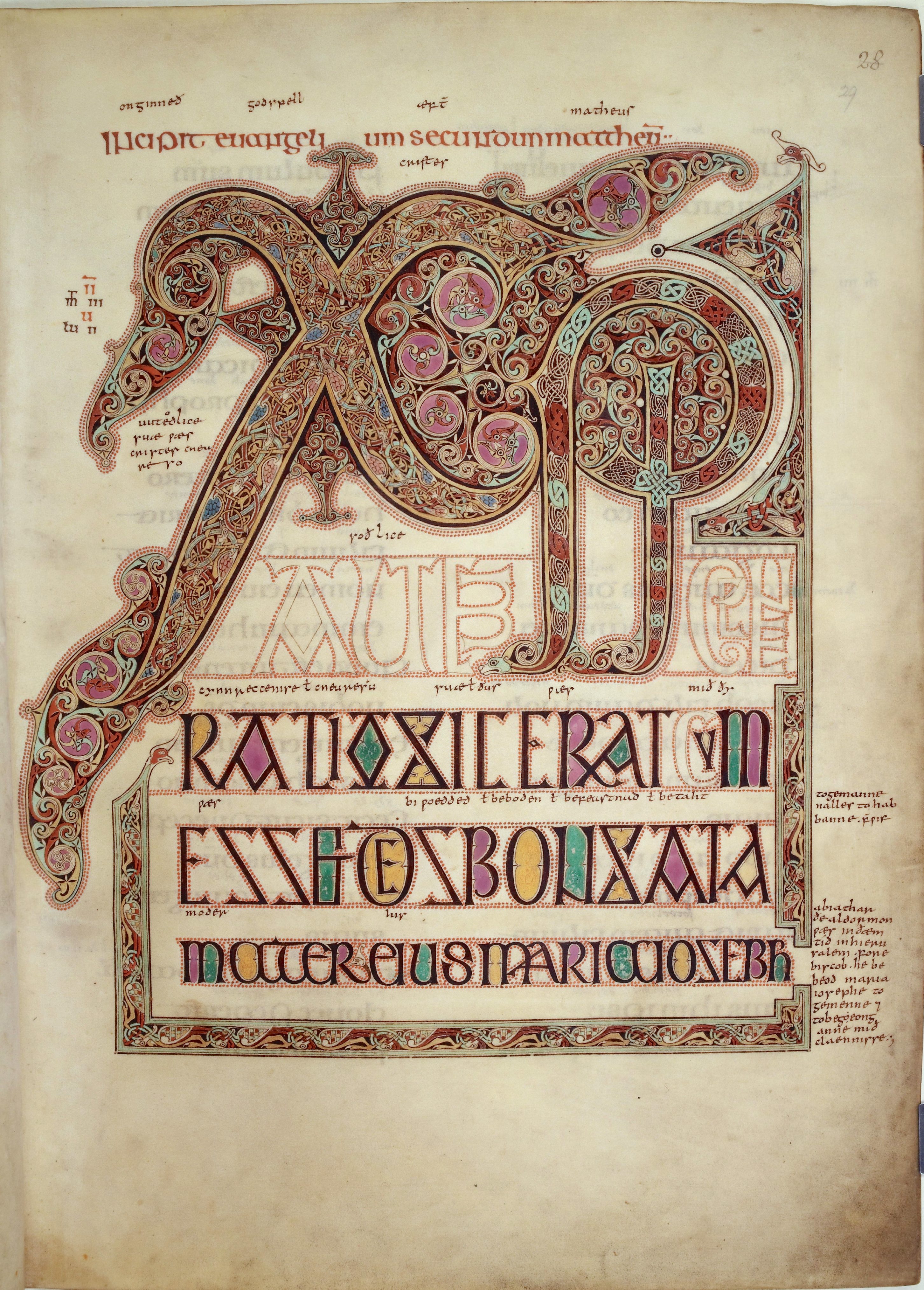
"Chi-Rho" monogram, the Gospel of Matthew—Wiki

Go hailin. Indeed the Lindisfarne Gospels are very beautiful Irish-Anglo-Saxon, or, more correctly, a joint Hiberno-Saxon manuscript, illuminated in the Irish style, The Lindisfarne Gospels, like the (later) Book of Kells, were once considered to be a relic of St. Columba. Calling it Anglo-Saxon art is to do it a disfavor; it's a much more cosmopolitan manuscript than that.

The Celtic monastery of Lindisfarne was founded in 635 AD, by Columban Irish monk Saint Aidan (d.651), from the Isle of Iona. Irish monks founded Celtic monasteries on most of the British, Scottish, and Irish islands, and Columban Irish scribes would've trained Saxon scribes in the the insular Irish style—right down to the red lead dots surrounding the letters (the Durham Gospels, and the Book of Durrow, being its predecessors). But first, the Irish monks had to convert the Saxons....
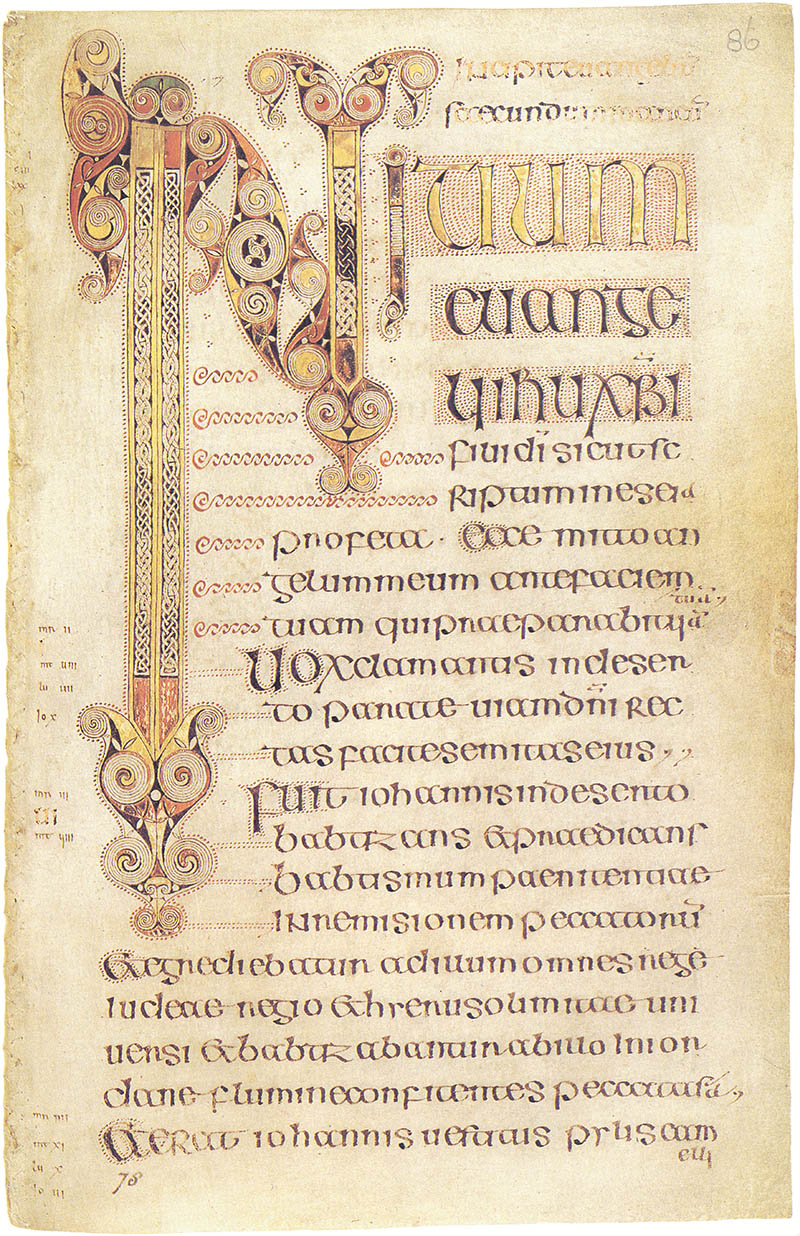
The beginning of the Gospel of Mark from the Book of Durrow.—Wiki

The Lindisfarne manuscript, an illustrated Latin copy of the Gospels of Matthew, Mark, Luke and John, was probably made at Lindisfarne, but it could've been made elsewhere, even Iona, as it has an Iona connection. The text is also written in (Irish) insular script.

The problem with tagging this manuscript as Anglo-Saxon, is that it's virtually impossible to tell the difference between Irish, Welsh, Scottish, and Anglo-Saxon illuminated manuscript art, because they were all created in Celtic Irish monasteries between 500-900; later in Ireland, to 1400 AD), and they share far too many similarities. It was also an incestuously small world.

A "safer" nomenclature would be to label these illuminated manuscripts as "insular." Ditto for the continental manuscript, also created in Celtic monasteries founded by Irish monks. (See "List of Hiberno-Saxon illuminated manuscripts" at bottom of page.)

And most 'scholars' writing of these things never delve beyond the current political border of a country when describing where an artifact was discovered, or attributed to, when labeling art. If it was made in St. Gallen, ergo it must be Swiss; or in Bobbio, it's Italian (Irish monasteries!)

The St. Gall Gospel Chi-Rho page, written by Irish monks ca. 750AD—from Irish Medieval History 
Irish manuscripts often display the first three letters, Chi-Rho-Iota, from the Greek ΧΡΙΣΤΟΣ, as a monogram. In the Latin Vulgate, it reads: "[Christi (XPI) autem generatio sic erat…  Note the distinctive long left leg on the Chi/X—also found in the Book of Kells, Book of Durrow, St. Gallen Gospel, MacDurnan Gospels, Book of Lindisfarne and many more. The long "i"pronunciation in Christ, is a result of Irish missionary work in England during the 7th - 8th c.—from Irish Medieval History 

Some slovenly writer described this manuscript as an amalgam of Anglo-Saxon, Irish and German art—WTF? I couldn't figure out how/why Germany—then it dawned on me, they were referring to manuscripts found in Germany, made by Irish monks. And archaeologists tend to be even sloppier. Sometimes I wonder if they know any history at all.
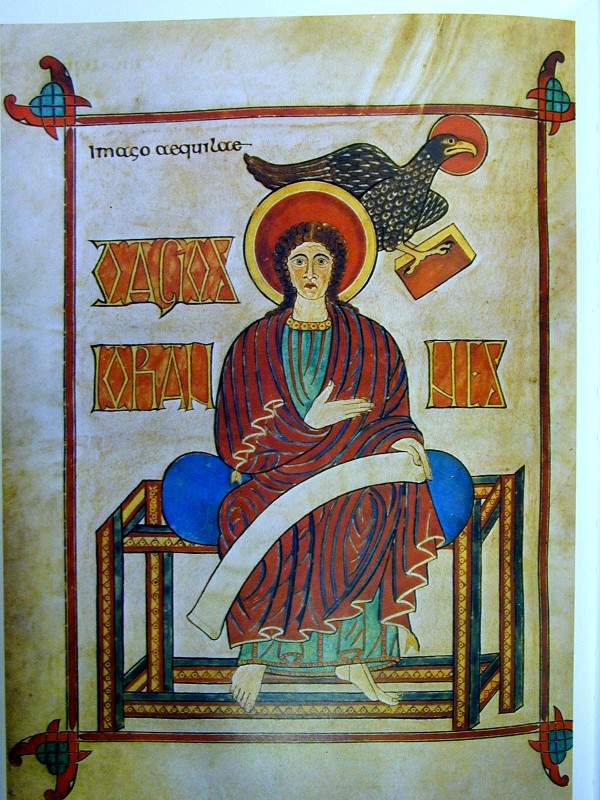
Eagle-eyed John the Evangelist Wiki 

Some background on Lindisfarne, founded in 632, according to the Annals of the 4 Masters; modern articles say 635 AD. It was also the age of writing fancy Vitae to one's patron saints.

The three Lindisfarne bishops who followed the Irish founder, St. Aiden of Iona (590-651), were all Irish-born: St. Finan, St. Colmán, St. Tuda—43 years later, Eata, apparently he was not saintly fodder, but he was St. Aiden's student, and the first native Northumbrian bishop (678-685); then St. Cuthbert (though born in Scotland, he was also from the Cult of St. Columba school).

From what I can tell, St. Eadberht was the second ever Northumbrian bishop—he put up lead walls and a lead roof on the thatched oak church, I bet many monks were very grateful.

And then we get to oor man, St. Eadfrith (also a fine Northumbrian, b.?, who was bishop from 688-98) who was possibly the artist and scribe...the manuscripts are attributed to him, but they could've also been commissioned by him.

A little backstory: Things were not all hunky-dory between the Saxons and the Irish just because Christianity gained a tiny toehold, and the Lindisfarne monastery was established, ca. 635. Oswald of Northumbria, a king living in exile since 616, vowed to bring Christianity to pagan Northumbria. In 634, when he gained the crown of Northumbria, he invited St. Columba's monks to establish a monastery.

But things were still pretty woolly. In 683, the Saxons raided Magh Breg in ireland and took hostages. In 684, Eadfrith's contemporary, St. Adamnán (624-704), St. Columba's distant cousin and Abbot of Iona (679-704)... 
...went to Saxon Land, to request a restoration of the prisoners which the North Saxons had carried off from Magh Breagh the year before mentioned. He obtained a restoration of them, after having performed wonders and miracles before the hosts; and they afterwards gave him great honour and respect, together with a full restoration of everything he asked of them. —Annals of the 4 Masters
 (These were the apocalyptic plague years. After nearly all the children and animals died, I imagine any kind of miracles were welcome—including Columban monks walking across the Irish Sea to Scotland, it was that cold. But at least the cold snap must've killed off the plague fleas.)
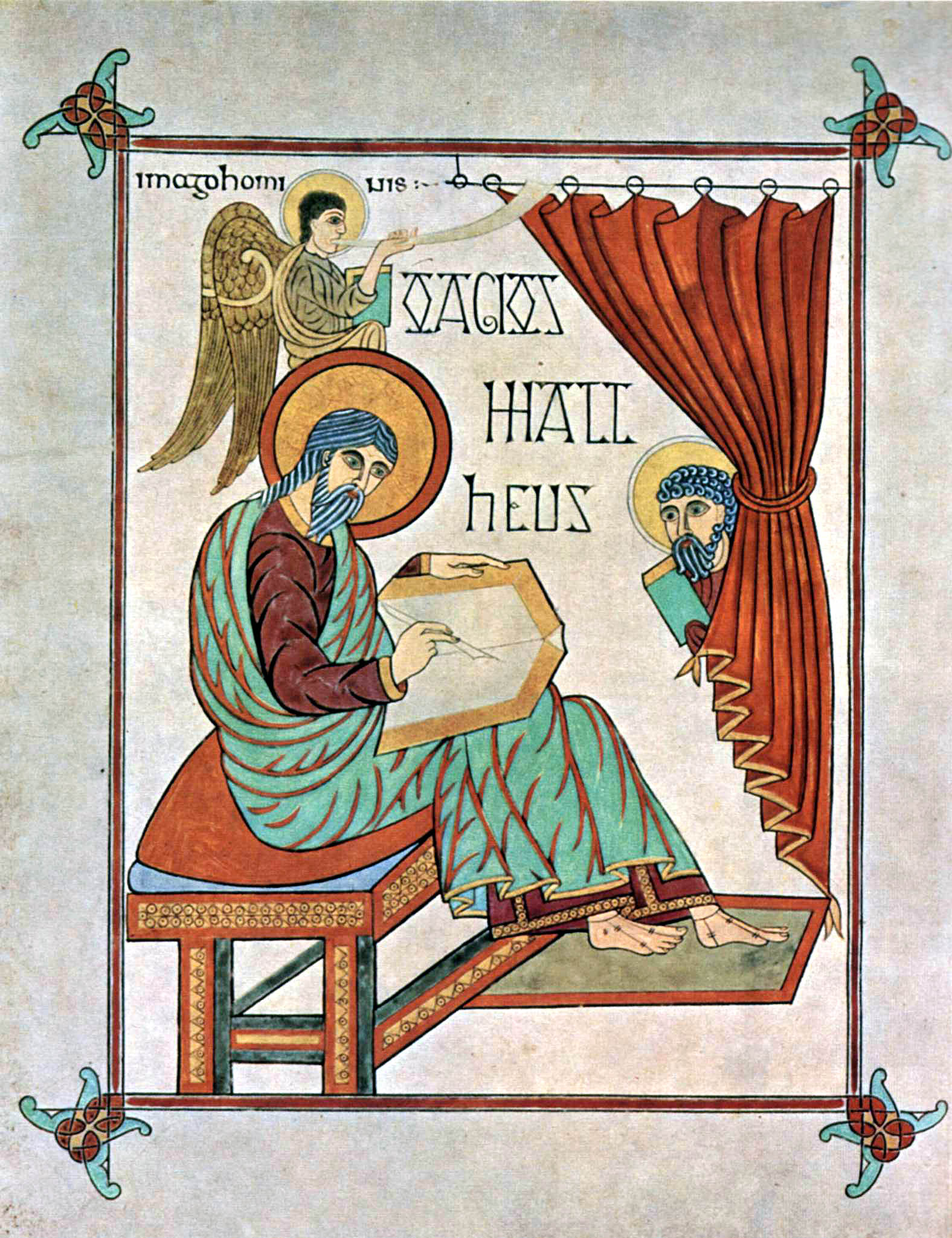
Portrait of the artist benched as Matthew the Evangelist —Wiki

A century after Lindisfarne was abandoned because of repeated viking raids, a colophon was added to the Lindisfarne Gospels by a self-serving scribe and provost, Aldred the Glossator, who penned Anglo-Saxon glosses under the Latin text, between 950 and 970, and then he graffitied on the text that Eadfrith was the scribe and artist responsible for the work—some 150-70 years later... Lead-poisoning aside, there must've been some librarian apoplexy in the wings. Stories do change. There was also a viking raid or two in the way as well.
it is only from Aldred’s inscription that we presume Eadfrith created the manuscript and another monk, Billfrith, its original binding. Margaret Walker, The Lindisfarne Gospels: A Living ManuscriptUniversity of Edinburgh Postgraduate Journal of Culture and the Arts
But the illuminated mss. was probably a commission produced in honor of St. Cuthbert (634-687). It was probably made ca. 700, most scholars suggest 715, but Eadfrith died in 721—presumably while still in office, of old age as did most bishops—with their boots on (it was a very good gig). If so, then he probably didn't scribe the manuscripts himself, as he also commissioned three books on the Life of Saint Cuthbert as well. Calligraphy and advanced old age don't mix well—too many hand tremors, not to mention a profound loss of eyesight.

Carpet page: possibly based on early Coptic manuscripts depicting Islamic prayer rugs. Can you see the embedded cross?—Wiki

The next bishop, (last) St. Æthelwold of Lindisfarne (721- 740), took the raw manuscripts that St. Eadfrith had prepared (note the word "raw"), had them bound and gilded, and commissioned a jewel-encrusted gold cover made by St. Billfrith (ca. 8th c.), which the Dane-vikings literally ripped iff, of course.

The Lindisfarne Gospels had to wait until 1852 to get another decent cover.  But that's another story. And this is the end of my story.
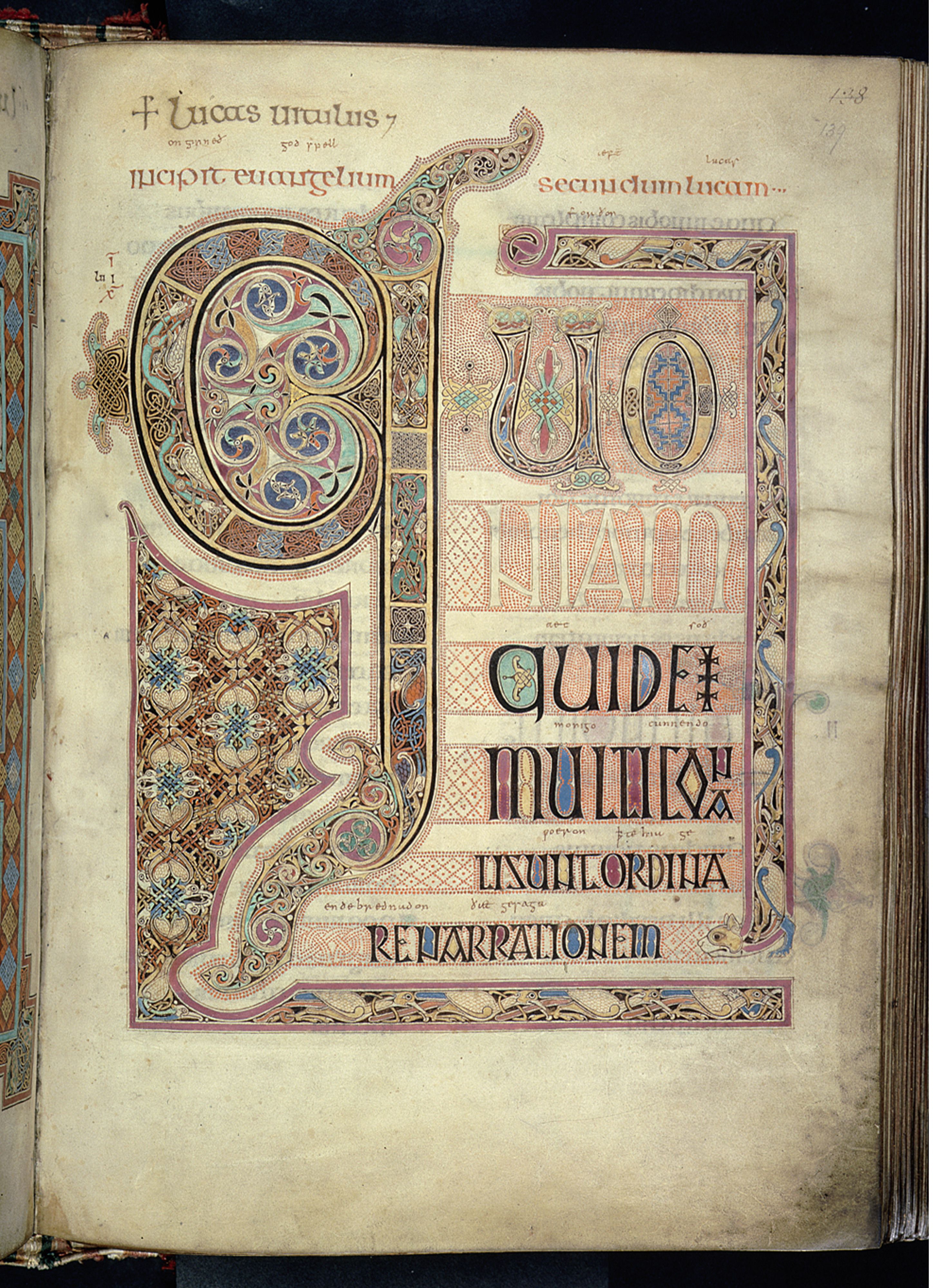

Gospel of St. Luke—Wiki 


The Old English name, Lindisfarena, was not recorded until 793, probably from the Irish (lin/d-pool/stream); the 9th c. Welsh Historia Brittonum, records Lindisfarne as Medcaut; the term Holy isle/Insula Sacra was commonly used until the 11th century, and is alternatively used to this day. Cumbria, northern Umbria, Lothian and the Kingdom of Strathclyde formed the diocese of Lindisfarne.

Friday, November 28, 2014

Cameraless in Nicasio (photo)


Cameraless in Nicasio, I resorted to using my old MacBook webcam to take this shot. I love the pastel, or almost watercolor look in this extremely low-grade resolution photo that's meant to transport an image of your face across the internet, not a landscape. But the lighting was so spectacular.

I loved standing in the middle of the road trying to take a photo with my weenie laptop skype cam (so I could change my cover photo), playing chicken with oncoming cars, while waiting for the turkey to finish roasting. The other wild turkeys crossing the road. No Wild Turkey in the hand, unless you counted the eggnog. If only we had some eggnog to spike, rather than the turkey. We're celebrating Thanksgiving a day late so my cousin Dave too can have TG dinner. He usually has to work.

Last night's storm was fierce. A huge gust of wind tore down several limbs, and trees fell across Lucas Valley Road. The church bell was ringing wildly, the wind was so strong. It really started raining hard, and the rain beat against the windowpanes of the old farmhouse like tiny hooves on pavement, so driving home was hairy.

Thursday, November 27, 2014

York is not a Norse name, it was called Eboricum

NOTE TO CELTIC GUIDE MAGAZINE:

York comes from Norse Jorvik? I thought it came from the Latin, "Eboricum", and before that, from a Celtic place name. York is most definitely not a Norse placename, it is a Norse pronunciation of a much older placename, Eboricum, founded in 71 AD, the Roman legionary fortress and capital of Brittania Inferior, when the Ninth Legion conquered the Brigantes. During Anglo-Saxon times, it was known as the trading port of Eoforwic.
The word York (from Old Danish Jórvík 9th century AD) derives from the Latinised name for the city, variously rendered as Eboracum, Eburacum or Eburaci. The first mention of York by this name is dated to circa 95–104 AD as an address on a wooden stylus tablet from the Roman fortress of Vindolanda in Northumberland. —Wiki
The old Brittonic name was probably Eburacon which was Latinized as Eburacum (with the same vowel quantities and stress sounds as the Brittonic pronunciation).
It is thought that Eboracum is derived from the Brythonic word Eborakon, a combination of eburos "yew-tree" (cf. Old Irish ibar "yew-tree", Welsh efwr "alder buckthorn", Breton evor "alder buckthorn") and suffix *-āko(n) "place" (cf. Welsh -og) meaning either "place of the yew trees" (cf. efrog in Welsh, eabhrac in Irish Gaelic and eabhraig in Scottish Gaelic, by which names the city is known in those languages); or less probably, Eburos, 'property', which is a personal Celtic name mentioned in different documents as Eβουρος, Eburus and Eburius, and which, combined with the same suffix *-āko(n), could denote a property. —Wiki
The Classical Latin spelling was Eburacum; the alternate spelling Eboracum reflects the Vulgar Latin change of u to o; but the stress remained on the sound. Some of the earlier instances of Eboracum mentioned in Ptolemy may be 'corrections' by later copyists, reflecting a shift in language sounds. Bede, writing in the 8th century, used both spellings. Besides, exact spelling was a relative concept even during Shakespeare's time.

That Norse J in Jorvik is trying to simulate a Celtic eu sound (as in ewe tree)—there was no y letter. In Irish orthography, the pronunciation and written Irish are not identical, nor do the sounds correlate with English pronunciation rules. They are closest to Latin, with their own peculiar twists of lenited vs long sounds. For example, the letters b and v within a word in Irish tend to gather a swallowed ya sound, or sometimes a w sound, like Samhain (Sowen). But there was no Y or W in the Irish alphabet.

Cicely Mary Barker 1895 -1973

What I found on the internet:

Yew in Old Irish is written as ibar/ibhar and (edad, edhadh), from Old Irish é(o). meaning either the tree or the weapon. Another Irish word for yew, is eo.

"W" is unknown to Latin or Greek writing. Old Irish, the language of the earliest sources in the Latin alphabet, takes place during the 6th century. Long before the Vikings came to York, I might add.

The morpheme aco /a:ko/ denoting a "place" still survives in modern Welsh as -og (earlier -awg).

There is debate as to the meaning of the root ebur(o)-. Some people insist that it is an old root meaning "yew" (Old Irish ibhar is glossed as 'taxus'), and thus Eburacum is "place of yews".

But Ebruros is also attested as a personal name in Gaul, so some think it meant: "Eburos' estate". On the balance the evidence seems to favor "place of yews", but it is not certain.

If the Romano-British name had been taken over by the English, then the modern English (after Norman spelling 'deforms') would be something like: Everock. And certainly not Jorvik.


On Rabbits and Linguistics


On an Eupedia.com linguistics forum, a user with the handle Maciamo wrote: "Quite a few [Wallonian] words have direct Germanic roots."

If Maciamo hadn't used the word "roots," I would've never even flinched. But I'd just read a long treatise on a Facebook site, Irish Medieval History, and had spent an afternoon tracking down all manner of leads on rabbits—double-checking their information. The Irish have no word for a rabbit nor do the English or the Germans! 
In Irish coinín (kun een) is the word used for a rabbit. It derives from the Latin “cunīculus”. Similarly in English the word used was “coney” which was correctly pronounced like the Irish as “cunny”. Rabbits were not native to northern Europe which is why there was no Germanic or Celtic word for them.
Well, I wanted to share my wealth of new-found knowledge (see below). I even joined Eupedia, a feat that took far too long, only to find that I couldn't post a comment anyway. So I'm posting it here.
RE: Walloon, a Germanised Romance language ?
conén (or conin) => rabbit/lapin (Danish/Norwegian/Swedish = "kanin", Dutch = "konijn", German = "Kaninchen")
robète => another Walloon word for rabbit (from Middle Dutch "robbe", obviously sharing a root with the English "rabbit")
Maciamo, you erroneously assumed that because there are similarities between certain Germanic words and Walloon words, ergo, Walloon borrowed words from the German, or the Dutch.

In the case of coney, or rabbit, you couldn't be more wrong. I suspect your other examples wouldn't hold up to close linguistic scrutiny either.

Both are loan words—as Iberian coneys/rabbits (Oryctolagus cuniculus) were not native to northern Europe. (Hispania, from the Phoenician, means 'the land of rabbits.') There is no native word for coney or rabbit in Celtic or Teutonic, nor mention of coney or rabbit in England before the Norman period.

You need to trace words back to their earliest sources before you can make that kind of declarative statement. Had you done your homework, you would've discovered that rabbits are not native to northern Europe and that the words (and rabbits) were borrowed from iberia.

The word robète does NOT sharing a root with the English word for rabbit, because that too was borrowed from the Latin. There were no native rabbits in Britain, they arrived during the 12th c. with the Normans. Rabbits were first domesticated by monks during the 5th c. in what is now France. (And the word ‘rabbit,’ from the French, means a young conin, or coney.)

OED a. A rabbit: formerly the proper and ordinary name, but now superseded in general use by rabbit, which was originally a name for the young only.

TheFreeDictionary:[Middle English coni, from Old French conis, pl. of conil, from Latin cunculus, possibly from cunnus,cunus, female pudenda.]

Coney used to rhyme with bunny, was a slang term for a red-light district, so it fell out of favor, so to speak.

English Language & Usage: OFr. conil, connil, cogn. w. Pr. conil, Sp. conejo, Pg.coelho, Ital. coneglio:-L. cunīcul-us rabbit, according to ancient authors a word of Spanish origin. The OFr. pl. (with l suppressed) coniz, later conis, gave an Eng. pl. conys, conies, and this a singular cony, conie. The ME. cunin, konyne, conyng was a. OFr. conin, connin, Anglo-Fr. coning, a parallel form to conil, which gave also MDutch conijn, Dutch konijn, and, with a for o, LG. kanîn, whence mod.G. dim. kaninchen. In Eng. the form cunyng, cunning came down to the 16th c.; but from the 12th c. onward it varied also with cunig, conig, connyg.

It has no native name in Celtic or Teutonic, and there is no mention of it in England before the Norman period; in the quotations the fur, perhaps imported, appears before the animal. The Welsh cwning, cwningen, is from ME.; the Irish coinnín, and Gaeliccoinean, coinein from ME. or AFr."

http://english.stackexchange.com/questions/81085/coney-and-rabbit-what-s-the-difference

Wednesday, November 26, 2014

Strange Bedfruits


Neil Astley who publishes Bloodaxe Books in Northumbria, posted a BBC link on Facebook: Stop eating cats and dogs say animal rights campaigners in Switzerland "Time to boycott everything Swiss? Barbarians!"

Many usual fuzzy bambi posts ensued, including boycotting Toblerone, but then there was a curious role reversal when the meat eaters chimed in and said if you're going to eat meat, then don't be a hippocrite (stet). By that point, I was on a roll. 

Sometimes you just eat what you're served. Even some of us (occasional) carnivores have moral issues eating endangered species, though. Sometimes it's unavoidable, our Guatemalan hosts proudly prepared us a regional dish: kebabls—which turned out to be a medley of wild creatures from the jungle. 
My new friend wrote: It is surprising however what people will/do eat. Cannibalism comes to mind when we eat animals. What is the difference?! Being a vegetarian is not without its dilemmas either.
Sometimes one eats what is available. (I can't eat legumes, a huge handicap in S. America, and fresh vegetables are out). However, not wanting to offend our hosts, I went through the usual list: pollo, vaca, puerco, oveja? No. Serpiente? No no...es venado, y como se dicie—los otros animales de la selva. 

By that point, I desperately searched my meager Spanish vocabulary for the word monkey...and learned a new Mayan word: tepesquintli. It took me decades to discover what it was: agouti. OK. Other stories about Baja sea turtles, and Peruvian cuy, too. 

Fodder for my poems, no? A historical note, during WWII, cats were called roof rabbits in Holland. Is the strange Swiss appetite somehow related?
She posted: Eat to survive vs eat to be polite. My father ate sheep's eyes as guest of honour in the Middle East and had to and in front of everyone. We could conceivably live on beans and rice. As far as I can tell everything has been eaten at least once by someone or something!
What a story. In Russia, I was in a similar dilemma with rooster feet in my borsht—a local delicacy. After living there one winter, I had to seriously change my squeamishness. I quit eating most things, and began to spontaneously bruise. The doctor said I needed to eat protein. How I learned to eat smalow—smoked fat.
Then she had to go there, the lower depths: How many trips have I been on where I had no idea what was in the food and never ever want to know! Ever. Enough said I got parasites! It was the best diet I have ever been on would recommend it to anyone wanting to loose weight and fast! 
So sorry to hear you were a hotel. I've been a host too...no fruit, not fresh veggies, can't eat any form of beans...and my partner wants to go to India...a dilemma. When traveling in third world countries, I eat... not much? Traveling can seriously challenge one's first world notions... Got sick once from ceviche, and I thought that would be safe with all the lime. hahaha! 

My partner at the time (poet-translator) would take us off the grid, meeting up with poets...crazy times. Isla Amantani, our host, an Aymara family, offered us bitter native black potatoes and cuy (guinea pig and fleas). 

Nothing else to eat, other than a local herb for tea...and water doesn't boil at that elevation—so rice and quinoa are out. No stores, no restaurants... an off the beaten trek island in the middle of a vast lake, waiting until the next mail boat came. I kept waiting for seals to appear as we overlooked the vast lago Titicaca, Potosi shining in the distance. Think I was hallucinating from hunger by then. 
She said: That is exactly where I travelled extensively with my son some years ago as well as in Mexico, Bolivia and Guatemala. Amazing our best trip ever! We often reminisce my son and I. Ceviche yes that sounds like a familiar horror. Lobster carpaccio in Lima Peru was our nemesis! 
Didn't the word carpaccio give it away? Yet, I wouldn't trade the experiences for anything, though they were hairy, to say the least... Never got yo Bolivia, sad to say. Then you understand the eating dilemma first hand as well. Travel is not a vacation.
It took me years to recover from bad Vienna sausage. It was an eyeball story: our Peruvian Chinese host brought out a delicacy—those blasted sausages. I'll say no more, other than I couldn't eat food for weeks—not even bananas. Or drink juice. 

I managed to hike over the Andes on a strange bevvy concoction of Lipton tea, sugar, lime juice and steeped coca leaves...but I made it to Machu Picchu the long way...over (ahem) Dead Woman Pass.
She said: Well what can I say?! We had to try something new, in a new place on the Pacific, the final frontier...you know life on the edge...Cataccio and dogaccio is where this all started!
Maybe we'll meet again somewhere on the Gringo Trail, see what's on the menu. Poor Neil will wonder how his post got so hijacked (it's her fault, Neil!)... Good job closing the circle. Cataccio and dogaccio! Are there cat bits in the Toblerone? just say no to fugu, OK? Yeah, if the pufferfish is prepared wrong, it's all hats off—there'll be no comment—ever again.

Impromptu birthday party Thanksgiving eve

A sheetcake with my name scribed on it mysteriously appeared on my doorstep this morning. If you're in the 'hood and have a yen for shaving cream textured chocolate frosting, drop on by this evening between 5 & 7 PM. I also inherited 5 lbs of cream cheese, so bring something to go with it, if you want savory. Wine is always good too. It seems I've got the cheese covered. Irish soda bread's being assembled now... Vats of tea to follow. Ricky got the oven lit. Explains why the salmon didn't bake and my excruciating headaches the past few days. I've been gassed. So come on over, it'll be a gas especially if I make Brussel sprouts.

It turned out to be a fabulous impromptu bash and there was music and beautiful white frosting roses. Thank you Chuck, Chetana, Rama, Micaela, Neil. Toni & Paul for your company, for bringing in my new year so gloriously. I needed that celebration and closure. Birthdays are tough—especially when they compete with Thanksgiving eve.

Tuesday, November 25, 2014

Viking Tribes notes

DRAFT

A Facebook site I often visit, Medievalist, which is a gateway for their blog of delightful medievalness, Medievalists.net, which posts medieval art, book reviews, videos, the adorable "Five-Minute Medievalist} column, and abstracts of scholarly papers on the medieval world. 

Sometimes I find myself disagreeing with posts. Especially when it comes to misinformation about vikings and the blatant appropriation of other cultures. (I guess it's fitting, considering they were raiders, but they're still raiding other cultures long after they ceased to exist.

This one particular paper, Norsemen And Vikings: The Culture That Inspired Decades Of Fear by Alexandra McKenna and John Broom, a paper given at the West East Institute International Academic Conference, October 2014, was not only rife with typos, it was loaded with wrong information. (The overall consensus was that it was a generically bad academic paper.)

So naturally, I posted a teeny comment. Four hours later, I'd traversed every Wiki post ever written on vikings and norsemen, from the Nordic Iron Age to the end of the viking era. This compaction is what follows. I really do need to revisit it but not now. I'm kind of sick of it.


Re: "...not all Norsemen were Vikings." And not all Vikings were Norsemen either. (And, oh, the typos... I thought papers were supposed to be proofread before publication.) "In one sentence, Medieval Britain was a land dominated by people of Norse decent, ..." Really?

And the in another sentence, (via Alby Stone), the paper attempts to co-opt the British Grail stories as stories inspired by Odin? Bah! Terrible paper. Truncated history at its worst.
Someone replied to my post saying: In the paper they said that not all Norse were Vikings. It was more of an occupation. Warriors would go on Viking expeditions. Many of the Norse were peaceful farmers just trying to make a living.
Nothing like revisionist history in the making.
Another more enlightened soul wrote: On the contrary, farming was rare in Norse Scandinavia due to landscapes and forests. In fact the nobility of the Norse were the few who had farms.
So I was on a roll. Not all Vikings were Norsemen.There were many nordic tribes and "Scatinavia" was comprised of thralls (slaves), karls (farmers), and Jarls (nobility—merchants). 

Slavery (from across Eurasia) was the central hub of Norse society—and not all Norsem were even Norse! The thralls, for instance. Slaves were often sold to Arabs for silver. Slaves made really good rowers...

Scandinavians of Thule were comprised of many tribes (modern terms: Nortmanni/Norwegians, Swedes and Dane) Rhos, Geats, Heruls, Dani, Jutes/Gutes/Gotlanders, Goths, Hallins, Suiones: Suehans/Suetidi (aka Varangians); and even Finns/Fenni (Hämenites/Tavastians Kvens, Karelians; possibly Sáami) who were radically different groups/tribes. 

The early Irish scribes distinguished between the different types of vikings Finn-Gall and Dubh-Gall. Generally speaking Norwegian vikings raided Ireland, Scotland, Faroes, Iceland, and Greenland; the Danes plundered Ireland, England and France; and the Swedish vikings raided Russia. All were different viking groups (aka Ascomanni, Lochlanach, Dene, Rus, Varangians).

The Vikings practiced an austere form of primogeniture, the eldest son got the entire farm, cattle, wealth, everything. There was also political unrest, not enough farmland, and all those landless younger sons (not firstborn) were encouraged to go a plundering (or kicked to the kerb).

This was also true of the landless younger sons of noblemen of 14th c. Spain, who plundered the New World with an equal vengeance. Perhaps it was because they were the offspring of vikings. Visigoths were considered the forefathers of Spanish nobility—A Spanish saying: an arrogant man is: "haciéndose los godos," acting like a Goth.

Wald [ruled] the Woings, 
Wod the Thuringians, 
Saeferth the Sycgs, 
Ongendtheow the Swedes, 
Sceafthere the Umbers, 
Sceafa the Lombards,

I don't know if I'll ever get back to this and turn it into a blog, add all the lost links—I never thought I'd put this much time into it, so I didn't save my urls. But then I said that about the Viking Redhead Myth post too. It doesn't hold up as well as a standalone blog entry, not like the Lindisfarne post. It needs context, but I'm tired.

Monday, November 24, 2014

Bay Area Generations Reading, Edition #15, Hotel Rex, San Francisco


For my birthday I read poems at Bay Area Generations 15th reading at the Hotel Rex, on Sutter Street in San Francisco. My intergenerational partner in crime was Bruce Moody.


It was one of those rapid turnaround events, when you no sooner applied, you were accepted, no sooner accepted, and then it was time to read. A whirlwind romance. It was also the evening of the first of the big freeway shutdowns—the protests. But we didn't know that at the time. Bruce, who was driving in from Vallejo, had to abandon his car in Richmond, and he hopped onto BART as there was a mondo traffic jam. Even so, he barely made it to the reading on time.

It was sweet to have childhood friend Micaela Wall and Scottish friend Margretta Campbell in the audience. I rarely have overlap from my myriad other lives. In fact, it was a fluke to even be reading with Bruce Moody.


An old flame, John Oliver Simon had asked me to apply to the reading committee but I couldn't think of a partner who was significantly older than me. Suddenly Bruce loomed on the horizon of the psyche. I remembered something he had said at his 80th birthday party—he didn't want gifts, he wanted people to read his poems. And so I have. I'm on his email list. Sometimes I comment on them, sometimes I let them sink into the void. (Yes, I am writing this piece post-mortem, but I wanted to post something on my birthdate. At the very least, a passing nod to a new publishing credit.)


A lot of water has passed under the bridge tonight. Being in the same room as John, and no longer hurting at the mere sight of him. I thought I'd never get to this point. Time heals all. I am glad to be at this place and time. But it did rather add up the psychic ante during the reading. Especially with Neil sitting there too.


I had a rather strange and disturbing interaction with co-reader Ellery Akers who thought I had dissed her as a teacher in this blog. It was a piece of raw reportage from a workshop she had taught for CPITS at IONS Earthrise Institute in 2012. I had no idea what she meant. I was broadsided. Then it dawned on me, she must've googled herself, and my blog post came up. I also reported on the workshops of several other poets as well. It wasn't about her. It was about my writing processes.


I thought about ameliorating it, even taking the post down but then I decided not to, as it was an honest evaluation of my reaction to her workshop. I loved meeting her, but I didn't like the way she was rushing us, nor could I read the sloppy copies of the model poems that were presented at 6 and 8 point type.

Apparently I haven't the right to say in public that it bothered me. I can safely say that she was hurt, and now I'm hurt. A sad little black raincloud for my birthday. I do apologize to Ellery, for unwittingly hurting her feelings. That was never my intention. But, after rereading the post, I've decided that I'm not taking it down.
A Cross Generational View: Transgressive! That’s the word that comes to my mind in relation to Maureen Hurley. I don’t know why that is, except that for me she embodies the democratic spirit of the Democracy in being so. An encompassing embrace. Fair-mindedness. Committed to challenging the rules when injustice rules them. I am in my 9th decade. She is timeless. —Bruce Moody
Bruce Moody: One of the original Manhattan Mad Men, he ad-libbed his way around asphalt jingles, he invented the Cheerios Kid, wrote for Look Magazine, The National Lampoon, then chucked it all for the west coast, lived on the road, where he took to playing the stage, discovered all the world’s a stage, still wordsmithing all along, he wrote plays, a novel or three: Will Work For Food Or $ won awards, and of course, poems. Whether by stage or screen, his voice transcends. On his 80th birthday he wished not for health, nor wealth, but to be read. He is quintessentially forever young.  —Maureen Hurley

Poems published:
INDIAN SUMMER
SINGING FISH
BLOOD DIAMONDS

Video: Bay Area Generations #15 » Maureen Hurley + Bruce Moody
Special thanks to all the poets who made this reading possible: Charles Kruger, Sandra Wassilie, Candy Shue, Deborah Steinberg, Fred Dodsworth, and guest curator John Oliver Simon, for insisting that I enter the contest. And of course, to Bruce Moody, and my co-readers.

https://bayareagenerations.com/tag/maureen-hurley/

Reading: Maureen Hurley & John Oliver Simon, Feb. 27, Bay Area Generations, Edition #42, The Bellevue Club, Oakland

Wednesday, November 19, 2014

Why I Teach, or Why I am a Writer. 1st draft


WHY I TEACH, OR WHY I AM A WRITER

It's hard for me to choose or to make a distinction between teaching and writing as each process informs the other.

I was a poet before I became interested in teaching for California Poets in the schools, but just barely. The two events were nearly twinned. I arrived to poetry all out of breath, with things to say and nowhere to channel them. I wasn't a writer and I was a below average student in high school and college. I couldn't retain or access the information I learned in school. It was like a hive of bees swarming inside my head.

Saturday, November 15, 2014

Gerald Stern reading at the Albany Library


Wow, what a rare evening, so many old and new friends in the audience. Poets everywhere. Thank you Joyce Jenkins, Richard Silberg, Catherine Taylor, and the Albany Library.      

In a rare West Coast appearance, Gerald Stern read from his new collection, Divine Nothingness, and from his previous book, In Beauty Bright—as well as from his latest manuscript of 60 pages and growing by the minute. Prolific and energetic,  Gerald Stern taught us with much laughter and wit, that 90 is the new 60. 

Gerald Stern is the recipient of a National Book Award, the Library of Congress 2005 Wallace Stevens Award, and the 2012 Rebekah Johynson Bobbitt National Prize. As this year’s Robert Frost Gold Medalist for Lifetime Achievement in Poetry From the Poetry Society of America, Stern is one of the country’s most honored poets. He has been writing for over seventy years, with seventeen books of verse and a memoir, Stealing History. 

Robert Hass, former U.S. Poet Laureate and Pulitzer Prize-winner, introduced Gerald Stern. We had a book signing with cake at Saint Alban's Episcopal Church, hosted by Poetry at the Albany Library and co-sponsored by Poetry Flash.I also ran into Jane Hirshfield at the reading, and she gave me a big hug. We haven’t physically seen each other in decades. Al Young took a photo of us together, but it was blurred. Story of my life.

Preparing the family home for strangers

Heading out to Forest Knolls, and stepping back into the magical realm of my childhood, for a bittersweet reunion with all the cousins (who just want out) in order to eventually sell my home, my grandmother's home—to strangers. I don't know how I'll bear it, the loss, so profound, it's an acute physical pain. My last refuge.  Many people have moved, sold their family homes etc, with little sense of loss. I feel torn apart and bruised from head to toe. What solace is there? How do people do it? A fair bit of Irish history there, nearly 100 years... Liam Mallows and Eamon De Valera in our lower field. Who else from the 1916 uprising took refuge at our house in Forest Knolls?

The facebook comments are an amazing tribute to this post.

Friday, November 14, 2014

PHILAE HAIKU

           Comet 67P/Churyumov-Gerasimenko

Interstellar probe
lands on a dusty comet—
primordial petrichor.


Precarious dance
of probe and comet, Philae
lands one, two, three times.


Indo-European
law of three equals good luck.
Philae makes touchdown.


The mothership Rosetta
translates stone musings
into origins of life.


First water, cosmic
gem harbors precious liquid
the first "I am" uttered.


Left or right handed 
twist of cosmic molecules:
an origin question.


Philae tastes the comet,
but may not survive a night
of solar shadows.


To sleep, to dream for-
ever, the plight of a drone's
dying power pack.


Interstellar dust
the stuff that dreams are made of
iridium lights.


Song of the comet
solitary oscillations
magnetic resonance.


I know—not all are 5, 7, 5, but I opted for craft over pattern.
Song of the comet caught by Rosetta

HEADACHE DENIAL


Good Lord, how much longer must I wait
before snogging some Advil for a headache?

Advil snogged, how much longer must I wait?
There must be some Murphy's Law that states,
the longer one is in denial, the longer it will take.

FB post

Thursday, November 13, 2014

HAIKU HAIHU


Five, seven & five
Less is more when you count them.
The hand holds the words.


We manically count
syllables to make haiku
refrigerators!


Left-handed counter-
feit words to convey meaning—
syllabic hand jive.

Versus dexterous:
all water under the bridge
is a sinister current.

Counting syllables
is silly; Japanese count
words, not syllables.


Anglo Saxon words
paint a much broader canvas
than Latinate ones.


Polysyllabic
words too cumbersome to count
English albatross.


To sleep bilingual
with hands signing in ASL
a transmission of tongues.


Archipelago
of words tangles the eyeteeth
of haiku thought poems.

FIRST RAIN HAIKU


Petrichor and rain
primeval cadence of sound,
caesura, then silence.


Scorched stones sizzling
a negative ion song
after the first rain.


Clear skies, luminous clouds
a tapestry of weather—
woven threads of light


Storm doors are open
the sky weeps for el niño
y la lluviia.


During times of drought
pattering rain is a dream
weeping in our sleep.


Good lord, how much longer must I wait
before snogging some Advil for a headache?

Wednesday, November 12, 2014

Garden freewwrite


IMAGERY freewrite

The wooly thyme still suffering from the drought, pulls in and conserves, doesn't quite trust that last rain. The decorative cabbages, newly planted, are frilly dancers in tutus awaiting a cue. The orchestral soil is dark as night, secret loam, full of life-giving nutrients, rises up in hillocks to greet the sky, the concrete barrier contains it but does not hold it. Pansies and sweet alyssum bloom, though the season for blooming, is a half-year gone. A lone dragonfly searches for ponds, or hidden water, any water will do. The moss between the pavers, takes advantage of the colder nights, and the meager rains, to resurrect verdant pathways. Red and green: it vibrates in complimentary hues, as if waiting for the sun.

11/12/14

Horse Totem


Of course I chose the horse as my totem animal. I always do. All my life, horses were always at the center. I rode friends’ horses, neighbors’ horses, horses no one else would ride. I was bitten by the dreams of horses. A tattoo of hooves on the pavement, moonlit escape, horses running wild, sparks flying from their hooves, fired my imagination. I was an incurable romantic, loved everything to do with horse from eohippus to equus caballus. They were my escape from this world. Nick Kobseff, who owned the Rancho Nicasio, and my aunt Canice rescued a horse from the glue factory. She was skinny and old but she was mine. We rode her bareback, sometimes three abreast. Chiquita Banana. When she died, a neighbor bought me a sorrel mare, bred for the track, with bad knees, but she was the fastest horse in the north country. No one could beat us. We flew like the wind. There was that point where she ran so hard, it was like riding a barrel. It was all I could do to stay astride. Life was like that: barely holding on. A handful of mane. And air. When she died, it was like my wings had been clipped but I was also freed of the responsibility of feeding such hungry mouths. I was done with such childish things. The world beckoned and I followed new roads. But sometimes I still dream of horses running wild down the streets at night.

11/12/2014

LETTER TO MY KNEES


LETTER TO MY KNEES

Oh how you've betrayed me,
you who've carried me across deserts,
and led me up mountains, zigzagging
Continental Divides, and divides of the heart.
You have brought me to my knees
in the face of beauty. Call it meadow,
call it mountain, island,
or where volcano meets the sea.
Because of you, I have stood
before the face of beauty.
None of this one foot in front of the other nonsense.

You have been my loyal servants, my dimpled twins
but the world was meant for wandering.
We have scaled the heights of Machu Picchu,
we've frogkicked in the Galapagos with sea lions,
and trudged through the snows of all the Russias.
Always your were there for me, scaling Mt. Whitney,
you even went up Half Dome twice—
What was I thinking? The first time was bad enough.
You were always in supple benediction,
even in the face of adversity. On bended knee.

You guided my horses in dressage movements,
you gripped myriad lovers with a fierce passion,
you danced your way across the stages of time,
you genuflected in front of the wonders of the world,
taking me to the open trails of the heart
leading me to poetry, and beyond. To find myself.
I never thought to the future. What you were thinking?

Bot now you just want to kick back and rest,
commiserate with pain, taking turns, convalescing,
so that I am fairly hobbled to this static place,
but the Camino is waiting. Always waiting.
Ah, but the mind, it travels, it travels unfettered
by the banalities of frayed ACLS and shaved meniscii,
or unadorned patella, and bone grating against bone.
Such exquisite pain you've brought me.
Ode to my knees sidestepping the ravages of time.
There is no replacement for you.

11/12/2014

Wednesday, November 5, 2014

A HORSE OF NAMES


1. The animal inside me
is a horse of names
a horse of night,
a horse of the sea and stars
galloping on the strand
the sea suckling at my hooves
wanting to drag me down to the depths
but I was born of the air
and the air is my savior
those birds on the horizon
calling me to lift off and take flight.
To trust them. To trust the air.

2. I am the Saggita,
the archer and the bow,
the arrow and the flame,
the hunter and the hunted.
I was born straddling the feast
of Thanksgiving, sometimes
it comes before, sometimes after,
the shifting of days and weeks,
a movable feast & founding fathers.
Old apples in the new world.

11/5/2014

My Name


MY NAME
                     —after Cisneros & Harjo

Maureen, my name, not like the others. Never a common name like a Kathy or a Sue, the only one in the school with that name. Named after my mother. It was a finely tooled harness that her mother saddled her with, a name of a movie star, Maureen O'Sullivan. But it could have been Maureen O’Hara in The Quiet Man. All that feistiness.

A name of indeterminate color, sometimes red, the red flannel of the petticoats of the women of the islands. A name sometimes bathed in green, perhaps the seaweed of starvation, or the green fields of Eire.

I was born with red hair but I soon disappointed them by turning brown, no green eyes, but envy was something I knew well. Wanting simultaneously to fit in and to strike a distance, a schizophrenic stance, at best.

The animal hidden inside my name is a raven, Maureen, not little Mary from Maura, but the Morrigan, the triune goddess of battle, the warrior battle is trapped inside my name, always on the bloody field, waiting for the raven to alight and feed.

When the potatoes failed, when there was nothing else left to eat, their mouths were ringed with green, my grandmother said. Beal na blath. Out of the mouths of flowers. These things my grandmother told me at the knee. The articulate hunger, the voracious appetite, Maureen, spelled the English phonetic facsimile, easy on they eyes and tongue, not like the Irish Máirin.

With the name came the persecution: branded Catholic, denied access to Bluebirds, Girl Scouts, Rainbow Girls. No scholarships from the DAR, Daughters of the American Revolution. Our immigration story to a WASP world came much later.

Small denials at play in the fields of the Lord. No Irish need apply. How the women whispered, calling my grandmother a cow. and The men remained seated on the trolly, though she was nine months pregnant, they would not offer her a seat, and her water broke. Her firstborn in the New World, welcomed thusly.

In Russia they saw that U in my name and it was all over, I was MAU-ren, like Chairman Mao, not meow. so I called myself Marina, hailed after a different saint. But, just my luck, it was Marina's feast day and they wanted to celebrate my birthday and then I had to confess I was not Marina after all. They felt betrayed, like I did when I was able to understand the meaning of my name.

But my baby name, at home was Baba, I was the baby and the grandmother all in one. And soon after I became the writer, Bei Dao will need to flee Tiananmen Square, and the only thing he will take with him is a drawing of his daughter's name: Tian Tian. the gateway to the sun, a drawing filled with red apples, and her name.

All this he will tell me over a golden beer, in a pub—the place where the Pilgrim Fathers, seeking religious freedom, left for the New World. Fleeing the homeland, taking it all with them. It was the end of beauty, as Joy Harjo said in Deer Dancer, shaking memory loose from history and the reconstruction of self from the shards.

Yes, we are deer dancing barefoot on table-tops, a staccato of hooves, and the stairway to heaven is in a frontier bar, the floor, too sticky with stale booze, wanting to hold us down to this earthly plane.

11/5/2014


Wednesday, October 29, 2014

I GIVE YOU BACK


1. What if I give you back, this land, this heart
this land of sirens, land of gunshots
the adrenaline cocktail that nourishes us.
What if I give you back this addiction to fear,
to death, to Fox News, because for you,
there is no other reality, other than fear itself.

What if the siren was an opera singer
stuck on the high notes of torture
a woman screaming in a dark alley
and yet you did nothing, immobile
and waterboard tears followed you in sleep.

I have heard gunshots late at night
waiting for a rain of bullets falling to earth
to water the gardens, the cemeteries.
I have learned friendly fire, they call it
fire, friendly, fire, fire away.
And what about collateral damage?
Dead is dead is dead is dead.

2. We are haunted by the acrid odor
of woodsmoke and petrochemical chasers.
We call it metaphor, call it simile.
Is it all good for our writing, no?
We make a cocktail for the guerilla & the soldier.
They are both one thing, caught in the cogs
of country and religion and idealism.

I have stood deep in the jungles of enemy territory.
I have stood on both sides of the equation.
Terror, night terrors followed me, they followed,
keeping me close as a shadow, as close as fear.
Terrior. How land shapes us.

There are things I tell no one:
At Lake Atitlán, boys melted into the selva
as we visited the islands of the saints
and he bought me that purple dress of sorrow,
of forgiveness, & a lapis heart made of sky & bone.
Sky & bone & blood & bone.

And in the Petén Jungle we learned the difference
between Uzis & AK-47s. What distant country?
I didn't want to know the difference between weapons,
but it was a matter of life & death. Of survival.

Once I was naive, but the shape of a man's
preferred weapon, & alliances made
in Israel & the USSR defined us as friend or foe.
I hardly knew what Communism was
but in Peru, the Puku Pukara followed us
wherever we went, hammer & sickle
stenciled on sacred stones, in black & red,
and in the act of running from danger,
we ran ever toward trouble.

We were dream swimmers adrift
on a political crest & trough,
the tide carrying us to distant shores
along with the rise and fall of nations,
the fire licking the sun on the intihuacana
licking it into the purity of an ideal.

10/29/2014

My Grandmother's Brooch


My grandmother's brooch,
a thorny 10-pointed bronze star,
alternating with ten 3-leaf clovers,
leads the eye to six small circles
and six black enamel petals,
leading the eye
to a small diamond, or a rhinestone.


DARK BROOCH SPEAKS:

Once I was a bit of dark sparkle holding wealthy widow veils, to a midnight hat. I was cheap costume jewelry, of no particular origin, with the acrid odor of merry go rounds. A thorny bronze star, lances, and clovers, flanked by small circles and six black enamel petals, leading the eye to a small rhinestone, or perhaps a diamond, it was that small. Then Mrs. Rixford gave me away to the maid who came on Thursdays to mend the clothing, and make Irish lace. But my eager arms snagged the silk blouses, so I was banished to the lapel of her black gaberdine coat, though I was no larger than a quarter. It was like a fishing expedition, whose scarf, whose hair, I could snag. I wanted to travel the world, perhaps get lost on a city street, or a park bench, and travel from woman to woman, but the clasp on a swivel bar, was well made. So my grandmother stuck me in a bureau drawer, and raised her kids, they came in a steady stream until there were eight of them, no place to wear me, except the time her second-born son died of a ruptured appendix at 17, and then she placed me in another drawer, as she grew older and changed houses, buried her husband, where I slept fitfully for decades amid bright cloisonne, crystal and jet beads, until the first grandchild stumbled upon me during a bout of dress-up. I loved hearing taffeta and velvet on watered silk, that sharp sound that contained so much anticipation. The grandmother who had forgotten all about me, but took me with her when she moved, said, you can have it, and the girl, kept it with her always, and wore it on the black sweater with a beaded collar, where it was a lodestone, a black star leading her home to the memory of her grandmother. Today is the 30th anniversary of the day her grandmother died. And still she remembers. She remembers.

10/28/2014
rev 11/12/2014

Wednesday, October 22, 2014

Bluetooth wars and harrd drive woes


For some reason, my mouse freezes every time I touch the numeric keypad (annoying). Ever the drama queen, it goes into cardiac arrest. Then I'm stuck with a frozen window. If it had tiny mouse feet, they would be sticking up in the air—dead dead dead. So I have to turn everything off and on, not a good plan. It all began innocently enough: after one crash too many, my back-up hard drives decided not to show up to the party. Of course, I went into super hyperventilate warp drive overload when my long-in-tooth Maxtor drives (which have outlasted the replacement drives) just don't want to play nice with each other at the same time. Must be having a tiff. New backup drive is on order.

I’m getting cleverer at reviving my screen. TG for the Force Quit window. As long as I kill any program, it'll unfreeze. Time to clean the keyboard—popping keys off and smacking its bottom hard is strangely satisfying. Hope it works. I think my keyboard is dying—at least the numeric pad is.. Talk about Mercury retrograde. No more frozen screen. Think I'll whack the keyboard again, just because I can. Where's that hard reset hammer when I need it?

At first I thought my typing skills went south, then I realized it's my keyboard. It's really old. I keep it clean but still, it has odd ideas as to how words are spelled and since I'm OCD about things like that.... it’s as if some of the keys went on walkabout! LOL. Some wingclipping is in order. I'm counting the days until my new backup hard drive arrives then I'll employ the hard reset tool to the old Maxtors. Solar flare might explain what’s going on. My keyboard is Bluetooth, my mouse is Bluetooth. They’re not playing nicely. And I’m far too dyslexic to use a manual typewriter...

New hard drive arrived today, just in time for the eclipse. Boy, was I ever torn between the two. Eclipse won out. Cloning old drives now. Still cloning; about half way there. I also added new RAM to the old MacBook (and a solid state drive a while back). It's tricked out with 8 MB memory. Super fast. A good way to extend life in legacy laptops, solid state hard drive (the fastest you can get), and max out the memory. Way cheaper than getting a new laptop. Of course it runs hot, which isn’t good for the motherboard, like a very hot cat on my lap. It’s only a matter of time when the motherboard goes south, and there’s no fixing that.

Saturday, October 18, 2014

No Egrets, drawing (art) 2014


No egrets. No yeller feet either. It's a drawing from a photo I chose in Prathro Serrano's class at the CPITS retreat last weekend. I didn't write the poem. Didn't have the heart to add words to my drawing. He's backwards, in that if I was drawing fro real life, I'd choose a bird facing the other way. It's a handed thing. What feels right. So I was out of my comfort zone drawing him to the left. I suppose I could've transposed him. I've a mind like that. The walleyed ability to see two different directions at once. He had black legs and feet. I love the silly yellow feet of our native snowy egrets—they use them as bright decoys to shuffle out small fish resting in the shallows. We used to call them cattle egrets as they'd hitch rides on the backs of cows in pasture. I remember being so bored watching them at Audubon Canyon Ranch—everybody being all hush-hush and whispery like we were in church watching birds preening and flapping their wings in the treetops—but I am glad now for the experience. My grandmother had a hat decorated with egret plumage that she wore to church on Sundays. Back in the 1970s, I used to work for Alice Kent at Western Star Press, selling glossy prints of egrets to raise money for the Audubon Canyon Ranch, and tarot cards for the Aquarian Age. Funny, when I see them now, I am in a church of sorts.

Friday, October 17, 2014

Spent the day shuffling paper


Spent the day shuffling paper, and rearranging books, scanning notes and bits and dross. Shepherded large piles (including laundry) here & there & back again—including a cool article from Archaeology that someone had sent: Sacred Landscape of Ancient Ireland—on books, as in the ancient Irish mss, that I'm sorry to say, sat unread since 2011. Making a pile of orphaned work that needs to be typed, I found an email from a friend who wants to publish my book....I'd totally forgotten about it. In arrears, I am. Am actually nauseous from working nonstop. Didn't get to any of my pending POL tasks, but it's all related. Now if only I could find my old mss clip binder with all my poems in it.

Thursday, October 16, 2014

New Cave Art


After viewing the cave paintings of Altamira, Pablo Picasso said "after Altamira, all is decadence."

Enamored by  the cave paintings of Altamira and Lascaux, I used to collect photos of cave art—I couldn't get enough of them. Usually they were poor, grainy, or worse, in black and white on newsprint.

Now we can zoom in and visit detailed images via the internet. And now there are more sites added to the list....I loved the photos of penguins in the walls at the Chauvet, France site—discovered in 1994. I'm still waiting to see a photo of the horses panel.

Celia Woloch and I once traveled the long backcountry canyons of Utah to see spectacular wall art there, petroglyphs—and also Kokopele, the water sprinkler at Los Alamos, New Mexico.

And Mouse's Tank, a winding canyon in The Valley of Fire in Nevada is a virtual garden of petroglyphs leading to a rare natural cistern in a land of no water.

I never knew about Magura Cave, Bulgaria. It even has a a solar calendar. Or the Cueva de las Manos in Argentina—a forest of left hand stencils done in the same style as Kakadu, in North Oz. Or Laas Geel, in Somalia, depicting a once lush North African landscape.

And now, the hand stencils of Sulawesi, Indonesia joins the Paleo-art hit parade.

I use Paleolithic hand stencils as an intro to poetry when I teach kids. Those stenciled hands, the first "I Am" ever written. A petroglyph of a swirled hand was once the logo for California Poets in the schools, an organization I work for, but the poets of color felt it was too negative, and now Peets coffee cups sport it.

What was the sidestory in The English Patient? The Cave of Swimmers in what is now desert? It still haunts me. All that memory of water, red deer, aurochs, mammoths, painted and written in stone. A decadent testimony on the cave walls, the megafauna that met their demise, were also immortalized by the hands of those first cave painters.

Wednesday, October 15, 2014

Possessed iPhone


Chris's iPhone and my cellphone are having a little tête-à-tête, a long-distance affair. It called my cellphone at least 6 times the other night—all night long. I'd no sooner get to sleep when it would ring its siren call—Mná na hÉireann—Lament of the Women of Ireland. A haunting melody.

I'd answer—no one there. We're deep in the Sonoma County hills and have poor cell reception in the canyon, so I can only send her very disturbed iPhone some random texts. Clearly, it's lonely. It called me right back within the hour and even left a few blank verse messages. Was it sexting
 me?

I was so tired from lack of sleep. Neil too. I thought about killing my phone but I needed it for the alarm function to wake up early in the morning for our poetry workshops. I finally put it on vibrate under my pillow. I had such strange dreams of earthquakes and horses running on paved roads.

So in desperation, I took my phone for a walk. Under the waning moon, I hiked to a ridgetop to get reception, dialed Chris, and got—Mexico. Then I began to imagine all kinds of scenarios. She was mugged, kidnapped, her phone was calling me for the ransom money
, but I couldn't answer it. No one there. What then? It was relentless. Apparently my friend's iPhone was busted skinnydipping without a wetsuit in the Sea of Cortez, and now it has the hots for my prime numbered dumbphone.

It's a real long distance affair (no matter that she and the iPhone are back in Vegas, baby. A case of extreme butt-dialing. Clearly, rebooting's not working for her. 

I finally had to block her number. I shudder to think what my phone bill will be. I've pay as you go plan. Now it's pay as you went. I will contact my phone carrier and see if we can stop the random charges, Nothing like a possessed, lonely smartphone and it's nearly Halloween. Somewhere in all of this is a story buried in a phone graveyard in another country.

A few nights later:

It's 3 AM. HI! I'm awake now thankyouverymuch!

Her iPhone must really be in love. It called my cellphone 16 times so, far, and keeps leaving blank little ditties in my message box. Is there any way she can delete my number (provided that she can restore her iPhone software), as a workaround? 


Unfortunately blocking her number didn't work, the iPhone can still call me. My cellphone doesn't ring. I disabled it. It vibrates and shimmies whenever the iPhone has left a message, though. Voicemail dutifully picks up every call and records nothing—no one is ever there, of course. Merely blank verse. Meanwhile, after every voicemail, the phone buzzes and spins like a sonic hedgehog with itchy 'roids. Torrid little thing.

So I pulled out the battery and SIM card—which doesn't fix the problem, Just lets me sleep. Unfortunately I had just put in $100 so now the iPhone's having a rare old time partying with my available minutes! Sort of like an open cocaine bar at a proctologist's convention. This could go on for a while. AUGH!

Chris finally had to turn the sucker into Apple, as it wouldn't cease and desist. It even stumped them. I figured that every phone call I received was another reboot attempt—except Apple employees usually don't work at 3 AM. Certainly not house calls....but call, it did—all night long. I think they had to euthanize it. I'd recommend a warm Prozac bath cure.

8     8     8     8

Chris writes:
To all my Facebook friends: my iPhone got wet and became a psycho schizo thing from hell. It has been dialing people on my list and leaving messages from Mexico. If this happens to you and there is a cost, I will be happy to reimburse you. I have tried turning it off and doing a restore but so far nada. Otherwise, things are great! Thanks for all the birthday wishes!

8     8     8     8

Sorry,
You are not the only one. It's off and unplugged and I'll be getting a new iPhone after wishing  this one a good long rest in the looney bin. I'll send you a check for any minutes that my iPhone has been gallivanting with yours. Just let me know how much. If it's any consolation, it kept me awake buzzing too, so finally unplugged. Tori got a call at 2 am.  Thank you Mexico!

8     8     8     8

I texted Chris suggesting that she delete my number. But she can't reboot the iPhone. In desperation, I dismantled my cellphone, removing battery & SIM (stomping on it, was not a productive option). A whole lotta good that'll do. It has my number. I'm sure it's still calling my voicemail. Meanwhile, that leaves me equally cellphoneless in Gaza. So don't call me, already. OK? I'm not answering da phone. OK?

8     8     8     8

Chris writes:
And the good news is: "ding dong the old iPhone is dead and gone." Stumped all the folks at Apple with its mad antics. Better news is that I only paid $39. for a new iPhone 5, with a recycle trade in allowance. If you consider that the old iPhone was free 2 years ago, I think I'm waay ahead. Anybody who incurred charges on their phones from my wacked out old one, just let me know and I'll cover the costs.

8     8     8     8

Good news! I told Chris: Your iPhone did not burn its way through my $100 pay-as-you-go phone credit. I called T-Mobile and was only charged for five texts i sent and for an equal amount for answering/erasing the voice message box a few times. None of the calls carried Mexican long distance roaming charges (at my end, at any rate—your end may be in danger, however). The operator at T-Mobile was laughing so hard she could barely function. I'd recommend a warm Prozac bath cure. I think there's a hilarious blog piece in it. Maybe now I can finally get some sleep.

8     8     8     8