Friday, August 31, 2012

BOOKENDS


I had a poetry teacher 
who shored up his old bed 
with the books of rival poets. 
He used library copies 
to prop up the missing leg
so no one else could read them. 
His ex-wife’s book, 
among the fallen.
All this was revealed
when he was carted off
to the funny farm, mid-semester.
Funny that we were discussing 
a photo of an enraged Ezra Pound 
crouched in a cage
at the time.

8/31/2012
added, rev. 8/21

Thursday, August 30, 2012

Bill Truesdale


If it wasn't for Bill Truesdale's constant encouragement, I would've never thought of my zany email letter to him as a possible prose piece for House on Via Gombito: North American Women Writing Abroad (A broad!). (I had just returned from the USSR; I was abuzz, agog, as well as jet-lagged.)

Bill rejected my Peru travel piece and said—work on the letter. My flabber was ghasted. My shell was shocked. What letter? My email? So, from my emails, I drafted a train piece about traveling across the Russias. First big prose piece I'd ever tackled. Something like 10k words, it went through many drafts, and it also opened up the doorway to writing prose. And here I am, right now, writing prose....

Bill believed strongly in supporting emerging writers, and founded New Rivers Press in an old barn in 1968; Bill picked up lead poisoning from setting type as he set the first books by hand. The legacy press, with some 300 titles in print, is oldest continuously publishing press in the country. It was also the first book publisher to obtain a 501(c)3 nonprofit status, thus changing the role of small publishing forever.

So, yeah, I Bill, New Rivers Press editor extraordinaire. Bill died in 2001, after a long illness. Wherever you may be, Bill, riding that great zephyr in the sky, thanks for reading my zany eleventh-hour emails and seeing a potential story in them.

Nearly fifty women writers from North America contributed to the House on Via Gombito, an extraordinary anthology, published in 1991, long before the likes of Cheryl Strayed, Elizabeth Gilbert, and other women traveller-writers came into the limelight. These women writers (and myself) were pioneers exploring the inner emotional landscape of travel, as well as the outer landscapes, in a genre stolidly set in a male-dominated world of heroic adventure writing.


My memoir about traveling across the USSR, Night Train to Moscow: Waging Peace was reprinted in Writing the Rails: Train Adventures by the World's Best Loved Train Stories—by a subsidiary of Workman Publishers, Black Dog & Leventhal. It was a great line up (of mostly dead writers), Paul Theroux, VS Naipaul, Edith Wharton... I kept thinking they'd made a mistake including me.

Sadly the book was stood up and remaindered after 9/11. I never did get to do an author reading or book signing at Barnes & Noble. Alas, I do not have an electronic facsimile of my story, it's on the ever-growing 'to do" scan pile. It's done! Visit the page, Writing the Rails: Train Adventures.


C.W. "Bill" Truesdale

Maureen Hurley teaching silkpainting at Pleasanton

Maureen Hurley teaching silkpainting with Living History at the 2011 San Francisco Caledonian Club Scottish Highland Games. See you in the barn at the Alameda Fairgrounds in Pleasanton this Labor Day weekend! Tickets are $12 at the gate. KIds get in free.

Thursday, August 23, 2012

Migraine cure

OMG! I've  found a fantastic cure for migraines—lemon curd tart smothered in fresh raspberries. Be sure to really push the berries into the curd for best results.

Fan o' the Week


Monday, August 20, 2012

CPITS Poetry & Writing Symposium


California Poets in the Schools

Passing the Gift Forward

A Poetry and Writing Symposium

September 14 - 16, 2012 Institute of Noetic Sciences Petaluma, California


Friday, August 17, 2012

A Maxfield Parrish sunset like no other


Did anyone catch the sunset tonight? My weenie flip cellphone (with serious technical issues) decided it wasn't gonna turn on, no matter what. So, sadly, no photo. I took mental pictures. What an incredible silhouette of Mt. Tam and the Bay replete with clouds that were etched straight out of a Maxfield Parrish painting. Weirdly there was also a hint of rain in the air—so we also had angel wings and buttermilk clouds lit from behind, glowing in shades of alizarin and woad. I raced home to get my cameras but I was too late. The sky had turned to dull pewter.

Susan Wooldridge said that were beams of light streaking out from "bimulous" clouds—it looked like a William Blake! Nothing like a little display of Godlight refracting through a sieve of clouds. Or smoke. So do ya think all that Chevron pollution is a contributing factor to that glorious sunset? It surely set the imagination afire. Jack Glider managed to get a photo from San Francisco but his fine photo was nowhere near as intense as what I witnessed.

Nice photo Jack Gilder! Did you snap any others? 
Tonight, I'll be at the ready
with my camera in hand. 
But no sunset was ever as grand
as last night's cloud confetti.

from a FB post, somewhat revised. Added 8/19

Wednesday, July 25, 2012

Hedgehogs

When my grannie was a child in Ireland, she told me how she spent hours playing with wild hedgehogs in the hedgerows dividing the fields. I imagined her crawling into tangled briar hedges to rescue them from themselves as they snoozed snug as dormice in their little dens. So I've always been intrigued by them.

In Scotland, they say it's bad luck to encounter a hedgehog, or, as they call it, a furzepig, on any road, high or low, after dark. But hedgehogs only come out at dusk. Does that mean hedgehogs are bad luck no matter what? Or is it strictly an off-road love affair?

Someone, most likely an Englishman visiting his summer holiday croft, ferried hedgehogs in a handbag to the Hebrides in 1974—ostensibly to control the snails and slugs in his garden. Things got out of hand. Hedgehogs now outnumber Uist island residents 2:1.

Hedgehogs, whose only living relatives are umpossom-ably ugly Borneo moonrats, share a distant ancestry to shrews. They are voracious as pigs and rats, and have no natural enemies. And that spells bad luck for shore birds and other ground-nesting birds, including the corncrake, as they are endangered due to the groundhog's lustful appetites. According to hedgehogs—escargot is overrated. They prefer their eggs raw.

I once heard corncrakes gather at dusk in the hedges of Iona singing like electric fences. Uist now exports more non-native hedgehogs than sheep to the Scottish mainland. So much for the corncrakes. There are only so many ways you can prepare a shepherd pie of hedgehog and wild haggis. The Hebrides hogs are routinely airlifted to Ayrshire. WWRB say? Tae A Hedgehoglet? Not exactly a sleekit, cowrin, tim'rous beastie for a' tha.

Meanwhile, washerwoman Mrs Tiggy-Winkle's relatives have their own rather mundane holiday hovel hidaway replete with tiny clothespegs in Beatrix Potter's garden in Dunkeld near Birnam Wood, not the Lake District, as was previously reported. I bet you didn't even know Peter Rabbit was as Scottish as Macbeth. Och, but that's an old Entish tale that's still waiting to be told.
Hedgehog by Luke Clennell 1815
All 17 species of hedgehogs worldwide are named after Ireland—Erin, not Scotland or England.
Order:Erinaceomorpha
Family:Erinaceidae
Subfamily:Erinaceinae

Meanwhile in merry olde England, hedgehogs really are an endangered species. Go figure. They have had a long run (er, waddle) of very bad luck crossing the roads ever since Henry Ford got inventive. The cars win every time. Cars: plus 100%. Hedgehogs minus 75%.

Besides, hedgehogs rather look like little scullery brushes scooting across the road. The chickens have a much better track record. They have wings. I don't think we're ready for the idea of winged hedgehogs. So now there are little hedgehog tunnels to help them cross the road to get to the other side. (Don't go toward the light!)

In England, there are hedgehog hospitals for the hedgehog survivors (and the occasional bad-temperred badger) who've had run-ins with lawnmowers and such—St. Tiggywinkles Wildlife Hospital being the busiest in the world. (Ya can't make this stuff up!)

Hedgehog is from Middle English heyg-hoge, via a circuitous street Latin hericion-em, via the Greek kher, meaning yrchon, or, urchin. An yrchon hab a litel body and many pikes and prikkes. The young are called hoglets. Really.

Since hedgehog was a preferred delicacy of the medieval riche, Chaucer probably ate hedgehog in cameline sauce—whatever that is. The camel part worries me. Some recipes from the Middle Ages called for hedgehog meat puddings studded with slivered almonds. This is how we know what they were called.
Putte hem in a Spete as men don piggys; take a litel prycke, & prykke þe yrchons, an putte in þe holes þe Almaundys….
 (Sounds suspiciously like a haggis recipe.)

According to The People's Cookbook, roasted hedgehog on a spit was an ancient Briton favorite dating back some 8,000 years. Apparently "the meat of a hedgehog is good for lepersand is also a guaranteed pissy diuretic. Think asparagus.

The English have been coining similes and false syllogisms of man (and knights) with hedgehogs dating back to Anglo-Saxon era. 
Made him with arwis (arrows) ot ther malis most wikke Rassemble an yrchon (hedgehog) fulfilled with spynys thikke. 
They also thought hedgehogs stole apples by rolling home with them in tandem like dunghill beetles. Or that the crafty buggers snuck up on dozing cows to steal milk straight from the teat while they y-slept unawares. Talk about spilt milk.

They say the gypsies still bake them in clay (to remove the spines). They stole children too—especially those street urchins. The gypsies, not the hedgehogs—nor the lepers.

*      *      *
During the summer of 1989, I was walking the tree-lined backstreets of Cherkassy with a new Soviet friend. As we strolled along the banks of the Dnipr River one sultry evening, we unfolded the good linen stories of our lives—and a hedgehog snuffled across our path. I scooped it up as it tried to waddle away.

Oleg said NO! It was bad luck to pick a hedgehog up, they were "quite disgusting." The same way he spoke of the street tziganii (gypsies). But I wanted to see one up close. 

The hedgehog grunted and snuffled like a little pig and tried to curl into a kootchie ball but he was far too fat. He gave up and stared at me with beady eyes—completely unafraid. Snorfling asthmatically all the while. We eyed each other in the gloaming. The fat hedgehog and I.

It was then my Soviet friend said, "The fox knows many things, but the hedgehog knows one big thing." He told me that hedgehogs could predict the weather. We were in the midst of the great Soviet Thaw. That was pretty big. He said it was an old Ukrainian custom to entice hedgehogs into the garden with saucers of milk, who repay them by eating garden snails and pests.

Alas, the hedgehog had critters of his own nesting between his spines (the hedgehog, not my friend) so I was not willing to hold him for very long for fear of fleas and ticks and lice.

Eventually our luck ran out. Sometimes that is the way of the heart crossing the road late at night. No one to blame but the weather.

*      *      *
When my grandmother was staring death in the eye, she complained of hedgehogs loose in the living room again.

We put out saucers of milk, just in case.


See Hedgehog Tale Index

Used with kind permission from Alastair Johnston Hedgehog by Luke Clennell is not technically public domain: since i uploaded it, it's in MY domain, but you may link to it, Mo, here's the first page of hedgehog text, it's from Recreations in Natural History, 1815.

On Lugh and Leprechauns


Celtic deity  Lugus[1]

My grannie once told me that if you were clever and quiet enough to sneak up and catch that little leprechaun who hides his pot of gold at the end of the rainbow, while he was busy at work, most likely he'd be smoking his pipe and cobbling a brogue, or a shoe.

Then, if you caught him, you got three wishes. But don't let go, don't take your eyes off him for one instant—or poof! He'll be gone in a blinding flash. And don't take any coinage he offers. It'll turn to stone at first light.

OK, so for years I thought little old Mr. Berini, the Italian cobbler who lived down the road, was a leprechaun. I'd sneak up on him but he was merely busy cobbling our shoes in his basement, nothing more.

But he only charged my grannie a quarter for resoling our shoes. In hindsight, she was probably just trying to get me to go away or be quiet. Mr. Berini must've thought I was a peculiarly "touched" child, I'm sure.

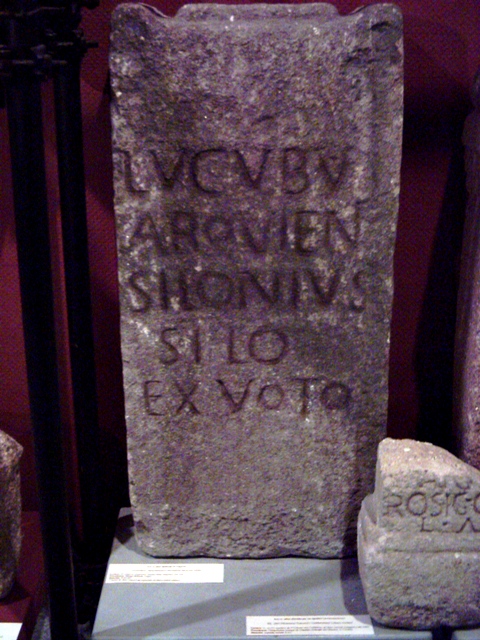
Some scholars think the origin of the diminutive Irish leprechaun was an offshoot of the bigger-than-life Celtic god of all crafts, the Irish Lugh Lámhfhada (Lew of the long arm), or his cognates, Welsh Ludd, or Lleu Llaw Gyffes, (Lew of the Skillful Hand), and the Gaulish triune god, Lugus. (The Romans equated Lugos/Lugus with Mercury).
Votive inscription to Lugus. Lugo,Galicia.
The great god Lugh (whose –Proto-Celtic moniker,*Lug-" is embedded in dozens of European cities—from London, to Leiden, to Laon), was erroneously referred to as the shining one, or a sun god before the advancement of Proto Indo-European linguistics proved it to be a false cognate.


Though Lugh was the maker of shoes, and master of all crafts, his name is not related to the Proto Indo-European leuk, and the later Latinate cognate, luz, or light—besides there already is a minor Gaulish Celtic lightning god Leucetios‚ whose name does stem from leuk. And we don't want to invoke lightning and rain. 


You're probably wondering why I've gone off the deep end writing about leprechauns during high summer. Other than it's nearly half way to St. Patrick's Day, I was responding to a Facebook post by Celtic Mythology, August, Lúghnasadh, is Lugh's month. The harvest month approacheth. Besides, our summer months, dubbed Junuary and now, apparently, Julyuary, have been socked in with thick fog and drizzle. What sun?
In Irish mythology, the Lughnasadh festival is said to have been begun by the god Lugh (modern spelling: Lú) as a funeral feast and sporting competition in commemoration of his foster-mother, Tailtiu, who died of exhaustion after clearing the plains of Ireland for agriculture. —Wiki
Lughnasadh, the night of the wicker man,
the burning man set aflame
Full moon marks the first harvest
The plain ripens, bellydeep in bright grain.

Some scholars think that the leprechaun is not a vestige of the pre-Christian Celtic pantheon at all.

Others say he was an invention of the Irish Tourist Board. I think he was a hangover invention of the Saint Patrick's Day Parade.

Clearly when Lugh got snared in the web of medieval hagiography in Christian Ireland, he got the roughshod Cinderella treatment and was subsequently shrunk like a wool sock in the hot water laundry cycle.

The leprechaun is supposed to be a singular entity (no plural hoardes or tribelets—that too seems to be a Disney-meets-Bord Failte Eireann shenanighan—courtesy of Darby O'Gill and the Little People).

According to the Facebook site, Celtic Mythology, “The Lore of Ireland: An Encyclopedia of Myth legend and Romance”, renowned folklore collector and native Gaelic speaker and poet, the late professor, Dathi Ó hÓgáin, stated that "the designation luchorpán was only invented in Ireland when the lore of dwarf communities was adopted from abroad by Irish writers and that the solitary leprechaun of folklore is a post-medieval development from the literature." (Collins Press, Cork, 2006; pp. 308-9).

University College Dublin Professor Dathi Ó hÓgáin's post-medieval claim is interesting in that luchorpán is clearly not a native Goidelic Irish word. Not with that "p" in it. There is no "p" in Goidelic. The Irish were positively allergic to plosives. This is how you can spot loan words in Irish, like páiste (from the word, page, or child, not the cymbals!) Or Welsh—map; Irish cognate—mac (son).

But I don't think it's quite that simple, as the term is indeed used in Old Irish texts.

A quick internet search reveals that the earliest version of "luchorpán" (a water sprite) was used in the 8th century in "Echtra Fergusa maic Léti". But it's a far stretch of the imagination—let alone, linguistics, as luchorpán mixes Church Latin with Irish—to be a native irish word.The Old Irish, lúchorpán is a hybrid word— lú means “small” and corp means “body.”

But Lú, or Lugh, also means the really BIG baddass god dude. What's a neopagan to do to keep the Cailleachan ("Storm Hags") at bay? The leprechaun's abode seems to be a curious conspiracy of sunlight and rain.

Of course, the watery luchorpán might have been a different entity altogether that was later conflated with Lugh and the leprechaun. Still, there's that pesky "p" to contend with.... And we know that those sooty godlets, the leprechauns, who live in caves, or wood huts deep in the woods, are not particularly fond of water, other than their Swiss bank vaults at the ends of rainbows.


The page from the Free Dictionary has some interesting information that seems plausible.

Leprechaun  n. One of a race of elves in Irish folklore who can reveal hidden treasure to those who catch them.

[Irish Gaelic luprachán, alteration of Middle Irish luchrupán, from Old Irish luchorpán : luchorp (lú-, small; see legwh-in Indo-European roots + corp, body from Latin corpus; seekwrep- in Indo-European roots) + -án, diminutive suff.]
lepre·chaunish adj.

Word History: Nothing seems more Irish than the leprechaun; yet hiding within the word leprechaun is a word from another language entirely. If we look back beyond Modern Irish Gaelic luprachán and Middle Irish luchrupán to Old Irish luchorpán, we can see the connection. Luchorpán is a compound of Old Irish lú, meaning "small," and the Old Irish word corp, "body." Corp is borrowed from Latin corpus (which we know from habeas corpus). Here is a piece of evidence attesting to the deep influence of Church Latin on the Irish language. Although the word is old in Irish it is fairly new in English, being first recorded in 1604.

The American Heritage® Dictionary of the English Language, Fourth Edition copyright ©2000 by Houghton Mifflin Company. Updated in 2009. Published by Houghton Mifflin Company. All rights reserved.

and

leprechaun [ˈlɛprəˌkɔːn]

n (Myth & Legend / European Myth & Legend) (in Irish folklore) a mischievous elf, often believed to have a treasure hoard

[from Irish Gaelic leipreachān, from Middle Irish lūchorpān, fromlū small + corp body, from Latin corpus body]

Collins English Dictionary – Complete and Unabridged © HarperCollins Publishers 1991, 1994, 1998, 2000, 2003


See also: How Lleu Llaw Gyffes Got his Name

Another Lugh link from Celtic Mythology with some interesting Indo-European connections.

Sunday, July 22, 2012

HEDGEHOG: NOTES ON DEATH

HEDGEHOG: NOTES ON DEATH

In the Ukraine, old people set out
saucers of milk for the hedegehogs
who repay them by eating garden bugs.
They say they do it because 
the hedgehogs bring them good luck.

In Great Britain and the Isle of Man
hedgehogs have achieved royal status.
There are hedgehog road crossings 
and tiny hedgehog hospitals 
for wounded Tiddilywinkles. 

When she was a child in Ireland, 
my grandmother loved to play with them.
She dragged them like puppies
around the farm of Coomb an Or.

When my grandmother lay close to dying, 
she complained of hedgehogs
loose in the living room—again.
With that, I wondered if dying 
was a bit like child's play.

7/22/12

Saturday, July 21, 2012

Alexander Cockburn, Dead and Alive


When I worked for the West Sonoma County Paper (aka The Paper, The Independent, then The North Bay Bohemian) we knew Alex Cockburn because he wrote for a sister newspaper, The Anderson Valley Advertiser, and he'd often send us missives (and books) that kept us up late at night changing our headlines on more than one occasion.

Cockburn wrote for both radical and conservative newspapers and magazines—from the Wall Street Journal to The Village Voice. He penned a controversial column for The Nation, called "Beat the Devil." And so he did. With a stick. Nothing was sacrosanct. His newsletter, CounterPunch sucker-punched greasy politicians right and left. Alex was a bit of a Schrödinger's cat, he could argue both sides of the quantum superposition paradox and come out smiling. 

I first met Alex when the Russians began coming to the North Bay—we had a grand Irish confab in the middle of all that splendid Soviet defection at a Booneville winery. I was covering Soviet artists for The Paper. Did I have the presence of mind to photograph Alex? Not sure. I think not. And now he's gone. There's a hole in the universe where he used to be. I don't have the heart to write an obituary. So this will have to do. Goodbye old man. Like Lenin said, "Be as radical as reality."  I know you will take those pearly gates by storm.

July 21, 2012 
added and expanded 7/24/16

first draft
When I worked for the Western Sonoma County Paper (aka Independent/NB Bohemian) we knew Alex because he wrote for a sister newspaper, Anderson Valley Advertiser, and he'd often send us missives (and books) that kept us up late at night–changing our headlines on more than one occasion. I met him when the Russians began coming to North Bay—did I have the presence of mind to photograph him? Not sure.

Wednesday, July 18, 2012

OLD MAGYAR WOMAN

"A madjar nyelv már vesz el. Mi örögek vadjunk még, beszélünk madjarul, de az éfijúság, ezek a tinerek, ezek nem. A zién lejányom még beszél, de ja ziszkólába sak oláhul tanult, nem madjarul. De tud madjarul jól. Az onkáim isz tudnak madjarul, de nem ura fórdjiccák vissza."       —Fotó: Ádám Gyula


—from a photo by Gyula Ádám

Csángó Magyar woman sits
in a windowed alcove stained
the color of a forgotten summer sky.
Her mind is lost in the crenulated folds
of memory and the wars, and those who left,
but her hands still know the path
to the freshly baked cornbread
moist and warm from the kemence.
Crumbs cling to the lip of the knife like a lover.
The cat speaks and weaves an intricate knot
between the staves of a 3-legged stool
that was once a wagon wheel
straddling the ruts on a dirt road,
now planted in the barren clay floor,
as the photographer records
the death rattle of an old way of life
threatened by time and culture.
She is dressed in maroon and black.
At her age, mourning is a permanent state of being.
She wears new running shoes,
the only concession to this age.
But even Nikes will not carry her to victory.
Her sad eyes that witnessed the atrocities
of war and the devastation of her culture,
can no longer see the lacy intricacies of light
and shadow playing on the oblique walls,
billowing like stormclouds on the horizon.
The limed stucco ceiling, stained
a robin's-egg-blue to ward off the evil eye,
sloughed off in the shape of a sacred heart
to reveal the the ribs of old wood and reed.
Clouded eyes that witnessed myriad winters,
are the secret color of bauchy ice.
She can no longer see the small stitches
her skilled fingers once embroidered
on the fine tapestries covering the wall,
enscribed in a fractal language of flower & field.
The meaning of the ancient patterns—
a mother tongue translated in gutteral runes
drawn in crimson and woad, a dying language
forgotten by the modern world,
only whispered in the funereal corners
of the past.

7/18/12

Sunday, July 8, 2012

Mad, Mad World

A frail wisp of a little old lady, dressed in flowing vague floral patterns of beige and white, wearing a lacy wide-brimmed hat, toddled up to the cheese booth where I was serving samples.

She looked vaguely familiar, and her eyes reminded me of an older version of my mom—if my mom was still alive. She was my mother's age. I searched her face for some clue. At first I thought she was a cancer survivor, because of her sunken eyes but she still had her hair, and she looked sane enough.

I puzzled over her face. I tend to remember the faces of people I photographed, sometimes decades later. But I couldn't quite place her.

But she wanted me to take her trash after I'd offered her a sample and I refused, not wanting to cross-contaminate the food... I was taken aback that that she had even handed me her trash with such an imperious gesture. An awkward moment ensued as I withdrew my hand  and pointed to the trash can. Inexplicably I was thinking of musicals—the scene between the Jets and the Sharks. Snap! Dancing in the aisles.

The little old lady, also taken aback, said she liked the cheese, and wanted two pieces. She said that she was having some people over tonight.  Did I have a larger piece? Thankful for the distraction, I gathered my wits as I rummaged in the box behind the counter for a large chunk, and offered it to her.

Meanwhile, another woman came up and was thanking her for something, I didn't know what, so I asked what that was about? She said: I really like her work. What work? Her movies. Movies? Don't you know who that is? That's Rita Moreno! She lives in the Oakland Hills. 

Oh. I was gobsmacked. No. I guess I didn't know that.

But indeed I was thinking of my mother's halcyon stage days when I thought the old woman reminded me of my mom.

I remember watching my mom at the Sausalito Gate Playhouse, performing Of Thee I Sing, and Pipedream. At Music Circus costuming Guys and Dolls. I remember searching for my mom in the big crowd scene in It's a Mad, Mad, Mad World. But I never found her. No matter how hard I tried. By that time she was already well on her way to the world of madness.

When I got my break, I went looking for Ms. Moreno in the store aisles. I wanted to apologize—well not so much to apologize so much as to smooth some feathers and to close the loop.

I wanted also to tell Rita that I knew of her world, and that my mother's escape came too late. But Rita was already gone. Deep into the Oakland Hills. An escaped West Side Story.

Snap!

ENVOI
Dec 3: I was chit-chatting tonight with Rita Moreno as I was putting away my cheese booth. We nibbled on dill havarti with salmon. I gave her suggestions for appetizers, etc., for a party.

I've become the Go To girl for spontaneous recipes and menus. This time she didn't try to hand me her trash. She must've remembered how I got cranky last summer.

Anyway, she does have the most marvellous eyes. So frail, yet so alive. Most people I work with don't even know who she is. Sad, Really.

At least they've heard of West Side Story.


Dec. 23 Wished Rita a Merry Christmas—we chatted in Spanglish. Sweet.

Dec. 30 Rita came right up to me to say hello. I met her friend
—we slid through several languages as he doesn't speak English. Fun. I told Rita about learning Russian while traveling there as an artist and poet. She looks so much better—I think she was sick.  She said she was feeling much better. Anyway, it's fun conversing with her. I think she enjoys the one-on-one, with no mention of her stardom.

Jan. 21 Rita came over to say hello—she's looking positively marvelous. I told her so.

I asked her if she would be restaging her one-woman show. All my friends are still talking about it and I never never got a chance to see it. She said, "I don't know, it depends upon how I feel."

She said that she's recovering from double hip surgery and it's been a long haul. She said, "I'll be sure to let you know if I do decide to stage it again." Looking forward to it.

A newer blog entry on Rita, Maybe Even Dance Again.               


Saturday, June 30, 2012

Some backgdound on Danny Boy


The one Irish ballad our family traditionally sings at every wedding, wake and funeral, is Danny BoyThe song is guaranteed to pull on the heartstrings and choke us up if the whiskey doesn't work. 

Last time we dusted off Danny Boy and all sang it as a family was at my aunt Canice's wake, at the Druid's Hall in Nicasio. We gave her a real send-off with a piper, an impromptu ceili band with Father Sullivan, the parish priest on the penny whistle, Cormac Gannon on the uillean pipes, and bodhran, and mine own laddie, Neil O'Neill on the guitar—it was a fine June wake. 

But is the song itself authentically Irish? Or merely American stage Irish—like the nostalgic wave that produced When Irish Eyes are Smiling, composed by Ernest Ball, a popular American song composer (with Chauncey Olcott), for a romanticised musical tribute about Ernie Ball's vaudeville life in The Isle O' Dreams, in 1912, and made into a film in 1944; or How are Things in Glocomora (a fictitious village) from the 1947 Broadway musical, Finnian's Rainbow?


With tongue in cheek I offer you that Irish schmaltzer, Daniel O'Donnell:

When Irish Eyes are Smiling

Danny Boy

So, Ian Paisley, the Pope and Daniel O’Donnell are shipwrecked on a desert island with a single palm tree in the middle. Paisley looks up to the sky and shakes his fist in anger, "Lord, why have you forsaken me? You have abandoned me to be tormented for the rest of my days, what have I done to deserve this?" Meanwhile, Daniel and the Pope just sit chatting under the tree. Paisley paces round and round, occasionally stopping to shake his fist at the sky  and stubs his toe on something buried in the sand: a Colt 45 with two bullets. He picks up the gun, puts in the bullets and looks up again at the sky, "Oh my dear Lord, you have not forsaken me. How could I have ever doubted you?" He walks up to the palm tree, points the gun and shoots Daniel O’Donnell—twice.
The American connection: It turns out, that the melody used in Danny Boy is indeed from an old Irish air that was supposedly "lost," and then "rediscovered" by London barrister and lyricist Frederic Weatherly's sister-in-law (apparently he had several) in the goldmines of Colorado (what was she doing in the mines, one could ask?). 

Why did Londonderry Air (AKA "Air from County Derry" or "Derry Air" depending on the origin of your Irish roots), have to travel from Northern Ireland to the Wild and Wooly West of the New World, circulate through the goldmining camps of the 1840s and boomerang back again to the streets of London, England, in order to be united with new English words written by a London barrister and lyricist in 1910, is a bit of a mystery. Circuitous, even. 

That berobed, bewigged and bewitched barrister, Frederic Weatherly who dabbled in song on the side, borrowed the unnamed ancient Irish tune, updated with his new song lyrics to chanteuse Elsie Griffin, circa 1913, who made it one of the most popular songs in the new century. (The first record was pressed in 1915). So we tend to think of him as the author and composer of Danny Boy. But he didn't compose the melody of the song, just the lyrics. 

The story goes that the original air was collected by Miss Jane Ross (1811-1879), from a blind fiddler, Jimmy McCurry, on market day in Limavady, Northern Ireland in 1851. 

One day Jane Ross heard Jimmy playing a beautiful melody outside the Burns & Laird Shipping Office, which she had never heard before. She came over to Jimmy and asked him to play the tune over and over again until she had taken down every note. Jane thanked him and gave him a coin for his moving rendition of the tune. When she departed Jimmy rubbed it against his lips, as was his method of determining the denomination of coins, and discovered it was a florin instead of the customary penny. He set off in pursuit of Jane and when he caught up with her he told her that she had made a mistake. Jane refused to take it back and asked him to keep it as a token of her appreciation of his music. —Ulster Ancestry
She recorded the notes and sent it to musicologist and antiquarian, George Petrie, who publisied it in 1855, in the The Ancient Music of Ireland, an imprint of the Society for the Preservation and Publication of the Melodies of Ireland.
World-famous song Danny Boy is taken from a melody composed by O’Cahan bard Rory Dall O’Cahan. The original version concerns the passing of the Chief Cooey-na-Gall whose death brought an end to a long line of O’Cahan chiefs in Northern Ireland. —Wiki
Dall means blind in Irish (and Gall means foreigner). We've not one, but two blind musicians shoehorned  in on the tale: the composer, a harper, from the Middle Ages, and an itinerant street musician, Jimmy McCurry, a fiddler from the Edwardian era.
For the following beautiful air I have to express my very grateful acknowledgement to Miss J Ross of Newtown Limavady in the County of Londonderry - a lady who has made a large collection of the popular unpublished melodies of that county, which she has very kindly placed at my disposal, and which has added very considerably to the stock of tunes which I had previously acquired from that still very Irish county. I say still very Irish; for though it has been planted for more than two centuries by English and Scottish settlers, the old Irish race still forms the great majority of its peasant inhabitants; and there are few, if any, counties in which, with less foreign admixture, the ancient melodies of the country have been so extensively preserved. The name of the tune unfortunately was not ascertained by Miss Ross, who sent it to me with the simple remark that it was "very old", in the correctness of which statement I have no hesitation in expressing my perfect concurrence. —Ulster Ancestry

One hundred years ago, Freddy Wetherby first sang Danny Boy on the radio (it wasn't successful), and published a version in 1913.


In the 1890s, Irish scholar, Osborn Ó hAimheirgin, who taught at Trinity College, wrote lyrics to the tune.

      Maidin i mBéarra

      Is é mo chaoi gan mise maidin aerach,
      Amuigh i mBéarra i m' sheasamh ar an dtrá,
      Is guth na n-éan 'o m' tharraing thar na sléibhte cois na farraige,
      Go Céim an Aitinn mar a mbíonn mo ghrá.
      Is obann aoibhinn aiteasach do léimfinn,
      Do rífinn saor ó ana-bhroid an tláis,
      Do thabharfainn droim le scamallaibh an tsaoil seo,
      Dá bhfaighinn mo léirdhóthain d'amharc ar mo chaoimhshearc bán.

      Is é mo dhíth bheith ceangailte go faonlag,
      Is neart mo chléibh dá thachtadh anseo sa tsráid,
      An fhad tá réim na habhann agus gaoth glan na farraige
      Ag glaoch is ar gairm ar an gcroí seo i m' lár.
      Is milis briomhar leathanbhog an t-aer ann,
      Is gile ón ngréin go fairsing ar an mbán,
      Is ochón, a ríbhean bhanúil na gcraobhfholt,
      Gan sinne araon i measc an aitinn mar do bhímis tráth!

      Source: Abair Amhrán, Comhaltas Uladh, Béil Feirste, 1969 —The Danny Boy Trivia Collection


For further reading:

The Danny Boy Trivia Collection—a lot of it's spurious information (it is a collection), but well worth a look. See Fred Weatherley's own description of how he came to write Danny Boy. Though it's possible that Weatherly wrote at least 3000 songs in his lifetime (that's the equivalent of a song a week), one suspects that not all the tunes were his original melodies or compositions. Or maybe the litigation business was slow.)

mudcat.org: Lyr Req: Danny Boy in Gaelic


Danny Boy?


The words to O'Cathain Lament may be as follows: Unfortunately no clear evidence supports this.

A chief far famed for liberal affluence,
For wise discretion and conducting sense,
Whom sages honour and learned commend,
The minstrels' patron, and the clergy's friend.

In his sad bower and damsel bands are pale,
And weep their chieftain and unwearied wail,
With lamentation oft renewed they mourn,
And know no joy, but hope for his return.

When Croghan's fate in battles fearful scale,
Hung trembling yet and their fair dames looked pale,
His arm rolled back the battle from afar,
Chief of valiant - Ulster's leading star.

With jewelled wealth and gay magnificence,
Whose bounteous tables heaped with princely hand,
Diffused a grateful odour o'er the land,
There met the brave, there came the poorest distrest,
And there the minstrel was an honoured guest.
O'Kane the brave, the generous to dispose,
Wealth to his friends - destruction to his foes,
Sword, fire and plunder followed where he trod,
And peace and mercy vanished at his nod.

The present day Lyrics to Danny Boy were written by an English lawyer, Frederic Edward Weatherly, in 1910. His version was unsuccessful, until his sister-in-law (in the United States), sent him the melody to the Air from County LondonDerry. The melody matched nicely with his words and became an instant success, especially in the United States. —
Brian O'Cathain


 This blogpost was hoodwinked and expanded from a longer blog I wrote called Old Tunes, New Licks.
From time to time I try to clean up the formatting on these old posts, no dice.

Monday, June 25, 2012

RIP Lonesome George


I met poor old Lonesome George, the Galapagos tortoise, in the late 1980s. He was nearly the size of a VW Bug frame and he hissed like a hydraulic car lift if you got into his personal space.


KQED Science June 24, 2012 RIP Lonesome George.
"The giant tortoise Lonesome George, whose failed efforts to produce offspring made him a symbol of disappearing species, was found dead on Sunday, officials at the Galapagos National Park announced.Lonesome George was believed to be the last living member of the Pinta island subspecies and had become an ambassador of sorts for the islands off Ecuador's coast whose unique flora and fauna helped inspire Charles Darwin's ideas on evolution."
Lonesome George, the last of his species, only lived to be 100—not very old in tortoise years. He hissed like hydraulic brakes on a semi truck. He had a tortoise-sized rock in his enclosure, and would eagerly mount it from time to time, then he'd get a despondent look in his rheumy eye, and forlornly slide off. Couldn't even get his rocks off. It was tough love being the last of his species.

Marsha Calhoun said: I met him three years ago - they still had hopes that he and his girlfriend might succeed (it took him 14 years to decide to approach her). But I don't think the species is extinct - just his island branch. The Galapagans are doing a lot to keep the species itself alive - they are impressive creatures (the tortoises, that is).

Maureen Hurley Alas, with the passing of Lonesome George, it marks the extinction of a species, not merely an island branch sub-species; he was a separate Pinta Island species—they're genetically different.
However, one formerly extinct species, Chelonoidis elephantopus, from Floreana Island was found—sailors had abandoned them on Isabela Island in the 1800s. "Darwin discovered that the islands... were home to their own, distinct, tortoise species. Each differed slightly from those on nearby islands... DNA research finds at least 84 animals who were the direct offspring of a different species from Floreana Island long believed gone Giant Galapagos tortoise species may not be extinct —USA Today

Thursday, June 21, 2012

Re-vision

I began blogging in August of 2008, laid up with a bum knee. At first I posted a lot of old writing, tinkering with it in the new medium to make it shiny.

Then I began to write actual blogs. I'm fast approaching my 500th blog mark, with 41.5 k readers following my work (since Blogger began to keep track in July 2009). That's not exactly a Huff Post following but it's way more readers than I'd ever have in the traditional poetry books and journals I've previously been published in.

This is technically blog number 499 but then I tend to cram more than one blog in per blogspot. For example, I published several day's (7) worth of poems under one February heading for Poetry Inside Out as I wanted to keep them all together. And I have several unpublished blogs that I've yet to release into the wild.

My morning routine: scan Facebook posts, click on interesting articles (Medievalist is a fave), saving them to read later. Then I scan Twitter for interesting science & tech links, until I have a backlog of reading material saved up. I read them in a haphazard fashion, which usually leads to looking up some term or other, which leads to a trip down Wiki Lane, or a dictionary cruise and POOF! there goes the morning. But oh, the things I learn. 


And sometimes, as I comment on links, I'm lucky enough to glean enough fodder for a blogger or two. If I'm lucky. Otherwise, I try and revise my old blogs to keep my writing genes kicking in the deep end of the pool.

I have an odd revising methodology: I use Blogger Stats dashboard to see who's randomly reading what particular piece, and I use that trending list as a guideline (like an everyman's blogging teleprompter) to expand and revise old pieces. Mostly, I begin by fixing old typos and then go from there, if the piece juices me.

I wonder what the readers might think—or if they even notice, a piece they were reading suddenly expanded with hyperlinks and photos? Sometimes I imagine that the reader is madly searching for the original link, as if it magically disappeared. Poof! Link gone.

I won't mentioned that the danger is, that when you begin to tinker with old posts, formatting goes to hell in a hot-lead lined handbasket, and entire blogs can disappear between the space of clicking on the Publish button and View page buttons.

Forget Blogger's reassurances that the piece is constantly being "autosaved" like some oldtime revival camp religion prayer circle. NOT!

I've had entire pieces disappear because I wanted to get them letter-perfect before I posted. That's when Blogger crashes—right as I'm pushing the Publish button. And all that makes it to the other side of the HTML page is the title and a row of social networking icons. ARGH! Some unholy blue-ribboned cursing, er, praying, ensues.

Yes, it happened again today. POOF! God's wounds. Or in modern parlance, zounds! The entire piece disappeared. Just like that without a howdido or an excuse me, ma'am. This peculiar form of crashing seems to happen when I write of the dead—as if they're interacting in cyberspace.

It's as if the dead were snagging the words from me before they magically reappear on the page you're reading now. Luckily I figured out how to back-navigate with the browser, and I usually can salvage the text, sans, last revisions and edits.

If that doesn't work then I Google the blog, and click on "cached" link. That works. Usually. Today I was lucky. The expanded blog was still in the browser buffer. But it had me shitting lead bullets.

Blogger Stats also gives me a body count by country as well as by search engines. Fascinating, really. Sometimes, I'll enter a search phrase, that someone used to find one of my pieces, and that link will take me to another and so on.

The links take me where they will. Sort of like getting lost in the OEDictionary and coming up for breath two hours, or two days later.

Sometimes they even point to another blogger using my material, sans permission. Like with my Jim Dodge interview. It irks me if they don't offer a backlink, but it's part of the danger of publishing one the internet.

Today's mad goosechase (has anyone ever really thought about what a mad goosechase might actually entail?) was a rather droll scanned article I posted about an art show I'm in every year, "Art from the Heart"... who on earth was reading that piece, why, and what search word led them to it?

Well, one thing led to another—and after some sleuthing, I found out that the search word was "Marty Stoelzel." Clearly, the "50 red head women fucking" search words didn't seem to be the right link. (I get a lot of "redhead" search words because of a blog I wrote on redhead myths that has scored 9,000 hits. Now watch, with Brave! opening tomorrow, the redhead stereotypes will kick into overdrive. My redhead piece will go through the roof.)

Marty was Chester Arnold's and my old painting teacher from College of Marin. I also found out that Marty died about 15 years ago. Too young! Probably had a heart attack—he was pretty intense.

OK, so it's old news but it was fresh news to me this morning—so naturally the process of revising the notes following my formerly dry press release took on a whole new level of meaning—sort of like stacking Chinese boxes inside one another—or Russian dolls—to find some semblance of order.

Sadly, I found almost no information on Marty, other than a photo—or examples of his surrealist paintings. Who remembers Marty? He had such a great heart. Ah, so today was about paying homage to our teachers, our ancestors. I never did get around to writing about Marty—too busy fighting technology. Maybe next time.