Sunday, November 29, 2009
DIAMONDHEAD
Diamondhead, sharp as a knife
against an impossible cerulean sky
nearly took my breath away
with a wild beauty I thought
I had long since forgotten.
For a moment, I even forgave Waikiki
for being what it is....
11/29/2009
added/slightly rev 11/17


Monday, November 23, 2009
Irish Salmon
 Wild hen turkey in downtown San Rafael police station parking lot. That's me and my blue shadow. "Isn't she lovely..." keeps trotting through my mind. And boy, can a turkey ever trot—they're world class sprinters along with emus and ostriches! I once clocked a turkey doing 30 MPH down MacArthur Blvd. in Oakland one foggy morning—I thought I was hallucinating, or my gallon of morning tea hadn't yet kicked in. Turkeys have made such a successful comeback, they've moved right into the suburbs along with the SUVs. I've seen toms take on red cars, chest-beating their own reflections on shiny car doors. Click on the turkey and click again on the second window to see her up close and personal. She really is lovely. She was a little nervous because I was following her and she crooned at me like a broody hen. I crooned right back. We crooned together. Small feminine moans of anxiety, reassurance and contentment.
Tomorrow's my birthday (Nov. 24) and I always get stood up by the damned turkey and everybody always forgets it's my birthday ...
Invariably, towards the end of Thanksgiving dinner, someone will suddenly remember and say—Hey, isn't it your birthday? and that's the end of it. No fuss, no muss, no cake—no prezzies either. Wow, what a long and winding anti-climax it's been.
To wit, I've adopted Thanksgiving dinner as my own personal feast. To mess with it, and go rogue with duck, goose, swan or ham instead of the Big Bird is not my idea of a good time.
And I won't even mention when folks go all crazy and adulterate the traditional Thanksgiving trimmings: instead of leaving well enough alone, and letting the integrity of the food offer its bounty to the palate, they fru-fru plain old cranberry sauce, and sweet potatoes.
This menu meddling disrupts my already fragile psyche. I don't want raw grated cranberries with orange rind, I don't want orange juice or HORRORS! marshmallows on my sweet potatoes. OK, so I don't mind garlic in the mashers. That's a good foodie addition. But make sure there's plenty of pan dripping gravy.
On Turkey Day (or any day), I really don't care about the current American food fad: the fear of fat fetish.
Minute traces of fat don't make you fat, calories do—and your body really doesn't care where the calories come from. Despite the dietistas' magic potions and formulae, as a nation, we grow fatter, we grow fatter. Couch potatoes aside, carbs is carbs is calories. Besides, Thanksgiving Dinner clocks in at 5-6000 calories, and that's before your just desserts. Did you know that we have two stomachs on Thanksgiving? One for dinner, and another special one for dessert.
And on Thanksgiving, the only thing worse than adulterated stuffing with mountain oysters and cornbread, is no stuffing at all. I want real chestnuts in my stuffing, and I want a slab of my grandmother's three-tiered jello salad, like a wiggly UFO draped in the colors of an Irish flag: layers of lime & grapefruit, cream cheese studded with walnuts, and mandarin orange.
See, I want to stop time itself. I want to wear pitted olives on all ten fingers, wave my digits like a crazy olive-headed mob at a puppet show, and run wild with my cousins up the hill. I want to wait in anticipation for the turkey to come out of the oven—always later than expected, but the anticipation. Oh, the anticipation builds. For I drool, I drool.
I want my favorite cousin Ricky—who died too young—by my side. I had to give Ricky my new birthday-cum Christmas bike because he contracted polio—I was at cross purposes with myself because I loved him more than anything in the world. (Not that I had a choice.) But I was six, and newly in love for the first time with the shiny new red bicycle—replete with training wheels and multi-colored tassels on the sparkle handlebars. I no sooner saw, then it was gone.
I grabbed the handlebars lovingly and went, vroom-vroom, as they carted it off into the trunk of a waiting car. Somehow, I feel a vague having involuntarily given him that bicycle. Like I led him down the road to perdition. He was killed riding his Harley down 4th Street in Santa Rosa. A stuck throttle.
I want to go for a long birthday ride on my fast horse with my best friend Stephanie who also shared a Thanksgiving birthday. We were twinned a year and a day apart in age—Stephanie, me and my 2nd cousin Eddie—like in the fairly tales. They were my bookends, one on either side of me like pieces of bread on Leftover Turkey Friday and I was the filling. But, alas, that's all in the distant past. The cancer ate Stephanie's bones. My cousin has long since slipped down the slender neck of a bottle.
Birthdays serve to chronicle the inevitable march of time with the finality of a coffin nail—whether or not they're celebrated. Fear of death follows me even in my sleep. I never did learn to properly ride a bike. Maybe in heaven—or more like Purgatory. I had an interesting life. No goodie two-shoes for me!
See, with the profound disappointment of yet another missed birthday, I need all that feel-good tryptophan I can get buried in that turkey meat. No other meat has it. Nothing else will do. Tryptophan, tryptophan, we all scream for tryptophan. I will rage, rage against the dying of the light. Bring on the turkey. Bring it on, Jeeves. Turkey, Zoloft is thy middle name. Let the sun shine.
Unless, of course, salmon is introduced in sunset hues. Then I'm at cross purposes with myself and tradition. How does one properly choose between a healthy dose of tryptophan, vs. wisdom and knowledge? Not that salmon is being offered this Thanksgiving, mind you. But duck is, well, sacrilege...
My workaround is to go to three separate Thanksgivings and make up for the tryptophan shortfall. Talk about eat and run. My tryptophanic greed is like the primal urge of randy ducks who will attempt to nail just about anything their shape and size, including footballs. It's a Must Have Thing. Score a touchdown!
On my personal score card of 1 to 10, most carnal flesh rates in at around 3 or 4 (well, chateaubriand scores a 5—but, seriously, when do I ever see chateaubriand? Last time I had chateaubriand was in 1976 and I won't even mention sex) whilst the sunrisen flesh of fresh salmon rates 10+ on the scale! Go figure. I must've been born under the archaic Sign of the Salmon—fish of wisdom (vs tranquilizing turkey—BTW, a New World food!)
In Irish mythology, the Salmon was the first creature, the oldest being in the world, and he was the fish of wisdom—as he ate the hazelnuts of knowledge that fell into his vernal pool. Each red spot on his side represents a plucked hazelnut. The more flecks, the more profound his knowledge.
Note the Irish distinction between wisdom (críonnacht) & knowledge (fios). You have to gather discrete bits of knowledge to gain the kingdom, but you are either born with or without innate wisdom. And knowledge is next to useless without wisdom to frame it.
Don't know what that says about my passion for the fish. Eating wisdom? And you know what happens when I eat hazelnuts (anaphylaxis)! Death of knowledge? Oh, where is thy sting-aling? Breathe.
But look at what my great friend and artist in residence co-worker, Alex sent me from Da Bronx Farm! Now that's a great gift of art(ifice). I wonder if he added a little Wild Turkey to it as well? I envision it as a heavy, deep chocolate gateau (none of that cakemix fluff) with a chocolate truffle filling and a chocolate ganache icing. Guitard will do in a pinch. No Nutella filling, no hazelnuts, please!

© 2009 Alex Schapiro comix. Hire this guy to teach art, he's brilliant.
Sunday, November 15, 2009
Long lost relations
I am so excited that a long lost relation, a distant cousin (3rd, once removed—I think—my great-grand uncle’s ggg-granddaughter) Jennifer Harwell, from the Home Ranch Nevada Walshes found me on the internet because of a blog I wrote about my grannie. That's the second group of long lost Nevada Walsh kin that found me via my blog. Regrouping the scattered family. It just gets better. Now I'm in contact with another branch of cousins from Paddy’s brother, David Walsh who was killed in a mining accident—Karen Kelly Boyce—she knew the name of Paddy’s mysterious 3rd brother—it was William Walsh. That jives with my memory—my grannie was always telling me stories of the elder William, and those long lost relations at the knee but I never had context by which to hang them.
Tuesday, November 10, 2009
Wrong passport at the US-Mexicali border

I am cranky and cold back home in Alta California after a tedious 13-hour drive north (and I very nearly wasn’t able to cross the border to get back into the United States because I grabbed an expired passport. A part of me was hoping I’d be turned away at the US-Mexicali border because I just want to return to Baja pronto! Was it appropriate to see the huge Mexicali iron fence on the anniversary of the fall of the Berlin Wall, or what? Maybe someday we can tear this wall down too.
Surprisingly, the border patrol accepted my expired passport that I had written void across the front pages with a big sharpie marker. He explained to me that even a voided passport was valid, because there was no way I could get it unless I was a US citizen. The last time I was in Mexico was with John Oliver Simon in 1987. A lot has changed. San Felipe is unrecognizable. My aunt owned a barren lot there for decades. She won it in a card or bingo game. Wish we had it now.
Paul Hardstone‘s wife owned a place in a fancy development in San Felipe, that she needed to check up on, so it was a mad weekend dash all the way from Oakland. We were there for the jumbo prawn festival. Everywhere people were selling barbecued prawns the size of sausages, and I couldn’t even eat one of them because I had developed an allergy to shellfish.
Saturday, November 7, 2009
EL MAR
EL MAR
El mar, el mar y el mar— de Baja—
un ojo azul es el celo
y el otro es todo el mar.
Ése es muy tranquilo aqui,
las palmas tienen muchos secretos.
El mar, el mar y el mar— de Baja—
un ojo azul es el celo
y el otro es todo el mar.
Ése es muy tranquilo aqui,
las palmas tienen muchos secretos.
Thursday, November 5, 2009
Mary, Queen of Scots
(NOTE BENE: This is in continuation of my response rant to Sharon Doubiago's conflated claim that Mary, Queen of Scots was a Norman. I rambled on, and off task, but some of the facts I uncovered in my meanderings were interesting.
I gave this piece a separate blog status as Mary, Queen of Scots was born half a millennium after the Battle of Hastings. So it was a little hard to justify explaining the information as to who the Normans were and the parentage of Mary, Queen of Scots all in the same breath! As for Mary Queen of Scots—of both Scottish and French extraction, she isn't Norman. After writing of the Norman Conquests, I pretty much lost my train of thought so this diatribe becomes more of a chronicle of her life, painting a picture.
Now that it is an orphaned piece of writing, I will probably need to go back and make it into a stand-alone blog... But for now, here it is in all its glowing newborn wartiness.
God knows what possesses me to take on these historical rampages. Ultimately, to learn something new. The origin of the word, "apologia" is to argue a point. So this, then, is my apology. Mea culpea. I was looking at Mary through different eyes.)
Elizabeth's first cousin, Mary, Queen of Scots (1542-1587) was plagued with extraordinary bad luck and poor choice of love interests for which she paid dearly. Her father, James V was the son of King James IV of Scotland (House of Stewart) and princess Margaret Tudor of England.
(BTW, Margaret was a Norman Plantagenet, and James IV was half Scottish and half Danish.) But all the mostly Celtic Jamess (there was the Maid of Norway too) were born at Sterling castle, Scotland. So what makes a nationality? Birthright or bloodline—two different concepts—too often in conflict. Mary's mother Mary of Guise was a Bourbon—from Lorraine. Mary, of the Scottish House of Stewart, changed the spelling to Stuart later.)
"...before her [Margaret's] sixth birthday, Henry VII conceived of a marriage between James and Margaret, as a way of heading off the Scottish king's support for the Yorkist pretender to the throne of England..."
"Mary, Queen of Scots and, in France, as Marie Stuart) (8 December 1542 – 8 February 1587) was Queen of Scots from 14 December 1542 to 24 July 1567. She was the only surviving legitimate child of King James V. She was six days old when her father died, which event made her Queen of Scots. Her mother, Mary of Guise, assumed regency and her daughter was crowned nine months later."
Point being here that 5 centuries after the Battle of Hastings. So is Scottish born Mary, Queen of Scots, (whose Scottish-born and raised father, grandfather, great grandfather, etc.,) a Norman????
Mary, when she was born, was legal heir to the British AND the Scottish throne, she became a pawn of Henry VIII, in the Catholic-Protestant wars in 1542.
At 6 days old, her father James died, and at 9 months old, she was crowned Queen of Scots, at age one, she was betrothed to Edward, a 6-year (illegitimate) heir to Henry in order to thwart her inheritance (and thus make Scotland Protestant).
Then in 1547, at age five, she was shipped off to Catholic France to marry the 14-year old Dauphin, King of France, but she was not Queen of France for long, he died the following year.
In 1565, 23-year-old Mary married a cousin (for love), Henry Stewart, Lord Darnley, who stood in line AFTER her to the English throne. The marriage was a disaster. She was 6-months pregnant, Darnley, who had aspirations for the crown, murdered her secretary in front of her.
He was murdered in 1567, she was framed for it and fled with the then married Bothwell...they did a Henry VII— he divorced, they married in a Protestant church and all hell broke out. So much for the What's good for the goose is good for the gander...idea.
She was imprisoned in 1567, and forced to abdicate to her year-old son, James VI, two months later. During the next 20 years, she was a prisoner of her cousin Elizabeth I (because she was the legitimate Catholic sovereign to the crown) until she was murdered by Elizabeth (who was illigitimate, BTW) in 1587 after an assassination attempt (or 3) in which Mary was implicated.
Bad luck followed Mary even in death. When Mary’s neck was stretched across the executioner's block, the executioner missed and had to strike twice in order to remove her head.
The Norman Invasion
RE Sharon Doubiago's email (below) stating that "The Norman Invasion," was not an invasion from Norway.
NB It's hard to pinpoint race (racism) as reason for behaviour—take the Normans and the Northmen meeting on common ground—England—they were all related by blood and ancestry or country of origin. The larger story is a bit more complex that what seems on the surface.
Technically what Sharon wrote is true, but the Normans really were the NORSE men—Viking invaders from Norway (not modern day Norway—it included all of Scandinavia & Iceland) who raided Frankish Gaul in the 9th c and then the pirates settled in Normandy, or Northmannia— and eventually mingled with their cousins, the Frankish (Ostro- & Visigoths), and the surviving "Romanized" Gaulish Celts.
The North men, led by Rollo, were bought off, and settled there by Charles the Simple—to the detriment of the natives—so that they would leave the rest of France alone. They became paid mercenaries of the Frankish Crown.
It was just another very large raiding party except now the Vikings spoke Scandinavian-French!
What they were unable to do during the British Viking invasions—take over the entire island of England (though their Anglo-Saxon kin did get a good toe-hold), etc, they were able to so at the Battle of Hastings. England, lacking a clear successor, was already ravaged by the original opportunist Norsemen from Norway. King Harald. Canute.
Though technically, King Edward the Confessor was Norman already. He died in 1066 with no heir. So it was a free-for-all with Norway and Normandy both vying for the British crown.
(In reality—it was Norwegian brother literally fighting against brother for England. Norwegian King Harald & Tostig were estranged. Harald was supposed to rule for a term, then turn the throne over to Tostig but he bogarted. England was their battleground. They nearly slaughtered each other but kissed and made up then joined forces to snag the abandoned crown rolling across the castle floor but then they were killed at the Battle of Stamford...)
Edward's kin, William of Normandy jumped in to pluck the crown—but tho he was crowned 3 months later, he was met with English resistance and there was continuous civil war for five years.
William the Conqueror (Wales) & Edgar used Wales and Scotland as refuges and staging grounds.The whole of the west of Britain from Devon & Cornwall to Scotland was in turmoil (mostly what was left of the Celtic tribes—I might add). BTW, meanwhile, the opportunist Danes [more Norsemen!] invaded too.)
(NB The idea of one united kingdom is a red herring here—there was no one uber king of all of Britain. It was five years of pure and total carnage, and then some. But the history books tend not to play it out that way. Neater PR package.)
"Many of the Norman sources which survive today were written in order to JUSTIFY their actions, in response to Papal concern about the treatment of the native English by their Norman conquerors during this period."
A Nigerian poet once told me, "When two elephants fight, it's the grass that loses." England was the grass. Only there was a whole herd of Norsemen fighting each other.
Skirmishes continued in England and France with the Norman Plantagenets coming to power in 1150, a crisis in 1204 escalated into the Hundred Years War (1337-1453!)
So how was the Battle of Hastings a good thing? Predecessors to the Hatfield-McCoy with battles played out on a continental scale for nearly 400 years!
The Normans who came to Ireland had conscripted Welsh troops who settled (as THEIR land was taken by the Normans!)—so that becomes a little more complicated as it also refers to the Brythonic Celtic speaking Welsh under Strongbow.
William seized all of Britain and paid his nobles (some 5000-8000 total) in titles and someone else's land. First England, then Ireland. New tactic. Self perpetuating Norman Conquests. Some English lords were able to buy back their lands but William forced Norman marriages to English nobles, changed inheritance laws—and he displaced native aristocracy.
"William systematically dispossessed English landowners and conferred their property on his continental followers. The Domesday Book meticulously documents the impact of this colossal programme of expropriation, revealing that by 1086 only about 5% of land in England south of the Tees was left in English hands. Even this tiny residue was further diminished in the decades that followed, the elimination of native landholding being most complete in southern parts of the country.[32]
Natives were also soon purged from high governmental and ecclesiastical office. After 1075 all earldoms were held by Normans, while Englishmen were only occasionally appointed as sheriffs." ibid
Norman rule was so atrocious, most English aristocracy fled to Scotland, Scandinavia, Byzantium, Russia—the Black Sea.
Dubh = black (Irish) or dark, Iago = James. Your name, Sharon!
My Bantry family name, Walsh, refers to the Welsh. Whether it predated Strongbow's invasion, I don't know but I think it does because the Laws of Breffney predate the invasion. Brethach—Brannagh (as in Kenneth) all are the Gaeilc form of Walsh.
Sharon Doubiago's email written to Maryna in response to John Bennet's piece on Norwegians & Their Long Boats Pillaging the Coastline of our Hearts
Last night (early this morning) I read Wikipaedia's accounts of both the Battle of Hastings, 1066, and Mary Queen of Scots. Can you believe I have never known either of these, tho both names were uttered as in daily prayer in my childhood. Suddenly, and finally, the history coalezes, fits. (I just hated Queens when I was a girl. And I so loved knowing something about the English, a major river (root) I was a part of).
How ignorant, how stupid and blind one can be all the way. Only last night (this morning) did I understand "The Norman Invasion," the term so often uttered by my grandmother, Lura Maude Chitwood Edens, was NOT an invasion from Norway!
And that Mary Queen of Scots (raised in France--Normandy? --was the Catholic mother of King James, his Bible. holy fuck!
There's a funny little sentence: about how the Norman invasion (William the Conquerer!) meant, wonderfully, phew!, that England was Europeanized, saved from being Scandanavian.
Are we being racist?
Monday, November 2, 2009
Atacama Civilizations
A recent NewScientist article penned by Andy Coghlan on the downfall of ancient Peruvian civilizations is misleading, suggesting that the deforestation of kiawe (g/h/uarango, or thaccu in Quechua) or algarrobo in Spanish, aka carob trees, considered to be a keystone species of the prosopis genus, or mesquite-tree, was the reason for the downfall of ancient Nazsca civilization through the loss of a fragile desert ecosystem and precious water resources.
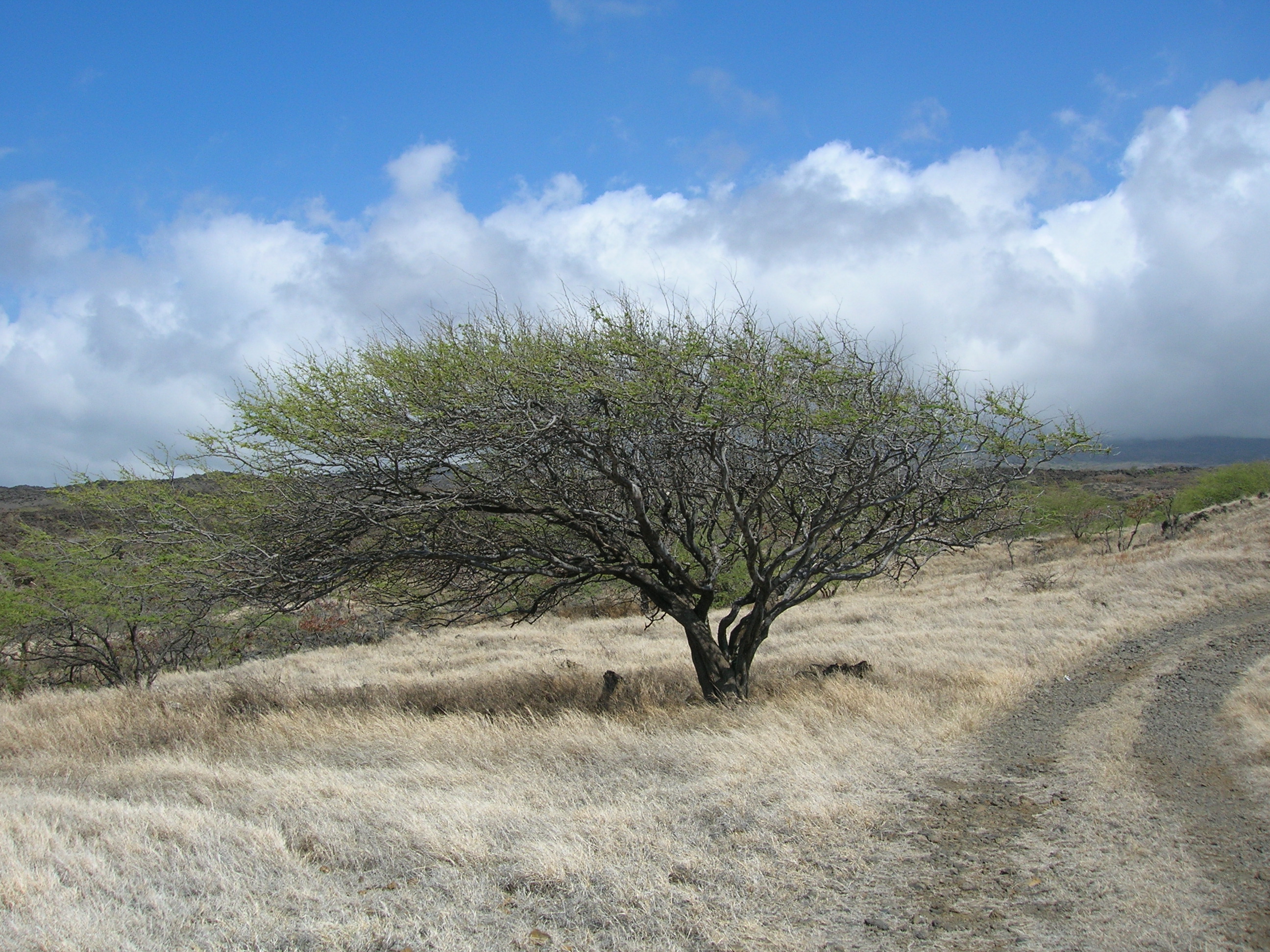 |
| This photo is misleading as there is no grass in the Atacama |
First, the Nazca (2nd c. BC - 7th c. AD) and their mysterious Nazca Lines were but one civilization inhabiting the Sechura-Atacama desert regions. Nor was the Nazca culture the only ancient Peruvian culture to create vast geoglyphs and vast irrigations systems.
Ancient civilizations rise and fall, each layer of civilization stacked upon each other like so much firewood. So the length of their stay, and their demise is part of a much larger cycle.
To enlarge the lens, there were many overlapping pre-Incan cultures that preceded, co-existed with, and followed the Nazca during 10,000 years of human settlement, including complex city-state civilizations of the northern Sechura desert region. The Chavín culture (1500 -300 BC; Late Chavin, 100-700 AD) was an Andean foothill culture but its sphere of influence was widespread along the Peruvian seaboard as far south as Nazca.
Then there were the Norte Chico/Caral-Supe cultures (3500-1800 BC), the Chimú-Moche cultures (ca.? BC -500 AD; [Moche ca. 100-800 AD]; and the late Chimú kingdom expansion into the Andean foothills of southern Perú [1370-1470 AD], their empire rivaled that of the Incas).
To the south, in the Atacama region, were the Paracas (750 to 175 BC—the oldest verified human remains date back 10,000 years), the widespread Wari (Huari) culture (500-900 AD) and the Ica-Chincha cultures (1000-1476 AD). (Paracas, in Quechua [para-ako] means raining sand—or sandstorm—the winds blow as high as 65 km/h and they will seriously sandblast you for a whole season at a time.)
The later Andean Incan Empire (1483-1583 AD) with its administratice center in Cusco, was not part of this complex—The Incan empire was the Andean equivalent to Roman empire (spanning from Columbia to Chile). So the Quechua-speaking inti-worshiping Incas are not part of this discussion.
Wikipedia Peruvian timeline:

But people are always attracted to sensationalism. And the Nazca have drawn their fair share of New Age kooks explaining both their existence and demise—from abracadabra to aliens. I fear that, under the guise of popular science, the Beresford-Jones treatise is yet another stringy theory riding the sensationalist's coat-wings.
Problem is, that the article, perhaps in the interest of brevity, does not paint an adequate representation of the larger story of the Atacama region and because of that, New(Age)Scientist readers are jumping on all the wrong bandwagons while shaking proverbial sticks and barking up all the wrong shrubs in the process....
What the NewScientist author fails to take into account of Cambridge archaeologist, Dr. David Beresford-Jones's claim, is that the vast hyper-arid Sechura-Atacama deserts, that runs along the Pacific coast from Peru to Chile, are in the most extreme rain shadow region in the entire world. And humans had absolutely nothing to do with that factor. So, naturally I was immediately questioning all assumptions.
Let me digress:
The massive Andes cordiellera blocks the path of precipitation. Rain-laden weather systems don't arrive from the Pacific, they come from the Atlantic and dump their payload on the OTHER side of the Andes. At 6895 meters (22,590 ft.) the Andes are too tall a barrier for eastern storm clouds to crest.
There are pockets high on the western slopes of the Andean foothills between 4-9,000 feet that do receive marine fog, or garúa drizzle, and sporadic rainfall spillover from the eastern storms, sometimes overflows, and is the headwater source of the few oases-rivers of Western Peru.
But the winter garúa, with its tall cloud ceiling that completely blocks out the sun for six months of the year, significantly does not come in contact with the relatively low-lying coastal region—hence no lowland drizzle is possible—despite high humidity.
Perhaps the NS author citing the fieldwork of Cambridge archaeologist David Beresford-Jones proporting the widespread deforestation theory should have looked a lot farther upstream in the timeline. Massive deforestation in the Andes is a very real problem. Deforestation of the huarango trees on the Ica plain began after Spanish colonization, with widespread massive deforestation at the beginning of the 20th century. (NB: David Beresford-Jones is very thorough in his Ph.D. thesis—it's a good read. See Ch. 8.)
The Sechura-Atacama desert NEVER get any rainfall. Ever. At least not within recorded memory. The official average is 1.5 mm per year. In some places, the average is .3 mm, or, put it this way: it hasn't rained since 1570 AD. In other places, it rains upon average—once every 400 years, the cumulative all-time average is once every century. The only place where there is any plant life at all is confined within the narrow river valley deltas, or on the crests of the isolated coastal foothill ranges of around 4-9000 feet.
 |
| The Atacama Desert in Chile (NASA) |
The idea of vast tracts of forests growing along these narrow river valleys is a relative term—unless you measure the idea of forest in terms of the width and length of dry riverbeds. There are few riparian valleys—except near Pisco—which is like Needles, CA. Cutting down the huarango trees is not a logical explanation as to why the Nazca civilization suffered a catastrophic collapse around 500 AD.
The most recent major phase of enhanced precipitation in this region was about 15,000 years ago. There seems to be little evidence of massive glaciation in the Andes as well. Though current popular thought wants to mold the Atacama into a vast ancient grassland like the pampas, there's little or no evidence of it. It's been the driest desert region on earth for a lot longer (20 million years) than during the last 5000 years when the region was settled.
In the Supe River Valley, 120 miles north of Lima, the ancient city of Caral was not only the oldest city in the Americas (2600-2000 BC), contemporary with ancient Egyptian and Mesopotamian civilizations, but it also had the earliest extensive crop irrigation system. Caral geoglyphs etched on ancient flash flood plains are similar to that of the plains of Nazca. It too disappeared. As did many ancient pre-Incan Peruvian civilizations. And when it rained, entire civilizations have fallen, their mud-brick pyramid cities washed away. And I haven't even mentioned the massive earthquakes that uplift the region.
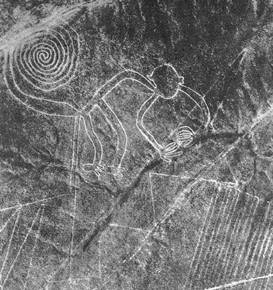 |
| Nazca Lines or geoglyphs—the monkey. |
What is the half life of the rise and fall of an ancient civilization faced with centuries of drought, catastrophic earthquakes, combined with rare torrential rains and flash floods—associated with supercharged current reversing barren El Niños—that devastated local fishing industries and rearranged coastal harbors?
The Andes mountain range is continually rising, uplifting the coastal plain—it's one of the most seismically active regions in the world—and its ceaseless uplift has rendered ancient irrigation and catchment systems obsolete in one shudder upon more than one occasion. Most of the region is situated on an alluvial mesa or tableland high above the Pacific. there are few natural harbors. Miles and miles of sheer mud cliffs drop 30 meters to the sea.
The only real form of precipitation in the Sechura-Atacama deserts is the seasonal camacacha or garúa, or thick winter (June-Sept.) marine fog. Certainly tree needles would trap some of the garua, but the fog itself never dampens the earth at lower elevations.
The Pacific Ocean is surprisingly cold, due to the Humboldt current, so the air temperature ranges from -2°C to 30°C. It's also a surprisingly fertile zone compared to the surrounding desert. There are also large colonies of penguins and fur seals thriving in one of the richest marine bio-regions of the world.
Only when there's a strong reverse warm El Niño current, does the icy nutrient-laden Humboldt current get diverted offshore and only then the traditional coastal inversion layer (anticyclone) shifts, allowing for the possibility of torrential rain and flash floods of Biblical proportions. And then there are no fish.
As far as the soil being too salty for agriculture after a flood, due to deforestation—huh? The ocean didn't climb up the enormous cliffs that rim the coast. Even a tsunami would be hard pressed to climb those cliffs. There was never excess runoff water (no rain) in the rivers to over-irrigate causing salt leaching. (Subterranean water, yes.) Dry farming and traditional drip irrigation methods were used (they tapped puquios-pipes into aquafers) to grow maize, squash, sweet potato, manioc and achira; cotton for textiles; coca, and San Pedro cactus—for religious purposes.
In the Nazca region (cradled by the Ica River and the misnamed Río Grande de Nazca), due to the sloping alluvial fan topography there were rare flash floods but no long-standing floods like New Orleans after Hurricane Katrina that took weeks to ebb. We're not talking about rich river delta floodplains here either as a large coastal range separates Nazca from the sea. But there is deep subterranean groundwater.
As for the extremely water soluble nitrate salts, the region has among the largest saltpeter deposits in the world that predate any civilizations by millions of years—suggesting an extremely stable, if, arid climate, for the lower Ica valley. Again, this points to a region of no rain.
True, the leguminous kiawe (huarango) trees desalinate soil as well as fix nitrogen (it's related to mesquite), but they would not be growing on the bone-dry arid plains but in river ravines wherever there's moisture. And they're similar to the water-hungry tamarisk, little water escapes their massive root system. So, no other plants survive in their perimeter.
Despite underground aquifers, few western Peruvian rivers actually make it all the way to the ocean. Most run dry long before they reach the Pacific like Lima's glacier-fed Rímac River.
Some Atacama river beds have been dry for over 120,000 years. And though there are plenty of water-rounded boulders strewing the Nazca Plain, they too are so ancient, their top surfaces are coated with a desert varnish that belie an ancient age. Desert varnish is a measurable slow-forming manganese patina, sort of like the verdigris on a copper dome. The darker the patina, the older the stone surface. The age of petroglyphs are measured in terms of desert varnish.
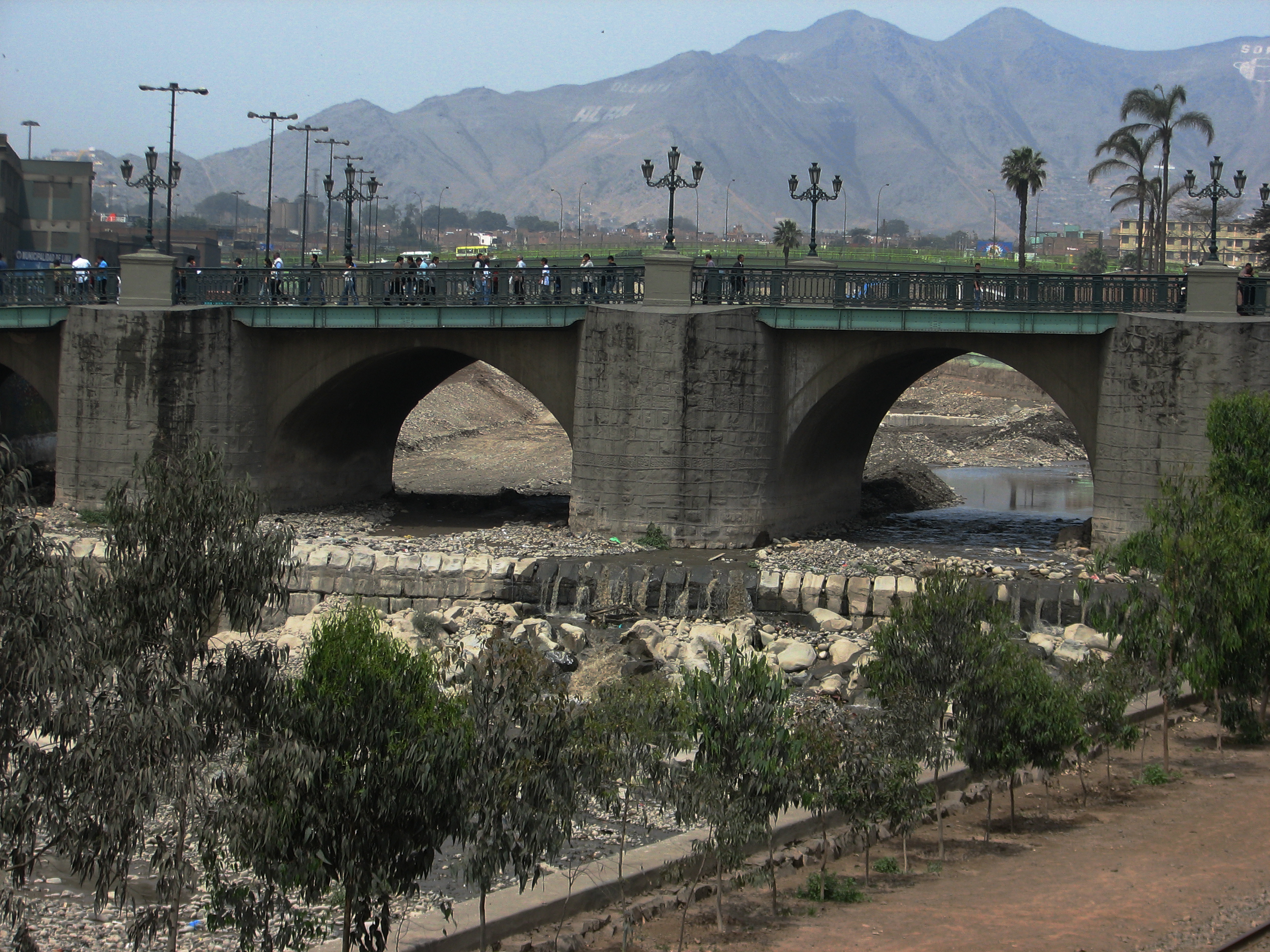 |
| Lima's glacier-fed Rímac River is usually a dry riverbed. |
Some Atacama river beds have been dry for over 120,000 years. And though there are plenty of water-rounded boulders strewing the Nazca Plain, they too are so ancient, their top surfaces are coated with a desert varnish that belie an ancient age. Desert varnish is a measurable slow-forming manganese patina, sort of like the verdigris on a copper dome. The darker the patina, the older the stone surface. The age of petroglyphs are measured in terms of desert varnish.
I picked up smooth-bellied river rocks crowned with a deep desert patina on their uppersides which means that they had lain undisturbed on the San José flood plain in that same position (the surrounding ground pebbles were also varnished) for at least 10,000 years.
Some New(Age)Scientist readers' comments also suggest a profound lack of understanding of the region. None, it seems, have ever been to the Atacama—including the author. Comments are just plain silly. There was no profound lack of imagination, no (gay) aliens, no (European) bees and certainly no livestock as we think of it— were involved. (Other than dogs, guinea pigs, alpacas and llamas—all of which were routinely harmed as they ate them.) However, according to NASA, the soil of the region is closest to that of Mars.
Blaming the farming practices of the Atacama civilizations that managed to survive with dry farming techniques for more than 5000 years—is equally silly. The armchair theorist who stated that ancient "man took a viable ecosystem and screwed it up for short term gain" is oh-so-geologically-wrong.
The idea of forest is a relative term here. One would be hard pressed to consider the mesquite that grows in Death Valley to be a forest by any stretch of the imagination—and the Mojave/Death Valley is lush (some 50 times wetter) by comparison to the Atacama.
And the Nazca civilization had plenty of faith—perhaps too much of it as they believed too heartily in their own Hereafter—judging by their practice of human sacrifice. It's a miracle they survived at all in such an extreme region.
There is, however, ample archaeological evidence that head-hunting became a major preoccupation during the middle and late Nazca culture. Maybe they just ran out of heads to trepan or they were victims of too much intense cranial manipulation—sort of like this article.
Maybe Beresford-Jones is right that the destruction of the huarango forest contributed to the downfall of the Nazca civilization, maybe my argument is slant-rhyme, maybe I'm too old school to accept these currently popular theories. Or I'm just cranky. But to my way of thinking, 4700 to 1500 years for any ancient civilization to survive under such harsh conditions seems to be a pretty good track record.
Note Bene: (In this case, it's a post mortem): A little internet sleuthing uncovered Beresford-Jones' 2004 PhD thesis on the same subject matter. So, was he out to prove his thesis correct? I haven't read it all yet, but Beresford-Jones compares the Nazca of the Samaca basin to the Sonoran culture as a model. OK, right there, that gets my goat.
The Sonoran desert is considered the lushest and wettest of the world's deserts, more rain (10-12 inches) falls in the Sonoran desert than any other desert. Though many of the same plants grow in both regions, the extra moisture of the Sonoran desert needs to be taken into consideration as well.
A closer comparison might have been the Mojave desert which receives less than 10 inches of rain (250 mm) per year, or better yet, Death Valley. The the annual rainfall average of Death Valley, the hottest, driest place in North America, is 1.5-1.9 inches (38-49 mm), comparable to the wetter regions of the Atacama.
Point being that these desert regions receive at least 50 times the amount of moisture as the Atacama (1.5 mm per year), so I remain skeptical.
The indigenous Sonoran cultures are varied: Pima-O'odham, Gila River, Papago, Pascua Yaqui (Yoeme), Seri, Tohono, Guarijio, Cavapizca, Tuguarda, and the Cocopah, to name a few.
I noted that Beresford-Jones also seems to refer to the Nazca culture as a unique singularity but all the Sechura-Atacama region civilizations practiced some form of massive geoglyphics—as well as constructing complex irrigation systems—not to mention temples and pyramid complexes.
Then there's the danger of making a hypothesis (say, a Ph.D. thesis) and then going out to find supporting evidence it because you're looking for material to that will fit your theory.
Me, I'll take the Schrodinger's cat approach. Is you in or is you out?
THESIS: OK, in the introduction, Beresford-Jones refers to the possibility of massive ancient deforestation. Right there, my dander's up—I think he's wrong. No indication of massive anything in Nazca, except mud and geoglyphs. Hundreds of mesquite tree trunks does not a forest make. Deforestation is a very real new-colonial manifestation beginning in the 16th c., and escalating during the Industrial Revolution.
However, Beresford-Jones' thesis does thoroughly assuage my concerns about the weather in more technical terms than I have access to. Too bad that information was omitted from the NewScientist article…it would have gone far to put my 'yeah-buts" at ease. It's a LOOOONG Ph.D. I may not get through it all…I'm up to Chapter 9.
Here's a thought: how does one critically read a piece? The wired story obviously got my dander up, due to obvious holes in the weather theory, but the Ph.D. thesis, less so—however I'm barely into it so I don't have the actual data in hand, er in my brain. Question is, do I really want to invest this kind of time to prove/disprove someone's theory? Other than the fact that I've been there, or that I harbor some opinions, what's in it for me?
Though I have an abiding interest in archaeology, I am not an archaeologist. That critical reading thing: I emotionally responded to the so-called facts presented, because my gut said they were wrong. I began to write this in order to see what I needed to know/relearn. So for me it's a teaching tool—a reason to learn.
However, when I began to research this piece, I found plenty of evidence to prove my climatic theory right—but the premise that the tree pollen count dropped (indicating the fall of the Nazca empire) requires further investigation. Sleuth on.
Disclamer: most links are from Wikipedia, there to expand the knowledge base but I read all Wiki articles with a grain of salt as they are not scholarly articles. That said, the links I've included seem accurate enough to shed light.
Sunday, November 1, 2009
In Requiem for those who’ve died too soon, classmates, friends, poets,
In Requiem for all our San Geronimo Valley and 60s Lagunitas School District (LSD) classmates:
Barbara Wilson
Mark Peacock
Mike Frank St. Cecelia's altar boy
Johnny Kaufman St. Cecelia's altar boy
Scott Weaver
Scott Huntsman is alive an well, I an glad to report.
Neil Kondratieff
Contrary to popular belief, Steve Tristano, whom we believed to be dead for years, is alive and well and living in Oregon. This I found out after I wrote a piece on his father, blind jazz great, Lenny Tristano for AmieStreet.com. Oops! Well Steve was tapped by the grim reaper in 2015? But lived a good long life.
Richmond Young, leading man to my debut as Julia in Stu Rasmussen's play, "San Geronimo!" LSD class president, died of AIDS.
Judy Soga (survived by her sister Kathy); Old Man Soga weighing in a 500 pounds and his big bad-ass Cadillac
I thought it was St. Cecelia's altar boy Mark de Rutti who was murdered by the Zebra Killer. Not his brother. Surely not two murders in one family?
I'm sure there were more ODs—it WAS the 60s!
Jerry Garcia & far too many other rock musicians
Janis Joplin—we used to hear her sing at Barbano's
The Barbano girl who was killed in Mexico; I will never forget Old Man Barbano who shot himself in his grief—the first dead man I ever saw (but not the last) wheeled out on a gurney as we came home from school. All that red and white.
Speck MacAuliff and his bar, burnt to the ground.
Mr DeLacy who ran the Lagunitas Store & gave us penny candies.
Kenneth Rexroth, his wife, Marie–we used to see her in church.
Lew Welch. Grover Sales. Old Man Gregg who got his daughter Linda's friend, Jack Gilbert to show he was a real man, not some soft poet, to fell a pine tree but it went horribly wrong and Jack eventually wound up in a wheelchair.
Teddy Roosevelt (Argentina House), José Revere, Alexander Graham Bell who set up the first telephone at the Dollar Ranch. Napoleon's brother... Samuel Taylor & his white mule Barnaby.
Mrs O'Lallie who gave my grandmother daphne & lily of the valley to replant in her garden.
Agnes & Lucien Vincilione, neighbors.
Mary & Mario Bianchi, she married him after his brother who died of mushroom poisoning; she used to feed me sponge cake after school.
I guess Joe Bianchi is now on the list.... And Billy Joe too.
Don Yerion, my aunt's best friend. he was like James Dean.
Dean de la Montaña the milkman & his white convertible. He was like Dean Martin.
Larry Moulton who rebuilt Forest Knolls only to have an arsonist burn it down again. So much of our historic Valley went up in smoke.
Patrick & Betty Wall, neighbors, parents of my best friend.
Uncle Bill Dinsmore & his breathalizer.
Old Man Latindorf (German Consulate-when war broke out he fled, and my grandfather stood in as Consul; we once found a Nazi knife up the top of our hill...)
Mrs. Decker, and her dog, Lorna, Guide Dogs for the Blind, who died in the fire
My best friend, Stephanie Stone, her mother, Johanna Stone who also died in the fire. Russian Mimi, Johanna's mother: I never knew her first or last name—but they gave me the urge to travel to Russia.
Old Man Nunes and his pet buffalo, Nickel, Mrs Nunes who gave me fresh chocolate chip cookies when I rode past the house on horseback up to the fire station.
Klaus Kinski who ran me and a lame dog, Becky off our traditional playground (Mt. Barnabe) with a shotgun. Is Orr still alive? He was another shootist. New interlopers to the Valley closing off the land and the public access fire roads illegally, RIP.
All our dead horses. Chiquita, rescued from the glue factory, Becky Dart, a Three Bars racehorse mare—fastest horse in the Valley at the quarter mile. Baby Snooks—a hore my aunts and mother rode, hhe was too mean for me. Steph's Gay Girl, Asus, Sununu and the donkeys. Mr. Smits, the stunted bull calf we rode anyway because he thought he was a pony...all my Shetland ponies, aka the little shits, as they were regular Houdinis at escaping.
LSD Class of '66
Barbara Wilson
Mark Peacock
Mike Frank St. Cecelia's altar boy
Johnny Kaufman St. Cecelia's altar boy
Scott Weaver
Scott Huntsman is alive an well, I an glad to report.
Neil Kondratieff
Contrary to popular belief, Steve Tristano, whom we believed to be dead for years, is alive and well and living in Oregon. This I found out after I wrote a piece on his father, blind jazz great, Lenny Tristano for AmieStreet.com. Oops! Well Steve was tapped by the grim reaper in 2015? But lived a good long life.
Richmond Young, leading man to my debut as Julia in Stu Rasmussen's play, "San Geronimo!" LSD class president, died of AIDS.
Then there were other Valley Folks whose passing I missed as well:
Judy Soga (survived by her sister Kathy); Old Man Soga weighing in a 500 pounds and his big bad-ass Cadillac
I thought it was St. Cecelia's altar boy Mark de Rutti who was murdered by the Zebra Killer. Not his brother. Surely not two murders in one family?
I'm sure there were more ODs—it WAS the 60s!
Then there were the 60s implants—the musicians hitching north who got stuck in Forest Knolls.
Jerry Garcia & far too many other rock musicians
Janis Joplin—we used to hear her sing at Barbano's
And the Old Timers:
The Barbano girl who was killed in Mexico; I will never forget Old Man Barbano who shot himself in his grief—the first dead man I ever saw (but not the last) wheeled out on a gurney as we came home from school. All that red and white.
And Mrs Barbano, who taught me how to swim at the age of 10 in a salt water pool.
Cal Davis, I guess Helen Davis too...
Cal Davis, I guess Helen Davis too...
Speck MacAuliff and his bar, burnt to the ground.
Mr DeLacy who ran the Lagunitas Store & gave us penny candies.
Kenneth Rexroth, his wife, Marie–we used to see her in church.
The Howards—Ken & Mary, both together and separately.
Father Connery.
Lew Welch. Grover Sales. Old Man Gregg who got his daughter Linda's friend, Jack Gilbert to show he was a real man, not some soft poet, to fell a pine tree but it went horribly wrong and Jack eventually wound up in a wheelchair.
Teddy Roosevelt (Argentina House), José Revere, Alexander Graham Bell who set up the first telephone at the Dollar Ranch. Napoleon's brother... Samuel Taylor & his white mule Barnaby.
Mrs O'Lallie who gave my grandmother daphne & lily of the valley to replant in her garden.
1
Jennie & Bernard Reilly, my grandparents at Coom an Or.
Feilim, Bill, Myles, my uncles; Maureen, my mother
Ellen and John Budjick (2nd cousins) on Tamal Road right below the Greggs.
Henry Bennican who remodeled our house on Barranca and fell off the roof.
Feilim, Bill, Myles, my uncles; Maureen, my mother
Ellen and John Budjick (2nd cousins) on Tamal Road right below the Greggs.
Henry Bennican who remodeled our house on Barranca and fell off the roof.
Agnes & Lucien Vincilione, neighbors.
Mary & Mario Bianchi, she married him after his brother who died of mushroom poisoning; she used to feed me sponge cake after school.
I guess Joe Bianchi is now on the list.... And Billy Joe too.
Don Yerion, my aunt's best friend. he was like James Dean.
Dean de la Montaña the milkman & his white convertible. He was like Dean Martin.
Larry Moulton who rebuilt Forest Knolls only to have an arsonist burn it down again. So much of our historic Valley went up in smoke.
Patrick & Betty Wall, neighbors, parents of my best friend.
Uncle Bill Dinsmore & his breathalizer.
Old Man Latindorf (German Consulate-when war broke out he fled, and my grandfather stood in as Consul; we once found a Nazi knife up the top of our hill...)
Mrs. Decker, and her dog, Lorna, Guide Dogs for the Blind, who died in the fire
My best friend, Stephanie Stone, her mother, Johanna Stone who also died in the fire. Russian Mimi, Johanna's mother: I never knew her first or last name—but they gave me the urge to travel to Russia.
Old Man Nunes and his pet buffalo, Nickel, Mrs Nunes who gave me fresh chocolate chip cookies when I rode past the house on horseback up to the fire station.
Klaus Kinski who ran me and a lame dog, Becky off our traditional playground (Mt. Barnabe) with a shotgun. Is Orr still alive? He was another shootist. New interlopers to the Valley closing off the land and the public access fire roads illegally, RIP.
All our dead horses. Chiquita, rescued from the glue factory, Becky Dart, a Three Bars racehorse mare—fastest horse in the Valley at the quarter mile. Baby Snooks—a hore my aunts and mother rode, hhe was too mean for me. Steph's Gay Girl, Asus, Sununu and the donkeys. Mr. Smits, the stunted bull calf we rode anyway because he thought he was a pony...all my Shetland ponies, aka the little shits, as they were regular Houdinis at escaping.
All the oak trees that are succumbing to sudden oak death. I could go on, but maybe someone else will "remember."
Saturday, October 31, 2009
NaNoWriMo
November is National Novel Writing Month That's 30 daze and nights of wild literary abandon!
You can sign up and register for NaNoWriMo or not. Wildcatting is OK.
Some pointers
1) write at least 2000 words a day; the more the merrier during the first week, makes weeks 3 & 4 easier. You need 175 pages or 50,000 words. Deadline—and I do mean dead line—is Nov 30.
2) find a NaNoWriMo group in a coffeshop near you. Writedriver captains (AKA Municipal Liasons) will flagellate and goad slaphappy and punchdrunk participating procrastinators with proverbial whips and spurious words. Oh my Captain...
3) never revise
4) don't worry about plot or storyline. That comes during revision.
Thursday, October 8, 2009
It's a canary egg omlette kind of morning
Hey, the Blue Angels are in town (er, in the sky), & I heard it through the grapevine that the Rolling Stones will play at Treasure Island for Oracle employees, no one else is invited, meanwhile Apple dropped out of US Chamber of Commerce, and childhood friend Adair Lara's canaries had unsafe sex, leaving eggs in their seed bowl. Cheeky little buggers. What a wacky morning—think I'm gonna find me some musical stairs. Gonna break me some tiny eggs. Make me a tiny canary egg omlette & I haven't even Twittered yet.
added 10/17
Saturday, September 26, 2009
Country life
Ah, the joys of West Marin! Loading FB is too much for dial-up. Even Gmail takes 5 min to load. Refreshing a
screen is a hefty time investment. No cell reception either. You'd think that
living 2.5 miles downwind fr Skywalker (Bullfrog) Ranch, we'd have a
connection. Lucas is his own hub. You can get cell reception outside the
gates—but not in the village square. You can get wifi at the libraries.
Think I'll drive out to the lake at Petaluma-Pt Reyes Rd to pick up my cell messages (if I'm lucky)...there's a lull in the cycling hordes...
Think I'll drive out to the lake at Petaluma-Pt Reyes Rd to pick up my cell messages (if I'm lucky)...there's a lull in the cycling hordes...
Last night's raccoons stealing cat food

RESPITE
I'm drinking in the coolness of the old farmhouse
after hours of taking photos of the parched reservoir
under the maddog midday sun.
Friday, September 25, 2009
EARLY RAIN
The sound of fall:
Last year's deer twins
cross the road with their twins,
the sound of hooves on the pavement
like a hard rain on parched clay.
They forage on oak leaves,
the dry grass seething with crickets.
Little nourishment there.
Last year's deer twins
cross the road with their twins,
the sound of hooves on the pavement
like a hard rain on parched clay.
They forage on oak leaves,
the dry grass seething with crickets.
Little nourishment there.
NICASIO MORNING

Outside the dining room window,
last year's twins cross the road with their fawns,
the sound of deer hooves on the pavement
like a hard stacatto of rain on parched clay.
They forage and browse on oak leaves,
the dry grass seethes with crickets.
Little nourishment there.
I'm sitting on my cousin's wreck of a front porch,
watching the traffic whip and grind its way
around the baseball diamond cum village square,
like it was the Indie 500 & bluejays squall like cop cars.
They all rubberneck, I learn to ignore them.
I do not know which type I hate more, the gawkers,
or the ones that make you invisible.
They are all trespassers on the sheaves of morning.
I imagine the commuters to be a smoggy tempest wind,
a dopplegang of music pulses from their coffinships.
At least they make the sharp turn: some didn't.
Sitting on this porch can be more than a moving violation.
Sinead's lost two parked cars to the road warriors, I've lost one.
Victor stops at the bend in his Porsche,
shouts "Hello," mistaking me for my cousin.
Guns off in first gear in his glove of a car.
Cat-eyes on the double line crunch beneath his tires.
The road unequally divides them into friend and foe.
My aunts are managing the shape of their death
in the unforgiving language of cancer.
Two cyclists, oblivious that I can hear their every word,
disparage the sorry state of this porch
and how this is such a ridiculously small town.
I answer their good morning with: "It's not a town, a village."
Two ravens croak and chuff as if in agreement.
Autumn bite in the air, laptop keeps my lap warm,
Cheetos the cat paws and laps from the water bowl,
strokes his dish, marking it with his "all-mine" scent,
half-heartedly fends off the bluejays poaching his kibble,
then inexplicably wants to share my lap with the laptop.
Meanwhile, two hawks keen in the blue bowl of a sky.
The cattle low, forage in brown pastures
and thirsty deer head down to the dry creekbed
for their morning drink out of genetic habit.
Upstream houses have robbed the creek of its water
for their luxury pools and extra bathrooms.
Deer learn to slake their thirst from bathtub troughs.
Between rare bouts of of utter country silence,
flies and hornets sing their small song in the weeds
as woodpeckers plumb the final depths of the dying oaks.
Tuesday, September 22, 2009
HOPE
I'm sitting in the hospital parking lot,
while websurfing on their dime,
sending out links on healthcare reform
waiting for my aunt's chemo session to end.
Today would've been my mother's 77th birthday.
rev., added 9/17
Sunday, September 20, 2009
Huckleberries on the Equinox
We had warm huckleberry pie at midnight (from berries we picked in the afternoon) with HagenDaas Vanilla ice cream. Ahhh, wilderness! But pie at midnight = insomnia, + slow dial up = 4 AM torture, the only solace is listening to the distant coyotes howl. A raccoon fell off the porch while hunting stray huckleberries.
Soon it will be time to head south, over Lucas Valley Road, hoping I'll be going against tourist traffic, but today it's unusually light out in the backroads of West Marin. Few cars at the church too. Church bell and droning flies, the oceanic surcease of passing cars.
added, rev 9/17
Friday, September 18, 2009
KITTY PORN
Old orange tomcat yowls for breakfast,
strokes his water bowl with his cheeks to mark it,
then hunkers down to watch the bluejays
swoop down to steal his kibble from a white bowl
nestled on the front porch.
added, rev. 9/17
Sunday, September 13, 2009
Black Bart Rides Again
On August 3, 1877, the Wells Fargo stagecoach pulled out of Fort Ross and headed south over Seaview Ridge, down Meyer's Grade toward Guerneville. The horses were tired, the stage clattered along the dusty coastal route that linked Point Arena to the outpost of Duncan's Mills on the Russian River, without mishap. So far, so good.
But as he was nearing the end of his arduous journey down the sleepy Sonoma County coast, a strange, cloaked figure stepped out of the scrub and shadows on River Road and yelled, "Halt! We have you surrounded" The startled Wells Fargo driver reined up and stared at an apparition in the sizzling August heat. He rubbed his eyes. Was it a mirage?
A ghost dressed in a linen duster, wheat sacks on his legs, a flour sack over his head, topped by a black derby. He didn't believe the wild stories of a ghost bandit loose in these parts. But this was comical.
The driver soon gave up any notion of a sunstruck ghost when the "ghost" demanded in a deep, hollow voice, that brooked no opposition, that he "throw down the treasure box." And he waved his double barrel shotgun in punctuation.
The driver, looking down the working end of a very real 12-gauge shotgun, decided discretion was the better part of valor and handed over the strongbox with its $300 in coin, a cheque for $3.05, and a silver watch, to the notorious outlaw.
When the apparition disappeared into the chaparral on foot, the Wells Fargo driver took off to Guerneville lickety-split, cracking his whit as the carriage careening along River Road, to report the robbery.
When the Guerneville posse arrived at the scene of the crime, he noted that it was in the same place as the last robbery three years earlier, last July; the mail sacks were slashed with a characteristic "T" shape. "Yep, that's Black Bart's M.O., all right," he said to no one in particular.
The sheriff found the smashed strongbox in the underbrush, devoid of coin and cash. When he found the axe, he noticed a scrap of paper on a tree stump fluttering like a wounded bird, anchored under a rock He tossed the rock into the bushes and examined a waybill with a curious message in different hands, scribbled on the back:
I've labored long and hard for bread,
For honor, and for riches,
But on my corns too long you've tred,
You fine-haired sons of bitches.
Black Bart
the PO 8
Driver, give my respects to our friend, the other driver; but I really had a notion to hang my old disguise hat on his weather eye.
Respectfully, B.B. (1877)
And so began the dubious literary career of Black Bart, the Gentleman Bandit, who, for the next eight year, with numerous daring thefts, successfully hoodwinked and bilked Wells, Fargo and Company, out of $40,000, relieving them of their petty cash to the tune of—or should I say the pure po8try of—thousands of dollars a year. Someone quipped, that whatever Black Bart lacked as a rhymer, he sure made up for as a robber.
California's first, and most notorious stagecoach robber poet of the West, Black Bart, had left his calling card—a note with a penned verse at the scene of another crime. A second verse left inside a hacked up strongbox at a holdup on the Quincy - Oroville stage line, read:
Here I lay me down to sleep
To wait the coming morrow,
Perhaps success, perhaps defeat,
And everlasting sorrow.
Let come what will, I'll try it on,
My condition can't be worse;
And if there's money in that box, '
Tis munny in my purse.
Black Bart
PO 8
(July 25, 1878)
After the second poem, again, each line was written as if in a different hand, there was a price on Black Bart's head. Governor Irwin posted a $300 reward for the capture of Black Bart, PO8. Wells Fargo matched Irwin's reward and the US Post Office added another $200. An $800 reward for bad penmanship, bad poetry, and a whole lot of Wells Fargo's moolah.
The $800 bounty merely upped the ante, Black Bart brazenly robbed three more stages that week alone, but the reward went unclaimed for five years. But never again did he leave his calling card of odd verse at the scene of any crime. Perhaps Black Bart, with his busy burglary schedule, suffered from writer's block.
Apparently C.E "Charles" Bolton, a retired San Francisco mining engineer, had a bone to pick with Wells Fargo and so he decided to lighten Wells Fargo and Company stagecoaches of their payload.
Bolton was born Charles Bolles, in Norfolk, England in 1829, was raised on a farm in upstate New York from age two, and at age 20, he arrived to the California gold fields in 1849, and eventually changed his name to Bolton. After five unsuccessful years of mining ventures on the North Fork of the American River with his cousin and brother, Bolton returned to Illinois after his brother, Robert, died tragically in San Francisco.
Bolton married Mary Johnson in 1854, settled down to raise a family, but soon grew tired of the farmer's life in Illinois.
Bolton enlisted in the Civil War and fought at Vicksburg, where he was seriously wounded, and General Sherman's March to the Sea. He received medals and a commission, but grew weary of civilian life. His feet were itching, so in 1867, he took up prospecting in Idaho and Montana.
In August 1871, Bolton wrote a last letter to his wife, of a dispute with some Wells, Fargo & Company employees who had ruthlessly forced him off his land in Montana by cutting off his water supply, making it impossible for him to mine his silver claim. He vowed to get even.
And thus began Bolton's life of crime. And poetry. Charles Bolton—a man of many aliases including Charles E. Bowles/Boles/Bolles, and T. Z. Spalding when he was arrested, robbed his first stagecoach in July, of 1875 in Calaveras County. His favored pseudonym was "Black Bart."
During the early 1870s, the Sacramento Union ran a weekly serial, a dime novel, "The Case of Summerfield" where a highwayman, Bartholomew Graham, AKA Black Bart, made a habit of robbing Wells Fargo stages.
A case where reality mirrored fiction, Bolton adopted the moniker. The description and persona suited him to a "T."
"He [Black Bart] is five feet ten inches and a half in height, thick set, has a mustache sprinkled with gray, grizzled hair, clear blue eyes, walks stooping, and served in the late civil war....It is said that he was engaged in the late robbery of Wells & Fargo's express...."
— Caxton, "The Case of Summerfield"
The real Black Bart made good editorial copy, he was the press and the public's darling. An eyewitness later described him as having graying brown hair and deep-set piercing blue eyes under heavy brows.
What made the crimes unusual was that stagecoach passengers reported that Bolton was always very polite, saying, "Please throw down the box." He was a real Robin Hood, always courteous, never robbed them, making a point of returning their items, with a poetic bow or flourish, saying, "Ma'am, I don't rob passengers. I'm only after Wells Fargo."
Bolton often took the train to Stockton and thought nothing of walking 40 miles into the hills, a soldier's quirk he picked up during the Civil War. He knew every road, trail and pass from Sacramento to San Francisco like the back of his hand. And then some. Even Wells Fargo was impressed with his prowess, describing him as a very "thorough mountaineer."
Perhaps it was because of the sheer distances he routinely traversed on foot that gave him the idea to rob Wells Fargo stages. A highwayman riding shank's mare? No one expected to find a man on foot in the middle of nowhere without a telltale getaway pony.
Black Bart, who pulled off at least 28 robberies in eight years, often revisited the scene of his last crime spree, with great success. He favored steep mountain passes, where the exhausted horse team pulling a heavy stagecoach laden with gold, were forced to a slow walk.
Wells Fargo began bolting the strongbox to the carriage floor of the stages to impede Black Bart's progress. But there were so many lonely stretches of road that naturally lent themselves to highway robbery. The stagecoach run from Clear Lake to Cloverdale was dubbed "The longest 30 miles in the World."
There's a road named after Black Bart between Forbestown, once a large mining center, and Robinson Mills i(near Oroville). During one hot summer day in July, 1878, Black Bart held up a stage on the road from La Porte to Oroville. A traveler tried to give her valuables to Black Bart who leld up his hand and said: "No lady, don't get out. I never bother the passengers. Keep calm. I'll be through here in a minute and on my way." He nabbed the Wells Fargo strong box with $50 in gold and a silver watch, the mail sacks, and disappeared into the seething heat.
There's a road named after Black Bart between Forbestown, once a large mining center, and Robinson Mills i(near Oroville). During one hot summer day in July, 1878, Black Bart held up a stage on the road from La Porte to Oroville. A traveler tried to give her valuables to Black Bart who leld up his hand and said: "No lady, don't get out. I never bother the passengers. Keep calm. I'll be through here in a minute and on my way." He nabbed the Wells Fargo strong box with $50 in gold and a silver watch, the mail sacks, and disappeared into the seething heat.
During one robbery Black Bart quipped, "Sure hope you have a lot of gold in that strongbox, I'm nearly out of money." In Shasta County, stage driver Horace Williams asked Bart, "How much did you make?" Bart answered, "Not very much for the chances I take."
And near French Gulch Bart said, "Hurry up the hounds; it gets lonesome in the mountains." Black Bart eluded the law for nearly a decade until his capture in 1883. His eventual undoing was a silk handkerchief he dropped at the scene of his last crime.
Black Bart's last holdup was—oddly—at the scene of his first crime on Funk Hill, near Copperopolis, in the Sierra foothills. Though he escaped into the hills with one gold bar after he was winged by a young hotshot hitchiker, Jimmy Rolleri, as he was trying to free the strongbox bolted to the stagecoach floor, Black Bart dropped a bloodied silk handkerchief at the scene of the crime.
Bolton was eventually identified by a laundry mark on the handkerchief and duly captured when Wells Fargo detective James Hume and Sheriff Tom Cunningham found the handkerchief, and exclaimed, "At last we have a clew!"
After visiting some 91 laundries in San Francisco, Wells Fargo detectives James Hume and Henry Morse traced a laundry mark, F.X.0.7., on the handkerchief to a Bush Street laundry that Bolton used. When who should walk in out of the blue but the dapper Bolton himself. Hume was startled, the resemblance was uncanny, he thought he was looking at his double in a mirror—right down to the broad white mustache.
Morse noted that Bolton was "elegantly dressed, carrying a little cane.... a natty little derby hat, a diamond pin, a large diamond ring on his little finger, and a heavy gold watch and chain.... One would have taken him for a gentleman who had made a fortune and was enjoying it...." At Wells Fargo's expense.
Hume and Morse engaged Bolton in conversation about mining investment schemes. They discovered that Bolton took frequent "business trips" that coincided with Wells Fargo robberies. Back at the Wells Fargo office, Hume's questions took another turn, stagecoach robberies. When an eyewitness identified him, Bolton knew the jig was up, raised his hands and exclaimed, "Gentlemen, I pass." He confessed that he was indeed "the P 08." Bolton may have gone meekly to his arrest but he bristled when they made fun of his verses.
Charles Bolton pleaded guilty to the charge of one count of stagecoach robbery (and two counts of poetry); he was sentenced to six years in San Quentin prison on Nov. 21, 1883.
Police reported that Bolton was a model prisoner. He was "a person of great endurance." Witty under the most trying of circumstances, he was "extremely proper and polite in behavior. Eschews profanity."
Black Bart's shotgun was never loaded. The "rifles" he had trained on the stage were merely sticks propped up in trees. He worked alone. His gang was an imaginary sleight of hand. Bolton was reputed to have said that he didn't want to take a chance of hurting any of his victims. "I never robbed a passenger or ill-treated a human being," he said.
After his early release from prison for good behavior, on Jan. 22, 1888, and in failing health, Bolton answered the bevy of reporters flooding the prison boat, one wanted to know how prison life treated him, another asked: did he intend to rob any more stages? He shook his head no, and said, "Gentlemen, I'm through with crime." One reporter pressed Bolton, did he intended to write more poetry verses? Bolton threw back his head and chuckled, "Now didn't you hear me say I was through with crime? I repeat, gentlemen, I am through with a life of crime."
Without so much as a goodbye, a month later, Bolton disappeared, leaving his belongings behind in a boarding house, and he was never heard from again. Wild rumors spread: he was spotted in Mexico City, living the life of a king. Or in New Orleans. He was never seen again.
But his work inspired many copycat robbers to pen their own verses left at the scene of their crimes.
So here I've stood while wind and rain
Have set the trees a-sobbin,'
And risked my life for that damned box,
That wasn't worth the robbin'
Agent Hume was called in several times to verify their poseys, but after examining the handwriting, Hume (Black Bart's literary executor?) declared; their doggerel was the work a copycat—it didn't match the work of the Gentleman PO8.
* * *
In May, 1983, in an irreverent history-making attempt— some 100 years after the capture of Black Bart—Sonoma County's own Black Bart Poetry Society held its first (and last) annual poetry festival and membership drive. Over 100 paying audience members were were held captive by poetry at the On Broadway Theatre in San Francisco's North Beach district.
Among the luminaries at the first and last Black Bart Poetry Festival were Beat poets Bob Kaufman, Joanne Kyger, and Bobbie Louise Hawkins; Sonoma State's novelist, Jerry Rosen, and Steve LaVioie, as well as other Bay Area poets. Steve Abbott, Cole Swensen, and Dave Benedetti also performed sets. One featured performer, [NPR's "All Things Considered"] Andrei Codresciu, was unable to attend, but sent his regrets.
The Black Bart Poetry Festival also aired the experimental films of William Burroughs, Lawrence Ferlingetti, and Kenneth Patchen as well as streaming live feed overhead videos of the performers in action. Sets were broken up with punk-rock riffles by bass player Dan Schiff.
In an irreverant history making surrender to creative anarchy, Monte Rio's own Po8 Laure8, Pat Nolan and his sidekick in crime, Steve LaVoie, co-founders of the Black Bart Poetry Society, also held their first annual paid membership drive at penpoint. There were few takers.
Besides cajoling patrons to sign up for the "Life of Crime" newsletter, there were featured readings, video loops and random music events. Nolan interviewed several prominent poets and he has plans to produce a video essay on the current State of the Arts in Bay Area Poetry.
The Black Bart Poetry Society whose sole motto is,"For those who think poetry is a crime" was named after the illustrious outlaw with the nome de plume of Black Bart. Black Bart robbed many Wells Fargo stage coaches from Marin to Mendocino—the epicenter of his nefarious activities was in Sonoma—especially the Russian River area were among his favorite harvesting grounds.
Black Bart's colorful history and infamous motto certainly adds an ironic twist to the folk song, Pretty Boy Floyd, "some rob you with six guns; some rob you with a fountain pen." Black Bart always signed his highway robberies with a poem—his trademark, the PO8.
If you think poetry is a crime, or have a momentary lapse in judgment and wish to join BBPS to submit some of your own doggerel, call Outlaw in Chief, Pat Nolan at (707) 865-1253. Says Monte Rio’s PO8 Laure8, Nolan, “All Outlaw Members will be held responsible for memorizing the monthly newsletter that comes out sporadically, at best.”
Future plans include a Black Bart doggerel poetry contest to be held at Duncan's Mills, reputed to be the scene of the original crime.
BLACK BART POETRY FESTIVAL PHOTOS

Bob Kaufman & Pat Nolan


Bob Kaufman & Pat Nolan


Steve Abbott & Mimi Mimeaux

Lynn Wildly & ?? ANYONE KNOW WHO THIS IS?

Jerry Rosen

David Moe

HD David Moe


Rod Iverson & Pat Nolan

Steve LaVoie, Gail KIng, Bill Hawley & wife, Susan, Phil & Tony Cotouri


Bobbie Louise Hawkins & Pat Nolan

Bobbie Louise Hawkins & Pat Nolan

Gail King & Bobbie Louise Hawkins


Bobbie Louise Hawkins


David Benedetti

Alastair Johnston


 |
| Pat Nolan & Steve LaVoie |


(a shorter version of this article was published in The Paper, Guerneville, CA, 5/83). The problem with revision is that it's endless. The previous version of Black Bart (9/11/09) and its endless revision took me two full days with no time off for lunch. This one ate up most of my Sunday. It's done by virtue of the fact that I'm sick of it. I've sent it onto its fate, whether it appears in the upcoming book, in its entirety, or in a vastly abbreviated format, or not at all, I'm done with it—or it's done with me. I later realized that I nicked the title from a later article I wrote on Black Bart & E. Clampus Vitis (next on board for the preservation of elderly typescript articles written in my hasty youth.) And what will I do for a title?
Subscribe to:
Posts (Atom)


