 |
| Neil O'Neill and Frank McConville, lurid sunset, Alameda Island, Alemeda, CA |
Saturday, February 16, 2008
Neil O'Neill and Frank McConville, lurid sunset, Alameda Island, Alemeda, CA (photo)


Sunday, February 10, 2008
Daffodils for St Daffyd's Day (photos)

A potted daffodil opened in time for St Daffyd's Day. Backlighting seems to be a more interesting visual approach.

Daffodil (related to narcissus) admiring itself in a mirror.


Some garden flowers and leaves—good subjects to learn digital photography as they didn't squirm or complain too much. I've always inherited really old technology—people's cast off Macs and cameras. In 2006, I got two small KQED SPARK art grants, which allowed me to buy an iMac and 2 cheap digital cameras. That technology upgrade changed my life and it's been a huge exponential learning curve ever since. I spent off moments lurking in my neighbors' flowerbeds or grabbing photos on the fly.


Some garden flowers and leaves—good subjects to learn digital photography as they didn't squirm or complain too much. I've always inherited really old technology—people's cast off Macs and cameras. In 2006, I got two small KQED SPARK art grants, which allowed me to buy an iMac and 2 cheap digital cameras. That technology upgrade changed my life and it's been a huge exponential learning curve ever since. I spent off moments lurking in my neighbors' flowerbeds or grabbing photos on the fly.
My little digital Nikons aren't all that great but they do fit into a
jeans pocket and half the battle is being ready to catch the light. I
find that the older CoolPix L4 4.1 megapixel camera (dropped dozens of
times) is much better at focusing while my S200 7.1 MP camera captures
more color info.
My $29.95 made-in-China trainer-bra camera, little better than a cell phone, was half-dead after I accidentally watered it in a creek at the 2005 Kate Wolf Festival (it was 114 degrees) in Memdocino Co. I was sad to see it go as it did such a terrffic job in full sunlight. Though I was able to kick start it on the iMac, it was never quite the same.
It was terrible grainy (3.1 MP) to begin with and had a blue color cast but it had a great macro lens. That's what got me into taking photos of flowers. So I kept it for sentimentality's sake until a fellow Freecycler coming to collect books spotted it. Last I heard, it had a new lease on life and was working perfectly.
Here's hoping the technology fairy will soon send a L14 or a D40 Nikon my way as the trusty little L4 CoolPix that I carry into every class I teach (to document student work), is having a harder time focusing these days.
© 2007-2009 Maureen Hurley All works of art and photographs in these albums is © copyright 2009 by Maureen Hurley and may not be used in any endeavor or context.
added 2/2017 from Facebook
My $29.95 made-in-China trainer-bra camera, little better than a cell phone, was half-dead after I accidentally watered it in a creek at the 2005 Kate Wolf Festival (it was 114 degrees) in Memdocino Co. I was sad to see it go as it did such a terrffic job in full sunlight. Though I was able to kick start it on the iMac, it was never quite the same.
It was terrible grainy (3.1 MP) to begin with and had a blue color cast but it had a great macro lens. That's what got me into taking photos of flowers. So I kept it for sentimentality's sake until a fellow Freecycler coming to collect books spotted it. Last I heard, it had a new lease on life and was working perfectly.
Here's hoping the technology fairy will soon send a L14 or a D40 Nikon my way as the trusty little L4 CoolPix that I carry into every class I teach (to document student work), is having a harder time focusing these days.
© 2007-2009 Maureen Hurley All works of art and photographs in these albums is © copyright 2009 by Maureen Hurley and may not be used in any endeavor or context.
added 2/2017 from Facebook

Thursday, January 31, 2008
Nicasio Reservoir drawing & watercolor for Art from the Heart (art)
 |
| Nicasio Reservoir, 8x11", colored pencil & pastel |
 |
| Nicasio Reservoir, 8x11", practice piece, watercolor |


Wednesday, January 23, 2008
My drawing album on Facebook
Few people know my training is in the visual arts. I love bold contour line and sculptural light. A car accident in 1997 put me in front of a lot of flowers and since I couldn't do much else but sit around for about a year (and heal), I drew a lot of flowers. I used to think that cutting edge artists didn't draw flowers or landscapes, only Sunday painters, and here I was a SMTWThFS flower painter. The only edges I was cutting were my nails as everything hurt. So I drew, and drew and drew until I got it. I also work in the schools teaching art to kids, so many of the drawings are quickies I've done in class. There are a few landscapes as well. I try to imbue them with energy because that's how I see landscape—alive, like a tawny beast. But I prefer to work from real life as the human eye can see far more than the camera lens. The only exceptions are the Scottish landscapes. They’re from calendar images. The fish and butterflies that have crept into this album are, for the most part, on the spot 2-minute teaching drawings I did in class. They all serve to inform me.
From a Facebook post. See all the drawing folder here. They’re also scattered throughout this blog, click on the tags below. Drawings dredges up a different collection than the tag drawing, etc.
Thursday, January 3, 2008
Letter to Shirley MacLaine's Camino, Johannes Scottus Eríugena
Dear Shirley,
I enjoyed many aspects of the autobiographical memoir of your pilgrimage and journey on El Camino de Santiago de Compostela, or The Way of Saint James over the Pyrenees and across Spain, ending in the Celtic lands of Galicia and Finisterra at the end of the known world.
To travel West, to Tír na nÓg, the island of the ever-young (or the ever-dead), that mythical place beyond the edges of the map, is well attested in Irish Celtic mythology and oral tradition. But the idea that the genesis for this particular pilgrimage would have originated in Scotland under John the Scot literally has one traveling in the wrong direction. Do the geography. France seems to be the likely origin of el Camino de Santiago de Compostela pilgrimage. Spain was another route.
Pilgrimage to the West would have taken the Irish monks (most medieval Scottish monks were Irish-born) rather out of the way of Galicia—to Iceland and the Farøe Islands (or Vineland!). Irish hermits settled there the sixth century, introducing sheep, oats and early Irish language to the islands. Farøes place names to St Patrick and St. Brigit attest to pre-Viking, Irish occupation.
The Irish Saint Brendan (ca. 484–578 AD), was said to have visited the Farøes on two or three occasions (512-530 AD), naming Sheep Island (Farøe means sheep) and Paradise Island of Birds.
St. Columba was more contrary, sailing northwest to Iona. For the record, Scotland's patron saint Columba (or Columcille—and instigator of the world's first use of copyright) was Irish-born. Iona was not part of Scotland then. There was no Scotland as we know it. The Hebrides were their own entity—settled by the Irish—I might add.
I must however, take umbrage with your passing off the first John the Scot (b. 800-815 AD in Ireland)—as being Scottish. He was Irish.
It is possible that the idea of pilgrimage to the shrine of St. James, or Iago of Compostela was based on Gaulish Celtic tradition and cultivated by the Irish missionaries of Iona, the Hebrides, Scotland and Europe as the Irish monks were the innkeepers of Christianity and knowledge (fios) throughout the Dark Ages in Paris, Rheims, Bobbio, St. Gallen, Laon, and other important Christian centers of learning. Galicia is still a Celtic stronghold to this day.
The Irish also found interesting ways to write themselves into the Bible as they weren't mentioned in the Old Testament as one of the Lost Tribes or otherwise. So they got inventive. And there have always been strong ties between Galicia and Ireland. De Valera, Ireland's first president was Galician. But I digress.
The origins of the Santiago de Compostela legend dates back to ca. 813, roughly the same time Johannes Scotus Eríugena (see also) or, John the Scot, was born, circa 800 to 815 AD. in Ireland—not Scotland. John spent most of his adult life in what later became France under the patronage of Charles the Bald. Charlemagne (b. 742 ) died in 814 AD—a year before John was born. (Now that really would've been an anachronistic miracle having Charlemange converse with John at such a tender age!)
From 575 to 725 AD, Irish monks founded some 150 abbeys on the continent. To paraphrase Paul Gallagher's study, Irish Monastery Movement:
We don't know when John arrived in Paris (circa 830-40 AD?), but he was a monk at the Benedictine Abbey of St. Denis, a place of ancient pilgrimage, the most sacred place to be in France. By 630 AD, it was also one of the richest and most influential abbeys in Europe. Burial ground of kings, a new church was completed by Charlemagne in 877 AD.
It is clear you did some research as you got much of John the Scot's story right, but alas, by making John the Scot a Scots-Irish man, you anachrostically conflated him with a 12th c. Bishpop of Scotland who, curiously, also seems to be Irish-born. John the Scot was more commonly known throughout history as Johannes Scottus Eríugena. Eire is the ancient word for Ireland, and "gen" means born: as in Irish-born.
As to your extrapolation of William of Malmesbury's story of a king asking John: "Quid distat inter sottum et scottum?" as being a literary Easter egg of your discovery, this is an old story I learned at the knee of my Irish grandmother, it is not particularly obscure.
Circa 843 AD, the Frankish king, Charles the Bald (b. 823 AD), not Charlemange as you had noted, asked the famous question of John. Anyway, the story is well attested in medieval manuscripts, and as John was also a famous medieval poet and philosopher, it's a story that often gets repeated.
…
This is the quote in full
The king, Charles the Bald, who was dining with John asked: Quid distat inter sottum et Scottum?
(What separates a sot (drunkard) from an Irishman?)
John replied: Mensa tantum.
(Only a table).
(See a cartoon of the event here.)
Did John the Scot ever go to Santiago de Compostela? We don't know but the first written record of a pilgrimage to Santiago de Compostela was a century after his death.
Legend has it that John the Scot was invited back to Britain by Alfred the Great (who was educate in Ireland) to become Abbot of Malmesbury, or Athelny, or Oxford, but he was stabbed to death in 884 (10 years after his death) by acolyte-students with their pens for "trying to get them to think." (Philosophers). But seeing how goose wing quills were used for pens—I think this is a flight of fancy.
It's also said that John fled to Ireland at Charles the Bald's bidding as the pope was on a rampage after John's translation of Dennis the Areopagite was published without his consent. One count gives John's death in 874 in Ireland, another in 884 in Malmesbury. But it seems John died the same year as his long-time friend, Charles the Bald, in 877 AD. —History of Ireland, p 202-3.
John Scot Eriugena was a monk at St. Denis before going to the Carolingian court and Rheims; Eriugena retired to the monastery of Laon, a center of Irish influence in France. —Paul Gallagher, Irish Monastery Movement

I've visited several places where John the Scot was reputed to have taught including the hillfort citadel of Laon. My particular interest is in place name origins and in opidda, or Celtic hilltown forts—I've spent this Christmas season combing Google Earth in Renfrewshire for standing stones and Iron/bronze age forts and standing stones.
(An interesting aside, modern Scots still 'dress the stones' on the Solstice and New Years. Ach it was a hellish oiche maiden (hogmanay) this year (2006-07) with storms and 70 mph winds, but we managed to dress Cloch-na-Rhyderrick, or Clochoderrick, (perhaps I'll tell you about King Rhyderrick, friend of Columcille sometime—I was a student of UC Berkeley's Celtic Studies program.)
The stone of Rhyderrick, some call it Merlin's Stone—depending upon which story you hear—is still dressed today: others were clearly there before us, leaving red flowers and holly. As were the standing stones of the Girdle Toll in Irivne, Ayrshire.
I learned to dress the standing stones (with flowers, red berries, evergreens and whiskey) from my Irish Bantry Bay grannie, so I was the strange American hanging out with the rock, what's geologically called a glacial erratic. It's not technically a standing stone.
The rock, at one time, wobbled and it was used as a druidic judgement stone. It no longer wobbles as the mud is packed in around its base. We were trying not to get electrocuted by the farmer's fence as we so very carefully went over the stone stile—but I digress.
I imagine you must take umbrage at fan divulgence. Rest assured, I'm no raging fan, though I loved many of your movies. I'm a writer, cursed with the gift of the gab—or gob—on a 3 AM caffeind jag, and sufficiently irritated by your stretching of truth—or, shanghaiing of truth in Camino, to write to you, though I assume you'll never see it, nor respond. No matter, I will defend John the Scot's rightful birthright to cyberspace.
(Note bene: As to celebrity, I live with an actor, and I am the daughter of an actress so I know that tangled route. Between matinee and curtain call, my babysitters were the likes of Tommy Smothers, Lloyd Bridges & Sterling Hayden. The Gate Playhouse in Sausalito, Tiki Junction. My mother variously went by Maureen Reilly (nee), Maureen Hurley; one of her stage names was Kellé Hurley (as there was another actress Maureen Hurley); she was a dancer too, she admired you, and had me Out on a Limb reading your books at an early age.
Some of my school friends did make it to the big arena like Robin Williams, so please be assured I'm no autograph seeker nor fame collector. I did so love the writings of Kenneth Tynan, so that bit of story of Kathleen was precious to me...'horsemen pass by.' I'm more like Kathleen, pragmatic, less inclined to believe. But I do have glimmerings of the Sight, which drives my pragmatism crazy.)
Anyway, you might be interested to know that John the Scot was, perhaps, the most famous medieval philosopher, having translated the False-Dionysis treatise on the idea of free will. This treatise lead to an intellectual foment across Europe as John the Scot/ Johannes Scottus Eriugena had again taken up 5th c. Britons Celestinus and Pelagius' cause of free will versus the rote catechism of religious experience through the auspices of church dogma.
Needless to say, the idea of free will was not a popular concept with the pope as it undermined the church's papal authority (and tithing coffers). The pope had also posthumously excommunicated Pelagius for heresey. John the Scot too was well buried as it were, but he was rediscovered in 1680, and repatriated again to become the new rage of intelectual thought, profoundly influencing Schoppehaur and Kant—probably Spinoza as well. (Alas, Spinoza died in Amsterdam a full 4 years before John's treatises were widly published.
I have stood before the small iron gate of the synagogye where Spioza worshipped. So I reiterate, John was hardly as obscure as you suggest in Camino.
What becomes fascinating, however, is that you latched onto John the Scot, he does become the neo-Platonist who reintroduces the concept of individual experience with God, and free will vs church/state mandated group experience of religion. "Saints, sinners, generals, misfits, kings and queens. It is done by the intent to find one's deepest spiritual meaning and resolutions regarding conflicts in Self."
And so, here we are… so I thank you for that rediscovery, or shall I say, revisualized, with a deeper undertanding that comes with age. I too hope to complete the real Camino trek, before I'm 60, if possible (a bum knee—too many falls from horses in my youth—makes it a tough 500-mile proposition as I'm 54 and not at all likely to get younger) so your story (and imagination) did serve to re-inspire me to traverse the same route as Dante, Saint Francis of Assisi, Charlemagne, and Chaucer to go on pilgrimage.
In medieval legend, The Milky Way was said to be formed from the dust raised by the vast hordes of trekking pilgrims. The Spanish name for the Milky Way is El Camino de Santiago. Folk etymology has it that Compostela means field of stars.
The road of St. John may indeed be lit by a field of stars. Hoever, the Galician word, Compostella, derived from the Latin, compositum, is Composita Tella meaning "burial ground," not Field of Stars. With that, I'll bury this rant.

(This letter was sent to Shirley's webpage. No answer was the loud reply.)
I enjoyed many aspects of the autobiographical memoir of your pilgrimage and journey on El Camino de Santiago de Compostela, or The Way of Saint James over the Pyrenees and across Spain, ending in the Celtic lands of Galicia and Finisterra at the end of the known world.
Your book, Camino: Journey of the Spirit provided an entertaining read while I was rainbound with Scottish in-&-out-law relatives in Renfrewshire during the winter holidays (San Francisco is my natal town).
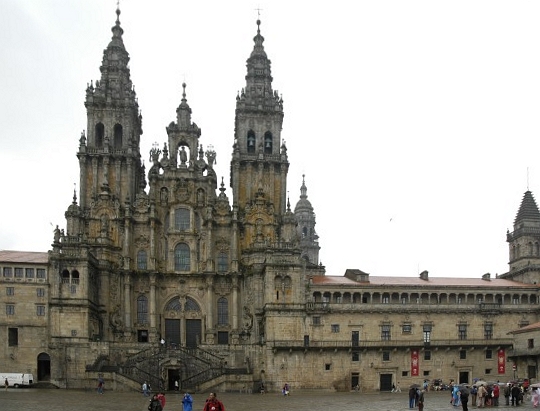 |
| According to Medieval legend, St. James's remains were carried by boat from Jerusalem to Libredon in Galicia where he was buried. In 813, a bright star guided a shepherd to the burial site, Santiago de Compostela. The miracle of St. James also served as a political wedge and a rallying battle cry against the invading Moors. (Wiki) |
To travel West, to Tír na nÓg, the island of the ever-young (or the ever-dead), that mythical place beyond the edges of the map, is well attested in Irish Celtic mythology and oral tradition. But the idea that the genesis for this particular pilgrimage would have originated in Scotland under John the Scot literally has one traveling in the wrong direction. Do the geography. France seems to be the likely origin of el Camino de Santiago de Compostela pilgrimage. Spain was another route.
Pilgrimage to the West would have taken the Irish monks (most medieval Scottish monks were Irish-born) rather out of the way of Galicia—to Iceland and the Farøe Islands (or Vineland!). Irish hermits settled there the sixth century, introducing sheep, oats and early Irish language to the islands. Farøes place names to St Patrick and St. Brigit attest to pre-Viking, Irish occupation.
The Irish Saint Brendan (ca. 484–578 AD), was said to have visited the Farøes on two or three occasions (512-530 AD), naming Sheep Island (Farøe means sheep) and Paradise Island of Birds.
St. Columba was more contrary, sailing northwest to Iona. For the record, Scotland's patron saint Columba (or Columcille—and instigator of the world's first use of copyright) was Irish-born. Iona was not part of Scotland then. There was no Scotland as we know it. The Hebrides were their own entity—settled by the Irish—I might add.
I must however, take umbrage with your passing off the first John the Scot (b. 800-815 AD in Ireland)—as being Scottish. He was Irish.
It is possible that the idea of pilgrimage to the shrine of St. James, or Iago of Compostela was based on Gaulish Celtic tradition and cultivated by the Irish missionaries of Iona, the Hebrides, Scotland and Europe as the Irish monks were the innkeepers of Christianity and knowledge (fios) throughout the Dark Ages in Paris, Rheims, Bobbio, St. Gallen, Laon, and other important Christian centers of learning. Galicia is still a Celtic stronghold to this day.
The Irish also found interesting ways to write themselves into the Bible as they weren't mentioned in the Old Testament as one of the Lost Tribes or otherwise. So they got inventive. And there have always been strong ties between Galicia and Ireland. De Valera, Ireland's first president was Galician. But I digress.
The origins of the Santiago de Compostela legend dates back to ca. 813, roughly the same time Johannes Scotus Eríugena (see also) or, John the Scot, was born, circa 800 to 815 AD. in Ireland—not Scotland. John spent most of his adult life in what later became France under the patronage of Charles the Bald. Charlemagne (b. 742 ) died in 814 AD—a year before John was born. (Now that really would've been an anachronistic miracle having Charlemange converse with John at such a tender age!)
From 575 to 725 AD, Irish monks founded some 150 abbeys on the continent. To paraphrase Paul Gallagher's study, Irish Monastery Movement:
Irish monastic scholars were renown throughout Europe for their knowledge of Greek, [Arabic], and Hebrew. Irish [monks founded European] monasteries that produced the teachers and scholars in Europe and remained centers of classical scholarship until the Viking invasions.If you had some medieval learning, you'd be aware that the word "Scot" referred to Ireland as Ireland was then known (since Roman times) as Scotia Major and Scotland (the part that was settled by the Irish) was known as Scotia Minor. That part of Scotland was called Little Ireland. Scotia probably means pirate, or raider, so I guess you're in fine order there.
We don't know when John arrived in Paris (circa 830-40 AD?), but he was a monk at the Benedictine Abbey of St. Denis, a place of ancient pilgrimage, the most sacred place to be in France. By 630 AD, it was also one of the richest and most influential abbeys in Europe. Burial ground of kings, a new church was completed by Charlemagne in 877 AD.
It is clear you did some research as you got much of John the Scot's story right, but alas, by making John the Scot a Scots-Irish man, you anachrostically conflated him with a 12th c. Bishpop of Scotland who, curiously, also seems to be Irish-born. John the Scot was more commonly known throughout history as Johannes Scottus Eríugena. Eire is the ancient word for Ireland, and "gen" means born: as in Irish-born.
As to your extrapolation of William of Malmesbury's story of a king asking John: "Quid distat inter sottum et scottum?" as being a literary Easter egg of your discovery, this is an old story I learned at the knee of my Irish grandmother, it is not particularly obscure.
 |
Carolingian king Charles the Bald had his hands full with the Breton Celts of Gaul who defeated him at the Battle of Ballon in 845. Challenging wits with John the Scot was not perhaps his brightest moment. But John was appointed head of the Court school.
|
Circa 843 AD, the Frankish king, Charles the Bald (b. 823 AD), not Charlemange as you had noted, asked the famous question of John. Anyway, the story is well attested in medieval manuscripts, and as John was also a famous medieval poet and philosopher, it's a story that often gets repeated.
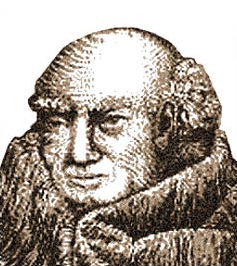 |
Johannes Scottus Eriugena b. ca. 800-815, d. ca. 874-877 AD, (also spelled Scottigena, Eriygena, Ierugena, and Erigena—means a "native of Ireland.") John the Scot, "a man of strong and eloquent mind", one of the brightest free thinkers of the Middle Ages, was eulogized as "coming out of the darkness like a meteor." A neoPlatonist, versed in knowledge of Greek, Arabic, and Hebrew, wrote that true philosophy is true religion. His work was condemned in 855 and 859 AD and labled "Scots porridge.")
|
…
This is the quote in full
The king, Charles the Bald, who was dining with John asked: Quid distat inter sottum et Scottum?
(What separates a sot (drunkard) from an Irishman?)
John replied: Mensa tantum.
(Only a table).
(See a cartoon of the event here.)
Did John the Scot ever go to Santiago de Compostela? We don't know but the first written record of a pilgrimage to Santiago de Compostela was a century after his death.
…the story of St. James was resurrected in perfect timing to spearhead the reconquest of Spain for Christianity, starting with the battle of Clavijo in 844 to the decisive victory at Las Navas de Tolosa in 1212, each time St. James appeared at the crucial moment to turn the tide of battle. St. James, Santiago Matamoros depicted as the knight in shining armour astride a white charger decapitating Moors with his sword. The first written record of pilgrimage to Santiago was when Bishop Gotescalco journeyed there in 950 and in 1072 Alfonso VI abolished tolls for all pilgrims travelling up into Galicia through Val Carce. —THE CAMINO – PAST, PRESENT & FUTURE
Legend has it that John the Scot was invited back to Britain by Alfred the Great (who was educate in Ireland) to become Abbot of Malmesbury, or Athelny, or Oxford, but he was stabbed to death in 884 (10 years after his death) by acolyte-students with their pens for "trying to get them to think." (Philosophers). But seeing how goose wing quills were used for pens—I think this is a flight of fancy.
It's also said that John fled to Ireland at Charles the Bald's bidding as the pope was on a rampage after John's translation of Dennis the Areopagite was published without his consent. One count gives John's death in 874 in Ireland, another in 884 in Malmesbury. But it seems John died the same year as his long-time friend, Charles the Bald, in 877 AD. —History of Ireland, p 202-3.
John Scot Eriugena was a monk at St. Denis before going to the Carolingian court and Rheims; Eriugena retired to the monastery of Laon, a center of Irish influence in France. —Paul Gallagher, Irish Monastery Movement

I've visited several places where John the Scot was reputed to have taught including the hillfort citadel of Laon. My particular interest is in place name origins and in opidda, or Celtic hilltown forts—I've spent this Christmas season combing Google Earth in Renfrewshire for standing stones and Iron/bronze age forts and standing stones.
(An interesting aside, modern Scots still 'dress the stones' on the Solstice and New Years. Ach it was a hellish oiche maiden (hogmanay) this year (2006-07) with storms and 70 mph winds, but we managed to dress Cloch-na-Rhyderrick, or Clochoderrick, (perhaps I'll tell you about King Rhyderrick, friend of Columcille sometime—I was a student of UC Berkeley's Celtic Studies program.)
The stone of Rhyderrick, some call it Merlin's Stone—depending upon which story you hear—is still dressed today: others were clearly there before us, leaving red flowers and holly. As were the standing stones of the Girdle Toll in Irivne, Ayrshire.
I learned to dress the standing stones (with flowers, red berries, evergreens and whiskey) from my Irish Bantry Bay grannie, so I was the strange American hanging out with the rock, what's geologically called a glacial erratic. It's not technically a standing stone.
The rock, at one time, wobbled and it was used as a druidic judgement stone. It no longer wobbles as the mud is packed in around its base. We were trying not to get electrocuted by the farmer's fence as we so very carefully went over the stone stile—but I digress.
I imagine you must take umbrage at fan divulgence. Rest assured, I'm no raging fan, though I loved many of your movies. I'm a writer, cursed with the gift of the gab—or gob—on a 3 AM caffeind jag, and sufficiently irritated by your stretching of truth—or, shanghaiing of truth in Camino, to write to you, though I assume you'll never see it, nor respond. No matter, I will defend John the Scot's rightful birthright to cyberspace.
(Note bene: As to celebrity, I live with an actor, and I am the daughter of an actress so I know that tangled route. Between matinee and curtain call, my babysitters were the likes of Tommy Smothers, Lloyd Bridges & Sterling Hayden. The Gate Playhouse in Sausalito, Tiki Junction. My mother variously went by Maureen Reilly (nee), Maureen Hurley; one of her stage names was Kellé Hurley (as there was another actress Maureen Hurley); she was a dancer too, she admired you, and had me Out on a Limb reading your books at an early age.
Some of my school friends did make it to the big arena like Robin Williams, so please be assured I'm no autograph seeker nor fame collector. I did so love the writings of Kenneth Tynan, so that bit of story of Kathleen was precious to me...'horsemen pass by.' I'm more like Kathleen, pragmatic, less inclined to believe. But I do have glimmerings of the Sight, which drives my pragmatism crazy.)
Anyway, you might be interested to know that John the Scot was, perhaps, the most famous medieval philosopher, having translated the False-Dionysis treatise on the idea of free will. This treatise lead to an intellectual foment across Europe as John the Scot/ Johannes Scottus Eriugena had again taken up 5th c. Britons Celestinus and Pelagius' cause of free will versus the rote catechism of religious experience through the auspices of church dogma.
Needless to say, the idea of free will was not a popular concept with the pope as it undermined the church's papal authority (and tithing coffers). The pope had also posthumously excommunicated Pelagius for heresey. John the Scot too was well buried as it were, but he was rediscovered in 1680, and repatriated again to become the new rage of intelectual thought, profoundly influencing Schoppehaur and Kant—probably Spinoza as well. (Alas, Spinoza died in Amsterdam a full 4 years before John's treatises were widly published.
I have stood before the small iron gate of the synagogye where Spioza worshipped. So I reiterate, John was hardly as obscure as you suggest in Camino.
What becomes fascinating, however, is that you latched onto John the Scot, he does become the neo-Platonist who reintroduces the concept of individual experience with God, and free will vs church/state mandated group experience of religion. "Saints, sinners, generals, misfits, kings and queens. It is done by the intent to find one's deepest spiritual meaning and resolutions regarding conflicts in Self."
And so, here we are… so I thank you for that rediscovery, or shall I say, revisualized, with a deeper undertanding that comes with age. I too hope to complete the real Camino trek, before I'm 60, if possible (a bum knee—too many falls from horses in my youth—makes it a tough 500-mile proposition as I'm 54 and not at all likely to get younger) so your story (and imagination) did serve to re-inspire me to traverse the same route as Dante, Saint Francis of Assisi, Charlemagne, and Chaucer to go on pilgrimage.
In medieval legend, The Milky Way was said to be formed from the dust raised by the vast hordes of trekking pilgrims. The Spanish name for the Milky Way is El Camino de Santiago. Folk etymology has it that Compostela means field of stars.
The road of St. John may indeed be lit by a field of stars. Hoever, the Galician word, Compostella, derived from the Latin, compositum, is Composita Tella meaning "burial ground," not Field of Stars. With that, I'll bury this rant.

(This letter was sent to Shirley's webpage. No answer was the loud reply.)
Tuesday, January 1, 2008
My old poems from the 1980s-90s
2/22/2014
I suddenly realized the reason why I never posted most of my old poems in this blog was because I had no logical order by which to post them.
For a while, I posted old poems amid the new ones, by month date—that quickly became problematic as I didn't have enough years to post them in as my blog began in 2007. Sometimes I posted poems thematically as well, leading to double postings.
Then I tried capitalizing poem titles. That didn't work out well. I had also typed old articles with caps. Then I tried using the word "poem" as a tag. Fail.
I still can't find anything as I can't remember the names—Poem titles are so arbitrary sometimes. I've noticed that my more recent poems don't actually have titles—especially if they were from a writing prompt. and I discovered that I actually miss not having access to my old poems.
Having them locked away on a hard disk isn't working out so well either. I won't mention how a cloning accident LOCKED me out of all my back-up hard drives and that it took a seven month wait for me to find a solution using BatChmod commands. (Thank you Chris Breen!)
Then I discovered that all my pomes, in Word 5 have picked up off artifacts and symbols, under the watchful eye of Snow Leopard and a 64-bit processor. I wasn't expecting that. Files fast turning into Unix scrabble. Uh-oh. Better dust them off while I can stiil open them. Some are missing words and lines.
NOTE BENE
I suddenly realized the reason why I never posted most of my old poems in this blog was because I had no logical order by which to post them.
For a while, I posted old poems amid the new ones, by month date—that quickly became problematic as I didn't have enough years to post them in as my blog began in 2007. Sometimes I posted poems thematically as well, leading to double postings.
Then I tried capitalizing poem titles. That didn't work out well. I had also typed old articles with caps. Then I tried using the word "poem" as a tag. Fail.
I still can't find anything as I can't remember the names—Poem titles are so arbitrary sometimes. I've noticed that my more recent poems don't actually have titles—especially if they were from a writing prompt. and I discovered that I actually miss not having access to my old poems.
Having them locked away on a hard disk isn't working out so well either. I won't mention how a cloning accident LOCKED me out of all my back-up hard drives and that it took a seven month wait for me to find a solution using BatChmod commands. (Thank you Chris Breen!)
Then I discovered that all my pomes, in Word 5 have picked up off artifacts and symbols, under the watchful eye of Snow Leopard and a 64-bit processor. I wasn't expecting that. Files fast turning into Unix scrabble. Uh-oh. Better dust them off while I can stiil open them. Some are missing words and lines.
Worse, some of the poems were still under Classic environment, whether Word 4, or Works 4—so the only way I can open them is in TextEdit in ASCII code. Huge cleanup involved. Actually anything I composed in Works 4 I can no longer open. I'd have to find an OS 9 Mac to save those files.
I guess this is my attempt to get my poems into the Cloud. I was saving them in a proverbial shoebox, saving them for a great poetic sendoff to magazines, virgin poems. But who am I kidding? No one wants to publish my poetry. Or make a book. Tired of asking, begging. I suppose I'll go to the grave, bookless. Except the insane oeuvre here in the iCloud. Catch and release. Feels weird to dust the poems off to the light of day after so many years. I can't believe I didn't date most of my work. Another cleanup chore with hard copy. I also need to add a publishing pedigree on many of them. If only I could find my hard copy mss.
I guess this is my attempt to get my poems into the Cloud. I was saving them in a proverbial shoebox, saving them for a great poetic sendoff to magazines, virgin poems. But who am I kidding? No one wants to publish my poetry. Or make a book. Tired of asking, begging. I suppose I'll go to the grave, bookless. Except the insane oeuvre here in the iCloud. Catch and release. Feels weird to dust the poems off to the light of day after so many years. I can't believe I didn't date most of my work. Another cleanup chore with hard copy. I also need to add a publishing pedigree on many of them. If only I could find my hard copy mss.
What I really need is an alphabetical listing system.
AK, yer not gonna believe this, but now I can backpost on Blogger all the way to 1970. I accidentally entered the wrong date. and I was able to post previously to 2007, when I founded this blog. This is great for all my 2000-2006 pieces. This also means it will be a lot of work moving those pieces.
Oy oy oy! after all the work I've done moving all my old poems to 2008?
7/17/2014 Most of the old poems are finally more or less in numeric order. No dates on a lot of my old work. In some cases I was able to sleuth the dates, in other cases, I put them in a general time frame—usually Jan 1, 19xx. Hopefully at a later date I'll be able to finalize the order.
7/17/2014 Most of the old poems are finally more or less in numeric order. No dates on a lot of my old work. In some cases I was able to sleuth the dates, in other cases, I put them in a general time frame—usually Jan 1, 19xx. Hopefully at a later date I'll be able to finalize the order.
Monday, December 31, 2007
Landscapes, wet pastels (art) 2007
I'm posting all my 2007 wet pastel landscapes at the end of December, though they were done over the course of a year, most were done during the fall of 2007.
Wet chalk and wet construction paper pastels: these are mostly 6x9" in-class demos. Some are 9x12". Many are experiments, or are not finished. If I don't finish them in class, I can't go back and finish them when the paper's dry as they're generally far too fragile to re-wet and add details. I usually only have about 10-15 minutes to complete a pastel as I have to teach the kids too!
This lesson evolved when my after-school art kids asked if they could do chalk pastels. I wasn't wild about the idea as I like more painterly colors, etc. But I also love to draw. So we did some pastels and I was disappointed in our results. I noticed that one child developed a cough from inhaling the chalk dust. (It bothers me too). His mother insisted it was only a cold (I think she was afraid I wasn't going to let him participate as he totally loved art). But.... I wondered: how can I reduce the chalk dust? Water. When I worked at a horse training stables, we used to sprinkle the indoor arena sand to keep dust levels down.
I discovered a technique of wetting both paper and chalk and it's akin to painting with sticks of chalk. (I've used both oil sticks and Aquerelle watercolor crayon sticks so it was a natural progression. With the Aquarelles, I weted the stiff morilla board first, or sprayed it with water after the crayon was applied. But I didn't want to use white paper for chalk pastels—besides, morilla board is astronomically expensive to use in the classroom.
So I experimented with all kinds of paper and the ONLY paper that would work was my former school painting/drawing nemesis, construction paper. It has a tooth (texture the chalk needs to adhere to) and the glue that holds the woodpulp together softens and the chalk adheres directly to it. Riverside acid free construction paper works best. Most schools have the worst grade cheap construction paper, but it will work, though it's more fragile and will easily tear.
An added bonus of using chalk wet, the colors are more painterly and vibrant. Cheap kid chalk or hopscotch chalk generally won't work, it's often too hard and will tear the paper, but the heavy teacher white chalkboard chalk is a perfect blending tool with a buttery consistency when wet.
We add black details with the waterbase stabillo pencils at the end of the session. (I also remove black chalk from the pastel sets). Pieces are very fragile until the construction paper dries. I put them on paper towels and in a sunlit window to dry.
Adult pastel sets often have toxic chemicals in them—like vermillion, cadmium and cobalt. Don't use them with kids! make sure the chalks have non-toxic AP labels.
Chalk pastel on construction paper, 6x9" or 9 x 12".
Landscapes, wet pastels (art) 2013
Landscapes, wet pastels (art) 2012
Landscapes, wet pastels (art) 2011
Landscapes, wet pastels (art) 2008
Still life (art) 2007
 |
| When this piece dried it was much lighter. |
 |
| After Monet |

 |
| The color fades as they dry |


 |
| One of my first pieces |
Still life (art) 2007
Drawn at Cleveland Elementary School, in-class demos. Wet pastel. Probably Fall, 2007.
Landscapes, wet pastels (art) 2011
Landscapes, wet pastels (art) 2008
Landscapes, wet pastels (art) 2007


Landscapes, wet pastels (art) 2008
Landscapes, wet pastels (art) 2007


 |
| Still wet, so vibrant |
 |
| Dry, the color fades |

Saturday, December 15, 2007
AmieStreet fanmail from John & Claire Roche of Celtic Ways for my review
From: clairseach
Maureen, so many thanks for your dedication that has given birth to a Celtic genre its own recognition. Its not a genre that easy to define, but its very handy for placing Claire's music work.
I am John of Celtic Ways, Claire's partner and I tend to look after all of her online presence. One one side Claire is not comfortable with this and on the other she has a lot of work on with new recordings, sorting out tours etc. so she really does not have the time for this. Having said that, Claire also does an incredible amount of correspondence and phone work with folks coming on Celtic Ways tours so we work well together and enjoy this.
Claire is currently on about 50 different digital download sites and it now creating a better income from this than with cds. Its all quite essential right now as the cost of recording her current cd, in the works, is a bit of a challenge.
Out of all these, we do like the Aime St. set up best of all. Asap we'll get into the spirit of being fans, well at least I will as there is some incredible music here. Nice to see Roy Gullane here for one, terrific Celtic songwriter. Been around a long time.
Yes, I'll discover more on this site and definately get into a blog habit here. Such a choice of networks now as I try to keep up on MySpace, YouTube, NowPublic, Facebook and Eventful too.
One thing I would like to see is Amie St. having a video service too. Maybe they have one and I have not found it yet. Soundclick have a nice video service, but I just have not got around to that one yet. Our loyalty is more for Amie Street at this stage.
I was led here, initially, by Two Tall Women from Canada, folks I have enjoyed for, must be, almost 10 years now. We met through the old original Mp3.com .
So thanks again for opening these doors Mo.
Wishing you the best in love and blessings through this Yule, Christmas and beyond.
John for Claire it's 1250
Wednesday, December 5, 2007
Tristano & Son (Amie Street)
But "Jazz Memories" is an extraordinary compilation from the great jazz masters including jazz divas Billie Holiday, Sarah Vaughan and Ella Fitzgerald, with jazz legends "Satchmo" Louis Armstrong, Count Basie, Miles Davis, Thelonious Monk and Duke Ellington, to name a few. These are all clean tracks of major hits from major labels—not muddied side B recordings. What's not to like?
(You can go to Amie Street News to read the review in situ. …Alas, Amie Street is no more—bought up by Amazon.)
Seeing the name Lennie Tristano on the track, "Judy" (perhaps named for Lennie's vocalist Judy Niemack?) startled me. My grade school classmate Steve Tristano's mom was named Judy too so the name Tristano took me down memory lane and I found myself enthusiastically recommending it on Amie Street despite the fact that I know nothing about jazz—which landed me a guest blog spot on Amie Street! I'm pretty jazzed by the whole thing. (Pardon the pun on oh so many levels!)
---------------------------------------------
Back to the Tristano memory lane: since my grade school classmate Adair Daley (Adair Lara) is off somewhere writing about her childhood days growing up in Lagunitas, and it looks like I'll have to wait for the next high school reunion in 2010 to see her as her SF Chronicle email bounces—by then, I know beyond the shadow of a doubt, that even more of our gray cells will be severely challenged—I thought I'd better contribute a few Lagunitas memories of my own to the great sphere of blogdada art now while I can still remember most of it.
In the late '50s, I went to Lagunitas School in the San Geronimo Valley out in the wilds of West Marin in Northern California with many interesting, if not downirght quirky characters—including Lennie Tristano's son, Steve.
During recess, after a jazz assembly performance by stride pianist Ralph Sutton (Pete's dad), we found ourselves alone in the classroom, and Steve went over to the piano to strut his stuff.
We weren't allowed to touch the old carved oak upright so this was pretty big deal. Steve opened the lid (we gasped at his audacity) and then he gave it an experimental trill. Soon Steve was honkeytonking tunes on that piano for us like "Tea for Two" and Scott Joplin's "Maple Leaf Rag," and he played the rockingist "Boogie Woogie" you ever heard.
(You can go to Amie Street News to read the review in situ. …Alas, Amie Street is no more—bought up by Amazon.)
Seeing the name Lennie Tristano on the track, "Judy" (perhaps named for Lennie's vocalist Judy Niemack?) startled me. My grade school classmate Steve Tristano's mom was named Judy too so the name Tristano took me down memory lane and I found myself enthusiastically recommending it on Amie Street despite the fact that I know nothing about jazz—which landed me a guest blog spot on Amie Street! I'm pretty jazzed by the whole thing. (Pardon the pun on oh so many levels!)
---------------------------------------------
Back to the Tristano memory lane: since my grade school classmate Adair Daley (Adair Lara) is off somewhere writing about her childhood days growing up in Lagunitas, and it looks like I'll have to wait for the next high school reunion in 2010 to see her as her SF Chronicle email bounces—by then, I know beyond the shadow of a doubt, that even more of our gray cells will be severely challenged—I thought I'd better contribute a few Lagunitas memories of my own to the great sphere of blogdada art now while I can still remember most of it.
 |
| Steve, b. in 1952, died Nov. 21, 2015 |
In the late '50s, I went to Lagunitas School in the San Geronimo Valley out in the wilds of West Marin in Northern California with many interesting, if not downirght quirky characters—including Lennie Tristano's son, Steve.
During recess, after a jazz assembly performance by stride pianist Ralph Sutton (Pete's dad), we found ourselves alone in the classroom, and Steve went over to the piano to strut his stuff.
We weren't allowed to touch the old carved oak upright so this was pretty big deal. Steve opened the lid (we gasped at his audacity) and then he gave it an experimental trill. Soon Steve was honkeytonking tunes on that piano for us like "Tea for Two" and Scott Joplin's "Maple Leaf Rag," and he played the rockingist "Boogie Woogie" you ever heard.
Saturday, December 1, 2007
Cool Jazz Rooms
"Jazz Memories" by Various Artists, is a stellar introduction to the Ultimate Jazz Experience—Whether you're relatively new to jazz, like me, or a dyed in the wool blue note aficionado, this compilation is an extraordinary 20-year retrospective of jazz history with some of the best works from the golden age of jazz.
The double album collection features jazz divas including Billie Holiday crooning My Man, Sarah Vaughan's Embraceable You, and Ella Fitzgerald's sultry How Long Has This Been Going On—all national jazz treasures. A real surprise was Dinah Washington's Easy Living. I've only heard her warhorse renditions and it was refreshing to hear her sing a sweet ballad.
Then we have the jazz immortals "Satchmo" Louis Armstrong viscerally trumpeting us through Dixieland with Dear Old Southland, and Count Basie's bebop rendition of Shoe Shine Boy; while on the other side of the jazz continuum, we've got Stan Getz tickling the ivories, Thelonious Monk's classic Blue Monk as well as Duke Ellington's Lotus Blossom. And then there's the cerebral Miles Davis' groundbreaking Tune-Up (say, is that 'Trane on the sax?).
"Jazz Memories" is yet another Amie Street solid gold sleeper. I love the fact that we get to hear such a wide range of music on Amie Street Music—from new indie artist hot off the press, er, Garageband—to fabulous vinyl classics that I would never otherwise listen to. It made me curious and want to know more about these musicians. (Keep an eye out for a copy of Herman Leonard's companion book which has some great stories about the musicians.)
I was surprised to learn that the longest track on the album, Tune-up, which, at first I found difficult to connect to, was really two songs in one. About 4 minutes in, When the Lights are Low kicks in and it's sonorously beautiful with several solos.
From what I can glean, the track Tune-Up/When the Lights are Low is from Miles Davis' groundbreaking 1956 Prestige album, Cookin' With the Miles Davis Quintet.
There's a great backstory attached to the Prestige label—it seems that Miles had to fulfill his Prestige contract with new work and so he just kept jammin' with his newly formed quintet.
The music Miles' quintet produced during the 24-hour marathon mother of all jammin' sessions was so hot, it resulted in three groundbreaking albums including the last one Cookin'—which also debuted My Funny Valentine. Whether it's Rollins or Trane on the mellifluous sax is moot, it's still all pure Miles on the trumpet and it put both Davis and Coltrane on the map.
These are all clean tracks of major hits from the major jazz label vaults—not muddied side B recordings. Blue Monk is my personal fave and Art Tatum's Willow Weep For Me is a close second. No, make it Frenesi, no, make it St. Thomas...aww, just buy the whole album. I suspect we'll be seeing some more compilation albums from this label in the near future.
An aside, I noticed that some tracks seem to cut out early, most noticeably Jitterbug Waltz and My Man. But then I had trouble downloading the album and had to download it song by song. You can hear some faint hissing on Blue Monk but considering when it was recorded, it's pretty clean. I checked Tune-up against another
download music services and the Amie Street track is definitely cleaner, clearer, brighter.
As I sad earlier, jazz is not normally my forte, so I was delighted to find how accessible and personable the album was with its collage of songs with just the right juxtaposition of cerebral and visceral. "Jazz Memories" is one of those rare albums that opens up new rooms in your head.
—Maureen Hurley
© 2007 12/9/2007 for Amie Street Music
go to Amie Street News to read the review.
The double album collection features jazz divas including Billie Holiday crooning My Man, Sarah Vaughan's Embraceable You, and Ella Fitzgerald's sultry How Long Has This Been Going On—all national jazz treasures. A real surprise was Dinah Washington's Easy Living. I've only heard her warhorse renditions and it was refreshing to hear her sing a sweet ballad.
Then we have the jazz immortals "Satchmo" Louis Armstrong viscerally trumpeting us through Dixieland with Dear Old Southland, and Count Basie's bebop rendition of Shoe Shine Boy; while on the other side of the jazz continuum, we've got Stan Getz tickling the ivories, Thelonious Monk's classic Blue Monk as well as Duke Ellington's Lotus Blossom. And then there's the cerebral Miles Davis' groundbreaking Tune-Up (say, is that 'Trane on the sax?).
"Jazz Memories" is yet another Amie Street solid gold sleeper. I love the fact that we get to hear such a wide range of music on Amie Street Music—from new indie artist hot off the press, er, Garageband—to fabulous vinyl classics that I would never otherwise listen to. It made me curious and want to know more about these musicians. (Keep an eye out for a copy of Herman Leonard's companion book which has some great stories about the musicians.)
I was surprised to learn that the longest track on the album, Tune-up, which, at first I found difficult to connect to, was really two songs in one. About 4 minutes in, When the Lights are Low kicks in and it's sonorously beautiful with several solos.
From what I can glean, the track Tune-Up/When the Lights are Low is from Miles Davis' groundbreaking 1956 Prestige album, Cookin' With the Miles Davis Quintet.
There's a great backstory attached to the Prestige label—it seems that Miles had to fulfill his Prestige contract with new work and so he just kept jammin' with his newly formed quintet.
The music Miles' quintet produced during the 24-hour marathon mother of all jammin' sessions was so hot, it resulted in three groundbreaking albums including the last one Cookin'—which also debuted My Funny Valentine. Whether it's Rollins or Trane on the mellifluous sax is moot, it's still all pure Miles on the trumpet and it put both Davis and Coltrane on the map.
These are all clean tracks of major hits from the major jazz label vaults—not muddied side B recordings. Blue Monk is my personal fave and Art Tatum's Willow Weep For Me is a close second. No, make it Frenesi, no, make it St. Thomas...aww, just buy the whole album. I suspect we'll be seeing some more compilation albums from this label in the near future.
An aside, I noticed that some tracks seem to cut out early, most noticeably Jitterbug Waltz and My Man. But then I had trouble downloading the album and had to download it song by song. You can hear some faint hissing on Blue Monk but considering when it was recorded, it's pretty clean. I checked Tune-up against another
download music services and the Amie Street track is definitely cleaner, clearer, brighter.
As I sad earlier, jazz is not normally my forte, so I was delighted to find how accessible and personable the album was with its collage of songs with just the right juxtaposition of cerebral and visceral. "Jazz Memories" is one of those rare albums that opens up new rooms in your head.
—Maureen Hurley
© 2007 12/9/2007 for Amie Street Music
go to Amie Street News to read the review.
Saturday, November 10, 2007
Facebook photo album: Mo's silk painting (photos, art)
Mo's silk painting.
Painting on silk has got to be one of the most challenging forms of painting but the rewards are amazing. The silk glows with an inner light and the paintings are luminous. Many of my silk hoops came out of my stint at drawing and photographing flowers. But I work from real life as the human eye can see far more than the camera lens.
I tend to work in series and in a variety of media. I begin many flower pieces with a pencil drawing (see my drawing folder) but sometimes I just draw directly on the white silk. There's something so compelling about that flowing surface. Nile iris...I lost interest in the drawing, never finished it but it does show the gutta (like batik) lines. 9.5" habotai silk and clear waterbase gutta.
NB I prefer gold gutta percha but it's extremely unstable and often tarnishes or worse, goes gummy and ruins everything it touches. It's basically rubber cement. I also tried acrylic Neopaque and really hated it and it constantly plugged the metal tip I used to draw it with.

First step is to draw the design on stretched silk with gutta percha, or water-based resist. Sort of like batik.

The Chinese gardener at Neil's ashram was ill in the hospital so they made a healing quilt for him. Mine was the only silk piece. I was on display at the Oakland SYDA ashram for quite a while. I had a pot of cyclamens as my model and a surprise night guest: a snail who appears in other silk drawings. 9x9" habotai silk, dye and gutta. 2004? 2005?

Panel for a silk wall hanging for the 2005 international SPIN conference in New Mexico. Mt St Helena, a coyote howling at the moon. A bluejay and a salmon, all totemic animals.9x9" habotai silk, dye and gutta.

Detail of a panel for a silk wall hanging for the 2005 international SPIN conference in New Mexico. This one was never used. I forgot to include a border for seam allowance and had to redo it all over again in 45 minutes and ship it to England in the evening post . 9x9" habotai silk, dye and gutta.

Mt St Helena—Alexander Valley. I don't even know where it is—it's part of an international silk quilt travelling the world. Last I heard it was in Sydney, Oz. Hard to tell, but there's also a poem written on it in gold in the furrows. 2005

The silk wall hanging for the 2005 international SPIN conference in New Mexico. Mine are 2nd row, first on left and last row, last on right. I was the only artist who had two panels. Isabella Wentworth of England created this project and most of the continents are represented. It traveled from GB to Iceland to New Mexico to Australia, where it resides today.

Celtic fish and eel. After 9/11, I drew about 50 Celtic hoops and didn't paint in most of them... This one I finally finished in 2006. I think having to adapt complex Celtic designs to fit 9 inch silk hoops was so challenging that it offered some respite from the horror that followed. 9.5" habotai silk, dye and gutta. 2002/2006

Waterfall at the end of the mind... Wildcat Beach, Beltaine. (May Day). This is the waterfall below Pelican Lake at Double Point above Bolinas. I camped there with a bunch of crazed fifth graders and that night we saw rare white deer under full moonlight. A poem came unbidden and some lines are scribed on the silk. 9x14" habotai silk, dye and gutta. 1989

Tengo Dinero. Cabo San Lucas before it was Miami beached. 9x14" habotai silk, dye and gutta. 1989

The first poem painting I ever made—only there was never a poem, I sent this idea as a valentine to a friend, and then I did another for the Sonoma State Art Auction, which the Dean of Humanities bought. He asked me if I had others. I said no but I went home and did this one which became part of a series of poem paintings. Illuminated manuscripts were my inspiration. I later had a show of the pieces at the California Museum of Art. 9x14" habotai silk, dye and gutta. 1989

Gauguin's The Savage Dream... my childhood friend Micaela Carr sent me her drawing of a gecko that wound up in this painting. I'd just returned from Peru and the Galapagos. Gauguin lived in Lima as a child. 9x14" habotai silk, dye and gutta. The direct scan doesn't do the piece justice. 1989

Three scarves. Orchids for Mina, roses for Justa and poppies for Mari. 9x45" habotai silk, dye and gutta. 2004


My cousin, a watercolorist said: Those roses are stunning! I answered: They had a short shelf life in the hot sun. A friend, Shiva grows hundreds of types of roses so I gathered the ones I liked and then drew them from life. This became a scarf for a Cuban friend's mother in Miami. 2004
© 2007 Maureen Hurley All works of art and photographs in these albums are © copyright by Maureen Hurley and may not be used in any endeavor or context. Got that, Facebook? November 10, 2007
added 2/2017 These are salvaged from Facebook, so I'm saving them here all in one place for the prose as well. They're extremely small files. Loaded with artifacts. No use printing them.
Facebook photo album: Mo's Drawings (photos, art)
Facebook photo album: Mo's Flower Pix (photos)
Facebook photo album: Mo's Landscape Pix (photos)...
Facebook photo album: Mo's Drawings (photos, art)
Mo's drawings
Few know my training is in visual arts. I love bold contour line and sculptural light. A car accident put me in front of a lot of flowers and since I couldn't do much else but sit around for about a year (and heal), I drew a lot of flowers. I used to think that cutting edge artists didn't draw flowers or landscapes, only Sunday painters, and here I was a SMTWThFS flower painter. The only edges I was cutting were my nails as everything hurt.
So I drew, and drew and drew until I got it. I also work in the schools teaching art to kids, so many of the drawings are quickies I've done in class. There are a few landscapes as well. I try to imbue them with energy because that's how I see landscape—alive, like a tawny beast.
But I prefer to work from real life as the human eye can see far more than the camera lens. The only exceptions are the Scottish landscapes. The fish and butterflies that have crept into this album are, for the most part, on the spot in-class 2-minute teaching drawings.

Shoes are amazingly complex to draw. There are so many details that it can be overwhelming. When I do this exercise with kids, they tend to scream because taking off shoes in school AND putting them on the table is way too crazy. The girls go squeamish and the boys go boisterous. Eventually they settle down and do some decent drawings. Sometimes I'll draw their shoes too. This is Freddie's shoe. I got the teaching idea from Greer Upton when we were in a group called Artists in the Schools of Sonoma County (ASC). (teaching drawing) 2005

.

Buddy's boot. One of my 2nd grade student's. 2005. (teaching drawing)

This little guy was so uncomfortable when I was drawing him, that he had constant fits of giggling so I had to draw fast. (teaching drawing) 2005

Little Jamie at the Clayton Montessori school had a deformed hand and she was like a small fragile bird but she was able to draw with that hand after I showed her some tricks of the trade. (teaching drawing) 2005

This old 1940s Argus camera was one of my first hand-me-down cameras, from my first boyfriend's father. I used it until it developed a light leak. Then it had another career as still life object. Countless kids drew it, took it apart. Note the film advance spool is really bent. Alas, my drawing notebooks were destroyed when my shed leaked. I managed to save only a handful of drawings from the 1980s.

Argyle Butte in Scotland (from a calendar photograph). 8x10" stabillo pencil. 2006?

Loch Tunnel, Scotland (from a calendar photograph). Marsha Connell, an artist I taught with in the schools of Sonoma County does amazing large watercolor landscapes and I can see a bit of her sensuous influence here. 8x11" stabillo pencil.©2006 Maureen Hurley

North side view of Mount Diablo from Clayton. I had a break between classes and since we were looking straight up the mountain, it was a pretty intense, if not unusual angle. 8x10 stabillo pencil. © 2005 Maureen Hurley

After a catering job there were hundreds of gardenias left over (it was a wedding) so I filled a trash bag with gardenias. Every large bowl I had was filled with them. There were so many I had to resort to filling the bathtub with flowers. Another lost drawing...luckily I have the xerox. Detail of a larger drawing, cheapie Bic mechanical pencil on xerox paper.

I only had three calla lillies, and I kept drawing them from every angle. I was too lazy to get another piece of paper. Then it reminded me of Diego Rivera's lilies. This version was scanned and colorized in Photoshop. 8x11, stabillo. 2000.

I absolutely love drawing star lilies, they're so huge. Unfortunately florists cut off the stamens and pistles which have amazing russet colors. I can't stand the heavy odor of lilies so they stay outside. 8x10" stabillo pencil.

Star lily and bud. 8x10" stabillo pencil.

Daffodils. Detail of one of my very first flower drawings (or rather a xerox of the original–which was destroyed when my shed roof leaked. I'm just grateful that I have the xerox. 2004, or earlier.
All works of art and photographs in these albums are © copyright by Maureen Hurley and may not be used in any endeavor or context. Got that, Facebook? November 10, 2007
added 2/2017 These are salvaged from Facebook, so I'm saving them here all in one place for the prose as well. They're extremely small files. Loaded with artifacts. No use printing them.
Facebook photo album: Mo's Flower Pix (photos)
Facebook photo album: Mo's Landscape Pix (photos)
Subscribe to:
Posts (Atom)

