Showing posts with label epistolary letter. Show all posts

Wednesday, January 19, 2022

Dear Alexander McCall Smith

Dear Alexander McCall Smith, 

During this time of pandemic, I have rediscovered your delightful books in audio format, as I seem to have the attention span of a gecko for reading these days, this is a real boon, and I do love falling asleep listening to Mma Ramotswe’s escapades. Comparing her traditionally built figure to a baobab tree had me laughing out loud in the middle of the night. Woke me right up. My roommates, too.


I have begun at the very beginning of the No. 1 Ladies’ Detective Agency series, but I must admit I snuck ahead to listen to How to Raise an Elephant. So, I know the little white van is in perfectly good, if bent, working order. Lovely to hear from you, and that you’re embarking on yet another book. All that I know of Botswana is through the lens of Mme Ramotswe. 


I do have some questions about the Botswanan cattle. Are they like the ones with massive horns, like the Ankole-Watusi of Rwanda? Horns so massive, they could cradle the sun? The reason I ask, is because weekly I pass a herd of African cattle on a west Marin hillside, and of course I think of Mme Ramotswe’s late father making this all possible.


Speaking of ancient cattle, I did take another spin through Portuguese Irregular Verbs, this time in audio format, and was surprised to find that I got to the end of the book. A first. Alors! In the past, as you may recall, I never got past Chapter Three because after reading about Irish Irregular Verbs, I was satisfied to stop there. What else was there to know? It has become a pilgrimage of sorts over the decades, to read the first three chapters, every few years, then drift off into an odd reverie of sorts, having once attempted to study Old Irish Irregular Verbs at Berkeley via translation of the Táin Bó Cúailgne, or The Cattle Raid of Cooley, in English. A real bloodbath, I might add.


I do look forward to your latest book, no. 23, is it? And this time, if you do visit California, God willing, I will indeed make an attempt to see you. The last time you were here, I came down with a frightful cold. I am still kicking myself that I didn’t make more of an effort to see you at Book Passage. Have you considered doing some Zoom appearances? I would love to listen to you, even if pixelated.


Your ever so grateful reader,

Slán agat,

Maureen Hurley

Thursday, September 23, 2021

Letter to Gregg Dunnett


To Gregg Dunnett, Author <hello@greggdunnett.co.uk
Hello Gregg Dunnett with two ggs (not to mention two nns, and two tts),

I read with vague interest when you told us your back went out, and I thought to myself thank God that will never happen to me, and then it happened to another friend, who told horror stories. I repeated the phrase, thank God, it will never happen to me. Well, you know how the law of threes works. Not to mention God. And then a friend abruptly knocked on my door while I was nose-deep in the process of writing, so I leapt out of the bed like a startled cat, and bingo! I tore out my lower back at the beginning of August.

Meanwhile, I was hoping we wouldn't have to evacuate again as Northern California was burning down all around me. So, I was making mental lists, what to save as I really couldn’t carry anything.

I know all about not being able to bend down to tie your own shoe, let alone, wipe yer own arse. I gave up on shoes. Getting out of bed required strategically placed bungie cords and abdominal crunches. Rolling over required an engineering degree. Sneezing, coughing and laughing required advance planning. Getting dressed, spearing my knickers and pants with a pointy toe required intense negotiation, and dexterity with my wrong foot (who knew we favored one leg over the other while getting dressed?), then a whacky hula-hoop belly dance gesture to get my pants from the floor to thigh level so I could grab them with my hands as lateral bending, or any torso bending, was out of the question.

I became adept at bending the knee, and doing the odd lunge as if I were auditioning for a fencing tournament or taking up ballet. And once, I accidentally sat down on the floor, with no game plan, or exit strategy as to get back up off the floor. So I wallowed like a warthog until I found the right fulcrum. And no one was around to help me up, either. Sitting in a chair was impossible and driving a stickshift car is still a form of medieval torture.

All in all, it was a humbling experience. It took a full month of mollycoddling before I was able to do the most ordinary of things. And though I have never met you, you were certainly on my mind. So, I am glad to hear that your back is healing. Mine still gives me some grief. But at least I can sneeze without pain.

As for Amazon, remember what Douglas Adams said, "I love deadlines. I like the whooshing sound they make as they fly by." And yes, I did write a zany letter to him, and yes, he wrote an equally zany letter right back. This was in the days of snail mail. Not like the whooshing sound of emails zooming across continents and oceans and time zones in a matter of seconds.

Cheers,
Maureen

(I love it when authors write back.)

Saturday, September 15, 2012

EPISTOLARY WRITING with Camille Dungy

Dear Ethyl,

Please don't go down
to the bridge
for it will make no difference
in the end
War is inevitable
an espionage against life
and the martyrs always
fall for all the old stories
I love you too much
to lose you again
Not like that
For if you go down to the bridge tonight
Then I too must go with you
Please don't go down
to the Delgado Bridge tonight
For surely I must accompany you
as your loving husband
I rremain faithful to the cause
but I love you more than life itself
so I will go with you
down to the bridge

Your Ira

LETTER TO MY SULLIED ART

Because my art is suffering
offering service to the void
the unborn legacy of words
awaiting birth, or rebirth
because nothing is new
we are continually reinventing ourselves
passing it forward
I want to tell you
about the way the eye sees
a certain angle of light
the way the shadows ease their grief
across the web of the labyrinth
hunting loose aspects of crystal
trapped within stone
Name it, call it feldspar and citrine
garnet and quarttz, serpentine and blueschist
But the deer ignore the pattern of the labyrinth
daintily picking their way across stones
At the crest of the hill
where buckeye and oak meet the eons
a horse's mane of clouds
shrouds the sky—whether in grief or as a bride
And so I write to fill the void
and settle into an easy chair
in the corner of a dream
These words, a gift,
a lone hawk keening in the wind
What was it Picasso said? A lie? Truth? 

Yours,
Maureen

BODICE RIPPER
—after Ezra Pound's The River Merchant's Wife

She married too young
but he was a great lord
who said absence
made the heart stronger
but the insecurities
One never comes back
Did the river take him?
So many undercurrents
written into the river
He loved her
passing of time
They were paired butterflies.
She thought him dead,
never coming back
It was a great leveler
of circumstances, the turning tide,
not translated, nor translatable.
She could never send that letter
into the void, let the river take it,
a paper boat jettisoned
on the far shore of regret.
How we communicate in this age
of artifice and intimacy
the lie that makes us
realize the truth.

Thursday, January 3, 2008

Letter to Shirley MacLaine's Camino, Johannes Scottus Eríugena

Dear Shirley,

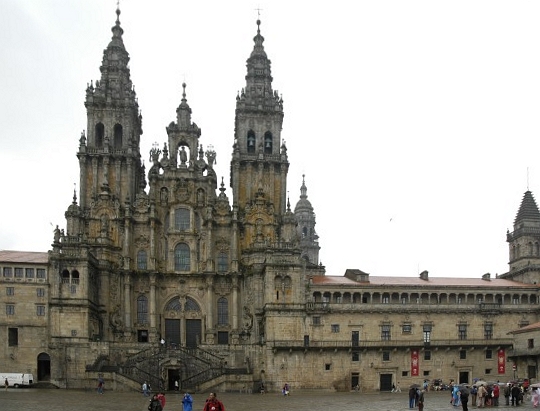
I enjoyed many aspects of the autobiographical memoir of your pilgrimage and journey on El Camino de Santiago de Compostela, or
The Way of Saint James over the Pyrenees and across Spain, ending in the Celtic lands of Galicia and Finisterra at the end of the known world.

Your book, Camino: Journey of the Spirit  provided an entertaining read while I was rainbound with Scottish in-&-out-law relatives in Renfrewshire during the winter holidays (San Francisco is my natal town).

According to Medieval legend, St. James's remains were carried by boat from Jerusalem to Libredon in Galicia where he was buried. In 813, a bright star guided a shepherd to the burial site, Santiago de Compostela. The miracle of St. James also served as a political wedge and a rallying battle cry against the invading Moors. (Wiki)

To travel West, to Tír na nÓg, the island of the ever-young (or the ever-dead), that mythical place beyond the edges of the map, is well attested in Irish Celtic mythology and oral tradition. But the idea that the genesis for this particular pilgrimage would have originated in Scotland under John the Scot literally has one traveling in the wrong direction. Do the geography. France seems to be the likely origin of el Camino de Santiago de Compostela pilgrimage. Spain was another route.

Pilgrimage to the West would have taken the Irish monks (most medieval Scottish monks were Irish-born) rather out of the way of Galicia—to Iceland and the Farøe Islands (or Vineland!). Irish hermits settled there the sixth century, introducing sheep, oats and early Irish language to the islands. Farøes place names to St Patrick and St. Brigit attest to pre-Viking, Irish occupation.

The Irish Saint Brendan (ca. 484–578 AD), was said to have visited the Farøes on two or three occasions (512-530 AD), naming Sheep Island (Farøe means sheep) and Paradise Island of Birds. 


St. Columba was more contrary, sailing northwest to Iona. For the record, Scotland's patron saint Columba (or Columcille—and instigator of the world's first use of copyright) was Irish-born. Iona was not part of Scotland then. There was no Scotland as we know it. The Hebrides were their own entity—settled by the Irish—I might add.

I must however, take umbrage with your passing off the first 
John the Scot (b. 800-815 AD in Ireland)—as being Scottish. He was Irish.  


It is possible that the idea of pilgrimage to the shrine of St. James, or Iago of Compostela was based on Gaulish Celtic tradition and cultivated by the Irish missionaries of Iona, the Hebrides, Scotland and Europe as the Irish monks were the innkeepers of Christianity and knowledge (fios) throughout the Dark Ages in Paris, Rheims, Bobbio, St. Gallen, Laon, and other important Christian centers of learning. Galicia is still a Celtic stronghold to this day.


The Irish also found interesting ways to write themselves into the Bible as they weren't mentioned in the Old Testament as one of the Lost Tribes or otherwise. So they got inventive. And there have always been strong ties between Galicia and Ireland. De Valera, Ireland's first president was Galician. But I digress.


The origins of the Santiago de Compostela legend dates back to ca. 813, roughly the same time Johannes Scotus Eríugena (see also) or, John the Scot, was born, circa 800 to 815 AD. in Ireland—not Scotland. John spent most of his adult life in what later became France under the patronage of Charles the Bald. Charlemagne (b. 742 ) died in 814 AD—a year before John was born. (Now that really would've been an anachronistic miracle having Charlemange converse with John at such a tender age!)

From 575 to 725 AD, Irish monks founded some 150 abbeys on the continent. To paraphrase Paul Gallagher's study, Irish Monastery Movement:
Irish monastic scholars were renown throughout Europe for their knowledge of Greek, [Arabic], and Hebrew. Irish [monks founded European] monasteries that produced the teachers and scholars in Europe and remained centers of classical scholarship until the Viking invasions.
If you had some medieval learning, you'd be aware that the word "Scot" referred to Ireland as Ireland was then known (since Roman times) as Scotia Major and Scotland (the part that was settled by the Irish) was known as Scotia Minor. That part of Scotland was called Little Ireland. Scotia probably means pirate, or raider, so I guess you're in fine order there.

We don't know when John arrived in Paris (circa 830-40 AD?), but he was a monk at the Benedictine Abbey of St. Denis, a place of ancient pilgrimage, the most sacred place to be in France. By 630 AD, it was also one of the richest and most influential abbeys in Europe. Burial ground of kings, a new church was completed by Charlemagne in 877 AD.


It is clear you did some research as you got much of John the Scot's story right, but alas, by making John the Scot a Scots-Irish man, you anachrostically conflated him with a 12th c. Bishpop of Scotland who, curiously, also seems to be Irish-born. John the Scot was more commonly known throughout history as Johannes Scottus Eríugena. Eire is the ancient word for Ireland, and "gen" means born: as in Irish-born.

As to your extrapolation of
William of Malmesbury's story of a king asking John: "Quid distat inter sottum et scottum?" as being a literary Easter egg of your discovery, this is an old story I learned at the knee of my Irish grandmother, it is not particularly obscure.


Carolingian king Charles the Bald had his hands full with the Breton Celts of Gaul who defeated him at the Battle of Ballon in 845. Challenging wits with John the Scot was not perhaps his brightest moment. But John was appointed head of the Court school.


Circa 843 AD, the Frankish king, Charles the Bald (b. 823 AD), not Charlemange as you had noted, asked the famous question of John. Anyway, the story is well attested in medieval manuscripts, and as John was also a famous medieval poet and philosopher, it's a story that often gets repeated.


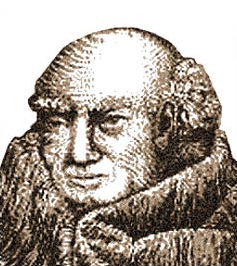
Johannes Scottus Eriugena b. ca. 800-815, d. ca. 874-877 AD, (also spelled Scottigena, Eriygena, Ierugena, and Erigena—means a "native of Ireland.") John the Scot, "a man of strong and eloquent mind", one of the brightest free thinkers of the Middle Ages, was eulogized as "coming out of the darkness like a meteor." A neoPlatonist, versed in knowledge of Greek, Arabic, and Hebrew, wrote that true philosophy is true religion. His work was condemned in 855 and 859 AD and labled "Scots porridge.")


This is the quote in full
The king, Charles the Bald, who was dining with John asked: Quid distat inter sottum et Scottum?
(What separates a sot (drunkard) from an Irishman?)
John replied: Mensa tantum.
(Only a table).

(See a cartoon of the event here.)


Did John the Scot ever go to Santiago de Compostela? We don't know but the first written record of a pilgrimage to Santiago de Compostela was a century after his death.

…the story of St. James was resurrected in perfect timing to spearhead the reconquest of Spain for Christianity, starting with the battle of Clavijo in 844 to the decisive victory at Las Navas de Tolosa in 1212, each time St. James appeared at the crucial moment to turn the tide of battle. St. James, Santiago Matamoros depicted as the knight in shining armour astride a white charger decapitating Moors with his sword. The first written record of pilgrimage to Santiago was when Bishop Gotescalco journeyed there in 950 and in 1072 Alfonso VI abolished tolls for all pilgrims travelling up into Galicia through Val Carce. —THE CAMINO – PAST, PRESENT & FUTURE

Legend has it that John the Scot was invited back to Britain by Alfred the Great (who was educate in Ireland) to become Abbot of Malmesbury, or Athelny, or Oxford, but he was stabbed to death in 884 (10 years after his death) by acolyte-students with their pens for "trying to get them to think." (Philosophers). But seeing how goose wing quills were used for pens—I think this is a flight of fancy.


It's also said that John fled to Ireland at Charles the Bald's bidding as the pope was on a rampage after John's translation of Dennis the Areopagite was published without his consent. One count gives John's death in 874 in Ireland, another in 884 in Malmesbury. But it seems John died the same year as his long-time friend, Charles the Bald, in 877 AD.  —History of Ireland, p 202-3.


John Scot Eriugena was a monk at St. Denis before going to the Carolingian court and Rheims; Eriugena retired to the monastery of Laon, a center of Irish influence in France. —Paul Gallagher, Irish Monastery Movement


I've visited several places where John the Scot was reputed to have taught including the hillfort citadel of Laon. My particular interest is in place name origins and in opidda, or Celtic hilltown forts—I've spent this Christmas season combing Google Earth in Renfrewshire for standing stones and Iron/bronze age forts and standing stones.


(An interesting aside, modern Scots still 'dress the stones' on the Solstice and New Years. Ach it was a hellish oiche maiden (hogmanay) this year (2006-07) with storms and 70 mph winds, but we managed to dress Cloch-na-Rhyderrick, or Clochoderrick, (perhaps I'll tell you about King Rhyderrick, friend of Columcille sometime—I was a student of UC Berkeley's Celtic Studies program.)

The stone of Rhyderrick, some call it Merlin's Stone—depending upon which story you hear—is still dressed today: others were clearly there before us, leaving red flowers and holly. As were the standing stones of the Girdle Toll in Irivne, Ayrshire.

I learned to dress the standing stones (with flowers, red berries, evergreens and whiskey) from my Irish Bantry Bay grannie, so I was the strange American hanging out with the rock, what's geologically called a glacial erratic. It's not technically a standing stone.

The rock, at one time, wobbled and it was used as a druidic judgement stone. It no longer wobbles as the mud is packed in around its base. We were trying not to get electrocuted by the farmer's fence as we so very carefully went over the stone stile—but I digress.

I imagine you must take umbrage at fan divulgence. Rest assured, I'm no raging fan, though I loved many of your movies. I'm a writer, cursed with the gift of the gab—or gob—on a 3 AM caffeind jag, and sufficiently irritated by your stretching of truth—or, shanghaiing of truth in Camino, to write to you, though I assume you'll never see it, nor respond. No matter, I will defend John the Scot's rightful birthright to cyberspace.


(Note bene: As to celebrity, I live with an actor, and I am the daughter of an actress so I know that tangled route. Between matinee and curtain call, my babysitters were the likes of Tommy Smothers, Lloyd Bridges & Sterling Hayden. The Gate Playhouse in Sausalito, Tiki Junction. My mother variously went by Maureen Reilly (nee), Maureen Hurley; one of her stage names was Kellé Hurley (as there was another actress Maureen Hurley); she was a dancer too, she admired you, and had me Out on a Limb reading your books at an early age.

Some of my school friends did make it to the big arena like Robin Williams, so please be assured I'm no autograph seeker nor fame collector. I did so love the writings of Kenneth Tynan, so that bit of story of Kathleen was precious to me...'horsemen pass by.' I'm more like Kathleen, pragmatic, less inclined to believe. But I do have glimmerings of the Sight, which drives my pragmatism crazy.)

Anyway, you might be interested to know that John the Scot was, perhaps, the most famous medieval philosopher, having translated the False-Dionysis treatise on the idea of free will. This treatise lead to an intellectual foment across Europe as John the Scot/ Johannes Scottus Eriugena had again taken up 5th c. Britons Celestinus and Pelagius' cause of free will versus the rote catechism of religious experience through the auspices of church dogma.


Needless to say, the idea of free will was not a popular concept with the pope as it undermined the church's papal authority (and tithing coffers). The pope had also posthumously excommunicated Pelagius for heresey. John the Scot too was well buried as it were, but he was rediscovered in 1680, and repatriated again to become the new rage of intelectual thought, profoundly influencing Schoppehaur and Kant—probably Spinoza as well. (Alas, Spinoza died in Amsterdam a full 4 years before John's treatises were widly published.

I have stood before the small iron gate of the synagogye where Spioza worshipped. So I reiterate, John was hardly as obscure as you suggest in Camino.

What becomes fascinating, however, is that you latched onto John the Scot, he does become the neo-Platonist who reintroduces the concept of individual experience with God, and free will vs church/state mandated group experience of religion. "Saints, sinners, generals, misfits, kings and queens. It is done by the intent to find one's deepest spiritual meaning and resolutions regarding conflicts in Self."

And so, here we are… so I thank you for that rediscovery, or shall I say, revisualized, with a deeper undertanding that comes with age. I too hope to complete the real Camino trek, before I'm 60, if possible (a bum knee—too many falls from horses in my youth—makes it a tough 500-mile proposition as I'm 54 and not at all likely to get younger) so your story (and imagination) did serve to re-inspire me to traverse the same route as Dante, Saint Francis of Assisi, Charlemagne, and Chaucer to go on pilgrimage.


In medieval legend, The Milky Way was said to be formed from the dust raised by  the vast hordes of trekking pilgrims. The Spanish name for the Milky Way is El Camino de Santiago. Folk etymology has it that Compostela means field of stars.


The road of St. John may indeed be lit by a field of stars. Hoever, the Galician word, Compostella, derived from the Latin, compositum, is Composita Tella meaning "burial ground," not Field of Stars. With that, I'll bury this rant.


(This letter was sent to Shirley's webpage. No answer was the loud reply.)


Monday, April 12, 1993

Letter to David Fisher


Tonight, largest full moon of the century, a blue moon. High spring tides earthquakes predicted, California slipping off. You wrote, I am the crab's utensils raised in the sea. . .

I bought blueberries from Oregon & tiger prawns from Southeast Asia— their nacreous color more than skin-deep: stripes of blue and yellow with markings of gold.

I remember one full moon night in a stranger's house, my throat swelled, wind whistling from the north, Ioanna Veronika sitting up with me, talking of Poland, her father’s tattoos. Ausweicz. Waiting for the vigil of pills to work, my memory flickered across the cornea at the speed of light.

Maybe it was poison spray on the blueberries, or Agent Orange. My adrenaline needle locked safely in the Volkswagen (Delft blue like the clams lining the streets of Holland).

Your young child who drowned in the pond; did his short life brush past in such extravagant detail, the artists were jealous? Relative age has to do with selective memory; crib notes replace specific details only the young are capable of noticing—their senses not yet jaded.

Groggy on benedryl, I sat in the hospital bed typing—furious words burned across the page, the poem wasn't finished with me. But the platen stuck; thick carbon banded the bottom of the page, I was no more enlightened than before.

As I defrocked the tiger prawns, the Mekong Delta came to mind: a place I've never been. Once I was too young, & I thought the explosions in the coastal hills at night were bombs dropping in Vietnam, (not poachers).

This age of innocence, the spawning ground for poetry took decades to manifest through the transcendence of mute speech (call it philosophy).

Blame it on destiny, or dyslexia.

I was a painter: everything in terms of shape and color—poetry is a conscious act. I think of you running through the indigo streets of America, naked as a jaybird, screaming, Stop the war! Any war, it didn’t matter.

There are worse nightmares: military commanders who don’t dream.

Tiger prawns in the river deltas of Southeast Asia feed upon the dead; what generation passed before my lips, roseated dawn baptized in garlic and oil. The fire purified them into the acceptable pink reserved for shrimp. Crimson dawn flushed in the pan.

I was sorry to see that lovely blue disappear into the void, as if the speechless sky swallowed its own tongue. I wanted to paint those prawn tails so like wings of blue dragonflies weaving and stitching the basket lakes of the Sierras.

Today, I took your poems, Teachings, into my poetry classes. My students, the bruised survivors of the domestic battlefields: the suicidal girl who jumped in the river in front of her classmates; the one who passed out under the bridge; the boys who touched her; the others watching.

The structure of the poem was a raft to carry us across the River Styx. It tended us like the good doctor's chickens beside the red wheelbarrow.

You said, Write me a sonnet to the color blue; I cannot find my way to the borderlines of a sentence; these thin boundaries by which we live.

Asleep at the stern, the remains of honeyed oatcakes on his lips,
Charon was well paid for his time.


© Maureen Hurley 3/4 - 3/8/93 & 2/26/94


Friday, June 1, 1984

LETTER TO “CRAPPA”


For Roger Kent 1906-1982
Who are we, and where are we going?
—Gauguin

We called you Crappa with a “C”
& you roared with laughter
until your milky eyes watered & your lungs failed.
You said, A toothless son couldn't get it right,
& like a typo, the name Crappa stuck.

While the oxygen tank stood guard by your bedside,
you returned the war trophies:
the New Guinean stone axes to the Bishop Museum,
& the yosegaki banner of heavy raw silk,
with its faded orange sun, to Japan.
Beneath the signatures, rust stains,
or was it old blood?
I wanted to ask: What village, whose son?
Someone translated: Given to ____
in the Great Pacific War fought to the end.
If you believe in it you win.

With the flag, you sent a snapshot of you on the beach:
a young man holding the enemy flag
& the Japanese prisoners all smiling
smiling for the unseen camera. Silent, posed.
Like a knife, the shutter severed a moment from time.

These tropics suck marrow from bone.
You told us about those boxes of freight
marked TYPEWRITERS—FRAGILE, DO NOT DROP.
Inside those boxes, whiskey.
The news nearly leaked out
when someone dropped a box & said, Damned heavy!
Why the hell you need all those typewriters for?
In our dreams we are always traveling towards paradise.
All those dead waiting in Iron Bottom Bay,*
their bones like coral—

All those names calligraphed on the sun,
& the islands: Guadalcanal, Tinian, Iwo Jima
needed witnesses.
But you never told us how it really was:
the ocean, the palm trees & the inevitable waiting.
Generations of fish have spawned in the iron reefs,
grinning skulls, & stained coral sand—
rusted war trophies no one will return.

As coral ages, it whitens like hair.
Like the sky must have done
that terrible second dawn.
Who will tell us the stories
when all the old men are gone?

When the Japanese sent a photo
of the family & flag reunited,
you tried to keep your hand
on top of the new flag from trembling.
The alizarin disc was brighter
than new blood without history,
the thin silk breathed & quivered,
waiting to make an escape.

Honolulu, HI
6/1984,
rev87 (was there a first draft in 82?)
rev. 8/95