|
| Clusters of berries, leaves and flowers of the arbutus unedo. |
A stand of Irish strawberry trees (or Killarney strawberry trees) are fruiting in front of my physical therapist's office in Berkeley. I climbed up on the hood of my car to reach the fruit, but didn't realize I couldn't get back down without loosing my "strawberries." I squashed them all over the place—they were like little golden suns with fiery coronas—when I nearly fell off the car. Would've been difficult to explain that injury to my PT. But I was gluttonous as a bear.
My grandmother often talked about eating the wild arbutus "strawberries" as a child, comparing their flavor to the haws of hawthorn trees. They don't taste anything like strawberries—they just look like them on the outside. In the inside, they're like little orange suns flecked with tiny seeds. The Irish do know the difference between strawberries and arbutus tree fruit. Wild strawberries also grow in Ireland. It's a simile, sweetie.
 |
| Ripe arbutus berries are pebbly & red outside, golden & mushy inside. |
My grannie, who hailed from Bantry, said that the Gulfstream, that warm Atlantic current that bathes the coasts of western Ireland, created an ideal micro-climate where tropical plants flourish—including palm trees. However, the arbutus, or strawberry tree, is also native to western Ireland but, curiously, not to England.
The Irish arbutus was introduced to England from Ireland during the 16th c., and one estate plant catalogue mentions "one very fayre tree, called the Irish arbutis standing in the midle parte of the sayd kitchin garden, very lovely to look upon."
The broad glossy evergreen leaves are about three inches long, an inch wide with a toothed, or serrated edge. And the clusters of fragrant flowers are showy white or pink tinted bells—like most plants in the heath, or Ericaceae family, as arbutus is related to heather and bilberries.
 |
Arbutus berries; the hard yellow ones are unripe.
|
The story goes, that when the Spanish explorers landed in California, they recognized our native madrone. (naming it madroño) as being related to their madroño the stately Arbutus unedo, or the shaggy-barked Arbutus arachne which is more common in Greece, and throughout the greater Mediterranean basin from Albania to Croatia, Lebanon to Sardinia, Portugal to Tunisia, and Iraq—even the Canary Islands. Father Juan Crespi, chronicler of the 1769 Portola expedition, wrote about the many madroños at the “lost bay” of Monterey.
There's an anomaly of isolated arbutus groves in western Ireland—especially in Bantry, West Cork, (my grandmother, from Bantry, gave me the roots of this story), and the Dingle Peninsula on the Kerry coast. Sligo has the most northerly stand of Arbutus unedo in the world, a remnant from the pre-Ice Age Atlantic period. (Or possibly brought to Ireland by the Iberian Bell-Beaker Folk, ca. 2500 BC—renown for their bell-shaped clay drinking vessels, stone wrist-guards, and gold lunulae. Their motto might have been: Don't drink that arbutus beer, and shoot arrows at the crescent moon. Or were lunulae really splash guards?)
The [arbutus] species is one of a select group of plants, fifteen in all, native to Ireland but not to Britain. Taken together, these special Irish natives have come to be known as the Lusitanian or Hiberno-Cantabrian flora, owing to the fact that their nearest relatives are to be found on the Iberian Peninsula. How this flora arrived to the blank canvass that was post-Ice Age Ireland is not well understood, but it is possible that they spread overland along the changing coast of the British Isles as they emerged from under glacier and sea. —The Strawberry Tree, UP CroninDr. Cronin (M.Sc. in Plant Science, University College Cork and a Ph.D. in Microbiology, University of Limerick), writes that the eighth century Irish legal tract, Bretha Comaithchesa (laws of the 'hood) ranks caithne (arbutus) as a fodla fedo — or third division tree, used for manufacturing charcoal or making small pieces of decorative red inlay.
It's an Irish toponym: Ard na Caithne (Ardnaconnia), or Strawberry Tree Heights (a headland—also known as Smerwick, or Butter Bay) is located in the heart of the Kerry Gaeltacht, near Corca Dhuibhne—the tip of the Dingle Peninsula. Ard na Caithne (with its arbutus groves, laden with little golden apples of the sun) is a significant site: it's the home of Dún an Óir ('Fort of Gold'), an Iron Age fort; the site of sixth-eighth c. monastic settlements, the Gallarus Oratory (the oldest beehive hut in Ireland—I saw it from the road but my cousin wouldn't stop the car) and An Riasc; and for the horrific Siege of Smerwick (1580), where the surrendered Irish freedom fighters were slaughtered by the British Lord Grey. The sacred ground was stained by more than just arbutus berries that day.
Ard na Caithne was home to 17th c. Irish poet and harpist, Piaras Feiritéar, who surrendered to the English after the Confederate Ireland wars, was granted safe passage, but was hanged in 1653. The ruins of his castle still stand among the arbutus trees at Ard na Caithne and his poetry lives on in the oral tradition.
Ard na Caithne was also home to Séamus Ó Muircheartaigh (1877–1927) who wrote under the pseudonym, An Spáilpín Fánach (The Wandering Labourer—also the name of his song). Séamus Moriarty emigrated to San Francisco (via Butte, MT) and knew my grandparents through the Gaelic League. His son, Cuchulain was a civil rights activist with César Chavez—the Lawyers’ Committee for Civil Rights Father Cuchulain Moriarty Award is named after him. But I digress....
There are four Old World species, and six New World species of arbutus. Our hybrid ornamental street tree, Arbutus x Marina is named after the Marina in San Francisco where it was hybridized. Its parentage is a mystery but it may be a cross between the Arbutus unedo and Arbutus arachne. Old World arbutus is related to our native madrone and its cousin, manzanita (Arctostaphylos). Our Pacific Madrone, or Madrona, is Arbutus menziesii. We often ate the tiny astringent berries that taste like sour crabapples. After all, manzanita means little apple in Spanish.
Kerry has the largest arbutus stands in Ireland. A recent DNA pollen study suggests the arbutus was brought to Kerry via Northern Spain more than 4000 years ago, possibly by Iberian copper miners. But that doesn’t explain the Sligo stand.)
The Irish "strawberry" is called caithne in Irish, arbousier in French, madroños, alborocera, alborio, borto, or albedro in Spanish, corbezzolo, or albatro in Italian, koumaria in Greek, and bearberry, or Cain apple in English. I guess Cain used them to slay Abel. Or maybe he fed him unripe fruit loaded with tannins.
The fruit has a vague anise odor but tastes more like tangy rose hips—which it's related to. Edible prickly red armor on the outside and a creamy-mealy amber flesh, it's a superfruit (like açai) loaded with vitamin C and pectin. The fruits are high in sugar and contain bioflavonoids, malic acid as well as tannin (more here). But the yellow unripe fruit can cause nausea (so it is said).
My friend Chris Devine said, "There used to be a pub in Killarney called 'The Strawberry Tree'. Never understood why. 'Til now." The Strawberry Tree Pub, 23 Plunkett Street, Killarney.
The Greeks make a liqueur called koumaro, which is often added to tsipouro (a type of ouzo), the Portuguese say they are very brave trees and make arguardente de medroñho or medroñheira from the berries, and the Italians make many liqueurs: in Corsica they make a Liqueur a l'Arbouse, in Sardinia they make fior, and Acquavita di Corbezzolo.
You can also make marmelades, jams, jellies, pies, dried fruit, vinegars, pomaces, sorbets, and a grilled meat sauce (like cranberry, or quince sauce), from arbutus berries. You can plop those overripe berries into a bottle of red wine to make a killer sangria, or use the fruit as a red dye, and the bark to tan leather. I wonder if the prized red Cordova leather was dyed with madroño berries? Research for another time.
Because the fruit and flowers appear on the tree at the same time, the Romans thought the arbutus held magical powers: flowers were also placed on graves as a sign of respect. In The Tenth Labor of Heracles, the blood shed by the giant Geyorn was said to produce a tree with both flowers and fruit at the same time when the Pleiades were high in the sky—the arbutus.
Hieronymus Bosch's painting (housed in Madrid since 1939), "The Garden of Earthly Delights," was originally called "La Pintura del Madroño", or "The Painting of the Arbutus." Why a strawberry tree? I bet something got lost in translation... The Tuscans use "strawberry" as an exclamation referring to ahem, the male anatomy.
In Latin, Arbutus means "struggle." But because the bear is so closely associated with the arbutus tree in myth and lore, I suspect that Artio (Dea Artio) a Gallo-Celtic bear goddess was also involved. Near Berne, a bronze sculpture of the goddess Artio is seated beside a small tree, holding fruit in her lap, feeding the bear—with the inscription: Deae Artioni / Licinia Sabinilla.
An Italian website on plants also hypothesizes that Arbutus may be a Celtic word:
Pliny the Elder enigmatically explained that 'unedo' means unum edo or "I eat one", and so I did. And another. Whether he meant you could eat only one because it was so awful, or eat one and not be be able to stop because it was so good (and you'd get a hangover, or a bad case of the farts), we'll never know. But I can safely say no struggle (or bears) was involved. They're tasty.
The Irish "strawberry" is called caithne in Irish, arbousier in French, madroños, alborocera, alborio, borto, or albedro in Spanish, corbezzolo, or albatro in Italian, koumaria in Greek, and bearberry, or Cain apple in English. I guess Cain used them to slay Abel. Or maybe he fed him unripe fruit loaded with tannins.
The fruit has a vague anise odor but tastes more like tangy rose hips—which it's related to. Edible prickly red armor on the outside and a creamy-mealy amber flesh, it's a superfruit (like açai) loaded with vitamin C and pectin. The fruits are high in sugar and contain bioflavonoids, malic acid as well as tannin (more here). But the yellow unripe fruit can cause nausea (so it is said).
 |
| Warty arbutus berries ripen on the tree tend to burst if you pick them. |
When eaten in quantities this fruit is said to be narcotic, and the wine made from it in Spain has the same property. —A Modern HerbalBerries will ferment right on the tree (berries have been measured up to 24.6° Brix, or 5 to 14% alcohol—and no liquor license needed); the birds get inebriated as they gobble up the beer-berries. A few peasants figured out that if the birds could get so blasted on arbutus berries, that they couldn't fly a straight line, then so could they. (Wing flapping ensued....)
My friend Chris Devine said, "There used to be a pub in Killarney called 'The Strawberry Tree'. Never understood why. 'Til now." The Strawberry Tree Pub, 23 Plunkett Street, Killarney.
 |
| Sun-dried arbutus berries are like dried apricots, full of flavor. |
You can also make marmelades, jams, jellies, pies, dried fruit, vinegars, pomaces, sorbets, and a grilled meat sauce (like cranberry, or quince sauce), from arbutus berries. You can plop those overripe berries into a bottle of red wine to make a killer sangria, or use the fruit as a red dye, and the bark to tan leather. I wonder if the prized red Cordova leather was dyed with madroño berries? Research for another time.
Because the fruit and flowers appear on the tree at the same time, the Romans thought the arbutus held magical powers: flowers were also placed on graves as a sign of respect. In The Tenth Labor of Heracles, the blood shed by the giant Geyorn was said to produce a tree with both flowers and fruit at the same time when the Pleiades were high in the sky—the arbutus.
Horace praises the tree for its shade and Ovid for its loads of 'blushing fruit.' Virgil recommends the young shoots as winter food for goats and for basket-work. Gerard speaks of it in his time as growing in 'some few gardens,' and says, 'the fruit being ripe is of a gallant red colour, in taste somewhat harsh, and in a manner without any relish, of which thrushes and blackbirds do feed in winter. —A Modern HerbalThe Coast Salish used all parts of the sacred Pacific madrone for medicine. The Coast Miwok, made a tangy brew from madrone and manzanita berries. According to the Coast Salish an anthropomorphic form of madrone tree sap went fishing at dawn but came home late one morning and melted in the sun; the other jealous trees stole all his sap. I don't know if this occurred before, or after they discovered that the berries could be fermented.
Hieronymus Bosch's painting (housed in Madrid since 1939), "The Garden of Earthly Delights," was originally called "La Pintura del Madroño", or "The Painting of the Arbutus." Why a strawberry tree? I bet something got lost in translation... The Tuscans use "strawberry" as an exclamation referring to ahem, the male anatomy.
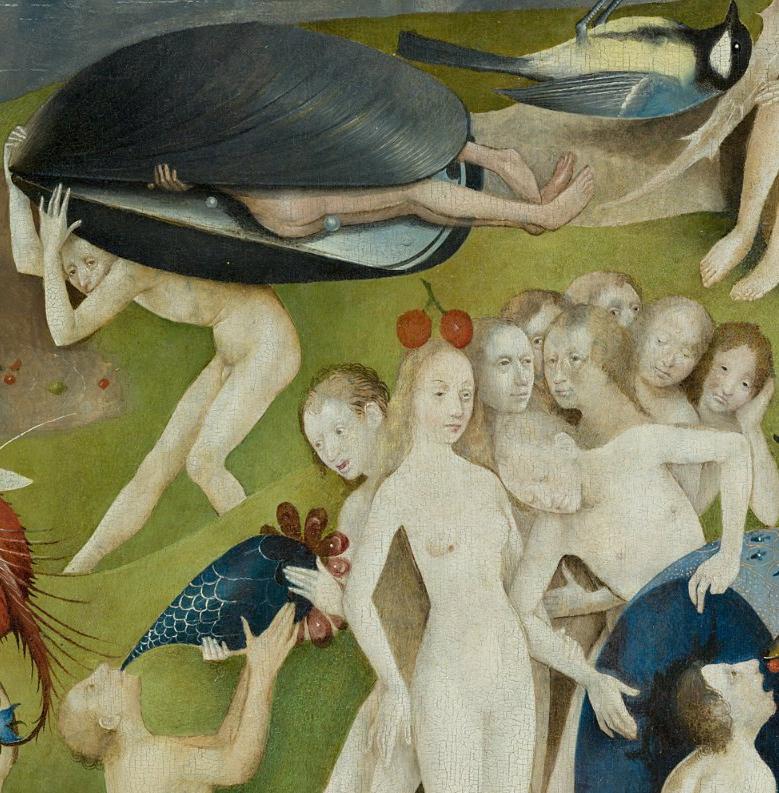 |
| The fruit above her head, identified as cherries, is a convenient explanation for popping the cherry, but if you look at the fruit, they're not cherries, but warty arbutus berries. Cherries elsewhere in the painting are painted smooth-skinned, with a reflective sheen. —Mo H. Image from Wiki |
 |
| Strawberry trees. Clearly there is other symbolism going on. Either Bosch didn't know what they really were, or he had other ideas for including them. —Wiki |
In Latin, Arbutus means "struggle." But because the bear is so closely associated with the arbutus tree in myth and lore, I suspect that Artio (Dea Artio) a Gallo-Celtic bear goddess was also involved. Near Berne, a bronze sculpture of the goddess Artio is seated beside a small tree, holding fruit in her lap, feeding the bear—with the inscription: Deae Artioni / Licinia Sabinilla.
 |
| (Artos means bear in Celtic. (Delamarre 2003 p. 55-56), from Proto-Celtic *arto-, from Proto-Indo-European *h₂ŕ̥tḱos, bear.) —Wiki |
An Italian website on plants also hypothesizes that Arbutus may be a Celtic word:
The name "Arbutus unedo" probably derives from the Celtic. In fact, "ar" in Celtic means "bitter, astringent" and "unedo" is the name that was used in ancient times which probably derives from the three Latin words "unu-off edo" "I eat only one" to mean that one should not exaggerate and give in to temptation because of the pleasantness of its fruit which when eaten in excessive quantities gave nausea and constipation. —MEDICINAL PLANTS, ElicrisoA gluttonous bear eating arbutus berries from the strawberry tree figures prominently in the coat of arms of Madrid, Spain. In Puerta del Sol, the city center of Madrid, there is a statue of a bear gobbling berries from a madroño tree.
Pliny the Elder enigmatically explained that 'unedo' means unum edo or "I eat one", and so I did. And another. Whether he meant you could eat only one because it was so awful, or eat one and not be be able to stop because it was so good (and you'd get a hangover, or a bad case of the farts), we'll never know. But I can safely say no struggle (or bears) was involved. They're tasty.