Sunday, October 6, 2013

English evolved from Scandinavian?

"The English language brings out the best in the Irish. They court it like a beautiful woman. They make it bray with donkey laughter. They hurl it at the sky like a paint pot full of rainbows, and then make it chant a dirge for man's fate and man's follies that is as mournful as misty spring rain crying over the fallow earth." T E Kalem —from Brendan Behan's play, Borstal Boy
A Science Daily post from Nov, 2012 suggests that English evolved from Scandinavian. Two professors in Norway make an interesting hypothesis that English evolved from Old Norse, making English North Germanic rather than West Germanic.
Jan Terje Faarlund, professor of linguistics at the University of Oslo said: "What is particularly interesting is that Old English adopted words for day-to-day things that were already in the language. Usually one borrows words and concepts for new things. In English almost the reverse is true—the day-to-day words are Scandinavian, and there are many of them," says Faarlund.
Here are some examples: anger, awe, bag, band, big, birth, both, bull, cake, call, cast, cosy, cross, die, dirt, dream, egg, fellow, flat, gain, get, gift, give, guess, guest, hug, husband, ill, kid, law, leg, lift, likely, link, loan, loose, low, mistake, odd, race, raise, root, rotten, same, seat, seem, sister, skill, skin, skirt, sky, steak, though, thrive, Thursday, tight, till, trust, ugly, want, weak, window, wing, wrong. Linguist Makes Sensational Claim: English Is a Scandinavian Language
I nearly snorted and circular breathed in my cuppa tea when I read that headline. I can hear the linguistic shit hitting the fan now.

Awww, there goes Beowulf!

So, let me get this straight, Everyone in the British Isles loved the Norse so much,   (they refused to have much to do with the invaders), that they couldn't even say Gimme an egg, Sister! in their own language(s) before the arrival of the Vikings? (It was mainly the Anglo—Saxons vs the short-lived Viking Danelaw (50 to 100 years of rule); most of the Britons were holed up in Wales or Brittany.

Sister and egg aren't even loan words ferhevinsakes! I'm no linguist but even I can poke holes in this argument. People usually borrow words and concepts for new things like computer, floppy disk, USB. Not for things they already know, or already have.

What would Bede say? All this splitting infinitives and hairs sounds like the Scandinavians are once again being culture pirates. A vikingr the academics will go.

Their hypothesis: English evolved out of Old Norse several centuries later? Not congruently? What about language drift, or convergent evolution—or even being closely related via the Indo-European continuum? It's like saying English (or Irish) evolved from Sanskrit because there are parallel words in both languages.

Sister is a prime example from the Proto-Indo-European continuum: *swésōr is recognizable and sounds familiar enough to be merely a dialect, rather than another language. No matter how many dialect armies and navys are conjured up, I'm fairly certain that Old Norse did not exist during the era that PIE was evolving. And then there's egg—clearly a very close word in Proto-Germanic:
From Middle English egge, from Old Norse egg (“egg”), from Proto-Germanic *ajją (“egg”).
Well, maybe egg isn't such a good example as Chaucer uses both ey, and egg. That could be a case of Norse and Anglo-Saxon eggs side by side. One could argue that that hard gg vs soft jj sound was borrowed from the Norse. I won't mention bull eggs here. (But you can look that world up if you like).

I wonder why outlaw wasn't on that list? That and law, and penny, schilling, etc.

The article was daft. (Not as daft as the eejit who recently posted that English has always existed in Great Britain. (MJ Harper, ‘The History of Britain Revealed’) The Belgae in Gaul and Britain were Celts, not Germans, ya twit. (It reads something like How the Martians Saved Civilization.) English ain't the mother tongue. Really.) Whose tongue was in what neither cheek?

Then there's the syntax argument:

•(subject/verb/object), SVO vs. Old English verb endings. Just to liven things up, Irish is VSOP. Good initials for brandy too. The Vikings, though they settled in Ireland too, had almost no impact on Irish other than town words, nautical terms, jarl, and window.

•Prepositions at the end of a sentence (a very good thing they didn't look at Irish!)

•My personal favorite: genitive (plural)s (The Queen of England's hat).

•Split infinitives (I promise to never laugh again). Well, there are no infinitive verbs in Irish, but we're not talking Irish here.

I admit I'm shaky on syntax. I know by doing. (By writing, that is). But since I had to go and make that strange segue, apparently the Norse absorbed more Irish words than the Irish themselves did of Old Norse words: "bachall (staff, crozier) >bagall; capall (horse) > kapall; lám (hand) > lámr; tarb (bull) > tarfr; and teine (fire) > dini.

Perhaps most surprisingly of all, one Norse word for a ship lung is taken from the Irish long." —Medieval Review Ó Muirithe, Diarmaid. From the Viking Word-Hoard: A Dictionary of Scandinavian Words in the Languages of Britain and Ireland. Dublin.

I'm sure I could argue some silly string theory that Gaelic impacted Old Norse, as spoken by Vikings, who, were, after a generation or two, no longer even Norse, but Norse-Irish, and Norse-Scottish. Irish and Scottish were pretty much the same people in those days as there was no Kingdom of Scotland yet. I can't use the term "one people" because nobody was unified.

Viking men did not bring any Norse women with them when they settled new turf. They just kidnapped Irish and Scottish women—and women are the bearers of language and culture—they taught their kids to speak Irish. And to a lesser degree, Norse British/Anglo-Saxon, mix, etc. (Iceland and the Faroes have a higher Irish/Scottish mDNA, than Norse yDNA but I already wrote about that).

So why would Old English suddenly die out, leave a linguistic void, and Old Norse suddenly take its place, and then evolve into modern English? Old habits die hard. We won't mention the other four English dialects that concurrently existed in the British Isles. Who has read Beowulf, or Sir Gawain in the original dialect? Or Blind Harry's Wallace?

OK, so the "Pearl Poet" author of Sir Gawain was from ca. the 14th c., as were Blind Harry, and Chaucer a little before that, and Beowulf was written in the late 10th or early 11th c., but the texts do serve to demonstrate that several different Middle English dialects survived, Not Old Norse. BTW, Beowulf was translated into late West Saxon from an older English dialect.

Clearly this is a case of lunatic fringe instead of Celtic Fringe. Like I said, those Norse academicians are cultural pirates! I don't think anyone was hypothetically sober at the time. Bring on Monty Python's version of Njall's Saga! Skol pafiskin!

Saturday, October 5, 2013

Olaf the Peacock's Irish Mother


Heiðarvíga saga, story of the heath-slayings

  The Icelandic sagas are prose histories of the Norse —and Celts—who settled in Iceland during the 10th - 11th centuries. The sagas, capturing an earlier oral tradition, were probably set to writing during the 13th and 14th centuries.

"Some of the richest and most interesting writings from medieval Europe come from one of its furthest corners: during the 13th and 14th century Icelanders began to write down the stories they had collected orally from previous centuries. These sagas would cover events in Iceland and elsewhere, going back to the days when the island was first discovered and settled back in the ninth century. They are stories of family feuds, outlaws and the occasional monster lurking somewhere the uninhabited stretches of the Iceland.' —Medievalists.net 

The only problem with this post narrative (above) from Medievalists.net is that when the Viking Norse "discovered" an "empty" Iceland, and Norse colonists arrived ca. 870-930 AD—there were already Northern European settlements dating from ca. 400-500 AD. And the other problem with Medievalist's statement is that those Icelanders were not wholly Norse, their slaves and concubines were often Irish or Scottish. Of course, viking means pirate, so I guess pirating of history itself is fitting.

Naddod was a Faroese Viking (by way of Shetland) who is credited with the discovery of Iceland. Grímur Kamban became the first to settle ca. 825. Grimur was either Irish/Scottish or Norse Irish, with a Gaelic nickname. 

Garðarr Svavarsson is credited as the first Scandinavian to have lived in Iceland one winter. He was was married to a woman from the Hebrides. A Hebridean woman would be Irish/Scottish, not Norse as the Norse did not bring Norse women with them. They took Celts as slaves. The Vikings were NOT the first Northern Europeans in the Faroes, and Iceland. (Not to mention, the Inuit.) Unless, of course, one were to definitively define Icelanders (and Faroes Islanders) as half-Scandinavian and half-Celtic.
The medieval chronicler Ari Thorgilsson said Ingólfr was the first Nordic settler in Iceland, but mentioned that "Papar" – i.e. Irish monks and hermits – had been in the country before the Norsemen. He wrote that they left because they did not want to live amongst the newly arrived pagans.  Ingólfr Arnarson —Wiki
Hjörleifr had been murdered by his Irish slaves because of his ill-treatment. Ingólfr hunted them down and killed them in the Westman Islands (Vestmannaeyjar, named after the slaves).
This tidbit's significant as you will see from the excerpts of the tale posted below, the Laxdaela Saga. The sagas seem to be "fictionalised distortions of real societies.…" and 'family sagas' of Icelandic literature are quite distinct, the overall network of saga society is consistent with real social networks." It's a strong possibility the Icelanders were following in the tradition of Irish recording of oral tradition, though a few centuries later. They could also have had Irish scribes living among them.

(BTW, what is this skewed fascination with Vikings anyway, and why is most everything we associate with Vikings, is plain old wrong? Like (Celtic) horned helmets? Where did we pick up this romantic ideal fraught with bogus information? Does it date back to Hitler, and his search for the "pure" Aryan race? Or is it an earlier Victorian hangover? But I digress.)

The ceremonial Waterloo Helmet is the only existing Celtic bronze horned helmet —La Tène  c.150–50 BC. —Wiki

The word "viking" was first popularised at the beginning of the 19th century by Erik Gustaf Geijer in his poem, The Viking. Geijer's poem did much to propagate the new romanticised ideal of the Viking, which had little basis in historical fact.    —Vikings  

A romanticised picture of Vikings as noble savages began to take root in the 18th century, and this developed and became widely propagated during the 19th-century Viking revival.

Norse myths were religiously adopted by Germanic Neopaganists in Germanic countries during the early 20th c., and in most of the the English-speaking world during the 1960s. It's probably during that latest Neopagan adaptation that most of our Viking misconceptions were spawned.

There's an Irish oral tradition that a Tralee mariner Brendan the Navigator visited Iceland and the Faroe Islands circa 400 AD. Bantry's (where my family is from) patron saint is Brendan. (Based on an immram, or voyage tale, the Brendan Voyage tale was transcribed in Latin in 800 AD.) The description of Brendan's "insulae" (islands) is remarkably similar to the Faroe Islands.

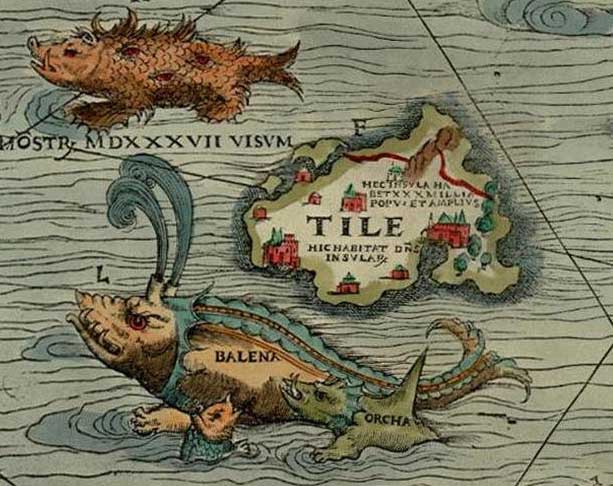
One fanciful name for these mythical northern islands was Thule, which was reported to be "a six days' sail north of Britain, and near the frozen sea." (There was persistent belief that islands to the west of Great Britain recorded as early as 330 BC. Whether fact or fiction, it fed the questing beast)  

The Irish Tír na-nÓg (Land of the Ever-young) was another mythical island to the west. Reason enough to set sail—because they were there. "The Icelanders' own records mention about 400 original settlers "with mostly Celtic nicknames" who were living in Iceland previous to Norse colonization. (Clements). The significant part of that statement is that settlers were there previous to Norse discovery.

Thule or Tile on the Carta Marina of 1539 by Olaus Magnus, located northwest of the Orkney islands, with a "monster, seen in 1537", a whale ("balena"), and an orca. —Wiki

My Bantry grandmother told me that the Irish monks brought sheep to the Faroes, and the name, though Nordic, means sheep islands. And sheep islands do figure into the Brendan tales.

St. Brendan described the largest island as the Island of Sheep (Streymoy?) A bay in the southern part of Streymoy, is called Brandansvik (St. Brendan's Bay). His "bird paradise" might be the island of Mykines. There are several Faroe places named after the Irish monks (papar) including remote caves. —Faroe Islands Review History
The Faroes were part of a trade network with Dublin as a hub, and many Irish women made their way there as wives or slaves. DNA analysis shows that 84% of Faroese females are of Irish or Scottish descent.  —Faroe Islands Review History
(NB: contrary to modern belief, Irish monks were NOT celebate.)

Dicuil, in the 2nd half of the 8th century, wrote of "heremitae ex nostra Scotia" ("hermits from our land of Ireland"—Scotia was Ireland, not Scotland!) who lived on the northerly islands of Britain for a hundred years until the arrival of Norse pirates. An Irish nickname of Faroe islanders, Na Scigirí, possibly refers to the Eyja-Skeggjar (land of bearded men).

Northern European settlements (whether Irish, Scottish or Pictish) in the Faroes have been archaeologically dated to ca. 400 AD.
“There is also good evidence that they [the Celts] had sails: there is a model boat from Ireland that dates from about 100 BC that has a mast, which could be a model for Celtic boats more generally,” Jennings said. “There is not so much evidence of sails in Norway until as late as 700 AD. It is therefore more likely that these early Faroese settlers came from the British Isles.” —Andrew Jennings, Nordic Historian
The Vikings settled in the Faroe Islands before they went to Iceland, ca. 800 AD. Then, 60 years later, Iceland was supposedly "discovered" by the Norse. That's the equivalent of three generations in the Faroes before the Norse shoved off to Iceland. Plenty of time to hear about those Celtic settlements in Iceland. During the settlement of Iceland, the Faroes, the half-way mark, was the only provision stop for grain, meat and water.

The Faroe Islands, a remote North Atlantic archipelago, stepping stones half-way between Scotland Norway and Iceland, were inhabited 500 years before the Vikings arrived. Archaeologists taking "scientific samples for environmental archaeological analysis from the medieval Viking settlement,“ did not expect to find evidence of a previous culture.

Archaeologists Mike Church and Símun V. Arge said: “We uncovered some burnt peat ash containing barley grains under the Viking longhouse. It was not until we had it dated that we realized what we had found.” Barley is not indigenous to the Faroes, and there were "old field systems that didn’t seem to tie into later settlements." Church concluded, “There is evidence of Irish hermits sailing into the North Atlantic islands in a passage by an Irish Monk called Dicuil in 825AD.”
Many other islands lie in the northerly British Ocean. One reaches them from the northerly islands of Britain, by sailing directly for two days and two nights with a full sail in a favourable wind the whole time … Most of these islands are small, they are separated by narrow channels, and for nearly a hundred years hermits lived there, coming from our land, Ireland, by boat.
Here's the rub: Icelanders have maintained that they were purely Scandinavian, and that they lived in genetic isolation for 1200 years. Note that there were no Irish mentioned in the equation. The Irish were expunged from Icelandic oral tradition and there's almost no mention of the Irish in the Icelandic sagas that were recorded around the 13-14th centuries—with the exception of the Laxdaela Saga, and Burnt Njáll—whose name sounded suspiciously like the Irish Niall. (Kin to 5th c. Niall Nóigiallach, whose middle name was randy: he dinna wear pants; his Y-DNA genes got around. M222 sub-clade rools.) But in the 1970s, my English professors insisted there was NO relationship—merely coincidence. Icelandic peoples were Scandinavian.

Then the human genome mapping project got up to speed. Lo, there were chinks in the Viking armor. Iceland had relative genetic isolation, yes, but their preferred bedfellahs of choice were Irish captives—who did not come or go gentle unto that good night. And who were the real transmitters of culture? The Icelandic-Irish women who spoke to their children in Irish, and in some cases, gave them Irish names. And we know this because they just happened to turn up in Icelandic sagas.

New genetic studies in Iceland uphold a deep Irish connection in that the DNA genome tests reveals that 20% males and 63% females are of Irish ancestry (Irish Roots in Iceland). "The population of the Faroe Islands appears to have the highest level of asymmetry in Scandinavian vs British Isles ancestry proportions among female and male settlers of the archipelago." mDNA analysis shows that 84% of Faroese females are of Irish or Scottish descent. Mitochondrial DNA is passed from mother to offspring. (Then there is the mystery of the Celtic sheep in the Faroes.)

Burnt Njáll the lawyer, and Erik the Red(head) had prodigious tempers. (I'm gathering that when the omens were bad, the Vikings burnt all the lawyers.) All that loose Irish DNA might explain some of those Viking redheads too. Tróndur í Gøtu of the Færeyinga Saga, was described as having "a shock head of red hair, and…freckled of face and right grim of look", features which were inherent to Faroese, who are said to have descended from Thorstan the Red's daughter. (I bet she was Irish). The appearance of red hair and freckles were exotic enough to be recorded in the sagas. By contrast, most Norse were dark-haired, not blond.

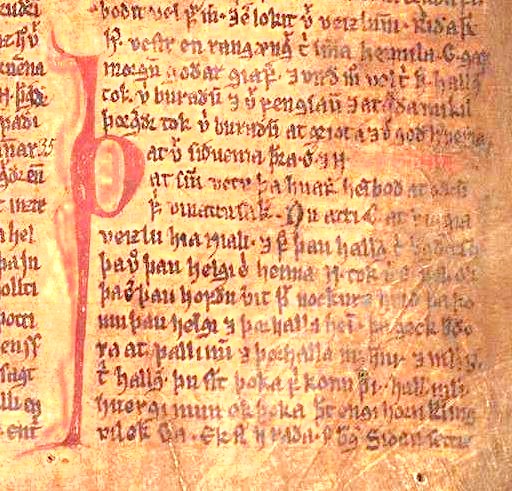
Excerpt from Njáls saga (Möðruvallabók AM 32 folio 13r cia. 1350). —Wiki

At least 60% of the Icelandic and Faroese.maternal gene pool hails from Ireland and Scotland. And the Viking contribution: "mtDNA lineages from Scandinavia to the populations of Iceland, Orkney, the Western Isles, and the Isle of Skye are 37.5%, 35.5%, 11.5%, and 12.5%, respectively." The mDNA study shows that the majority of female settlers came from the British Isles, "whereas ~80% of male settlers were Scandinavian." This data confirms Irish oral tradition. 

The study also notes that "the Gaelic contribution to the Icelandic mtDNA pool may have been at least as large as that from Scandinavia." (mtDNA and the Islands of the North Atlantic). That means there were almost no Scandinavian women emigrating form Norway. Norse-Irish women from Dublin and the Hebrides, yes.

I found interesting research on Iceland where "genealogy is an integral part of the culture — 80% of all Icelandic people who have ever lived can be traced on family trees." The country is isolated geographically, with little migration from other places ever since a few hundred Vikings and some Celts arrived almost 1200 years ago. (Decodeing Iceland's DNA). Note the acretion: "and some Celts," and these Celts are?

Islandia map by Abraham Ortelius ca 1590 —Wiki

Contrary to what we've been led to believe, Iceland was not an isolated Norse settlement unto itself. There's also a slew of Icelandic-Irish names which is curious as Vikings were more conservative naming boys than girls: Njáll/Njála, Brjan/Brjánn, Dufniall/ Domnall, Konall, Kjartan, Kjallakr, Kaðall, Kormakr, Meldun, Melpatrikr, Oskar, Patrek, Brigit. 

An Icelandic village, Patreksfjörður, is Padraig's Fjord. Vestmannaeyjar means "Irish Island." Írafell, and a mountain called, Írafellsbunga (are Éire (Irish) Fell, and  Éire Mountain, respectively), and Kjaransvík (Ciaran’s Bay) in the Westfjörðs, which seems to have been an Irish-Icelandic stronghold.

Of particular interest is the placename, Melkorkustaðir, once home to an irate Irish slave girl, Melkorka (see my story below), who was mother of Olaf the Peacock, a prominent character in many Icelandic sagas. None of this proves the Irish were in Iceland beforehand, it just proves they were there right alongside the Norse—in the thick of things. It also strongly suggests the sagas are based on historical fact.

Recent archaeological digs in the Faroes and Iceland note that there were Northern European settlements from ca. 400 to 800 AD, that definitely predate the Norse settlements. Archaeologists are reluctant to suggest as to who these people actually were. Chances of finding burials and intact DNA are slim to none. 

Also, Vikings often built on top of the older sites—which means their either integrated, or wiped the other settlers out. We know the earlier settlers raised barley, cut peat turf, and built soil beds with ash and seaweed—like Aran Islanders.

Another fact that seems to get buried in the Viking version of history is that female Icelandic settlers; slaves and concubines were predominantly Irish. Aud the Deep-minded, (Unn, or Auðr, daughter of Ketil Flatnose (ruler of the Hebrides)—he kicks off Laxdael Saga). Aud/Unn/Auðr, wife of Olaf the White, King of Dublin (853 AD), brought Irish slaves with her to Iceland from Dublin (by way of Caithiness). (Clements). She may not have been Irish, but it's possible that her father was Norse Irish, (and the chances of her mother being Irish?) which makes her…

At any rate, Aud/Unn/Auðr was a singularly unViking woman: she secretly built a ship in the forest (Scandinavian women were not allowed to own ships; had fewer rights—unlike Irish women who were on equal footing with men); she sailed to Orkney; married off one of her granddaughters; and then set sail for Iceland. She then freed all her Irish slaves in Iceland. Another reference noted she had a child with an Irish slave. I guess the attraction worked both ways. Fiercely independent Aud sounds similar to 15th c. Irish pirate queen, Gráinne Ó Máille ( c. 1530 – c. 1603).

Olaf the Peacock's grandfather, Höskuldr Dala-Kollsson's mother was Thorgerd Thorsteinsdottir, daughter of Thorstein the Red, who was son of Olaf the White, King of Dublin, whose father was Hiberno-Norse warlord Ingjald Helgasson. I won't even mention that several these Icelandic and Norse characters who settled the Hebrides, or came from there, before emigrating to Iceland, were also Norse-Irish. (And no you won’t be tested  on this.)

Ketill Bjǫrnsson, aka Flatnose (Old Norse: Flatnefr), was a 9th c. (Irish?) Norse King of the Isles—who led raids AGAINST Norway. (Orkneyinga Saga). However, Irish genealogy recorded that Aud's father was also Irish King Aedh. (Annals of Ulster). It could be a scribal error, or there was more than one outrageously uppity Norse woman named Aud. And Aud sounds a lot like Aedh. A female version of Hugh? 

Ketill sounds suspiciously like Kaðall/Cathal, and Flatnefr may be a phonetic corruption of Find (white). Scratch the surface—most emigrating Norsemen had Irish mothers, their children had Irish nicknames. (Jennings and Kruse).

The sagas of Iceland's colonization attempted to expunge all record of any Irish presence, but the Laxdaela saga-maker captured an Irish family pedigree—probably because the story wouldn't work without the Irish connection. Unique among Icelandic sagas, the Laxdaela Saga seems to have a feminine hand—recording matrilineal lineages in both Norse and Irish; perhaps it was composed by a woman, in Western Iceland, ca. 1230-1260.

Excerpts from the Laxdaela SagaChapter 21:

Wednesday, October 2, 2013

TALKING FISH & SEA WHISPERERS


The sounds that fish make
when no one is listening
in the koi pond, do they mouth
& baise-moué l'ail to the sky
and dream of swimming among the stars?
But in the depths of the ocean,
there's a piscean clack & growl,
the sonic boom and tump of black drumfish
travels up canals through bedroom walls—
their song akin to water-boarding, or a hydraulic engine.
At Strawberry Cove, the first high tide after the full moon,
we'd wait for the grunion run, they'd crawl out of the sea,
the only fish that must be caught by hand.
But the town drunks and Asians gathered them up in buckets
In a bioluminescent sea, we heard shoals of herrings
fart out a Morse code—like an angry army of Jimmy Choos
let loose in Grand Central Station at rush hour.
Those droning toadfish, those heavy metal rockers
sitting by the dock of the bay, no Country Joe & the Fish
singing We don't give a damn, drive Sausalito houseboaters
stark-raving-mad on warm summer nights.
Cusk eels jackhammering in the key of sea,
force sleep-deprived oceanographers inland.
We listened to miked pirañas, castenetting
like SETI radars in the Steinhart Aquarium.
Runaway seahorses, chirping clownfish,
yellow croakers, pistol shrimp, cod & haddock
thrumming up an aquatic din—
fishily belting it out in the name of love.
From Ensenada to Point Lobos
fish are chorusing a grand stadium "wave."
No passive acoustics, they sing the body electric
with a cacophony of barks and grunts
worthy of a Liberian ship engine with thrown rods.
Midshipmen looking for love in all the wrong places,
might have stumped Aristotle and sailors alike.
But no one has ever heard a butterfly fish make a sound.
Merely a whisper and sigh of fin and wing, like rustling leaves.

10/2/2013

OCTOBER POLKA


In the car overnight, she left Polish
dogs meant for Aunt Jane & Toddy's dinner.
We make jokes: did the dogs bark in Polish?
Almost. And the car stank like Hell's Kitchen.
What if they were dressed in sauerkraut gowns?
Then they would wildly dance to the polka.
At least she brought in garlic & onions.
There is no telling what would've happened
to the Polish dogs & onions—alone,
snuggled in the back seat, unchaperoned.
You know: one polka leads to another.
The wolfish accordions unleashed &
keyed up, they would howl at the Hunter's Moon;
& then the frenzied music would take flight
upsetting bright stars in the steadfast night.


10/2/2013


POLKA GLOSS

No, it's not quite a sonnet,
no couplets held in time
not much by way of rhyme
nor a good volta in the 8th line;
trains of thought were overturned
at every whimsey and whim
but in every line, ten syllables,
yes, count them, one and all,
not iambic, but a veritable sonnet,
so Shakespearean, plus one.

See Keats' Bright Star
abab-cdcd-efef-gg

Tuesday, October 1, 2013

10,000th TWEET

10,000th TWEET

Fitting that my 10,000th tweet
was in tribute to Seamus Heaney:
for 10,000 birds have taken flight
across the dark shoulder of the night.


10/1/2013

PROSE POEM

Remembering Séamus Heaney at UC Berkeley


Tribute to Séamus Heaney at UC Berkeley. Featured readers were UC professors (Heaney taught at Berkekey) Robert Hass, Robert Tracy, Peter Dale Scott, Morton Paley, Geoffrey O'Brien, C.S Giscombe, Catherine Flynn, Eric Falci, James G Turner, plus many from the community including Vice Consul Kevin Byrne, Neil O'Neill, Leslie Cody, Shay Black, and myself.

Someone read Digging, another read Oysters (two of my favorites—nearly committed to memory. The Burren is another.) Several read selections from Station Island: IV was brutal, Dantesque, about The Troubles. Neil read Sloe Gin.

We told Seamus stories, the poet's job was to explore the marginalia of life, and since I'd studied medieval Irish mss at UC, I read The Glosses. Three poems of kites, it became a theme. Someone read from Heaney's Beowulf, then Dante, another read pithy literary criticism notes.


And stories, yes, the stories. There's no such thing as a short whiskey or a short poetry reading. Bob Hass recounted what Heaney told him: "Sex is in its infancy in Ireland." Our homework was to read Heaney's Irish erotic poem, The Skunk, of course.
 
Among the storytellers were my favorite seanchaí professor and Joyce scholar, first translator of Osip Mandelstam, Bob Tracy who testified at Lenny Bruce's obscenity trial. I think he testified at Joyce's too.

Fellow Marin poet and longtime friend, Bob Hass read from The Apple Trees of Olema—my home stomping ground. At an Occupy Cal demonstration at UC Berkeley, Hass was hit in the ribs by a police officer with a baton. His wife Brenda Hillman was shoved to the ground. There's a YouTube video of it. Bob got back. He wrote about it in a New York Times opinion piece, "Poet-Bashing Police." 11//19/2011.

Both Bob Hass and Geoffrey O'Brien took part in Occupy Cal. O'Brien spoke out to a police officer who was hitting a Berkeley student because he would not break his link in a human chain. The police officer then hit O'Brien in the ribs, a reaction he would later call "brutal."  

So many new faces (at least to me). Lovely man, Peter Dale Scott. Some may know his Coming to Jakarta: A Poem About Terror.  And Eric Falci, C.S Giscombe whose work has appeared in Callaloo, Another Chicago Magazine, Hambone, New American Writing, o.blek, Obsidian, River Styx, Situation and Samizdat.  

Irish VIce Consul, Kevin Byrne

Our new Irish Vice Consul, Kevin Byrne, a Dublin man. His first event in America? A Séamus Heaney tribute. Seamus Heaney would've enjoyed it.
 
The Maude Fife Room temperature was 110°—due to an electrical eruption this AM at UC Berkeley, nobody could figure out how to turn off the heat. It was a real Dante's Inferno—so we held the memorial tribute to Seamus Heaney in the hallway at Wheeler Hall, UC Berkeley—t'was like a longship cathedral of poetry. Perhaps it was the feast Hall, Herorot. Beowulf was invoked in both languages. Dante too. It was a real poetry roast. Heaney would've like that.

It was so hot even in the hall, we shed what clothes we could, my silk scarf became an impromptu podium cloth. By the time the reading began, there were chairs all the way to the far end of the hall.

At first they thought the electrical explosion was a bomb. Huge fireball. Someone stole copper wire from an underground utility station. The entire campus was w/o electricity for most of the day. Instead of cancelling classes, students took out their smartphones as a source of light, and carried on.

So the least we could do, was to carry on ourselves. Even with every window and door on the 3rd floor open, cross ventilation, the room was like an oven—a bit like standing in front of the glory hole of a big glass kiln.

An amazing turnout. Even if we were all nearly broiled in the process. It was hot as a crematorium. A smithy's forge. The Goibniu, Himself was in attendance. 

 Afterwards, we ate and drank and told stories—we spread a little joy. Bob Hass sad to take the leftover food from the reception, and as we walked down Telegraph, so many homeless. So we gave a shoutout to Occupy Telegraph with a poet's funeral feast. And so we fed about 20 folks on the street. Poco a poco, that's how it's done. There's a poem embedded in this somewhere.

Ta to Bob Hass & Christopher Miller for an abfab event.

Fitting that my 10,000th tweet was in tribute to Seamus Heaney: for 10,000 birds have taken flight across the dark shoulder of the night.

Noli timere!
 a Shéamus! Rest in peace.


Saturday, September 28, 2013

Colum Cille & the Picts notes

Another Facebook comment  from my Celtic Surnames and Place-names - History and Origins group. We were discussing the roots of placenames with aver, inver. I created a long list. I will post it here later—when I find it! I am conversing with someone whose handle is Celtic England (in italics.) The rest is mine


St. Adamnán, 9th abbot of Iona (627– 704 AD), in a centennial celebration of his distant cousin, St. Columba, scribed Vita Columbae. St. Adamnán wrote that Colum Cille (521-597 AD) was able to converse with King of the Picts, Bridei ca. 565 AD in Inverness.

Of course, Inverness—Inbhir Nis—is a Gaelic word—dating from at least 679 AD—according to Adamnán.

Bridei is mentioned in 558–560 AD in the Irish annals. The Annals of Ulster report "the migration before Máelchú's son, i.e., king Bruide"—which makes him a pagan Irish king in Pictland? Or Bruide— son of Máelchú, or Maelcom/n, an Irish name, or Melcho; or possibly even Maelgwn-Welsh. It would certainly explain why Columba, who spoke Irish, could converse with him. An overlooked detail.

Adomnán of Iona, Life of St Columba, tr. & ed. Richard Sharpe. Penguin, London, 1995.

(Celtic England wrote that Maelchu and Malcolm are different names. He also notes that he used a translator.)

I'm merely gathering from many sources. But we're not so much debating the spelling of King Brude's father's name—the thread is more watery in nature as in river, mouth. Pictish vs Gaelic place names, no?

One source noted Maelwyn. It was also distinguished as Maelchon vs com. I wondered over the spelling. Máel (disciple/follower of) + Con (Máelchon), or Máel Com. Máel + Coluim = Malcolm. I found this too: Mael means 'prince' in Breton and Welsh.

Celtic England: given that he subdues a monster in the river ness we might not want to take what Adamnan says too literally, especially as the Vita Columbae was finished in about 703 and that Columba's visit to Bridei's court was supposed to be in 566 or so. 


Nonetheless, Inverness was an Irish place-name in Adamnán's time. That, we can take literally. Forms: inber; Inber; indbir. VC, Book 1: chs, 26, 29, etc.

Abhainn is Irish for river. Don't let the spelling throw you off*, it sounds like Aven, or Awen.

(*IE in which the consonants count for very little and the vowels for nothing at all.)

You disparage the text because of the Loch Ness monster? Note that Adamnán refers to the monster as an account told to Columba by the Pictish inhabitants of Loch Ness: "according to the account of those who were burying him…"
"ON another occasion also, when the blessed man was living for some days in the province of the Picts, he was obliged to cross the river Nesa (the Ness); and when he reached the bank of the river, he saw some of the inhabitants burying an unfortunate man, who, according to the account of those who were burying him, was a short time before seized, as he was swimming, and bitten most severely by a monster that lived in the water;"
ALIO quoque in tempore, cum vir beatus in Pictorum provincia per aliquot moraretur dies, necesse habuit fluvium transire Nesam: ad cujus cum accessisset ripam, alios ex accolis aspicit misellum humantes homunculum; quem, ut ipsi sepultores ferebant, quaedam paulo ante nantem aquatilis praeripiens bestia morsu momordit saevissimo: —Book II, ch 28.
Vita Columbae was written in Latin–so I doubt that the translator's veracity is in question. Vita Columbae was written 100 years after the death of St Columba aka Colum Cille (521-597 AD) —to commemorate the centennial of his death. It would've been completed loser to 697AD  than 700 AD. So 703 AD is a bit late. Besides, Adamnán was doing some serious traveling in 703 AD, the year before he died. No time to work on a treatise that was due in 697 AD. 
"Adomnan had almost certainly finished the Life of Columba before traveling to Northumbria for his last visit. Bede tells us that Adomnan had an extended visit in Northumbria and then traveled to Ireland where he discussed eucmentical relations between the Irish and Rome and then he returned home where he died before the next Easter"
http://www.fordham.edu/halsall/basis/columba-l.asp


Merovingians notes

A Facebook group I belong to, Celtic Surnames and Place-names - History and Origins is:
A repository and discussion about the history behind placenames and the original Celtic names pre-anglicisation and before local corruption. Feel free to post in any Celtic language or English. 
For some peculiar reason, someone in the group keeps posting bits on Merovingians. What they have to do with Celtic Sur- and Place Names, is beyond me. Of course, he didn't see any problem with posting something on the Merogingians in a Celtic studies group. So I decided to tie in his post with a Celtic context.

Understand that the moderator is a bit harsh if you post anything without some sort of back-up analysis. I might also add, these guys are mostly GoBs—good old boys—clubbers who barely tolerate women posting in the group. As a result, few women post, after being ridiculed and bullied. I'm sure these GoBs are not aware of their generic or genetic arrogance, but sometimes they can be quite funny, if not bordering on the rabid. 

I love the subject mater, and so, call them on their general twattiness and happily arm-wrestle with them. Besides, I don't respond well to attempted silencing.

I posted:
Merovingians seem to be wholly Frankish at first glance, but at an anthropological dig I attended in Rogny, near Marle, we could see the Merovingian dressed with Celtic La Tene style artifacts—specifically Celtic style silver inlay belt buckles. Lots and lots of them. 
Of course, belt buckles don't point to identity, but it does suggest many of the Merovingians may have been Gallo-Frankish. All those Gauls of Gaul weren't killed off by the Franks. 
The Merovingians were also called the "long-haired kings" (Latin reges criniti) as their preference for long hair was considered an oddity among the short-haired Franks. And Irish monks held great influence in the Merovingian court—St. Columbanus, especially. And most of the Merovingian clergy were from the Gallo-Roman aristocracy. 
I got a lot of flack for this comment—bordering on the mysogenistic. Rip me a new asshole. So I deleted my comment. As if archaeology wasn't proof enough that there was indeed a Merovingian—Gaulish contingency.

So this then, sir, is my revenge.


Saturday, September 21, 2013

Cloudburst


A cloudburst in September? Really? I didn't think it would reach the Bay Area. Now I'm drenched, covering up the outside summer beds.

Hmm, I knew I shouldn't have washed my hair yesterday. Just got an extra rinse. Rainwater conditioner. 

Malcolm posted that rain had hit Sonora about an hour ago. I just didn't think it would hit us. And on the equinox too. We usually don't get rain until November. There go the huckleberries. They weren't sweet at the beginning of September. Not enough heat. Not now either.

I paid for that drenching, my virus came back to visit.

Wednesday, September 18, 2013

SNAPPY MOUSETRAP haiku


Erm. One snappy mousetrap
just caught the other mousetrap
in its snappy jaw.

Junior mouse is still 
on the lam. Cute bugger but
clueless as they come.

Now I have 10 traps 
all set and at the ready. 
Springform death; heh heh.

It's a three-mouse-night. 
Make that 4. One at dawn. But
I was too tired to count.

Many false alarms, 
traps bit air, I tried a new
configuration.

Bleary-eyed I lay
a row of traps in a row.
All snickety-snap.

Junior: an ex mouse. 
Maybe now I can get plan 
a decent night's sleep

added 9/17

Tuesday, September 17, 2013

Fall fever


Ugh, day 3 of virus, no more sore throat or dull earache, but everything has that strange new penny feeling, an odd synaesthesia of light and sound, lets me know I ain't quite out of the woods yet. Acute hearing out of both ears at once is vastly overrated. Worse than a hangover. I only made it worse by being in denial about it. 

One thing good about a raging virus is that I've read a string of bad ebooks & haven't had apoplexy over myriad typos. Simple plural nouns don't need apostrophes, just because it's spelled right doesn't mean it's  the right word. And what's with authors evading com pound  words? It's a safe bet that if an Amazon book teaser is spangled with gratuitous apostrophes & typos, that I won't download the ebook. Just sayin'.

I found a poem I had written Aug 20, Cluster Sneeze—where I was sneezing so hard, I lost my brains. That must've been inception of this virus. Yes, I had a bout of it a while ago—replete with earache and headaches. It's like it dribbles out the symptoms in drabs so it's not so obvious. Sneaky, crafty virus. Mimics allergies. Had me fooled for quite some time as Sudafed takes care of the earache. I was beginning to run through a mental list of obscure diseases—including the plague—like a first-year med student. Now the symptoms have stacked up like a domino race. Gotcha! I could do without the jelly-knees, though. Uh-oh, want a little nappy-poo. I NEVER nap. Definitely still in the woods.

Speaking of obscure symptoms. The mice are back. I bumped Big Mama off but Junior is still on the lam. How's that for a plague segue? Junior is the size of a quarter. Too small to trigger the traps, he snags the pecans and makes a run for it. I now have acute cat's hearing but not the reflexes to go with it. Probably a good thing or I'll be leaving little prezzies on the doorstep for Neil. I have 10 mouse traps set TEN! And Junior climbs right over them, he's so small, they don't even snap. I am thinking of velcro, sticky fly paper, or hair wax removal gunk. I once accidentally caught a mouse with the gunk when it spilled over. Really, really.

Friday, September 13, 2013

Coming up Redhead


Blogspot has this nifty overview feature called Traffic Sources so I can see some of the Google search keyword parameters that lead people to my posts. (Other than my biggest pageview fan, vampirestat.com—a spamspider, or a web crawler domain.)

Nearly all my traffic sources are redheaded questions. OK, I get that. THE VIKING IRISH REDHEAD GENE (at 27,127+ page views out of a total of 95,005 page views) is, by far, my most popular blog post. It accounts for 1/3 of all my blog traffic. (But, why this rabid fascination with redheads? Especially Vikings and redheads—she asks.)

By comparison, a spin-off redhead post, Red-headed step-children ranking number 5 on my top 5 blog posts, at 952 page views, doesn't even come close. Not even remotely. I even changed the filters on my Hot Blogs list. So THE VIKING IRISH REDHEAD GENE post is somehow Google-charmed.

So I created a spin-off post to see what would happen:
REDHEADS IN THE GRECO-ROMAN REALM
Would it too leap off the charts? At 86 page views, that would be nada. To level the playing field, I even used the exact same searchword list (like i did with this post): 
Celts, ginger, Irish redheads, red hair, red hair gene, redheaded stepchildren, redheads, Scottish redheads, Viking redheads
I used to think that traffic popularity had to do with total back-links within a blog post. So I began to add links right, left and center—to see if it made any difference. Nope. Let's just see of this post suddenly gets a lot of hits. I changed the title to Coming up Redhead.


However, in my all time Top Ten Pageviews by Countries list, I have 48,663 US readers ('splains that lack of historical acumen), my Number 9 ain't even close at 6023 UK readers, and in Ireland, the land of redheads, only 747 readers. No Scandinavian countries even made the Top Ten list. 

So, I guess that answers my question: who are my readers. So if I may extrapolate, Americans, in love with a skewed post-neoclassical notion of repatriation of Vikings as a romantic ideal, assume that raping Irish women lead to red hair? 


Not that any of this is even remotely blogworthy, but….

But when I saw this latest search question in my traffic sources, I nearly had butt-apoplexy:

are celts descended from vikings? 

(Warning: dangerous segues ahead.)

AGH! Talk about acute historical cluelessness. Really?


FWIW: List of outside traffic source search words (note: the largest entry is Vikings!):

red hair gene
redhead origin
"types of red hair"
redheads decent
are red haired people warriors
worrior model red hair
redhead origin red hair gene
where do red heads trace back to
what countries is it good to be a redhead
ancestory of natural strawberry blond fair skinned womanhighest redheads per country
why do some redheads have afros?
are redheads descended from africans
do the spanish like the irish red hair
red hair gene portuguese
german red head experiment
ancient history of redheads
origin of fair hair freckles blue eyes
what is the dominant eye color of red heads
algernon redhead wife willing
do men lime redheads

irish redheads
ireland women redheads
redhead irishman
redheaded celtic male
the irish vs the scots genes
why is it thought that red hair is irish?
are irish people known for red hair
where did the irish get their red hair
red heads in ireland when did they come about?
do all redheads have irish
does red hair mean your irish
are all gingers of irish descent
irish red hair gene discovered
irish genes
irish travellers genes
red hair regressive gene irish traveller
samhain redheads
ginger hairy scottsmen
vikings genes irish scotish
irish red hair vikings
irish genes red hair vikings ireland
redheaded irish people related to vicking chieftans
are blue eyed irish descended from vikings
when did blond hair ireland

are there redheads in russia
redheads in ukraine
are redheads nordic
red hair norse trait
redheads in norse mythology
does red hair come from scandinavia
are redheads from norwegian dicent
did the vikings bring red hair in ireland and scotland
are redheads from ireland really vikings
red heads in iceland
redhaired dane
redheads in sweden
pictures of swedish redheads
between skandinavia and eastern europe where are green eyes & red hair more prevelant
can scandinavians have redhair
vikings genes irish scotish
irish red hair vikings
viking redhead
vikings red hair
red hair green eyes vikings
are blue eyed irish descended from vikings is it true that red headed people desended from vickings
were there dark headed vikings
scandinavian genetic traits
viking bloodtype
norse blood type
is a+ blood from the vikings?
? how dna can tell you have viking blood
vikings steal irish women
scandinavian rape irish
redheads of viking rape
irish genes red hair vikings ireland
are celts descended from vikings

are celts descended from vikings? What?
nononononononooooooooo! 

And it's killing me to leave the spelling errors stet.

Are Celts descended from Vikings? Let's see. A timeline would help, dude.

The Late Neolithic Copper Age Bell Beaker culture (ca. 2800 – 1800 BC), is probably the ancestor of the Celts. They had distinctive pottery drinking vessels and made barley beer. The Bell Beaker culture was a linguistic ancestor of Proto-Celtic. Also linguistically associated was the Pre-Hallstatt  Urnfield Culture in central Europe, as an ancestral culture of Celtic culture.

Iberian Bell Beaker culture had strong ties with Ireland—which hosted an archaic form of  Bell Beaker culture. Irish copper from Kerry had a specific lead isotope—was found in N. & C. Europe from ca. 2300 to 1700 BC. Central European Únětice Culture which predated the Celtic Hallstatt culture, also had strong ties with Britain and Ireland during the formation of Bronze Age Europe. (Irish gold lunulae, and later La Tène gold torcs).

Celts date back to at least 1200 BC (if not earlier), during  the Late Bronze Age, (Hallstatt culture was in full swing by 800-450 BC), followed by the La Tène culture (450 BC) of antiquity— and the Vikings first landed in Great Britain ca. 789 AD, but didn't stick around.

When did the Celts arrive in Ireland? There were several migrations. The Late Bronze Age, or earlier—mid 2nd millennium BC.
The arrival in Britain of cultural traits identified as Celtic is usually taken to correspond to Hallstatt influence and the appearance of chariot burials in what is now England from about the 6th century BC. Genetic studies regarding Y-DNA Haplogroup I-M284 have concluded that there was Late Iron Age migration of Celtic La Tène people to Britain and then onto north-east Ireland. —Wiki
The first recorded Viking raid in Irish history occurred in 795 AD when Vikings from Norway looted the island. —Wiki
The Vikings (from Old Norse víkingr) were seafaring north Germanic people who raided, traded, explored, and settled in wide areas of Europe, Asia, and the North Atlantic islands from the late 8th to the mid-11th centuries AD. —Wiki
The Viking Age is the period from 793 AD to 1066 AD in European History, especially Northern European and Scandinavian history, following the Germanic Iron Age  In England, the Viking Age began officially on 8 June 793 when Vikings attacked the abbey on Lindisfarne. The Vikings who invaded western and eastern Europe were chiefly pagans from Denmark, Norway and Sweden. They also settled in the Faroe Islands, IrelandIceland, Scotland (Caithness, the Hebrides and the Northern Isles), Greenland, and Canada. It is unknown what triggered the Norse expansion and conquests. This era coincided with the Medieval Warm Period (800–1300) and stopped with the start of the Little Ice Age (about 1250–1850) —Wiki
Maybe the person who wrote that query was dyslexic or didn't know the difference between BC and AD.

The only way it could remotely work is if you switched the query around:
are Vikings descended from Celts? And even then it would be problematic, unless you were referring to the Dublin Norse who took Irish (and Scottish) wives. Their children and grandchildren (who settled Iceland and the Faroes) would be Viking Celts. Agh! So their descendants were Vikings descended from one branch of Celts.

But that wasn't the question, was it?

Can I fish-slap someone now? What about a fish dance? With a redheaded salmon? Huh? Huh? Can I? Can I? Please, pretty please with a redhead on top? (No, not that way! Ya scurvy-ridden....)

This moment was probably brought to you by Monthy Python. Or not.

It is, however, Friday the Thirteenth.

Algernon?

What's Algernon doing in this list anyway? FWIW, even a detailed Google search didn't shed light on that one. (Sigh.)

Heh. This list ought to keep them occupied.

Wednesday, September 4, 2013

Denial, a river of ice. (Knee chronicles)


Rather than fight it,
I should ice my torn knee.
Denial, a river of ice.

Someone tells me they had to ice their knee for two years.. Two years?  Same bag of frozen peas? Talk about mushy peas. I also use frozen peas. I like petit pois best. They mold to the anatomy. I need surgery but insurance is stalling. I got a cortisone shot on Friday and it made a huge difference—I was able to get around at the Highland Games, but it's only a stopgap. Paying for it now. I've kept off my knee the whole week. It really makes a difference. It still has phantom twinges of pain for no reason, but icing always helps. Trying not to take Advil. Reading a lot of ebooks these days to pass the time.

Facebook conversation added 9/19

Tuesday, September 3, 2013

Mouse Wars, redux

MAUSIAN DIARIES: MAUSGATE 9132013

9/3 It's officially Fall. Forget the equinox. The mice are back. A little early. I can't help but think they are foul weather predictors. Like little groundhogs. Apparently that lone August mouse was not an anomaly.

Over Labor Day weekend, the mice moved in and got cozy with the tea cozy and all my Rabbie Burns napkins. This won't do. Mice in the condiments/ tea drawer. I spend the morning pulling out kitchen drawers, and cleaning. TIme to dust off Victor-the-trap. If I can find it. Aha! Under the stove. Still set, patiently waiting all these years for a wayward mouse.

9/7 Gotcha! Good old Victor-the-trap, fit as a fiddle after years of benign neglect. Badda-boom! Can't say the same for my metal clippie mousetrap—a casualty of time. Rust is a great equalizer. I still have hope for my plastic clippie mousetrap—but my faith is eroding.

Uh-oh, the second one is a big mama mouse. Still nursing. There will be more. Mark my words.

91/2 All quiet on the mousy front. Victor-the-trap has been silent for days. Maybe I was lucky and got them all.

9/15 Oh no! Mouse poop on the cutting board. Fuck Rabbie Burns' To a Mouse. This is war. They've wiped out two old boxes of D-Con, but here's the dilemma: Dora the Cat is hanging out, so something's gotta go. Wow. I haven't checked out these cabinets in years. So that's where they went.

After a comical interlude where I asked the clerk for espejos (mirrors) instead of Miguel Ratóncito mouse traps in Spanish, I snagged two old-school mouse traps at the Dollar store. Do you know how hard it is to find old fashioned mousetraps? Now I get Build a better mousetrap. Otherwise, it's D-Con all the way, baby. Poison. Arsenic and old mice. But what about the environment? The outside cats? I'm uneasy about using all this poison.

My last major mouse invasion was Fall Equinox, 2009. See MOUSE WARS (warning: cute mouse pictures). Sure, we've had a few wayward mice since then. But nothing big. They never stuck around. Not like this.

9/17 Victor is victorious. But the knockoff mousetraps are worthless. I bumped Big Mama off, but Junior is still on the lam. Junior is the size of a quarter. Too small to trigger the traps, he snags the pecans and makes a run for it. What if he's carrying a disease?

How's that for a plague segue? I madly Google The Plague. No outbreaks reported—not even at Fallen Leaf Lake. I imagine I have symptoms like a pre-med student before exams. Swollen glands? That can't be good. No fleabites.

I have…a virus: oh, thankgawd. I also have acute hearing from my earache but not the cat reflexes to go with it. Probably a good thing or I'll be pouncing on the curtain and leaving little mouse prezzies on the doorstep for Neil.

I read up on house mice again. Definitely different than field mice. I learn that house mice (from Asia) are the same species as lab mice and pet store mice. And the chances of wild mice carrying disease are about the same as a pet hamster or rabbit. It's just that they poop all over the place. Now I'm afraid to use my cutting board. Three-seed baguette is out. Fennel seeds remind me of mouse turds.

Sorry, I'm not into those hav-a-heart traps. What's the point of live traps? All I'm doing by relocating the mice, is sicking vermin on unsuspecting neighbors. Too NIMBY. And all that goin' out to the country and feel-good wild release crap? Pl-ease! House mice are not native species. I repeat. Not native. Got it? They're from Asia, just like city rats. Introducing non-native species into a rural ecosystem is far worse than killing them in a humane manner. Besides, the mice won't even enter those live traps. Far too smart for that.