Thursday, April 30, 2009

ODE TO A PENKNIFE


Ode to my lost penknife
that once rested cool
and sleek as a schooled minnow
nosing in the murky depths
of some young boy's pocket.
The deer antler handle, chipped,
diamond cotterpin askew,
Siamese twinned blades of grey
carbon steel, pitted with rust,
arabesqued from myriad sharpenings,
blades that once carved goose quills
or initials in wooden desks with inkwells
and sweet hearts on slender saplings,
in a silvery copse, now grown ancient
with the ponderous weight of age,
bark hearts splaying out into Crab nebulae,
blades that once sliced eggs, cold potatoes.
cleaned fingernails, and pared apple cores,
picked teeth, and in that order.
A small child's penknife,
a memento I carried for three decades,
a small something from my grandfather,
I carried it forth daily into the next century,
played a final game of hide and seek in my pack,
only to be flushed out by Homeland Security.
No: Olly olly oxen free. Or Kick the can.
or frustrated oceans of tears could save it.
It was branded a threat to national safety,
and as we missed our flight,
in it went to the TSA dropbox,
destined for the slag heap.
No more feather quills to sharpen,
no more words to carve and hone
on formica desks or on the wings of planes,
only this fleeting farewell.

Wednesday, April 29, 2009

PIKE STREET MARKET

                 — from a photograph

A smiling Japanese woman
leans into the camera lens
holding her right hand up to the sky
never dreaming she was a waitress
offering the belly of a lavender fish
swimming in a billboard sunset
with neon green lettering like scales
pointing the way to the next fishy bar.
Her head blocks the "et" in Market
so it reads Mark, in tall red letters
as in X marks the spot or maybe
she's waiting for ET to phone in for sushi.
As the sun sinks over her shoulder,
hanging from the fishmonger stalls,
small fairly lights like the braille ellipsis
of an unfinished thought lighten
the end to a perfect day in Seattle.
Perhaps she was thinking of a sushi sunset
done up in salmon and pale wasabi stars.

NEVER


Never say never. I never thought I could keep up the writing, a poem a day and I was right. Some days, I wrote several poems, other days I completely dried up. I dried up before taxes (because I was doing taxes) and this whole week's been a wash.  A lot of strenuous teaching and materials prep.

To do by May 1st: poem # 12 (revise),write poems # 13, 14; poem 22 (revise) write 23, 25, 26, 27, 28, 29, and 30. That's a whole lotta work to pull off in 2 days. Today I imagined I'd get several poems done, I revised, edited and posted 17 prompts. A few had several versions, so it's more than 17 poems total. 

Then I have to get the CPITS poems in for the anthology as well. Friday is going to be one busy poetry day! One new principal meeting too. I'm scheduling three new schools for poetry.

Tomorrow is pretty full with teaching and prepping for tomorrow night's ISED class at SFSU. I was interrupted today with a teacher meeting at a new school and scheduling, follow up emails, etc. I never got back on track. I edited one classes' poems; two more to go and I'm tired, it's late and Hulu beckons. Rescue Me blares: It's another day c'mon, c'mon... and I watch the Twin Towers fall in slo-mo for the unteenth time.

Never gonna make it.
No, never. Never.

Addendum May 1, got the poem a day challenge down to all but 6, but several poems shifted focus in revision, and so I have multiple poems for some days, and none for others. I probably posted 30 poems total counting haiku, which doesn't count for much. With an estimated 25K poems being posted, one of mine being chosen for the final 50 poems roundup are slim to none.

But it was a good practice, and I met on Facebook, wondrous poets who were also posting poems. Pam Uschek's work is luuninous as is Molly Fisk's. They were the ones that kept me in the great PADI race.

Friday, April 24, 2009

After the Solstice, Machu Picchu


© Maureen Hurley 1984 All rights reserved.


On the northern slopes of the Andes, 
the packhorse veered sharply from the trail
that led to the fabled lost city of the gods,
makeshift hacamore biting into his eyes
he was running blind, but his hooves knew
the paths, both sacred and profane.

I pulled the runaway's head into in my lap,
thigh muscles burning to maintain balance,
I gasped as the thin air whipped my face
but his eye was a lake of fear rimmed by a pale shore
as I hammered on his hollow forehead with my fist.
Perhaps he was remembering his Arabian blood,
his tail was a prayer flag raised high to the wind.

The grey gelding raced up the slope to a chicha bar.
Unaccustomed to the live weight upon his back,
his hooves tattooed a drumroll of panic on the hard clay.
At the last second, I lifted a leg over his neck,
as he slammed sideways into the adobe wall,
the wooden pack frame splintered into kindling
and the hut resounded like a wood drum.

The startled Indios abandoned their beer gourds
and scattered to the four directions like crickets
away from the flash and churn of hooves and teeth,
and a crazy gringa astride a packhorse, sidesaddle,
without a bridle, only a stiff lariat across his nose.


* * *


Like Frost's pony, the dappled packhorse
was used to stopping there. No frozen woods
or downy lake, this was an alien land. He stood shaken,
with heaving flanks, head hung low, nostrils flaring red,
as the Indios gathered around this Epona in their midst.

The poet rode up to translate us out of that mess.
The Gates of the Sun and Moon to the Lost City
of the Incas opened wide to let us in.
We made peace offerings on the intihuacana.
We made poetry, equating it to eternal love,
we played a benediction of mathematical equations
with the piercing stars of the Southern Cross,
compared it to the emptiness of the sky to the south,
and descended into the inferno, as a forest fire
raged on like a ruby-throated monster gone mad
on the terraced slopes of Machu Picchu.


But when we returned home from the Cordilleras,

the poet went south, without so much as a tu
or an
entonces or even a pues, he translated
the burden of a mid-life crisis, into the classic
binary subdivision with a blonde student—
younger than his daughter.  Of course.
A descendant of the ill-fated Donner Party,
she was born into a cannibal hunger for men,
and a survivor's lust for horseflesh and melodrama,
he blamed her strange appetites on the vagaries
of weather and stars but in the end, 

she left him for another woman.


24 a travel-related poem

Thursday, April 23, 2009

FAMOUS PEOPLE I'VE KNOWN

On Facebook, someone asked me about the famous people I've met, and I replied in no particular order. Small fragments of stories began to appear, some are pasted here, in hopes I'll do something with them at a later date. 

Some fragments I've already blogged on about, but I'll want to compare the language, to see if I have any fresh perspectives, or new leads...otherwise, it's merely archival, and maybe it should stay in draft form. Tho I don't think I ever wrote about the musicians or Scatman...

Scatman Crothers, Kate Wolf, Bob Dylan, Janis Joplin and Grace Slick. I've met so many of the legends.

Well, it WAS the 60s...and 70s and 80s...Janis lived on Arroyo Road at Camp Barbano. She'd be getting up about the time we walked home from high school...

Grace Slick—we wandered into her house in the middle of a drug deal...there were red roses on the piano and a sunken hot tub in the living room. She came out in a black ecru hemmed  babydoll neglige (I kid you not), makeup caked under her eyes, and she was quite cross with us for being in her living room.

Scatman Crothers was at the Rio Theater in Guerneville we all piled into a booth at the coffeeshop and gossiped the night away. He was a great storyteller. What I remember is Scatman imitating Cab Calloway's famous song, wth a Heidi heidi hei. I took notes, it appeared in The Paper with photos. All my tear sheets have melted back into the earth after the biblical rains we had in the 1990s. I have the negatives somewhere. 

I met Kate there at the Rio too. Nina Gerber was on guitar. Man, that girl can play. It was a fundraiser for something—was it for Kate's own leukemia? I don't remember. Kate kept quiet about it. I remember she sang so drearily, I was bored to tears. It was only later that I found out about the leukemia and I felt so bad for panning her performance. But it was dreary.

Never actually talked to Janis, she was pretty hung over... We were shy high school kids, so we merely said hi as we went up the road home.

Stan Getz, Etta James, Dr. Maya Angelou, Irving Layton and Donald Sutherland...

Stan Getz wrote a letter to The Paper praising my Russian River Jazz Fest photography. It was a thrill watchinig him backstage playiing Take Five, one of my mom's favorite theater sayings. (Note to myself: I have to find my famous people letters and scan them).

Steven Gross who also was working for The Paper, took pix also, I secretly think he coveted my job, and he coincidentally stole my negatives of Etta. He was quite nasty about it. Not on my list of people to reconnect with.

Maya Angelou and her son Guy Johnson, I read with them in SF for National Poetry Association. This was long before she got famous.

Irving Layton and Donald Sutherland at his sister Boschka's wake. Never talked to Donnie. Irving was quite the charmer. I could see what she saw in him. That Newfie crowd got rather famous: Irving—Canada's Poet Laureate, Donald took some Oscars home—Ordinary People or Six Degrees of Separation?  And there was Leonard Cohen. So I'm one degree of separation from Leonard. The wake was at Boschka's new home at Goat Rock so the events are inexorably intertwined.

I met the Bridges all at once at the Sacramento Music Circus: I think it was Guys and Dolls. We were all staying at the same motel. I was six, and wanted to know why Lloyd named Beau "Boy" as Jeff clearly was younger (closer to my age). Mr Sea Hunt himself gathered me up on his lap and roared with laughter. He bought me a crystal star necklace. A prized possession that I lost down the back seat of a neighbor's car. I cried, she was too drunk to help—at 9 AM. Lloyd's crystal star slid down my neck into the void. Later, I would meet Leeta, my first boyfriend's  mother—who went to high school with Lloyd ini Petaluma, so our worlds were all fairly intertwined.

Big bad Beau wouldn't let Jeff play with me in the pool. My feelings were hurt.

My mom was costuming the play. It took me a half a lifetime to figure out why Lloyd was laughing uproariously at my unconscious Beau/Boy "joke." I was pretty sure adults weren't to be trusted. Beau didn't want to have anything to do with me. I was 6, I was a girl, I couldn't swim so Jeff & I eyed each other in the shallow end, with Beau being the bossy older brother....they were so blond, they took my breath away. Even then.

Tommy Smothers used to babysit me at Gate 5 while my mom was at the Gate Playhouse theater. Dick Smothers never babysat me, he left it to Tommy who liked kids. And he was more fun to be around.

Bobby Darin was in Big Sur and my mom met him after midnight at the Esalen baths. She met lots of people: even Frank Sinatra bought her a drink once at the Cal Neva—she showed me where they sat. They drove up to Forest Knolls. Bobby showed me the chords to "If I were a Carpenter." Can you dig it? I payed badly for him on my palamino pony guitar, until my fingers bled, I was but a child. What did I know about fame?

Tom Waits, Joan Baez, Cheech Marin, Tommy Smothers and Sterling Hayden. I've met them too.

I met Tom Waits at Ruth Mankin's 50th birthday party in Sebastopol but he was afraid of being bugged by fans, so we ignored him until he began to feel like a ghost of his own choosing. I felt sorry for him so we mostly just stood at the stove and ate sweet potato fries with lime & chili powder, talking of food and inanity itself. He hennaed his hair so his sideburns were sort of an auberge-eggplant color. I taught his daughter art and calligraphy one summer at LBC...she was sufficiently spoiled to be too cool for her own good.

I was an extra a few times on Nash Bridges. Cheech Marin and Don Johnson arrived on the scene, so I guess technically, I've met them as well. I was shouting out to them and taking photos like a good brash reporter. I took fake photos with my camera. On hindsight, I wish I'd had film in my camera. They blew up the VA hospital. It was quite astounding. My blue truck was an extra too, & it got paid more than I did. Tiny little checks from Universal Studios...almost not worth cashing. But I did. In those days, every penny counted.

Extras blend into the woodwork or wind up on the proverbial cutting room floor. Neil had a longer scene with Jeff Bridges in Tucker, that was reduced to a 30-second blip. You have to slo-mo it to see him.

Oh, we met Dame Edna too... We ushered at Theater on the Square in SF and met Barry Humphreys after the show...but I've already done far too many of these Famous People quizzes.

Seamus Heaney, Kenny Rogers, Carlos Santana, Robin Williams and Eric Idle.

I went to school with Robin way before fame came along...I ran into Robin later with Eric Idle at the Greek Theater, I was working backstage, Bread & Roses Festival. He remembered me...which shocked me. Nothing like getting a slippery, steamy bear hug from a very sweaty performer after a show... Once I was madly in love with Robin when I was 17, I used to follow him all around College of Marin, as he did his silly walks in green gym shorts and a woman's bathing cap on his head with the chin strap dangling. 

I was asked to take photos of Kenny Rogers with some friends in the Green Room at the LBC in Santa Rosa, after a show. He was very nice. Lotta pancake makeup. I got to see the show too. I gained a new appreciation for Kenny Rogers, not formerly on my music radar screen.

Then there was Bo Diddly. It was at  the Sonoma County Fair, I was taking photos, and Bo Diddly invited me into his trailer after the show (I was dancing up front, and taking photos during the show).  I expected to do a story on him. What I wasn't expecting was to be chased around the trailer by him. I was much more cautious around Chuck Berry.

Gotta get the negatives out of storage...several volumes met up with a bad end when some half and half overturned...I was asked to bring my contact sheets to a party, as people wanted to see them. Most negatives were pulled out of sleeves, washed and never remated with contact sheets so they're  a right mess. I need a good Nikon 35 MM negative scanner as they're Tri X pushed well past 400 in most cases. Lots of famous poet pix as well. But only poets are impressed with famous poet pix. For a while there Chris Felver & I were turfing it out with competing photos in Poetry Flash. 

When am I ever going to find the time to do all this? It seems life keeps on speeding up exponentially each year, and we become more and more fractured...timewise, and divided attention is exponential. 

If I don't get to them done in this lifetime, all poet negatives & pix  go to Poetry Flash, all my signed poetry books go to SFSU Poetry Center, all my Celtic books to UC B O'Hehir Library. What passes for a will, here.  I do want an Ex Libris nameplate with my name on it put inside all donated books.

What to do with my poetry & art?  My journals? Who will be executor when I'm gone?

Then there are all the rare hand-signed first editions of poetry. They really should be in collections. Muldoon and Snyder donated boxes of memorabilia to universities, maybe that's what I need to do. Then there are the Letters from Poets: Heaney, Galway Kinnell, Tess Gallagher, Ray Carver, Don Adams (Hitchhiker's Guide). No  one writes letters any more. It's all ephemeral email. Hell, it isn't even that: it's a Twitterverse in 140 characters or less, including the address.

Yert another silly Facebook quiz I took: 
First 5 cars you've owned  (another vein to mine)
1959 Volvo PV 445, 1969 VW bug, 1981 Mitsubishi pick up, 1979 Jaguar and 1988 Honda Civic Hatch. I miss the Volvo van (my first car) and the pickup truck. It was dubbed Blue Lazarus and had 300,000 miles on it before someone sideswiped it. It was even in Nash Bridges as a carpenter's truck—or was it the villain's?  The guy who blew up the VA hospital. The Jag coupe is a pain in the ass to keep running. Honda is most reliable of them all.

None of this is willing to let itself get worked into a poem, from the look of things. So STET it is.

Wednesday, April 22, 2009

TO MY POETRY STUDENTS

The foundation of every state is the education of its youth. 

Do not be offended if I don't remember your names.
My children are as varied as the voices of the wind.
Do not assume that because I don't call you by name,
that I do not know you. For I remember all of you,
the poems you write & all your faces shining
with the first faltering words of hope. 
Do not rage against the wind or lack of memory
as if the sun had risen prematurely at daybreak
painted with rosy yearning, only to find the clouds 
had forgotten how to properly mourn the tragedies 
of a world drowning in the vagaries of the heart.
For once I stood alone with the voices of the wind,
my own song hanging at the end of its chord, 
like Munch's silent scream echoing off the canvas,
a nocturne of loneliness, an etude seeking rebirth
before I called it poetry, before it called for me.
Sleep returns lost memory in minute increments
of time swaddled in the supplication of blue solace 
unburdened by prayer or the length of the road
set adrift in the traceless grasses' slow current.
To love words requires only the longevity of a mind 
that is part redwood, & part bristlecone pine 
& a threshold  for a mouth that is part estuary,
& part river to address the worded islands of the world.
Remember to write of what is visible and seen
pay homage to the slender names rooted in oak,
lichen & moss, reed & bracken fern, lupine wolf  & moon. 
Treat your poems like long lost kith and kin.
Someday when you can forgive their waywardness
they will be Diogenes' lanterns on dark, restless nights.


There are two Dogenes: Diogenes of Sinope, founder of the Cynic School of Philosophy, 4th c. BC, who used to stroll about Athens and ancient Greece with a lit oil lamp in full daylight; when asked what he was doing, he would answer, "I am just looking for a human being" (or an "honest man").
Then there's the 3rd c. philosopher, Diogenes Laërtius, who wrote:
The foundation of every state is the education of its youth.
Nothing endures but change.

And there's the rare yellow wild California lily, Diogenes' Lantern.

I invoke all three.

Tuesday, April 21, 2009

Badwater


Back from Badwater,
stuck my toe in a salt pot.
The lake nearly all gone now.


Telescope Peak lacy white.
The desert dressed in full bloom!


The Valley of Fire,
rocks glowed with an inner light
the color of freeway cones.


Two Haiku for Poetry Month


Rainbow shimmers
above an old blue jeans sky
rain falling in holes


Fingernail moon falls
in a surprise of snowflakes
a mosquito mist


In my ISED Adult Ed class, an artist presented haiku as her teaching lesson, she used word cards so all the nouns were hers. She gave few directions—other than the usual 17 syllable  5-7-5 routine. 

No matter than in Japanese, each single syllable character is an idea unto itself, often worth three to ten words in English. Unlike English, Japanese naturally rhythmically falls into the 5-7-5 pattern and easily rhymes. And there are no ifs ands or buts to clutter the concept... They're often not even written in three lines!

Haiku is the most completely untranslatable poetic form. Brush strokes of songs to be uttered in one breath. What is missing in translation is the wordplay: the double entendre, the pun, assonance, alliteration, onomatopoeia, the asymmetrical caesura of cutting words, and front rhymes. 

Then there's the translation issue. Take Basho's:

Furuike ya
kawazu tobikomu
mizo no oto               (1681)

variously translated as:

Old pond
frog jumps in
sound of water

old pond...
a frog leaps in
water's sound

Old mossy pond
frog jump
water sound


I would have printed several traditional haiku:

Now listen you watermelons
if any thieves come—
Quick! Turn into frogs!
—Issa


I would have added, use three painterly images:

What: Invoke a hoku (a stand alone line) 
use one or more of the senses—often a memory from the past,  
Where: a sense of place—use images from nature
When: include a kogu, a seasonal reference (or a signal word)  


No "I" should enter the poem. Think epigrams, three snapshots or telegrams reduced down to a bare minimum of words.  "Little drops of poetic essence," as Sir George Sansom wrote.

Then there's the hidden dualism: near and far, foreground/background, then and now, past and present, sound and silence, temporality and infinity.

Then I would mention the idea of Renga, or linked (verse/song) haiku: 5-7-5; 7-7; 5-7-5.... (The word for verse or song is the same in Japanese.) Pat Nolan was a great fan of renga, and often invited me into the workshops...


Moon madness shining 
a dark sky of illusions
pearl tears of tired stars

Stars wear a necklace of light
a song for the sun’s mirror

Can I please stop now?
Hard writing in syllables
A sign of madness.


Most of this is from my poetry teaching notes from ca. 1981 to 2001, when I was teaching it in the schools in CPITS workshops. I didn't reference my notes back then but I suspect I leaned on Bill Higgenson's book a lot. And haiku invariably came up in poetry workshops I attended in the 1980s. Bob Hass was playing around with Basho and Issa way back then.

Old yellow moon
snails crying in a saucepan

Bob Hass

-----------------------------
From Writers' Digest:

21 two prompts for the day (you only need to choose one):
1. Write a haiku. The haiku is not just a form but a genre of poetry. People sometimes go into writing a haiku and end up with a senryu or a faux-ku.
Most haiku deals with natural topics and avoid metaphor and simile. While most poets agree that haiku have three short lines, there is disagreement on how long those lines are. Traditional haiku poets insist on 17 syllables in lines of 5/7/5. Other contemporary haiku poets feel that the first and third lines can be any length as long as they're shorter than the middle line. Haiku do not have to include complete sentences or thoughts. They do not have titles. The best haiku contain some shift in the final line.
2. Write about the haiku. I know there are some poets (in this very group even) who are anti-form. So, I'm giving them the option to write their anti-haiku manifestos. Of course, if you pay attention to this 2nd prompt, it doesn't need to be anti-haiku; your poem could be questioning or even praising the haiku. Or something.


-----------------------------------------

More random notes I've collected on haiku over the years (in no particular order):

old pond.....
a frog leaps in
water's sound

-- Matsuo Basho
translated by William J. Higginson.

This is the most famous and most commonly recited haiku in Japanese; most Westerners, though, are utterly bewildered by it. I confess that I can't make out what it's about either, so I'll content myself with sending you a whole bunch of extracts from various sources.

About Haiku:

Haiku is a poetic form which takes nature in each season as its theme and expresses inspiration derived from nature. Since the natural world transforms itself swiftly and since inspiration is fleeting, they must be caught in words quick, short and precise. The traditional rules for haiku are that each verse uses seven or eight words, a total of only seventeen rhythmical syllables (5-7- 5), including a season word. In diction haiku values simple words over obscure and difficult ones.

Students learn Japanese Haiku in Japanese language class usually during the fall term of high school. They study the great Haiku poets of the past 300 years. In Matsuyama they study the modern poets too (1993 was considered the 100th anniversary of modern Haiku poetry and 1994 is the 300th anniversary of Basho's death). The opportunity to write Haiku in English is a novel idea for many Japanese. In a second language, the rigid rules of form and specific words can be relaxed.

The best Haiku is clearly written; without metaphor, personification and other literary devices. Simple, clear images written in their shortest form possible but arranged so the words last as long as possible in the mind is the power of Haiku. It can be easily understood from the direct words, but these words often contain a stronger message that has to be searched for. A significant image is produced. Haiku speaks in parables of life.

About today's poem:

Matsuo Basho (1644 - 1694) was a leading haiku master and is known throughout the world.

On a misty rainy day he was walking alone. It was very quiet around an old pond of mossy water, then a frog just leapt into it making a little sound. The momentary action and the lingering sound reminded him of the wonder of a moment and eternity. He composed that famous haiku:


furuike ya
kawazu tobikomu
mizu no oto

In this haiku, 'ya ' is a technical haiku-cutting word (kireji). It does not have specific meaning but it is used to arrange Japanese syllables and express subtle or sometimes deep feelings and an exclamation or an interjection.

[you can think of 'ya' as being equivalent to 'stop' or 'behold' in English - t.]

An essay:
'On ants and poets'

When ten poets each endeavour to write about an ant, the result should be ten different ant haiku. If any of these haiku resemble another, the poet has only been observing the ant superficially or has based their haiku on their preconceptual image of an ant. Let us look not at our ants but rather into them. Surely the ant will speak to us. Ah!! Now quickly write down what caused that feeling of discovery. This is your ant and yours alone. Your "ant" must now be expressed in a fixed poetic form. In Japanese a count of 17 syllables (5,7,5) is used. This expression should be in your own words, as they come naturally to you. If your haiku has captured a Truth, there is no need to decorate your poem with flowery words. One should, however, keep in mind some of the main characteristics of haiku.

1. To state without stating. In order to say ten things a haiku presents only two. Due to its length, every word is of the utmost importance.

2. A haiku is like a cross-section which gives the observer a new perspective and restimulates their thoughts on the object as a whole.

3. When juxtaposing one must be careful that the two elements do not fit together too well. Their relationship must be "surprising".

4. Seasonal words (kigo) are very important to haiku. However in the modern world where the seasons have lost much of their omnipotency and where we wish to share our haiku internationally a more relaxed stance on kigo may be called for. Kigo need not necessarily place a haiku in any particular season but could rather be included simply to relate the haiku to the natural world.

One cannot make good haiku simply by going about one's life in a day-to-day fashion. It is necessary to hone one's senses to the world around one and take an interest in all things great and small.

- Yoko Sugawa

And another essay (written in the most wonderful Japanese English):

What a short life cherry blossoms have! The miserable April rain and wind blew them off, and now fresh green willows are whispering with azaleas on the water of the castle moat. Here comes early summer. In the blue sky, carp are swimming. Wonderful weather! It will soon rain. Everything is changing in this world, but still how small we remain. As long as we are alive, we have to recognize the transience of our life, then we experience a moment that something attracts us, and when we see changing nature, when we watch people, maybe, sometimes, we want to express that feeling or impression. It is that moment when we can compose a Haiku.

thomas.

From: "Tanawade, Vandana"


There is another very beautiful translation for this haiku.

'In the old pond
A frog jumps in...
With a splash!'

And yes it is about 'The momentary action and the lingering sound that reminded the poet of the wonder of a moment and eternity.'

*The translation at the top of the page is from The Haiku Handbook: How to Write, Share, and Teach Haiku, by William J. Higginson with Penny Harter, published by Kodansha International and copyright © 1985 William J. Higginson. Used by permission of the translator.
--------------------------------------
Please note: Since I worked about 8 years perfecting this translation, I do feel some proprietary rights in it. Anyone wishing to quote it on the Web--or anywhere else--is asked to contact me and obtain permission first.

Best wishes,
Bill Higginson
:
old pond . . .
a frog leaps in
water's sound

-- Matsuo Basho

The last "o" in "Basho" is long, and would normally appear in English type with a macron.

One more time,
Bill Higginson

PS: Regarding Hofstadter's thoughts on this poem in *Le Ton Beau de Marot* (pp. 523, 552-556), he mistakenly assumes that what Japanese poets count has some metrical counterpart in English syllables. Not so. He also assumes, from one epigraph to the chapter, that haiku is "A lyrical Japanese verse form stemming from Zen Buddhism . . ." (an epigraph he seems to have fabricated himself, since he cites no source for it). Wrong again. Haiku "stems from" hokku, which derives from haikai, the popular (read "vulgar") form of Japanese linked poetry that dominated the Tokugawa Era (about 1600-1868). In fact, Hiroaki Sato's version of this poem, aside from its unfortunate dash separating the second and third phrases, parallels the original quite nicely as to both rhythm and meaning: "An old pond: a frog jumps in--the sound of water." (There is no forced pause at the end of the second rhythmical unit in the original.) For those who enjoy chasing translations of this poem, see Sato's excellent book, *One Hundred Frogs*, preferably in its first edition (1983).

On the Zen bit, suffice it to say that Christians have written sonnets, quite nice sonnets, but I've never heard a Japanese--or anyone else--claim that the sonnet "stems from" Christianity. Some Zennists today may incorporate haiku-writing into
their "practice" as Zennists, or say that they do. Other Zennists also may happen to write haiku. This does not make haiku any more allied with Zen Buddhism than Petrarch's or Donne's sonnets make sonnets allied with Roman or Anglican Catholicism, though the latter certainly expressed some of his religious ideas in that form.

There are stained glass objects that illuminate Christian themes, others that illuminate those of other religions, and still others that simply help illuminate the interiors they shelter from the wind or shield a lamp from dust. All are stained glass, however.

Bless All,
Bill Higginson
------------------------
William J. Higginson
P. O. Box 2740
Santa Fe, NM 87504 USA
1-505-438-3249 tel & fax

http://renku.home.att.net
http://wordfield.home.att.net

From: "Bieler, Jack"


Allen Ginsberg did a musical translation of this haiku on his album, "First Blues." It is a blues rag with Ginsberg's characteristic irreverence, humor, transcendent philosophy, and soul-ripping honesty. The Bashou foundation verse in his rendering:

The Old Pond
A Frog Jumps In
Kerplunk!

This converts the literal "sound of water" to onomatopoeia, which hits you in the face like a splash and grabs the moment. I think it is actually an improvement!

Ginsberg studied the structure of poems, especially William Blake's, and imputed the melodic structures that would be appropriate for them. He said of the "Songs of Innocence and Experience" that they likely were set to music originally. Many of his musical reconstructions can be found on "First Blues" and other recordings.

Jack Bieler
Teaching Assistant, Naropa Institute, Summer 1981
 Otomo No Yakamochi

Two Tanka
From outside my house,
only the faint distant sound
of gentle breezes
wandering through bamboo leaves
in the long evening silence.

Late evening finally
comes: I unlatch the door
and quietly
await the one
who greets me in my dreams.

-- Otomo No Yakamochi, (718-785)
Translated by Sam Hamill.
: an unrhymed Japanese verse form of five lines containing 5, 7, 5, 7,
and 7 syllables respectively; also : a poem in this form

[from www.americantanka.com]

Tanka are 31-syllable poems that have been the most popular form of poetry in Japan for at least 1300 years. As a form of poetry, tanka is older than haiku, and tanka poems evoke a moment or mark an occasion with concision and musicality.

During Japan's Heian period (794-1185 A.D.) it was considered essential for a woman or man of culture to be able to both compose beautiful poetry and to choose the most aesthetically pleasing and appropriate paper, ink, and symbolic attachment---such as a branch, a flower---to go with it.

Tanka were often composed as a kind of finale to every sort of occasion; no experience was quite complete until a tanka had been written about it.

Tanka have changed and evolved over the centuries, but the form of five syllabic units containing 31 syllables has remained the same.Topics have expanded from the traditional expressions of passion and heartache, and styles have changed to include modern language and even colloquialisms.

In Japanese, tanka is often written in one straight line, but in English and other languages, we usually divide the lines into the five syllabic units: 5-7-5-7-7. Usually, each line consists of one image or idea; unlike English poetry, one does not seek to "wrap" lines in tanka, though in the best tanka the five lines often flow seamlessly into one thought.

Wa ga yado no
isasamuratake
fuku kaze no
oto no kasokeki
kono yube ka mo

Yu saraba
yado ake makete
ware matamu
ime ni aimi ni
komu tou hito o

scent of plum blossoms
on the misty mountain path
a big rising sun

-- Matsuo Basho

We're in the middle of cherry blossom season here in Japan, and the country is going through its annual bout of spring fever. To understand why, it helps to know a bit of Japanese history...

In 1600, Tokugawa Ieyasu put an end to several hundred years of constant fighting among Japan's feudal (and feuding) lords, and established himself as the first Shogun (I think the word means 'commander-in-chief', but I'm not sure). This marked the beginning of the Edo period of Japanese history - although the Emperor still nominally ruled the country from his palace in Kyoto, the real power was centred in the eastern city of Edo (modern day Tokyo).

During the Edo period, the upper classes were bound by a rigid code of honour. The heads of noble families (the 'daimyo') were obliged to spend half of every year in Edo, and the other half in their personal fiefs; their wives and children, however, were forced to remain in the capital, courtesy the 'hospitality' of the Shogun. The ruinous expenditures of shifting residence every six months, coupled with the fact that their families were virtual hostages of the ruler, meant that the daimyo were never able to mount a successful challenge against the authority of the Shogun, and the system remained stable (and completely isolated from the outside world) for over 250 years.

It was during this period that the Samurai rose to prominence. Originally the armed retainers of the daimyo, it was recognized (most shrewdly, by the Shoguns) that they were the real wielders of power in what was essentially a medieval society. The Samurai developed their own code of honour, in which loyalty and stoicism played prominent roles; this code has survived virtually unchanged to this date, and it forms an important part of modern Japanese society and culture.

So, where does the sakura feature in all of this? Over time, the humble cherry blossom became a symbol of the Samurai and their code - starkly beautiful, short-lived, and glorious in death. When the Shogunate was finally overthrown in 1868 and the Emperor Meiji was restored to the throne, cherry trees all over Japan were cut down - the Emperor (a modernising nationalist) wanted no reminders of the feudal past to remain. Today, though, the sakura tree has regained its place in the national consciousness, and every spring, the Japanese indulge themselves in an orgy of celebration when the delicate pink blossoms finally make their appearance after a cold and bare winter. The time is right to go to a park, spread out a mat, drink sake, and do hanami ('hana' = flower, 'mi' = see).

thomas.

ume ga ka ni
notto hinoderu
yamaji kana

Monday, April 20, 2009

Leaving Las Vegas

We're stuck in purgatory 
because we were two minutes late 
for a 7 AM flight. Perhaps seeking words.
my lost penknife mysteriously
reappeared like a calyx in the spiral ring of my journal
and Homeland Security took it far too seriously.
No matter that I'd turned my backpack inside out, 
spilling its guts on the bed,  trying to find it.

I yelled but it was my grandfather's
just take it, we'll miss our flight
the guard, trying to assuage my tears, 
said you can mail it to yourself.

We ran the long mile to the gate
and were bumped from 6 standby lists 
to anywhere in the Bay Area. 
Our luggage boarded the first flight
and arrived unchaperoned.

Like the movie says, 
leaving Las Vegas is indeed hard. 
Very Bukowski as in Barfly. 
Every flight was overbooked
between the Miss USA pageant in town,
and the world's largest horse show,
people milled like cattle, played the slots,
or slept it off  beneath the pay phones.

I won a nickel jackpot: wow, 35 cents. 
Last of the high rollers, stick in Vegas. 
Five more jackpots to go
and maybe I can buy a cuppa coffee.

Maybe we'll get lucky this time. 
Catch the full LA flight, then another to Oakland.
Seventh time is a charm. Will we make the cut?
They announce our names over the loudspeaker
and we feel like we won first place or the jackpot.
A friend said she flew to Beijing in less time.

Already I miss the bone-handled penknife, 
a family heirloom carried a lifetime in the pocket.
Once young boys sharpened goose quills on it, 
carved their initials on the trunks of trees,
and I fixed meals and screws with that tool.
A faithful traveling companion in tight times.
Now all I can offer is a few bone-dry words.
I can scribe no remembrance 
or scratch feathered flights of fancy, 
except on the steel wings of planes 
carrying us homeward into the west.


And this poem is oh so not working. In hindsight, I should've written an ode.
Take two.

Ode to my lost penknife
that once rested cool
 and sleek as a minnow
nosing in the murky depths 
of some boy's pocket
The antler handle, chipped, 
diamond cotterpin askew,
Siamese twinned blades 
that once sharpened goose quills
or carved initials in desks 
and on the slender trunks of trees,
that sliced eggs, cleaned fingernails 
and pared apple cores, in that order.


rebirth

Rebirth

Insomnia... apparently the fridge has it too.
Late at night, it keeps opening and throwing 
a wedge of light across the kitchen floor.

I found the culprit, 
an abandoned mooncake 
in the back of the fridge
trying to crawl out.

Sunday, April 19, 2009

Desert Sandstorm, Diablo Winds


The palo verde slashed the sky into submission
until it blanched pale with alkali dust. At Zabriski Point
it spoke to the wind, like a whip into horseflesh
slashing the lost words of the long dead into shards
carrying them, until a storm raced across the desert
only to come back to haunt us with malingering speech,
a frenzied devotion of syllables and sand in translation,
not knowing where its been, or where its going to,
just topographically gritting its teeth below sea level. 
At the oasis, palm fronds invoked the names of the wind:
diablo, sirocco, mistral, santana. A resurrection of sorts.


19 angry poem

Saturday, April 18, 2009

Alkali Dust over Death Valley


Yesterday we watched dustdevils
whipping up from the alkali flats
and deserts of Badwater and Armagosso Valley
dissipate like a maya veil toward the east,
over the mountains of Las Vegas.


The dust turned the deep cerulean sky
into a pale shadow of its former self.
We gritted silica dust between our teeth,
tasted ancient salt on our lips
and though our eyes blurred and burned,
the sunset was a spectacular flash of fire.


The next day, the poet William Pitt Root
wrote from a neighboring state
how the dust blew in from the west 
dimming even the sun.

I thought of Dorthea Lang's photos
and the Saharan dust cloud visible from space. 
The sharqui and the shumali sandstorms of Iraq.
The lack of rain and snowmelt. The names of wind.

In this way, I realized how everything, 
even distance and time 
is right on our back doorstep.


18 write a poem with an interaction of some sort. The interaction does NOT have to be between people. For instance, you could write about the interaction between a bee and a flower; or an owl and a field mouse. Or just write about a traffic cop getting into an argument with a speeder. Just as long as there is some sort of interaction going on.

Friday, April 17, 2009

All I want


All I want is the poetic voice, 
like a green wine glass singing
in harmonic resonance, 
the finger circling the rim 
a braille moon tracing. 
The aftershiver of wine.

Thursday, April 16, 2009

A Violet Tide

In the westering shadows of Tehachapi Pass,
a violet tide of lupine tumbled and surceased
at meadow's edge amid bright spring grasses
and oak as if taking instruction from the sky.

Wednesday, April 15, 2009

Summer on Barranca Creek, West Marin


after Jack Gilbert's Summer at Blue Creek, North Carolina

There was no hot water at my grandmother's 
country home in the wilds of West Marin
though it was the only home we ever had.
After my grandfather died, we had only each other.
The neighbors were absentee city folk.
We were alone in our bee-loud glade on the hill.
Come Saturday night bath time, she'd fill 
the big oval copper pan from the indoor tap,
gravity fed from the artesian spring he'd hand-dug,
and she'd lift and slide the coalscut onto the hob, 
its charred wooden handles curled like the fists
of an anxious child awaiting punishment or delight.
I'd run my hand along the green enameled ankles
and ornate curved legs of the kerosene stove
as I lay half under the glass gallon jug that gurgled 
and spluttered, glugged and belched like a cozy beast. 
I loved watching twin blue flames lick and rasp 
the copper, combusting into fiery dragon's blood.
I anticipated the momentary slide into warmth
where she'd scrub a week's worth of grit
and hard play from my skin, never imagining
that her loneliness would bathe my psyche 
until I emerged from the baptism of bath to live 
her dream of an imagined life worth living.


15 Take the title of a poem you like and change it

Monday, April 13, 2009

HOBBY


Hobby is not a word that comes across my proverbial desk and I do mean proverbial as I write in bed,  slouched back to protect my back or old car injuries manifest in haloes of pain.

Perhaps I take myself too seriously to consider hobby as a pastime.  Maybe gardening, but I'm too occasional a gardener. There are few sports I love, other than skiing and riding and my knees tell me otherwise, so that's in the past tense. Hiking is a passion, when I can do it, but again, the knees. I don't knit, scrapbook, or do anything on the hobby level, what is a hobby, exactly? Something done for fun. Well, maybe drinking latte and eating chocolate.

When I teach, I take photos, when I travel I take photos, when flowers bloom, I take photos. The camera is an extra eye, to recall what the eye forgot to record. Interestingly, my color poem was from a photo I couldn't capture...so memory had to suffice. 

Maybe reading pulp fiction counts as a hobby. It has no real use, other than escape. So does TV. Does Hulu count as a hobby? I am dry as bone, no poem will come... 

The IRS would like to think poetry and art are hobbies, but that's how I earn my living. Maybe that's a direction I could go in, in defence of poetry...


13  write a poems about a hobby

Sunday, April 12, 2009

And So We Decided


I'm too tired to cook an Easter Dinner, 
later, when guilt consumes me, 
a tiny Danish canned ham will suffice. 
A minor miracle I can pull from the cupboard. 
Just like my grandmother, I will parboil it, 
to remove nitrates and excess salts.
I will score it with a knife to make diamonds, 
I will rub the ham with dark mustard, 
and dress it with dark brown sugar 
and in every diamond I will bury a whole clove, 
spicy nails commemorating Jesus on the cross. 
It will taste delicious and Neil will eat most of it.

What is it with men? Every year,
My aunt Toddy made me Easter baskets, 
after mass, an egg hunt in the raspberry patch, 
squabbling with the chickens, reluctant 
to give up their hard boiled dyed eggs 
never to hatch no matter how long they brooded.

I was a proxy child. Toddy couldn't have kids. 
Everything worked, sperm and egg connected, 
but it stopped there, a stuck fermentation. 
So I was the child-gift on loan. Easters 
and foggy summers, hiking down to the beach,
the Boardwalk, and the inevitable sunburns. 
The sand and sun, sea and sky was my palette.
 
When John was too drunk to drive, Toddy learned.
If the car wouldn't run, she took it apart. 
It was either that, or walk. That's how 
we got to Easter mass. Shank's mare.
Two miles was a long way on child legs. 
My grandmother was a great walker, 
but she was no spring chicken. So Toddy learned.

We'd scour the thrift stores, and yard sales, 
we picked fruit by the lugful and canned  it. 
I loved climbing the white nectarine tree 
savoring its bitter-skinned fruit, soft fuzz 
of apricots against my lips, like baby's cheeks. 

I remember Toddy explaining carburetor valves. 
Likewise, the miracle of life in words 
I didn't want to know at age 10: penis, egg, sperm. 
The randy ducks nailed cats and hens,
how Toddy struggled to explain that.

The yard and garage gathered the detritus, 
a junkman's wetdream backwashed in,
filled the house. Billard tables, Slipstreams. 
Chickens and rabbits. Books stacked everywhere.

The year we saved an orphan hummingbird, 
I shared a bunk propped up on bookcases
with a hummer the size of a grasshopper 
demanding his snootful of sugar water on the hour.

Toddy was a reader and imparted that love to me. 
One Easter, I read the classics, Treasure Island,
Swiss Family Robinson, and Moby Dick.
Dark tiles turned to sandy beaches tracked in by the dogs. 
The tall grasses out back became my wilderness. 

Invariably, my uncles, aunts, or my mom 
would make their way to Santa Cruz for Easter. 
Winter holidays were my grandmother's domain, 
but Easter was always Toddy's domain. 
John's drinking unraveled a string of lost jobs.
Midnight Mass involved pushing cars out of ditches, 
propping boards under tires sluicing us with mud.

Each year my grandmother told Toddy how to boil ham, 
dress it in cloves and brown sugar. Sign of the cross.
They draped pineapple haloes over it, filled the rings 
with maraschino cherries like sacred hearts.
I loved seeing the ham emerge from the oven,
symbols of mortality and resurrection rolled together.
 
One Easter, my mom delivered a baby boy to Toddy.
Miracle of loaves into fishes, water into wine,
it was the transformation of brother into cousin.
With the adoption, Toddy's barren period reversed,
John cut back on drinking, she had three more kids. 
Full house: the bases and John were always loaded. 
No room for us, Easter visits ceased. No baskets.
Her last child at 46, flamed the first bout of cancer, 
the same cancer that claimed her brother Myles, 
brown islands of melanoma in a pale freckled sea, 
then the breast cancer that also claimed my mother.

John got elected to the school board and dried out.
But a dry drunk was hard to get to know, John was 
a stranger in our midst, having alienated his kids, 
Sean ran headlong into drugs and the penitentiary.
Easters were infused with the blare of Fox TV,
I grew distant from them, until the heart attack, 
and slowly we all made our amends with him, 
except for Sean, but he too was dead within the year.
A bullet to the mouth. Was it suicide or murder? 
Only the admiral of death knew the score. 

All this painful rambling, to write of family ghosts,
this year, we decided to forgo Easter, except for ham
because now the cancer has settled into my aunt Canice,
and Toddy, a two-times survivor, is our beacon of hope. 
To soothe my stigmata, and roll the stone from the tomb
I measure time by the incremental length of books.

And so now all we can do is wait for the results. 


22 so we decided

EASTER

Cáisc Shona Dhaoibh! Beannachtaí na Cásca oraibh.
Happy Easter to you. Easter blessings to you.

Rachaidh triúr leis an aistriúchán atá cruinn.
Three rungs on the ladder of accuracy.

Is fearr Gaeilge bhriste ná Béarla cliste.
Broken Irish is better than clever English.

Ar scáth a chéile a mhaireann na daoine.
People live in one another’s shadows.

Dean do smaoineamh féin
Do your own thinking.

That's just it, I can't think...I'm resorting to posting triad fragments in Irish.

Today's writing prompt is: So we decided... 

And for some reason my mind just went south, the idea of we deciding anything was beyond me. I'm worn down by the week, too tired to care that it's Easter. No call from my cousin...no usual gathering in Nicasio. They must all be in Santa Cruz.

I'm too tired to call Santa Cruz, let alone, drive there, or sneak out to Longs, grab some fake grass and chocolates to make a basket for Neil. For twelve years I've made him an Easter basket, and the favor has never been returned. 

Every year, Toddy made sure I got an Easter basket, and there was always the Easter egg hunt to look forward to. Not this year.

This year, I'm too tired to even cook an Easter Dinner, I'm having a nice lie in, as they say, but later, when guilt consumes me, an emergency tiny Danish canned ham in the cupboard will suffice. I can pull that miracle out of my hat later. 

I will parboil it, like my grandmother did, to remove the nitrates and excess salts, then I will score it with a sharp knife to make diamonds, I will rub it with dark mustard, and dress it with brown sugar and in every diamond I will bury a whole clove, spicy nails commemorating Jesus on the cross. It will taste delicious and Neil, who professes not to like pork, will eat most of the tiny pressed ham.

Santa Cruz. Every Easter, when my grandmother was alive, we made the annual trek to Santa Cruz. In the 1950s and 60s, it was a quiet retirement community. My aunt Toddy and her husband John Ritter, were among the youngest families. No children. 

 They moved to Santa Cruz following a job and when John lost that job at EBSCO, and every other job thereafter, the marriage to the bottle, too great... There was no place else to go to, so they stuck it out.

I was the proxy child. Toddy couldn't have kids. Everything worked, sperm and egg connected, but it always stopped there, a stuck fermentation. So I was the child-gift on loan every Easter and long foggy summers. 

Easter is irrevocably linked with Easter egg hunts in the raspberry patch, squabbling with the chickens, reluctant to give up their  hard boiled eggs, visiting Mrs. Brookshire, riding the neighbor's pony...hiking down to the Boardwalk, the inevitable sunburns. The sand the sun.

John would drink just about anything. Aunt Jane's precious Pernod she brought back from France for the Oysters Rockafeller we never made. One time Toddy made mulberry wine from the tree in the front yard and John got ahold of the carboy before it was done fermenting, and he was sick as a dog for a week. 

Most women would have never stuck that kind of marriage out, but Toddy did, and when John was too drunk to drive, she learned how to, if the car wouldn't run, she took it apart. It was either that, or walk. That's how we got to Easter mass. Shank's mare.

Toddy was far from the center of town, on the border between Soquel and Capitola. We walked everywhere. The marine air would tire me out and two miles there and back was a long way on child legs. My grandmother was a great walker, and thought nothing of it, but even then, she was no spring chicken. So Toddy learned to drive. Sort of.

Toddy had no marketable job skills, so she made do. We'd scour the thrift stores, and yard sales, we picked fruit by the lugful and canned or froze it. Frozen raspberries or boysenberries and sugar were a personal favorite. I loved climbing the white nectarine tree and savoring the bitter-skinned fruit in summer, the soft fuzz of apricot skins against my lips, like baby's cheeks. 

I remember her explaining the carburetor needle valve to me when I was going on eight. Likewise, she also explained to me, how sex worked, words I didn't want to know: penis, egg, sperm. The randy ducks who would nail anything and Toddy struggled to come up for an explanation for that.

 The yard and garage gathered detritus over the years, was a junkman's wetdream. Junk backwashed in, filled the house. Billard tables, and Slipstreams. Chickens and rabbits. Books stacked everywhere.

The year we fed the orphan hummingbird with sugar water every two hours from an eyedropper, I slept on a bunk over a bookcase piled high with books. She was an avid reader and imparted that love onto me. She still gives me armloads of books every time I see her. 

One Easter, I slept on the living room couch and read all the classics, that corner of the room, tied to Swiss Family Robinson, Treasure Island and Moby Dick, the dark tile gave way to sandy intrusions, impromptu beaches tracked in by the inevitable dogs. The tall grass in the yard became my Treasure Island, my wilderness where I hid from the adults. 

Grandma and Toddy spent hours talking about all manner of things...circling back to the Celts, and past historical wrongs. Invariably, my uncle John, Toddy's brother, my aunt Jane, aunt Canice, or my mom would make their way to Santa Cruz for Easter dinner. Thanksgiving and Christmas was my grandmother's domain, in Forest Knolls, but Easter was Toddy's. 

Every year my grandmother would tell Toddy how to boil the ham, how to dress, it with the cloves and brown sugar. They went a step farther and draped pineapple rings over it, embedding the rings with maraschino cherries. It was a sight to behold, though in those days, I didn't like ham, but I loved seeing it emerge from the oven in all its finery. Sometimes we had leg of lamb but that was rare. Ham was more economical. The ham bone made cabbage soup. In hindsight, I suspect my grandmother was buying the Easter hams since John couldn't hold down a job for very long.

When John got a job at UC Santa Cruz, as a custodian, we were elated. By that time the drinking had escalated, he'd alienated most of us several times over. Every Christmas, he drove the car into the ditch so Midnight Mass was coupled with pushing the car out of the ditch, propping boards under the tires and the inevitable mud and rain. 

One Easter my mom delivered a baby boy to Toddy, my baby brother Sean was now my new cousin. But that's another story. Yet another half-brother. Suffice to say,with the adoption of Sean, Toddy's twelve-year barren period reversed itself about the time John cut back on drinking and she went on to have three kids of her own. It was a full house: the bases and John were always loaded. Her last child at 46, spurred on the first bout of cancer, the same cancer that claimed her brother Myles, the melanoma, followed by breast cancer that also claimed my mother.

Somehow, John got elected to the school board and did good work, so when he was fired for being drunk on the job, he had the school board to cling to. He did good work there. At Sean's funeral, one of the stories was how John took a cyclone gate and attached it to the back of the Chevy with chains and cement pylons for weights and dragged the track when no one else would pony up for maintenance.

But a dry drunk was hard to get to know, John was a stranger in our midst, having alienated all his kids over the years, Sean running wild and headlong into drugs and the penitentiary... Easters became, the constant blare of Fox TV, john reading his tree to five newspapers daily, the rabid racist and bigoted remarks...and I grew distant from them, until the heart attack, he wasn't expected to survive, but he lived on for years, and slowly we all made our amends with him, except Sean and he too was dead within the year.

All this rambling with no central viewpoint, painful as it is, to write of family ghosts...and so we decided to...forgo Easter this year, except for the ham.

And I found out why there was no dinner in Nicasio, they were all down in Santa Cruz, because the cancer had settled in Canice's intestines. Toddy, a two-times cancer survivor, a beacon of hope. And now we await the results. And so we decided to wait...


Saturday, April 11, 2009

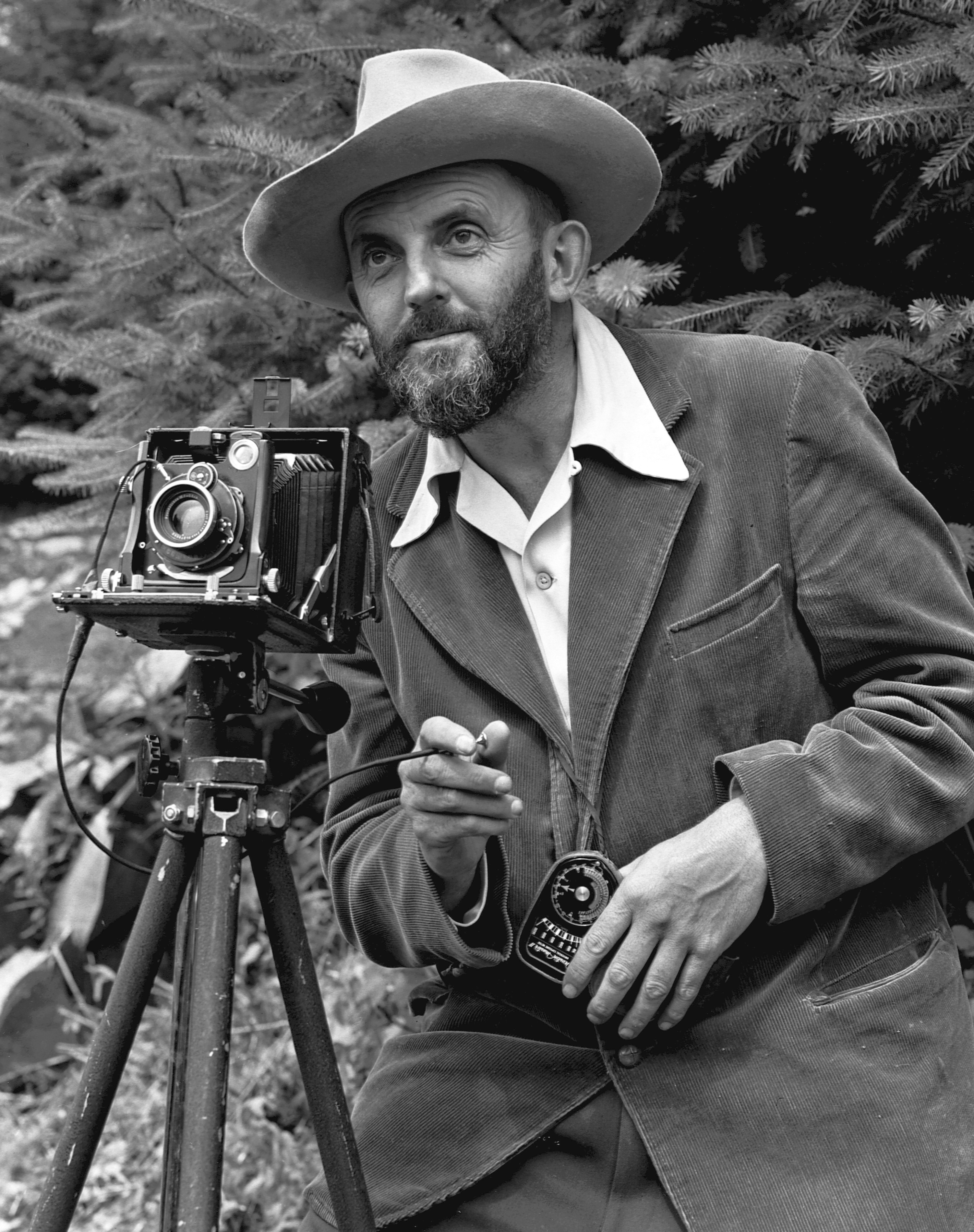
Ansel Adams' Studio

This morning I looked at Colin Wills photograph of Tenaya's hoary white head in the distance, and yes, the glacial polish enhances it. Blows it out while the foreground verges on inky midnight.

Such extremes of black and white were Ansel Adams' trademark. The f/64 club, shoot with lens wide open. See what you can see.

I knew those mountains well in my youth. When I was young, my aunt and grannie rented a tent cabin at Camp Curry. My life was forever changed. I was a child born with wanderloust. In high school, every chance I got, I traveled across the state to Yosemite. Wild coming-of-age times, camping in the Big Meadow—a be-in, and the feds busting everyone.

I remember stopping by Ansel Adams photography studio in the valley. I was too afraid to speak, too afraid to take a photo of him, so I was content to watch him instead. He was an island of silence amidst his gaggle of photography students—all male I might add. Little did I know, that in one half life later, I'd spend time with his second cousin. Met Alice who didn't want to talk about Ansel. He had that kind of effect on women.

J. Malcolm Greany photo ca. 1950  Wiki commons

Ansel Adams' Studio

Summer afternoons, he'd step out
of the darkroom for a quick breath.
As he leaned against the doorjam,
he'd shove the bifocals up his forehead,
cup his hands, light a cigarette.

As he bent his head to the flame,
small twin suns reflected
on that Half Dome of his pate.

He gazed into the distance
towards Tenaya and Cloud's Rest,
drew the smoke in deep,
his depth of field unfocused,
with lens open wide.

Then he finished his smoke
flicked it into the bin, shoved his glasses
up the bent ridge of his nose
and he stepped back
into the shuttered darkness
to face Tenaya in the negative light.

For a moment, water rippled in the pool
of memory, then closed in over that day
and sank to the depths like a stone.


object, a la WCW Red Wheelbarrow

Friday, April 10, 2009

Antarctic ice up close & personal


(photos ©2005 Tony Travouillon, Caltech)


The Antarctic ice shelves (and the Arctic and Greenland shelves) hold the advancing land glaciers at bay, keep them from sliding into the sea (and thus raising the level of the oceans). Here, you can see how an Antarctic ice shelf is supporting upthrusted mountain of blue glacial ice.

(photo: Tony Travouillon used with his kind permission.)

Someone sent me an email with these extraordinary images of Antarctic ice. I was supposed to write s poem a day for Poetry month. Instead, I spent hours hunting the photos down on the internet to find a compelling story behind them. I also found out that they were taken by two different people. One photographer was easy to find and we corresponded, so much of this story is base on his writings.


These photographs are beautiful earth poems and serve as a more powerful testament to the ephemeral beauty of Antarctica than any article I've read, they capture the story of the sublime beauty and fragility of this seventh continent.

(photo: Tony Travouillon) More photos here:

According to the first photographer, Caltech astronomer, Tony Travoullon, this particular formation of sea ice taken near the coastal station of Dumont D'Urville, is what he dubbed a "blue berg," a recycled ice floe flipped on end, possibly thrust up from an earthquake. Though it looks like a frozen wave, it's not. The ethereal blue ice is either formed at the bottom of the sea ice pack or meltwater that has seeped into a crevasse or crack, and was flash frozen, it has no trapped bubbles to refract light, and so it appears an intense blue.


Think displacement: what happens when you add a big chunk of ice to an already full glass? Our coastal cities are perched on the edge of that proverbial glass. Last March, a chunk of ice several times the size of Manhattan was set adrift. Around Valentine's Day, 2010, an iceberg that broke off from the Ross shelf in 1987, sheared off the tongue of the Mertz Glacier, creating an iceberg the size of Rhode Island. BTW, those are solid mountains of fresh water, not sea water. Glacial ice melts more slowly than other ice.

The extremely rapid calving of the Wilkins ice shelf is the latest harbinger to a global catastrophe we cannot easily reverse. The shelf is anchored to an island by a narrow shard of ice less than a thousand feet thick. When it breaks free, imagine icebergs the size of Manhattan (but taller), adrift at sea. Then the landlocked glaciers, with nothing to hold them back, will begin to inexorably slide down to the sea like a breach birth. This is where the real catastrophe will begin if global warming continues at the current rate it's been going since 1966.

In a post equinox coitus, the Wilkins shelf is calving into the Wedell Sea with chunks the size of houses. Better pray for an extremely cold winter. Come December, this shelf will probably shear off.

(See amazing photos by: Oyvind Tangen, a sailor aboard a Norwegian research vessel, the G.O.Sars, 660 miles north of the Antarctic. ca. March 2008.)

Blue stripes are created over long periods of time, and are often caused when a crevasse in the ice sheet fills with meltwater and then refreezes so quickly that no bubbles form. The lighter bands are compressed snow, trapped bubbles act as prisms and reflect light. The darker colors in blue ice generally connote extreme age.

There are two kinds of ice formations: land-based glaciers and sea-formed ice shelves, where sea ice coagulates and forms islands of ice, then snowfall and the continued freezing of the sea adds height. On land glaciers, the blue and white horizontal stripes of compressed snow represent a timeline of sorts, a snowfall record similar to dendritic redwood or white pine tree rings, but millions of years old.

Under extremely cold conditions, sea ice crystals forms at -18° C; float to the surface, to create an "oily" slick, called grease ice, which coagulates into pancake ice.

Core ice samples reveal an ancient record of atmospheric conditions including fallout and cataclysmic eruptions and now, modern pollution. Trapped air bubbles also provide a good record of pre-industrial atmospheric conditions. When I studied Irish Medieval manuscripts, I found it helpful to have a glacial timeline in hand. What was the weather like in 800 AD?

In Switzerland, on Jungfrau, there is an early 19th c. ice palace carved out of a living glacier where you can count the ages from inside the glacier. I've also stood at the foot of the great Columbia ice field and gazed into that mesmerizing aquamarine banding. The glacier moaned as it inexorably pushed forward. Now it's retreating.

When I flew over Greenland during the winter of 2007, I was horrified by how much glacial ice had tumbled into the sea. There was clearly far more than the annual global average of two million tons of ice floating on the sea. One suggestion for the accelerated glacial ice calving is due to "bottom melting" not just of icebergs in an increasingly warm sea, but this phenomena, well documented in Antarctica, also threatens Greenland's glaciers by lubricating them from beneath—which causes them to literally lose their icy grip on the land and skid into the sea, unchecked.


(Calving glacier in Greenland, mid-winter. Photo: © 2007 Maureen Hurley)

(Greenland from 40,000 feet, those little white dots are thousands of very large glaciers, some stand as many as 400 feet above the waterline (and triple that below) that have calved off and are adrift in the open sea, mid-winter, Jan. 2007. Double-click to enlarge. Photo: © 2007 Maureen Hurley)

TEDTalks Photographer James Balog shares new image sequences from the Extreme Ice Survey, a network of time-lapse cameras recording glaciers receding at an alarming rate, some of the most vivid evidence yet of climate change in Alaska, Greenland and Iceland. The Greenland glacier (that I photographed above) is so enormous, it boggles the mind. This is a MUST WATCH in order to grasp the severity of the ice melt! To read more on James Balog go to TEDTalks © distributed under a Creative Commons (CC) license.


Antarctica's Lambert Glacier, the world's largest, at 40 by 400 kilometers; is moving from 100 to 1200 meters per year onto the Amery ice shelf, which impedes its headlong rush into the sea. Dramatic unprecidented ice collapses occurred in 2008, 2002 and 1995.

(See photo: Øyvind Tangen) See HoaxSlayer story here:

As for the candystripe banding, it's real, when an iceberg falls into the sea, a layer of salty seawater freezes to its underside. If the water is rich in algae, it will form a green stripe. Brown, black and yellow lines are caused by sediment and pulverized rock picked up when a landbased glacier inexorably grinds downhill towards the sea and picks up debris enroute.


(See photo: Øyvind TangenNorwegian sailor 


After 12,000 or so years of stability, three vast Larsen ice shelves on the east side of the Antarctic Peninsula that extends toward Chile, and Wilkins' neighboring ice shelf, the Wordie ice shelf have completely vanished, in some cases, fracturing up within three weeks, during 2008. Ice shelves are extremely sensitive to temperature change, and over 11% of Antarctica's mass is shelf ice. The Antarctic holds 91% of the world's glacial ice. The loss of the ozone layer is a major contributing factor to the 5• temperature rise.

(See photo: Øyvind Tangen) This striped iceberg towered 30 metres above the surface of the ocean. Only one-tenth of an iceberg lies above the water. The tallest recorded iceberg towered 551ft above sea level - that's the height of a 55-storey building.

During 2000 to 2005, 150 trillion liters of icemelt have rushed headlong into the sea. I would guess an equal, if not accelerated amount has melted into the sea since then.


GOOD FRIDAY REQUIEM FOR ICE

Imagine a vast archipelago of icebergs
larger than Manhattan, unseasonably set adrift.
This is how it begins. The mad race to the end.

Too late I am learning the complex language
of ice: firn, ogive and swale, iceberg ballast,
the secret emerald tear and Tanzanite heart,
strange unfathomable blues: lapis & sapphire,
azurite & aquamarine, cerulean & cobalt.

Precocious tongues of fresh water
150 trillion tons float on a salt brine sea
as scientists try to translate and explain
and decipher the final symphony of ice
playing it fast-forward at both ends of the earth,
before it's too late. For whom the bell tolls.

They say that frozen breath rings in small knells.
A song of ice islands adrift on a final migration.
For the continent at the ends of the earth,
the western ice shelf is disappearing into the sea.
Sweet tongues of ice speak in a new sea dialect.
Things are heating up: Mt. Erebus is erupting:
fire and ice. Fire and ice and floods.

But hey, a new species of krill was discovered.
The krill shall inherit our flooded cities.

Meanwhile in the far north, beneath Ursa Major
the ice melt has accelerated out of control,
the first ice free summer in the Arctic
is predicted to arrive midsummer, 2013.
Who's going to explain that to the polar bears?

Break out the beach chairs and sunblock
and lead us on to the new Riviera.
We'll sip Manhattans on polar ice.
I hear the aurorae borealis and austrailalis
are spectacular this time of year.

Too bad about the penguins, though.

No resurrection likely, or in sight.


mayday mayday mayday


(For a glimpse into the rich ecosystem beneath the ice, see Norbert Wu's Life Beneath Antarctic Ice). It is reported that the rise in temperature is creating an explosion of vegetation, which in turn, raises the temperature.

Friday poem


Øyvind Tangen's photos are listed on several sites as being in the public domain—I have tried to contact him, and have written to the publications where the photos have appeared, to no avail. So I have made links back to those sites. These photos have been widely published under Hoaxslayer,  Snopes, Digg, The Daily Mail. The Telegraph, UC Santa Barbara Dept. Of Geology, A Fish Blog, etc. If anyone knows how to reach Øyvind Tangen I would be most appreciative if you would forward his contact info.


Update on Arctic ice—I didn't have the heart to write about the North Pole but this NASA photo of the Petermann ice island, four times the size of Manhattan in 2010, drifting toward Labrador puts it into a global perspective.