Saturday, October 4, 2014

INDIAN SUMMER

 
This is my photo from ca. 79
    —from a photo by Joy Harjo


During the dry heat of Indian summer,
toad families crawled out from their dens
along the earth bank above our house. 
Because they cried like babies, 
I put them in the wicker crib that 
corralled three generations of family. 
If I picked the toads up wrong 
or scared them, they'd pee on me,
gazing at me with gilt-rimmed eyes
the color of dry summer grass,
as I weighed their squat mossy
coolness in my grubby hands.
It was a time of little water, our spring,
reduced to a trickle, meant no baths,
our bodies became rough as toadskin.
What brought them out? Hunger? 
Thirst? Anticipation of rain?
I'd carefully place them back 
by their gopher hole burrows
not thinking of the water I'd stolen.
Little hogan earth dwellers, they'd tuck
back into the cool darkness,
waiting for a safer time to migrate
down to the creekbed and lay
their beaded strings of pale eggs.

10/4/2014
Published in Bay Area Generations 15, Nov. 24, 2014

Western toad, A. Boreas —Wiki


2nd draft: Late summer, the toads would come out. Because they cried, I put them in the old wicker baby crib that corralled three generations of children. If I picked the toads up wrong or scared them, they'd pee on me. It was a time of little water. What brought the toads out? Thirst? But I always put them back by their reclaimed gopher hole burrows. Little earth dwellers.

Thursday, September 25, 2014

Rain rain rain rain rain

Rain rain rain rain rain rain rain rain rain rain rain a light rain. Petrichor.
It's little more than garúa, a heavy mist, but rain's gurgling in the gutters.
Not quite Limeño garúa, but close. Not real raindrops falling on my head,
but at least it's wet outside. Love the sound of rain in the storm gutters.
Runoff's pretty foamy. Wouldn't want to save it. Drought, or no.

BY-THE-WIND-SAILORS


Adrift.
By wind, and by sea
flotillas of Velella velella set sail
& the skin of the ocean is their home.
Offshore pelagic dreams will beach them
on distant shores where people will puzzle
over their cobalt mantles and glassine sails.
They will make odd metaphors and similes,
reducing them to jellyfish—or man-of-wars,
not realizing that their strange uniqueness
makes these small by-the-wind-sailors 
a singularity in the animal kingdom
that defies simple classification.
& they'll set sail into the void 
to lodge in the flotsam 
of the mind.


Voices of Gold: California Poets in the Schools Celebrates 50 Years of Poetry, Oct. 10-12 at IONS Earthrise in Petaluma


Poets, teachers, poet-teachers, and plebeians who want to become poets in the schools: join us October 10 -12, for our 50th Anniversary celebration, Voices of Gold Symposium at IONS in Petaluma. If you haven’t yet marked this on your calendar, do it now. Good job! Now, if you can't attend the whole the weekend, then come for Saturday's fabulous festivities. You'll get to spend the day or the entire weekend participating in innovative writing workshops and partying like rockstars with kindred poets, of course.

Did we mention that many California poets laureates, and civic poets laureates are/were CPITS poets—including Jane Hirshfield, Celia Woloch, Molly Fisk, John Oliver Simon, and our latest California Poet Laureate, Juan Felipe Herrera, have gone on to win huge accolades? Yep. Poetry is us. Jane Hirshfield credits CPITS as that “superb and still thriving program” that gave her first job as poet teacher; she said CPITS instils in young writers a passion for poetry, allows freedom of mind and offers the open-ended “writing invitation.”


LA poet-actor-playwrignt Jack Grapes, publisher of ONTHEBUS, will lead a deep writing intensive on Friday, Oct. 10. His Method Writing Approach teaches us to listen deep within ourselves. Celebrate and honor the elders of CPITS with a banquet, and welcome newcomers with special festivities.


Saturday, Oct. 11 former California Poet Laureate and CPITS board member, Al Young will give a keynote address, followed by four sets of workshops that embrace themes of poetry & sound, poetry & visual art/media, poetry & movement, and poetry performance—we'll be joined by special guests, performance poet-activists Josh Healey and Jason Bayani.

California poet teachers—from San Diego to Del Norte—will lead ab-fab workshops. CPITS workshop leaders include Amanda Chiado, Phyllis Meshulam, Karen K Lewis, Claire Blotter, Tree Bernstein, Jim Cartwright, Karen Benke, Dan Zev Levinson, Julie Hochfield, Prartho Sereno, DanaTeen Lomax, Blake More, Margo Perin, Kathy Evans and Sally Doyle.

More cool workshops on Sunday morning, including poetry & yoga, poetry & art—and don't forget to leave extra time to say those long goodbyes with newfound friends.

WHERE: at IONS Earthrise Retreat Center in Petaluma—right off Hwy 101, at San Antonio Creek. The beautiful campus is nestled in the Northern California foothills. You will dine on sumptuous organic meals while engaging in a multitude of interactive poetry workshops that will enhance your own writing or teaching in the classroom.

Please visit https://www.cpits.org/events.htm for registration information and complete workshop descriptions or contact Tina@cpits.org, better yet, just call Tina 415-221-1401 to register. See you there!

Friday, September 19, 2014

Procrastination Syndrome


Yesterday, I was procrastinating over an important writing job I needed to finish, but kept putting off, so I read old blog posts instead. I meant to correct one small typo on a piece I'd written on St. Brendan in the Faroes Islands, and then just get on with it. Some 14 hours later, I was still at it, revising—hammer and tong. It occurred to me as I utterly destroyed my bloggy bit on St. Brendan, that:
a) I really, really should've saved a copy of the first draft, at present, it's unrecognizable, and 
2) The joy of writing is having the temerity to turn a piece into a dog's breakfast, knowing that eventually I'll have to rewrite my way out to the other side—having uncovered all kinds of connections that wouldn't otherwise have happened, had I played it "safe."
(Sheesh, I can't even think linearly within any given system: a), b). I had to change points mid-stream: a), 2). What's with that?) Oh look, shiny!

Out of destruction and chaos comes... But now I have to really fix the demolished post..it's all over the place.(Or at least hide it from the web crawlers). But I'm stalling. Again. Procrastination. Again. Shun's the operative word here.

So far, this morning, I've mopped the floor, organized my hair bands and postage stamps, shuffled piles of horizontal files, uncharacteristically hung up his clothes, I also uncharacteristically rearranged his closet, cleaned out old emails from three different accounts (not an easy thing as I'm an obsessive reader, and need to read everything before I delete it), I beheaded basil flowers, thus disturbing the leafhoppers.

I thought about those bugs, wondering how many of them we accidentally eat, without knowing it, and about making pesto with sunflower seeds because I'm fresh out of pine nuts and they're too expensive anyway. Pesto would the perfect last hurrah before summer's end. But I'm fresh out of garlic. Phew. Sidestepped that one.

Meanwhile, I've got one thoroughly garbled post that needs mending. Or nuking. And that other thing I was avoiding yesterday. And today as well. Apparently.

With that, I bring you, Dear Reader, a little distraction for our reading pleasure: an article from the Atlantic Monthly, on writers and procrastination!
Why Writers Are the Worst Procrastinators
The psychological origins of waiting (... and waiting, and waiting) to work. (Which is adapted from Megan McArdle's The Up Side of Down: Why Failing Well Is the Key to Success.)
See, I too am an inveterate procrastinator. This morning I posted Facebook messages to a classmate whom I hardly knew, and haven’t seen in at least four point five decades... we took a spin down an unpaved memory lane. I also marvelled with childhood friend Micaela who found a photo by Brett Weston, of her mother Rosalind Sharpe Wall, in Bixby Canyon. That's how I "met" that old classmate.

I talked like a pirate about John Malcovich's stunning role as Blackbeard the Pirate (Edward Teach) in CrossBones—sadly cancelled after one season. I suggest that you watch all nine episodes today, it's international Talk Like a Pirate Day. Arr and avast, ye maties! Teach invented the pirate flag. I bet you didn't know that.

I even rewrote a Peter Piper tongue twister on Adair Lara's wall... If Peter piper (shouldn't that be a capital P, or should I use commas?) picked a peck of pickpocket-proof pants, was he peckish for pound notes? It's all her fault. She shouldn't have posted that cool Instagram photo. My mind was off and racing like the ponies at Golden Gate Fields. What about California Chrome, anyway?

Yes, I do procrastination quite well. Layers upon layers, embedded so deep, that I can no longer tell which particular task I'm avoiding. Or for what reason. And who among us doesn't suffer from "imposter syndrome"? I've been faking it for decades. So far, so good. Do you think they know?

I agree with that author Megan McArdle that among writers procrastination "is a peculiarly common occupational hazard." I wonder what other foibles writers use to distract themselves from themselves.

For example, I wonder if the incredibly prolific Maria Popova of Brain Pickings ever procrastinates? What is Adair Lara's particular, peculiar anti-writing vice? Besides posting photos of her new pickpocket-proof pants. 

I know Eugene O'Neill liked to sharpen a dozen no. 2 Ticonderoga pencils to weapons-grade perfection before he arranged them just so, on a dozen yellow legal-sized writing pads fanned out on the living room rug. By then, it was time for drinkies all around.

O'Neill did not view alcohol as a performance-inhibiting drug. Nor did Steinbeck, Hemingway, F. Scott and Zelda Fitzgerald, or Styron. When novelists sober up, they usually dry up. Drinking is good for inhibiting the "imposter syndrome." There are sober coffee-table books, fergawdsakes, on writers and their favorite tipple.


Monday, September 15, 2014

Straddling the Continental Divide (photos)


Our last day at Estes Park we decided to take the long way back to Denver, via Rocky Mountain National Park, with its breathtaking views. We stopped to hike the Old Ute Trail, on the aptly named boulder-studded trail along Tombstone Ridge, a glacial moraine, or glacial toe, on the Continental Divide, in Colorado. As we stood on an overlook we could hear elk bugling in the valleys.

At Timberline Pass we turned around to go back to the trailhead. I thought of the thousands of years the Ute trail had been used since the Ice Age. Myriad travelers.

Knee braces on both knees kept me safe. I was slowly recovering from knee surgery. But I wasn't about to let that deter me. The landscape was sublime. I didn't want to turn back, and was feeling euphoric at that height.


We gazed down into the deep valley, Estes Park in the distance. The Arapaho who lived around Mary's Lake, during the summer called the valley "the Circle," and built eagle traps atop the 14,259 foot Long's Peak. The Utes came to hunt bighorn sheep. There were the inevitable clashes. The Arapaho ousted the Utes. In the fall the bull elk still run the town. There's even a bull run, as in running with the bulls. A risky business as they're unpredictable creatures.


Missourian John Estes settled in the valley in 1859, and raised cattle, but saw potential for a dude ranch. However, Anglo-Irish peer, The 4th Earl of Dunraven, tried to take over the valley in a huge land grab, as his exclusive hunting preserve, most of which, is now the Rocky Mountain National Park.

The Earl of Dunraven, a journalist by trade, opened the first resort, the Estes Park Hotel, which later burned down. But the stage was set. Tourists arrived in Stanley Steamers, and the iconic Stanley Hotel, featured in The Shining, still holds a commanding presence. All work and no play.... We stayed at the incredible YMCA of the Rockies. I was sad to leave the beautiful valley.
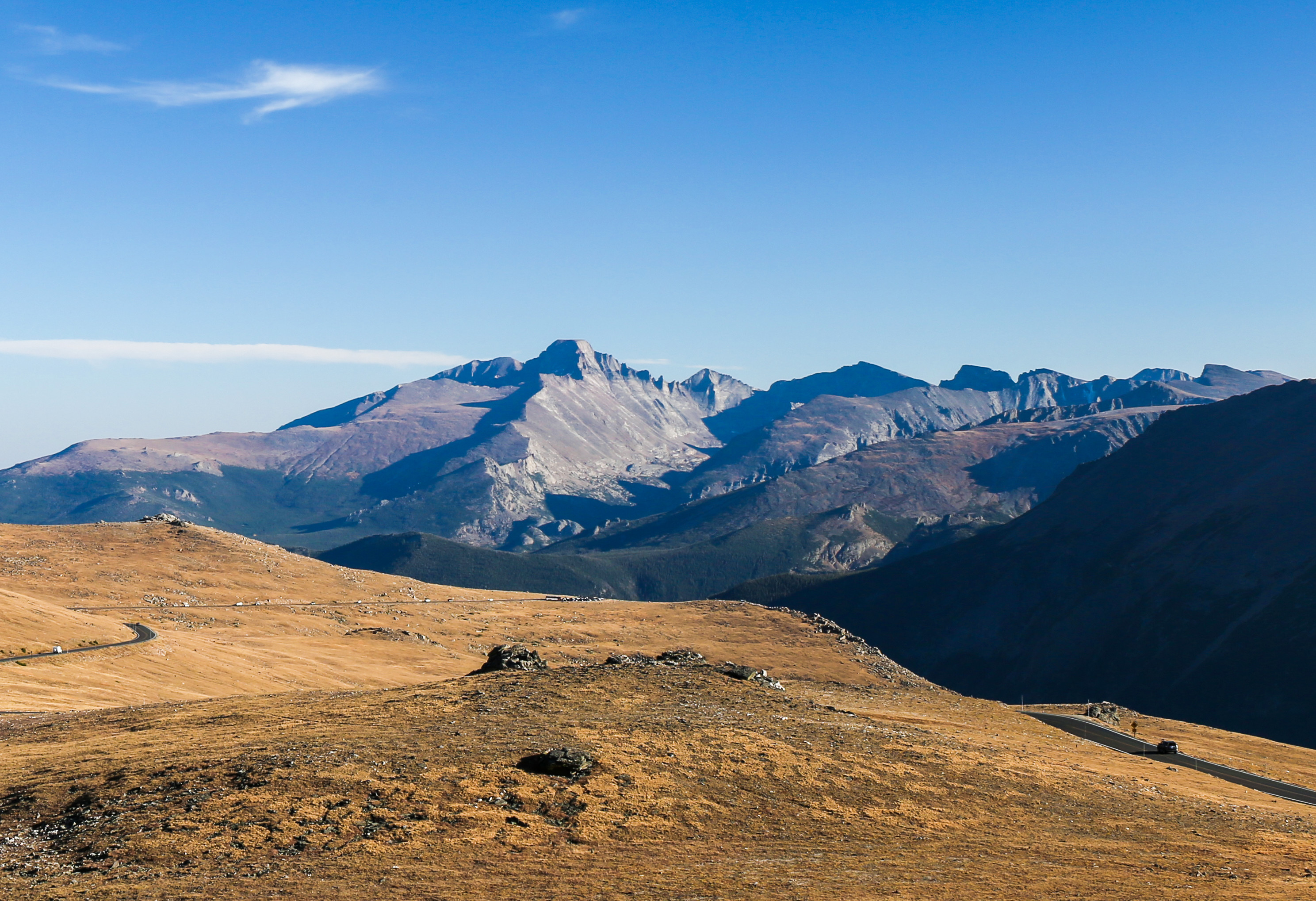
Trail Ridge Road and Longs Peak —Wiki

Clouds were rolling in. Storm brewing. Time to head back to the car. Then, on the way back down the trail, I tripped over a rock, and fell flat on my face. I fell correctly, I fell soft, and protected my face with bent right arm, but a smooth glacial cobble embedded in the trail sucker-punched me between nose and lip.

Good news. I didn't break a tooth, but my upper teeth were numb. Bad news. My nose didn't fare so well.

Now I get why people use walking sticks. Not for sissies at all.

I made Neil run back to the car to grab some ice from the ice chest while I pinched my nose, tilted my head back, and tried to eye the trail for boulders as I walked back toward the car. I was amazingly calm, considering that I was being gagged by a bucketload of blood.

All that horse training and vet stuff paid off. Body check. Breathe. Can you walk? No broken bones? Then, get outta Dodge. Or Tombstone, in this case. Fastest way to get rescued is to rescue yourself.

Neil was the one in need of focus. No EMT potential there. I had to scream at him to go get the fucking ice. We were about a half a mile out from the trailhead, on Highway 34,aka Trail Ridge Road; at 12,183 feet, we were well above timberline. Incredibly beautiful alpine tundra dressed in fall colors.

Good news: no concussion. Bad news: I donated copious amounts of blood to the trail. And I looked like hell.

But Justine the park ranger at the First Aid Station at the Alpine Visitors' Center, was awesome. The Visitors' Center, on the other side of Trail Ridge, and Sundance Mountain, was a long ten miles down the road. She ushered me right in, and examined me like a pro, flashlight in eyes, usual trick questions, etc. and concluded that I didn't have a concussion. Miracle of miracles.

I was intimately reminded that the word Colorado means red, or blush. It was a long way to the first Advil. I iced my face the entire way over the Continental Divide. I looked out over Wyoming in an altered state of reality.

I felt like I had a bad hangover. Sound was cottony, light was twinkley, and and I couldn't look down for fear of bleeding. But we were on top of the world and it looked like the Swiss Alps.

I was pretty angry with myself for tripping over a submerged trail rock, as this place was clearly a ten out of ten bucketlist destination. Considered one of the Top 10 Hikes in Rocky Mountain National Park, and I had to go and smash my face in. To make matters worse, Neil blamed and berated me for smashing my nose, it was my stupid knee braces that caused the fall... I couldn’t pick up my feet properly, and tripped over a rock. As if I already wasn’t feeling bad enough. 

This was the secret natal grounds, the homeland of the Colorado River. And water draining to both sides of the Continental Divide. To the Sea of Cortez, or to the Gulf via Old Muddy. Something most holy about that. In my case, my blood was straddling both sides of the Divide. I donated heavily at the sublime office.

No Advil until we got to Grand Lake, a long ways off.

I boarded the plane home that evening looking like a street brawler, with two shiners. Neil was afraid that people thought he beat me up. No, the mountain did. It exacted a trespass fee. The blood pooled under one eye and left a red track, like an after image of the Colorado River down my cheek. Vampire blood trails under the skin that no amount of washing could remove.


Thursday, September 11, 2014

Late summer in the Rockies (photo)


Me solving the great ram’s horn puzzle on the continental divide in Colorado. Late summer in the Rockies, a snowstorm brewing over Estes Park. Neil was being a right arse that day, we quarreled all they way up the mountain. It was such a relief to be out of the car. He was so volatile. I later paid for it by doing a face plant on a rock on the old Ute Trail, on Tombstone Ridge, a glacial moraine. I was wearing double knee braces, as I was still recovering from knee surgery. Then he had the audacity to blame me for stumbling and smashing my nose, it was my stupid knee braces that caused the fall. If ever a man lacked empathy....

Tuesday, September 9, 2014

Tombstone Ridge

Traversing the Continental Divide I got a wee Glesga Kish! I walked out on the pass, listened to elk bugle in the valleys, I watched snow turn to rain, I saw blue gentian and sky pilot on the tundra, pure magic. And then I tripped and fell on my nose right before I go back to the car. Let's just say the Rockies made a real impression on me face with a murderous left hook. I now get why people use walking sticks on uneven terrain. Just call me Rocky Graziano. Singing Paul Simon's The Boxer right about now...

I busted up my nose hiking on the Continental Divide. My blood spilled on both watersheds. Not a place where I wanted to take my last stand, on Tombstone Ridge. Believe me, I was calling myself Maureen the moron on a glacial moraine, I didn’t need extra help from Neil in the chastisement department. I had it covered. I yelled at Neil to get me some ice from the cooler. He was useless in a crisis. No EMT potential there. So, I was really on my own on that long walk back down the ridge to the car park.

It was a long half mile back to the car. As I walked, I tilted my head back, propping my neck and head with one arm, pinching my nose with my other hand. I was trying hard not to swallow blood, the last thing I wanted to do was hurl, my stomach was bilious. It was a challenge to avoid all the little fucker tombstone rocks jutting up on the trail, using peripheral vision to navigate, as I couldn’t hold my head upright without gushing blood.

Not the first time I’ve busted my nose, I know the drill. Alas, I found out that Neil was useless in a crisis. So ironic as this is where we entered into this relationship, me administering first aid to him, possibly saving his life, when his nose and face were busted up in a car crash, when he was gushing blood. 

It didn’t help that we were fighting all the way up the pass. I was so glad to get out of the toxic environment of the car, and to be at one with nature, and then the landscape punched me. Irony, much? Such capricious gods of fate. I guess it’s payback time. I won't mention the buckets o' blood sacrifice I left in Colorado—which means red. Duh. No need for metaphor, here. Too literally inclined, I guess. Erm, make that—declined. Reclined? 


Home, now, mirror is not my friend. You might say that I’m working on the lying Pinocchio/unicorn horn look. Maybe this time I really will have to get my nose fixed. Not. Lots of ice on the hour & Advil every three hours like clockwork. Not too bad looking now. Some raccoon eye, and weird blood tracks under the skin, but not too bad, considering... just can't touch my nose or sneeze. 

I spend my days icing the schnozz. I have this really good idea for a kickstarter—a svelte patch you can contour to your injury and freeze it. Like a fleecy molybdenum ice pack. The commercial ones are awful. I made one out of a flannel bath mitt. I soaked it and then froze in in the shape of my nose. Pure dead brilliant. I've been diligent with ice and heat. I don't look too bad, considering. Just can't wrinkle my nose, etc. Upper lip is no longer swollen, it's itchy. Lower lip still a bit swollen. My big honking nose saved my front teeth, I'm sure. Clean bill of health from the doctor. No concussion, but it's like having a hangover. Light and noise are excruciating.


Day 10—My nose is still swollen, looks a little crooked too, but at least the black raccoon eyes are gone. I can wrinkle my nose a bit, but it still feels like somebody else's face is super-imposed on mine. I made the mistake of taking a selfie with a smacked nose. Agh! Think I'll crawl under a rock. Definitely not ready for my close-up, Mr. DeMille. It's hard enough to take decent selfie w/o looking self-conscious or like you're in a prison line-up. (some of it's because of parallax issues with the 2.2 wide-angle lens). Think I should go back to my squirrel portrait on Facebook. Or maybe a rock portrait. After all, that's how I got into this mess. OOF! Icing my nose now. Off Advil since Mon. as I was having issues with it and didn't want to barf!

Someone suggested that next time I land on my can. I don't have a lot of padding on my bum, or my nose either. At least I managed to protect my injured knee, next time, I'll happily choose the bad knee to fall on, trust me...

from a Facebook memories post, revised and rearranged for clarity, added 9/21. I was glad to find this particular post because I could not focus, or write coherently about it after the fact.

Friday, September 5, 2014

Bull Elk in Estes Park (photo)


Bull elk thrashing the bushes and bugeling. Rutting season. Incredible song of the wilderness. Huge animals just off the road, we're in ElkTown...

The Shining, Estes Park (photo)


Who remembers The Shining? All work and no play makes Jack a dull boy. The very haunted Stanley Hotel, Estes Park. Don't go into room 217.

Thursday, September 4, 2014

Facebook conversation on Lagunitas with Pete Sutton while in the Rockies (oral history) (photo)


Outside my window...YMCA of the Rockies. Petrichor!

Mo: YMCA of the Rockies is pretty amazing. Like summer camp. We landed in Denver, went thru Aurora—yes, that Aurora. Got supplies before heading into the Rockies.

Pete Sutton: Mo, do you ever stay still? Very nice photo.

LOL! Wanderlust at an early age—look at it this way, when I was four and a half and had to walk a mile from Barranca Road to Sir Francis Drake Blvd., I rarely made it in time to catch the bus. Had an equally hard time making it back home on my own steam but your mom Chuck was pretty cool about the little gatecrasher. PB&J sandwiches, and sometimes even a ride home. Still wandering. Er, hobbling...icing the knee now.

Rockies are socked in the AM. Rain last night. Divine petrichor! We're here for the Long's Peak Highland Games—Neil wants to get on the menu for next year. Never been to Colorado before. Wyoming, Idaho & Montana, yes. Saw elk the size of horses down by the Fall River last night. Had bacon for brekkie and thought of you and The Kev. Lots of folks fishing. You'd love that. Thinking a lot of Thano Johnson right now. I ran into his ex-wife, and he wrote me a nice, long, lovely letter about living in Colorado...I was in a horrific car accident and never wrote back. Still feeling guilty. Wonder if he's even still alive?  (Musician Kevin McConnell)

Pete: Thanks for the kind story of my mother.  I of course, do not remember such antics but am very glad you do. I hope that I played with you. Thano was a tough old son of a bitch - he's probably still dodgering around although i doubt it. Colorado s a favorite state of mine. My dad left us in '64 and we started visiting him in Aspen in '65 - nice place , this was before the fucking rich people found it. Why do they always fuck places up by moving there?

Note Bene: Pete’s das was the famous stride pianist Ralph Sutton. Chuck, or Charlene, was friends with Grover Sales, and probably poet Lew Welch (as was my mom).

Mo: Yeah, it's hard not to get pissed off...lots of bullshit estates and luxury homes here—juist like what happened to Marin. Yeah you played with me...sort of...sometimes you ditched me and Nick when Jeff was around... I absolutely adored Chuck. Is she still alive? When did you move to Lagunitas? I remember visiting you a few times there but that was a long way from home—until I got the horses.

Pete: We moved to Lagunitas to the Hawaiian Princess's house on Corona Ave across the SFD blvd divide from Weaver's mountain top enclave during 3rd-4th grade- between Miss Lenz and Mrs Raddick's class. We used to yell  over to the Weaver's from time to time.. "Hey Weaver!"  and one of them would yell back, "Hey Sutton!" and so forth.  I scandalized Mrs R because I read 'The Rise and the Fall of the Third Reich' brought to yours truly by Arrow Scholastic Books. Any way I met the Woodacre crew in her class. Mom died in 2012, May 24th I believe. Then some sonofabitch invents a beer and names it after my home town. Pretty good beer I must say. Not really my home town but what the hell...

Mo: Great story, Pete. So sorry to hear about your mom. I don't even know the names of the roads we played on—I rode them all... Tell me more about the Hawaiian' princess? I remember going inside that house. Like the Argentina House that was TR's old hunting lodge.

Pete never answered my last question. And then, weirdly, deleted all his comments on my Facebook thread. I am glad I saved them here. Research is required. But the Hawaiians came to Marin and Sonoma counties. There was a cane chair factory in Lagunitas, at the old cafe,, and another in Forestville, I think. We had three cane chairs from Lagunitas. Each one had a different patterned bottom of stamped wood. The Hawaiians were called Kanakas.

Wednesday, September 3, 2014

Tea vs Chai—if by Land, or Sea

I'm having me a nice cuppa Yorkshire tea in me hond.... But Yorkshire tea, which I discovered while housesitting Dave Hansen's flat in Amsterdam, is hard to come by in the US. I found a rare stash at the Petaluma Grocery Outlet and bought up a big flat of tea. Soon it will be gone.

Currently I'm stranded in a lost republic between teas (any old tea won't do—most of the organic designer teas are fancily packaged hogwash). My mainstay, Trader Joe's, changed its Irish Breakfast tea a while back, leaving me adrift in a vast sea of peaty mediocre teas. I have a drawer-full of straw-flavored teas that I periodically recycle into iced tea, which is more forgiving on the taste buds than hot tea.

T.J.'s new twin packs of Irish Breakfast tastes suspiciously like Tetley's English Breakfast teadust dregs. The round teabags also look suspiciously like Tetley's. I can't tell them apart. I miss the old square bags of Trader Joe's Irish Breakfast tea. It made for a good cuppa tea.

Besides, I have issues with the idea of English Breakfast—politically incorrect in our household—no matter how similar they are. Who can taste the difference between English Breakfast and Irish Breakfast teas? I take that back, after a taste test, I concluded that there is a difference, English Breakfast is often more perfumy. I can't stand teas that smell like a flower stall.

At UC Berkeley's 1991 Celtic Colloquium Conference I was in charge of making the morning tea for our elevenses. I made real black tea, brewed in china pots—none of that tepid metallic urn water dumped into a mug with bagged tea that Americans are so fond of. 

Because the thirsty scholars were swilling tea (or free whiskey) faster than I could pour it, I opted for Tetley's bagged tea. A British scholar promptly dubbed the Tetley's tea as "chimp dust." 

When she saw my puzzled look, she explained that whatever was left over in the tea packing room, the cartoon chimps swept up afterwards and repackaged it as Tetley's. In other words, it wasn't the good stuff. But now, even the Tetley's chimp dust is also no longer as good as it used to be. 

I do like PG Tips, McGowan's, Lyons, or Barry's Irish Breakfast—when I can get it. But the tea's pricy and hard to get in bag form. T.J.'s Irish Breakfast tea was a real bargain at $2.99 a box. And it made a right good cuppa tae. OK, potta tae. I drink it by the potful.

I can hear you tea purists sniffing now: bagged tea? Unfortunately, I don't do mornings well. I'd need a strong cup of tea in order to make that pot of loose leaf tea first thing in the morning—or I'd be in danger of scalding myself.

Morning tea should be nice and black. None of that pale amber stuff. Tea should be strong enough for mice to skittle across its surface. I guess salted yak butter tea qualifies. Never tried it. But milk and sugar will do.

So when someone posted a Facebook link to a blog, The Language of Food, about the origin of tea, I nearly swooned.  
 Tea if by Sea from The Language of Food: a Linguist Reads the Menu. By Dan Jurafsky

We drink a lot of tea in San Francisco—I guess you should expect no less for a city originally named Yerba Buena, after a local wild herb in the mint family (Satureja douglasii) used as an herbal tea....
The Language of Food is a delightful romp through the history of tea. It focuses on real tea, not herbal tea, though tea itself is an herb—a fermented Camellia sinensis leaf native to north Burma and southwest China.

During the Shang Dynasty, tea, or t'u, was used medicinally. The Chinese character for tea is , originally written as  (pronounced t'u.) The earliest records of tea consumption date back to the 10th century BC, and Chinese legends attribute the invention of tea to Shennong, ca. 2737 BC. A 3rd century AD, medical text by Hua Tuo, stated that: to drink bitter t'u constantly makes one think better. Bitter is better. With butter?

The Portuguese sailors introduced tea to Europe in the 16th c. In 1660, the Portuguese wife of King Charles II of England, brought the tea habit to Great Britain. Tea was not readily available to the masses in Britain until the 18th c,. so smuggling was rampant, and its importance led to the Boston Tea Party and led to the end of British dominion in America. The Brits should've just let everybody have their cuppa tae in the end.

Tea plant (Camellia sinensis) from Köhler's Medicinal Plants

When tea arrived to Europe by sea via the Portuguese in the 16th c., it was called chá. Somewhere along the line, it was changed to tea, probably by the Dutch. Tea is pronounced differently in various Chinese languages: chá in Mandarin; zo / dzo in Wu Chinese; or ta / te in Min Chinese. Other Chinese words for tea: jia, she, ming and chuan. (—Wiki). Dan Jurafsky follows a compelling linguistic thread to include the word chai traveling overland via the Mongolian to Persian route.

Jurafsky writes:
These tea words ("tea", "cha", "chai", "matcha", "laphet") are players in an unusual linguistic story, in which two differing pronunciations of a word reflect the two ways that Europe and Asia have traded over the last 500 years: by land or by sea.
Jurafsky goes to great lengths to prove that if tea arrived overland across the Eurasian Steppes (via the Silk Road), then it was called chai.
The very first written mention of tea in Europe in 1559 is as Chiai, with an -i, by the Venetian travel writer Ramusio describing the Persian traveler Chaggi Memet...
However, I do have a very minor linguistic quibble with the basic premise of the article tea by sea as the Portuguese sailors who brought it to Europe in the 16th c., called it chá. They definitely didn't go overland, and their Chinese contacts were strictly maritime.
The second group of languages describes tea with a word pronounced something like "tey"—the way our English word tea used to be pronounced. This group includes western European languages like French (thé), Spanish (té), Italian (tè), and Dutch, German, Danish, Swedish, Welsh, Irish, and Hungarian. And, mysteriously, the very much non-European languages Indonesian and Malay.
I'm not sure if I'm buying the linguistic aspect of the entire tea- vs chai- arrival theory. Both the T- and CH- sound are too closely related. It really comes down to a matter of spelling from two different languages (or dialects, depending upon which army), Southern Min (in Taiwan), vs. Cantonese. I am reminded of the H.L. Menkin quote: There is always an easy solution to every problem—neat, plausible, and wrong. 
 
CH- is a modern Western orthographic approximation of a non-Latinate language system. Using modern Latinate orthography on an aural interpretation of a non Indo-European language family, is, at best, a slippery slope of an argument to convey pronunciation of the word tea. It depends on the listener/recorder's native language. 

For example, Manx and Irish are closely related dialects—you'd never know it, as English orthography was used to transcribe Manx, and Latin was used as the base language to convey Irish. 

In addition, in several IE languages, there are both soft and hard consonants: t/ch. What determines hard/soft (slender) sound is the vowel. Tea/chai. Also, Persian is an Indo-European language, like Hindi, not Turkic. "La" is another story altogether. 

I do love Dan Jurafsky's poetic statement: "chai if by land, tea if by sea." And it's probably more or less true. But it is a minor accentual difference. Like bags vs begs, or park/pahk in Boston. Or Ha ha ha vs Ja ja ja (same sound, different languages.)

What it really comes down to is this: the (Latinate-speaking) Portuguese traders of Hong Kong and Macao heard the word as chá, and the (Germanic-speaking) Dutch traders in Indonesia and Java heard it as tea.

Yes, in Irish, follows those "tey" rules, but that's a slender, or soft T sound, more like CHI. Full circle—except for the extra Persian case ending of -i, of course. But Jurafsky notes that extra i in cha-i is an alternative ending. "Persian nouns ending in long -â have alternative forms ending in -i." That makes it chaayi? In Ireland and Scotland, it's usually pronounced tae, as in the River Tay, not tea (tee).

So, how did the Persians really pronounce tea? Cha? (Wiki says the Persian چای is chay, derived from the Cantonese 茶 chá. So, chay rhymes with the Hibernio-English pronunciation of tae. Apparently the English word "tea" (tee), comes from Teochew Chinese "teeh".)

And of course, Starbuck's, in a rare tautological move, has chai tea on the menu—tea-tea. Like the River Avon (river-river), you might say something got lost in the translation.

Oops! My cup's emp-ty. Think I'll have another cuppa tea with me potta tae.

As my grannie would say: tea makes you pee.

Sunday, August 24, 2014

TREMOR AT 3 AM


I was just north of Pt. Reyes Station
sleeping over in a friend's living room,
I got up for some water, I was feeling woozy
and then I fell back to sleep.

But the trees were whispering and shimmying.
The land around me moaned and roared
like a freight train through Tortilla Flats.
And I was nearly tossed off the couch.

I couldn't figure out someplace safe to go,
I was in a strange house, So I screamed.
Brian came running out and we shivered
on the front porch in our underwear
as the earth hissed and shook and the stars jigged.

I was positive it was San Andreas' fault
which is only a few feet away, and runs
the length of Tomales Bay, lapping, lapping.
Thought I was gonna be on a floating island,
drifting out to sea on this slippery raft of a couch.

I must've been wakened by an earlier tremor. 
In my dreams the earth was roaring so loud,
the hum seemed to be coming from inside my head,
then I realized it's the earth, deep inside, groaning.
Singing a primal earthquake song.

Next time I sleep over, I'm bringing a seatbelt.

8/24/14
rev 10/16

Earthquake!

Quake, rattle and roll. Was nearly tossed off the couch in Pt Reyes Sta. Apparently I needed a seatbelt. Who knew? I leaped up but didn't know where to go—I was at a friend's house, Tomasini Canyon on the Marshall Road. You know how it is when you finally fall asleep in a strange house, all the creaks and groans are new, and surprisingly disturbing, and you never slip all the way under. You could hear the redwood tree swaying like a fierce wind storm. An owl lives at the top of that tree. Kept thinking he might fall out of his nest. Helluv an alarm clock. And for once it's not San Andreas' fault. Go home Hayward Fault, you're drunk. (Or Rogers' Creek, or Calaveras' fault) or whoever's fault it was. LOL—it was Napa's fault! I think some of the earlier quakes must've woken me up. Sleeping square. I needs must sleep. The earth is Rockin' me Baby. Went back to sleep at 5:30 AM.

Lots of aftershocks according to Quakebot SF. I think this one woke me up. So I could be ready for the Big One. SF QuakeBot @earthquakesSF 7m

A 1.8 magnitude earthquake occurred 4.97mi NW of American Canyon, California. Details: eqbot.com/aPL Map: eqbot.com/aP3

6.0 #earthquake centered 8 mi. N/NW of Vallejo, Napa County. Shallow quake says #usgs.

The epicenter party was in Napa, it seems the earth decided it needed a little drinkie-poo. Now this is a first. Napa, of all places, is the epicenter. Didn’t even know there was a faultline in Napa. Napa’s brick buildings didn’t fare so well. OMG, all that wine LOL, people standing ankle deep in really good wine. Quite a few folks lost their entire wine collections. Thinking of custodian/janitor/sommelier as new job description! Clean up on isle 4. Quick! Get me a straw. 

Thursday, August 21, 2014

SALT-SEEKING MARMOT, MT. WHITNEY


While we climbed to the summit
of the tallest mountain in the Sierras,
a salt-seeking marmot munched a hole 
right in the middle of my foam mat
stashed in the scree at our base camp.
Sleeping on bare rock that night was no picnic.
My bruised sacrum and hips found no solace
from muller and quern grinding basalt into flour.
I can't imagine the marmot survived the night
after eating that ensolite. Clearly, it tasted
good to him, seasoned with chocolate,
sweat, and the yeast of new love under stars.
I didn't think to cut my holy pad in half 
and marry the two uneaten ends together. 
If only duct tape had been invented, 
if only I'd thought to bring a roll with me. 
But the view from the crest of Mt. Whitney
was a feast for the eyes that nourished
me long after he lost his appetite—
when climbing the tallest mountain
wasn't fodder enough.

8/21/2014

Wednesday, August 20, 2014

Celtic Aedui oppidum (from a Facebook thread)


I usually don't repost Archaeology Magazine articles as they're barely more than teasers with photos, but this oppidum dig was about a Celtic tribe, the Aedui—a tribe that left an impact—as Caesar practiced genocide and scorched earth politics. The Celtic oppidum (hillfort) was founded in the third or second c. BC. The (Burgundian) settlement was abandoned after the Romans defeated a coalition of Celtic tribes including the Aedui and Arverni in 52 BC, at the the Battle of Alesia. The oppidum fell after Gaulish leader, Vercingetorix, who unified the Gallic tribes against the Romans -(no mean feat in, and of itself), was defeated—he was held prisoner for 5 years, then paraded through the streets of Rome and then brutally executed. That was, in effect, the end of Gaulish resistance. They cowped.

And the Vikings stole it from...? They are not "Viking artifacts." Sloppy, misleading writing, An snameled 9th c. silver Celtic cross? Not bloody Viking. Galloway was settled by the Irish 1200 years ago.


Nik Saulter If it helps paint a clearer picture of Viking raiding/travel history, I don't see what your problem is.

Maureen Hurley The problem is that Irish artifacts suddenly become "Viking art" when found in a Viking hoard. Much of what we think of as "Viking" art is not. The Gundestrup Cauldron is a good example. Only recently has that been corrected. Bot there's lots more in Scandinavian museums that is identified as as Viking art—when it really came from Viking raids.

Martin Mcsweeney As someone who was there and witnessed this all being found and excavated I totally agree with your statement, many of the silver items are what we call viking but many items such as this bird, the pot, etc are not in fact of viking origin but booty collected or traded or even passed down along the way so yes this doesn't appear to be viking origin but it was labelled viking due to it being found in a viking hoard, stupid media lol

Maureen Hurley Drives me fecking crazy! So many Irish artifacts were labeled as "Viking" during the Romantic Era—the beginnings of modern archaeology—that it's now impossible to untangle the mess. This merely promulgates it... You'd think the Vikings had invented La Tène art before they even existed! (Thesis-worthy...)

Karalea Hirneisen The vikings did indeed pillage and plunder but they also established vast trade networks that ranged from present day North America North into what is now Russia and East into the Baltic regions and South into the Mediterranean regions. The horde isn't necessarily stolen goods. It could very well be made up of trade goods and or Viking made ornaments. Vikings were a very well traveled people and they saw flora and fauna from many different geographical locations, including flamingos from the Mediterranean area. This is a fact as it has been confirmed. At one time there was even a contingent of Vikings who were employed as the personal bodyguard for a Roman Emperor.

Maureen Hurley Not necessarily, but probably stolen goods during the 9th c. Much of what is labeled as as "Viking art" is actually art styles borrowed from (or executed from) the conquered tribes. In Northern Europe. the Vikings borrowed heavily from the Celts, and probably kept Irish and Pictish artisans as well. Interesting to note that the Irish art style (or so-called Viking art style) did not travel east with the Vikings to the Eurasian Steppe—which leaves the definition of what is "Viking" art suspect. Hmm—only from the British Isles, but not in Russia? If it was Viking art to begin with, you'd see Celtic art turning up in the Ukraine and beyond. But you don't. However, a reverse tide introduced Eurasian art styles to Scandinavian Romanesque art. It would be great to see more comparative analysis in some of these papers—the myopist view is so limited.

Please boycott bottled water—most of it comes from California


Please boycott bottled water—most of it comes from California: Calistoga, Crystal Geyser, Arrowhead, Aquafin, Dasani, etc. Every drop counts. And for every litre, it takes an additional 1.65 litres just to bottle it. Besides, Niagra, Paradise, Aquafina and Dasani are just plain TAP WATER!!! Really, really.

Nestle's and Coca-Cola drill wells and steal take our free unregulated groundwater from towns and to sell it back in designer bottles. Nestle had plans to drain the town of McCloud's water supply—they fought and won. Now it's moved to Sacramento (unregulated water). 

Nestle sells 70 different brand names including Arrowhead, Calistoga, Deer Park, Perrier and Poland Spring. The average American consumes 30 + gallons (200 bottles) of water a year. Bottled water (5.2 billion gallons last year), is an inefficient use of water with excess packaging. Consumers are paying a thousand times mark-up for tapwater.


And if you're still not convinced, this is Lake Shasta—tiny white dot is two houseboats sans marina which is up the hill, high and dry. Mt. Lassen (in the distance) and Shasta have NO SNOW AT ALL! Most of our reservoirs depend upon snowmelt. Not this year. Next snow season is November, if we're lucky. Could be as late as January or February, and then, very little.


Montague is just about put of water—no snow on Stasta. No sowmelt coming into Lake Shastina which holds 30,000 acre-feet of water. This year, the lake started well below 10,000 acre feet, and it's dropping... More than 80% of California is now in a state of extreme exceptional drought. These top ten cities are almost out of water: Bakersfield, Fresno, Visalia, Madera, Merced, Santa Cruz, Santa Maria, Gilroy–Morgan Hill, Salinas, Hanford. And that's not counting all the little towns lie Weed, Montague, Healdsburg, etc.


Nevada too is suffering—Lake Mead is at a historic low. That's a three-story ferryboat. The old shoreline (white) is way more than 30 feet above the current lake level. This historic low water level was taken in April. Lake Mead's in much worse shape now.

What is "lawn"? In California, it should be an alien concept. We're saving every drop of greywater (especially dishes and showers) to water our plants. I try & save the cleaner water for the vegetables. Two dishpans and a sawed off gallon milk container as a catchall and scoop. Actually I do have a postage-stamp sized lawn—part of Candlestick Park. I save my greywater to keep it alive.

The drought that is devastating California and much of the West has dried the region so much that 240 gigatons worth of surface and groundwater have been lost, roughly the equivalent to a 3.9-inch layer of water over the entire West, or the annual loss of mass from the Greenland Ice Sheet, according to the study. 

So, I reiterate, don't buy bottled water. You're part of the problem.

Thursday, August 14, 2014

Closing the 'Stick with Paul McCartney


We're closing down the 'Stick tonight with Sir Paul where The Beatles performed their final concert nearly 50 years ago, this month. Epic event. Ironic also, in  that the last night at Candlestick will also be my first time there. I will wear all my clothes as if it was Moscow on the Hudson. I will wear my sleeping bag too.
"Hey, Paul McCartney here. Listen, I'm gonna be coming to Candlestick Park on the 14th of August. Now, it's actually gonna be the last night, we're closin' it down. It's gonna be a very emotional night, gonna be a great night, we're gonna rock. I have some very special memories, as you know, of Candlestick Park, so come along, be a part of it, 14th of August, Candlestick Park, let's do it!" —from a video 
The concert began more than an hour later than scheduled, because the biggest San Francisco traffic jam in history literally prevented thousands of fans from arriving from the north to even reach the park. Like, the entire North Bay and East Bay.

Paul held up the show as long as he could in the hopes that some of the fans could at least make the show. Even with an hour's delay, some 6000 fans still didn't make the show. Officially, 49,000 to 50,000 did arrive. Unofficially, who knows? The show sold out with blinding speed, within two hours. It was reported that scalpers were selling tickets to the sold-out event for more than a thousand dollars, I wonder how many fans who paid a king's ransom didn't make the show?

There was a lot of last-minute rearranging of banks of chairs in front of the stage to accommodate more last-minute fans on the green. Meanwhile, the bleachers to the south remained empty until intermission. It was a visual aid for all the fans who couldn't get in. And the Candlestick parking lot kept receiving a steady stream of cars—people paying homage—even as we were still leaving at 2 AM.

We got to the concert on time because we went across the San Mateo Bridge, literally a last minute snap-descision, a fluke, otherwise we too would have been stuck in traffic. The long way around turned out to be the quickest way there. The real traffic jam was trying to leave Candlestick Park. It didn't let us go easily: it held us hostage for two plus hours, a foul cloud of smog with thousands of cars idling in the parking lot. Apparently Uber & Lyft drivers made a killing.

I wore a long-sleeve shirt, (longjohns), two sweaters, a vest and a coat, topped with a neckscarf, and hat. About as much clothing as I wore when I was in Leningrad one winter. I felt like the Micheline Man. We were still cold. Hot town, summer in the City, San Francisco is not. Paul did sing Back in the USSR. Burrrr. Then, the wind quit blowing in off the bay, it became balmy right in time for Live and Let Die! Spectacular light show.
Paul's set last night went heavy on Beatles and Wings cuts – plunging deep from "I Saw Her Standing There" and "Maybe I'm Amazed" down to "Lovely Rita" and "Nineteen Hundred and Eighty Five." Songs doubled as exhibits: He played "Paperback Writer" on the same guitar he'd used to record the song. Between-song banter doubled as a docent's monologue: He told a story about Jimi Hendrix covering "Sgt. Pepper's Lonely Hearts Club Band" at a 1967 concert, days after the record came out, and asking Eric Clapton, who was in the crowd, to come up and help him tune his guitar. McCartney prefaced "Blackbird" with a few words about the "civil rights troubles, particularly in the South," that inspired the song and attended the Beatles' 1966 tour. McCartney didn't need to focus his gaze southward, of course, to find injustice:
McCartney arranged his schedule to send the stadium off, with a pre-demolition show that few in attendance will forget. The key word there is "in attendance." Some of the worst Bay Area event traffic in recent memory forced thousands of concertgoers to say goodbye to Candlestick from an idling car outside the stadium. McCartney did his best to accommodate the stragglers, starting at 9 p.m. and playing a nearly 2 1/2 hour show with more than 30 songs... —Candlestick Farewell
It was a night of homages. Paul wore the maroon undertaker's jacket (or facsimile) that he wore at the final US concert at Candlestick Park, August 29, 1966. And he opened with Little Richard's "Long Tall Sally," the final song performed at the 'Stick in '66. Though laden with nostalgic Yesterdays, the concert was very much set in the present. 

Paul looked tired, he was battling a long tern virus in May, but then, he's 71 years old! He played more than 30 songs during the three-hour set, plus encore. I'm not going to cover the innuendos of the concert here, as everybody else has already done that ad nauseum. Here's a great review from Rolling StonePaul McCartney at Candlestick Park: 'We're Going to Close It Down in Style!'  Let's just say we were Out There!

But I will say is whadda night that was. Paul blew the proverbial roof off the amphitheater. I'm not a mondo concert fan, but it was spectacular. I was also still in mourning over the death of Robin Williams. But for a few hours, grief was transformed by music, the entire crowd, 50,000 of us singing through the night. We watched the moon rise over the park and fireworks lit the night sky as we said goodbye....

Then, at the end, as we were leaving, we paid homage to the park itself, we gathered sod from the infield, and took it home as a souvenir, and planted our own little 'Stick park in the circle of bricks in the middle of our driveway. I kept it alive all through the drought watering it with greywater from the bath.

People taking the turf home with them.
You know the party's really over, 

one lone yellow suede shoe in the sandpit.
I guess the woman limped home.

My photos on Facebook are probably more eloquent than I am at this point: 
Paul McCartney's Farewell to Candlestick Park

Preparty, strangers shared food with us.

I was shooting with a 2ox zoom on a Panasonic Lumex (Leica) camera, wide open lens at a low shutter speed aperature (as low as 4 to 30th sec) with my depth of field wide open, set  on mountain scenery, etc. Most of the shots of Paul are from the Jumbotron. You can see the dots. The ones of the stage are pretty blurry. They're not great, but they'll do. If you want to see great shots, check out some of the links below. The pros with stage access and good cameras. We were really in the bleachers, the boondocks.

A fan with a fantastic tophat

Another big fan, Neil & Paul share the same birthdate
The program came with 3-D lenses

Paul paid homage to the first gig at the "Stick
with the same maroon undertaker's jacket


He played the same guitars used to record the songs.

And he played for us. One of the few photos I took that was more or less in focus


He wove in backstories from the past

with historical references with  unreleased  photos from the 1966 concert never before seen

We had a moment of silence for Robin Williams a vigil, people lit lighters and candles.

We knew all the words to all the songs, we were a collective, hive mind singing well into the night

Sir Paul played well past the official closing time,
more than making up for the concert's hour delay,
and then too soon it was time to say:
And it's Goodbye Candlestick Park,
we (really don't) hate to see you go....
But hey, we put the Candle out in style.

#OutThere #Candlestick #PaulMcCartney #Candlestick #FarewelltoCandlestick 

Robin Williams' Magic Mirror


The truth is, if anything, I'm probably addicted to laughter. —Robin Williams 1951-2014
It's really been upsetting reading the news with myriad gossip-mongers having a field day at Robin Williams' expense. Folks have been busy blaming Robin's turbulent drug-ridden past and/or a lack of money for his suicide.

According to his financial advisor, despite two divorces, Robin was not on shaky financial ground. He was solid. Royalties were coming in. He has three new movies about to be released. Income (or a lack thereof) wasn't the reason for his death.

Nor was vice the cause. His vices: he was clean from drugs having gone cold turkey since the day John Belushi died in 1982, and he was also sober for 20 years. Yes, Robin fell off the wagon in 2003 while on a movie set in Alaska, and when he began to fall off the barstool, with family intervention, he got back on the wagon in 2006—so he was eight years sober on round two.).

His vices didn't kill him; being bipolar is not a vice, it's an illness. Profound depression was the real enemy. I've seen what it did to my mother, the failed suicide attempts. When slitting his wrists failed, Robin hanged himself with his own belt, wedged over the top of the closet door. He could've saved himself, but death was the only escape route. The toxicology report is still out but I'm willing to bet it will come back clean.

Robin was also recovering from massive open heart surgery (2009), an operation that often leaves survivors profoundly depressed and suicidal. As if his plate wasn't full enough, we come to find out that he also suffered from early onset Parkinson's Disease, a neuro-degenerative disorder that affects balance, movement, and cadence; other symptoms include tremors, and facial paralysis.

One million Americans have been diagnosed with Parkinson’s; it affects as many as 10 million people worldwide. Men are more likely to get it than women. There is no cure. I wonder if Robin Williams had gotten a chance to talk to Michael J. Fox about his symptoms, if it would've made a difference? Or was being diagnosed with Parkinson's disease the final straw? With that prognosis hanging over his head, his future must have seemed like a bleak Godot.

Robin was a very prolific man, he's left behind a prodigious body of work with nearly 50 movies to his credit, and almost as many TV shows, not to mention comedy shows, and charitable work. In 1986 he helped found Comic Relief USA, raising $80 million for the homeless. He's won two Oscars Screen Actors Guild Awards, two Emmys, four Golden Globes, and five Grammy Awards.

His work literally defined who he was. Robin's very identity was wrapped up in his ability to mime and to mimic others. A man of a thousand voices and thousands of  characters. The magic mirror itself was shattered. And no amount of drugs or superglue could fix that.

RIP, Robin. You had the courage to dream big. You made your life spectacular. And we are all the better for it.

Oh, Captain, my Captain.