But then the little bits of Lew fragments began to add up into a strange constellation of words wanting reassembly. Like Brodsky, I'm "caught up by the relentless centrifugal nature of language." So I guess I have David Meltzer's Two-Way Mirror to blame for this wee blogeen. Go raibh maith agat! They are so few and far between.
David wrote on his wall: "Lew was mentor & friend & we all miss him & keep waiting for him to buzz the bell & visit & listen to Lester Young & knock back a fifth of something strong & then say goodnight & split."
My mother, nee Maureen Reilly, then, Maureen Hurley, who chucked out all her given and married names, and went by the stage name, Kellé Hurley, and later, Kellé Green, as the name Maureen Hurley was already taken at SAG. She was a Project Artaud artist-painter, an actor, fey poet, and friend of Bobby Kaufman, the first poet who was reputed to have been called a "Beatnik." (Thanks to the press in Herb Cane's weekly column, the moniker stuck).

THE SONG MT. TAMALPAIS SINGS
This is the last place.
Human movements,
but for a few,
are Westerly.
Man follows the sun.
This is the last place.
Or follows what he thinks to be the
movement of the Sun.
It is hard to feel it, as a rider,
on a spinning ball.
This is the last place.
Centuries and hordes of us,
from every quarter of the earth,
now piling up,
and each wave going back
to get some more.
This is the last place.
"My face is the map of the Steppes,"
she said, on this mountain, looking West.
My blood set singing by it,
to the old tunes,
Irish, still,
among these Oaks.
This is the last place.
This is why
once again we celebrate
the great Spring Tides
Beaches are strewn again with Jaspar,
Agate, and Jade.
The Mussel-rock stands clear.
This is the last place.
This is why
once again we celebrate the
Headland's huge, cairn-studded, fall
into the Sea.
This is the last place.
For we have walked the jeweled beaches
at the feet of thr final cliffs
of all Man's wanderings.
This is the last place.
There is nowhere else we need to go.
In 1971, while staying at Gary Snyder's house on Kitkitdizzie Ridge, Lew Welch walked off into the wilderness carrying his shotgun; his body was never found. So the story goes. Fare meter up. He left a note for Snyder:
And at a fateful reading of Gary Snyder's at Olney Hall, College of Marin, CA. 1976, I heard Gary read Lew and Manzanita. He was reading poems about MY watershed, my ridges and groves, that's when I decided to become a writer. I said, "I can do that." Little did I know what I was in for...and some 33 years later, I'm still teaching the children about the life cycles:Ar scáth a chéile a mhaireann na daoine:
people live in one another’s shadows.
My mother, nee Maureen Reilly, then, Maureen Hurley, who chucked out all her given and married names, and went by the stage name, Kellé Hurley, and later, Kellé Green, as the name Maureen Hurley was already taken at SAG. She was a Project Artaud artist-painter, an actor, fey poet, and friend of Bobby Kaufman, the first poet who was reputed to have been called a "Beatnik." (Thanks to the press in Herb Cane's weekly column, the moniker stuck).
My mother occasionally hung out with the Beats in North Beach but they were really an exclusive bad boy's club. No women need apply. Many women who later aligned themselves with the Beats were ex-girlfriends and hangers-on. She was no one's girlfriend. She was her own woman. (I once saw a photo in a coffee table book, of my mysterious mother dressed in a striped Marseilles style sailor shirt and black capri pants. Several Beat poets and artists are standing on a street corner. But she's standing off to one side, by a street post, as if not quite with the group, slipping out of the confines of the frame and time. But she was like that.)
I was raised—not by my mother, but by my Irish grandmother who hailed from Bantry Bay, County Cork—out in the west country, in the wilds of Forest Knolls, which in those days, was light years from Fairfax, let alone, San Francisco.
We lived in an red iron oxide stained house perched on railroad ties; it had a summer porch with copper screens and windows salvaged from St. Vincent's School for Boys. It sat alone on a southwestern slope above the watershed of Arroyo Creek on Barranca Road.
We lived in an red iron oxide stained house perched on railroad ties; it had a summer porch with copper screens and windows salvaged from St. Vincent's School for Boys. It sat alone on a southwestern slope above the watershed of Arroyo Creek on Barranca Road.

My grandmother named the land Coom an-nÓr, the Hill of Gold, with twinned live oaks lining the gateway. Our place looked remarkably like my grandmother's lost family farm in Bantry. Hence the name.
Living out so far in the country in the late 1950s without public transport or a car, meant we were fairly well isolated, and dependent upon neighbors and relations to go Over the Hill (White's Hill) into Fairfax for shopping, or out to Point Reyes, where my doctor, Dr. Whitte (the poet), lived. (But I didn't find that out until years later). But the land was good to us, it fired and fed the imagination.
My grandfather had died a few years before, of throat cancer so I was my grandmother's sole companion. They sold the City victorian on 131 Third Avenue after he died. Forest Knolls was always our country home since the early '20s, we were Old Marin. My grandfather bought the house back in 1910 and the two other lots later from a railroad man who kept his silver under the floorboards. We had thirteen acres straight up a steep coastal hill replete with its own dolmen and artesian spring, facing westward towards Mt. Barnabe, was home.
During the Great Depression, my family lived in Forest Knolls year round, with my grandfather commuting into San Francisco by train and by ferry. The train tracks were all pulled up during WWII for the steel. We used to love hiking and riding along the level railroad beds. No greasebush meant no ticks.
Anyway, one bright afternoon, this yellow checker cab came bounding up our long dirt driveway, lurching and leaping the potholes like a wild pony. The white cab sign perched on the roof, like a nurse's cap. Maybe it was a Red Cross rescue mission. Who was being rescued will never be answered in this lifetime.
We rarely had visitors. In those days, there was very little traffic in the San Geronimo Valley. In those days, it was so quiet, you could hear the progress of a lone car shifting into third gear up the long mile stretch of Arroyo Road from Sir Francis Drake, the highway that bisected The Valley.
We were trapped on an island lost in time and place, caught somewhere between a metaphoric incarnation of Appalachia, the Ozarks and the Azores. We were a backwash of immigrants and welfare families. Not part of Marin proper. The Point Reyes National Seashore was still working ranches, not an urban escape route.
Seeing a cab this far out in the wilderness was akin to seeing a mirage or maybe seeing the bus, Priscilla, Queen of the Desert (but neither Priscilla nor the Magic Bus had yet been born—there's a story about that too.) In those days, there was an unwritten rule: a San Francisco cabbie didn't cross the Golden Gate Bridge. Ever. Besides, there was a $50 surcharge. A bloody fortune in the 1950s and '60s. If my mom had paid that cab fare, it would've taken her SSI checks for the next six months.
Whenever my crazy mom got her SSI check, we could expect a visit, so it must've been at the beginning of a month. What month, I couldn't tell you. Or what year. Or whether it was spring, or fall, but it felt like it was a Sunday afternoon in the fall. Perhaps because my grandmother was lying on the couch reading the Sunday paper, or because it was sunny and there was something evocative about looking up at that indefatigable blue sky of childhood so irrevocably linked to memory that will haunt me forever.
The cab pulled around the Bishop pine at the bend by the big live oak into the turn-around in front of our house and came to a sliding halt at our front door. A puff of dust. My mom and a tall fellow unfolded themselves from the car. My grandmother looked out the kitchen window and said, "Oop, it must be the beginning of the month. Here's your mother." She put the kettle on.
In our house, the ritual of tea was required to properly welcome all visitors, whether they were family, friends or strangers. Fill the kettle to the top with spring water from the tap. Bring the water to a full rolling boil, scald the big teapot, measure in a rounded teaspoon of loose Irish tea (McGraths, Barry's or Lyons will do), one for each guest. Don't forget to put in an extra spoonful for the pot. Reboil the water. Fill teapot to brim. Brew 5 minutes.
Mom and the cabbie, Lew Welch came in and settled in on the other couch by the window; my grandmother got up from her couch, stooped over the tea tray atop old Life magazines and the Sunday paper scattered on the heavy octagonal oak card gaming table, with sawed off legs cut down low to coffee table size. As my grannie poured tea, it was the music of running water and ancient healing wells. My mom had resurfaced the"coffee" table with an awful gold and white mottled faux marble finish, and in the middle of that gold lake, a large crescent black and gold moon shaped ashtray floated; it matched the painted black legs. Very homegrown '50s moderne.
Scores of escaped cigarette butts had burned and scarred the table surface so that it puckered up like tiny craters. But a permanent layer of newspapers hid them from sight. Besides, over the decades, the original oak surface had been burned so many times it looked like a herd of tiny black feet had trompled across it.
What made that oak table really great, was being able to put both your feet up on it, and kick back. It was funny to watch a guest realize that he was expected to put his feet on the table—thinking he'd died and gone to heaven. Someone said those old oak tables were made heavy on purpose so that no irate gambler who lost a fortune at a bad hand of cards, could tip it over in a rampage. It was made to keep gamblers honest. It was so thick, it could probably stop a bullet too. I sat on one corner and watched my mom and Lew chat.
My grandmother poured the properly brewed Irish tea into big mugs, mixing it with milk and sugar, the spoon beat out a melodious rhythm like the clapper of a small bell— like the ones the altar boys rang during the mass. Lew was in luck. There were thick wedges of her famous sodabread hot out of the oven, slathered with butter too. He settled back with a jailhouse mug of tea in hand. Put his feet on the table and kicked back while the Bushmills was released from its prison of closet and shoes to baptize and benedict their cups.
Conversation droned on, sonorous as bees converging on the hive. My grandmother launched into yet another long diatribe about the ancient Celts or politics and such…. Her index finger punctuated each point. My grandmother's maiden name was Walsh. She was busy telling Lew that Walsh and Welsh/Welch were all the same name, meaning the Welshmen who came into Ireland with Strongbow during the Norman Conquest (1169) and settled in Wexford and Bantry.
By the second cuppa tea, we were practically cousins in her telescoping of time. She was deep into the abduction of Dervorgilla, a Breifne chieftain's wife (Tiernan O'Rourke), by Dermot MacMorrough and his traiterous deed which led to Ireland's downfall and played her into the hands of King Herry II of England.
At the creek of Baginbun, Ireland was lost and won.
Welch-Norman lord, Richard FitxGilbert de Clare, Earl of Pembroke, AKA Richard Strongbow (moniker for Welch longbow archers), had fallen out of favor with Henry and saw the invasion of Ireland as a way to curry his back into Henry's good graces. Strongbow's forced marriage to Dermot's daughter Aiofe and the fall of (Viking) Wexford in 1170 pretty much sealed Ireland's fate; when Dublin fell, she would be forever wedded and chained to England.
The diatribe of Cromwell the antiChrist, was up next. My grannie was on a roll. We were well beyond the Pale. My attention wandered, I was a child, and I wanted to play outside, so I don't remember much else.
What I do remember was looking up at Lew; he was a tall, thin cool drink of water, with his auburn hair slicked back, looking so much like my uncles, I thought we were related. They all had the same pointed widow's peak, freckles, and a toothy Irish grin. Lew looked like a cross between Uncle Myles (who had recently died of melanoma) and Uncle John. We were down to two men. Lew was a shoe-in.
But Lew's widow's peak was more pronounced like Uncle Bill's. He looked closest to an old picture of my Uncle Feilim on horseback, but I never met my Uncle Feilim as he died at 17, in my grandmother's arms, of a ruptured appendix right in this very room. Perhaps that's why my grandmother and my mom took such a shine to Lew. Family resemblance. My grandmother never got over Feilim's death.
How my mother and Lew met, the details are lost to history, or herstory—interrupted by death, but my mom probably was a fare he'd picked up in San Francisco, and they got to talking. You know how gregarious the Irish are, with the gift of the gob, I mean, gab. I suppose Lew was living in Corte Madera or Fairfax (or maybe Bolinas) in those days, so he was probably on his way home after a slow day trolling for fares.
But Lew did rescue my mother from the streets of San Francisco more than once. She was a damsel in distress (I'm sure it didn't hurt that she was a a tall, willowy stunner with a long mane of fiery auburn hair and a classic Irish face). Those two crazies decided to take a ride out in the country to meet my rather remarkable Irish grandmother who was an active bearer of the oral tradition and language.
Besides, Lew had friends in The Valley. Grover Sales was living right down the road with Chuck (Charlene) Sutton, the jazzman's wife, in Lagunitas. Sutton and Tristano were hot in the New York jazz scene. When I was in my 20s, a boyfriend, Geoff Davis loaned me a copy of Ring of Bone autographed by Lew over to Grover Sales. But Geoff took it back when we broke up. So I made a photocopy of the book because Ring of Bone was out of print and Lew hadn't yet been "rediscovered" so there were not reprints and posthumous collections in their second incarnation.
In those days, Kenneth Rexroth still had his summer cabin past St. Cecelia's Church on Sir Francis Drake Boulevard between Dead Man's Curve and the cutoff to China House by Shafter's Bridge and the Inkwells. Though Rexroth probably wasn't there as he lived mostly in town.
Come summer, we saw his wife. Marie in church on Sundays. Never Rexroth Himself (my grandfather once hiked up Devil's Gulch with him). My grandmother religiously read Rexroth's weekly column in the News Call Bulletin. Mrs. Rexroth sat in a pew near my grandmother. They always sat on the left side of the church, facing the altar, third pew from the front.
Well, my mom came home that afternoon for tea, stayed a while and then, inexplicably, she left again with Lew. Oxymoron. I was pretty upset as I rarely saw my mother as it was. Sometimes it was months, or a half a year or more between visits. I pined in loneliness like a dog. Hid my scalding tears so no one ever knew.
I guess my mother was no longer just a fare, but an affair of sorts, she got around, some memories are better lost or forgotten and buried along with the dead. She was always leaving me behind. The road, always longer than memory. I carried an ache that was never erased by posthumous promises and tearful embraces at Christmas.
I remember Lew coming back up to the house a couple more times, dropping my mother off. I used to confuse him with Keith Bullock whom I knew long before I met his son Ken, in high school.
I don't remember meeting Huey Lewis, Lew's stepson (it was plausable), but we went to different schools. I knew of Huey because when he played at Uncle Charlie's in Corte Madera with Alex Call, we'd make a pilgrimage to see Lew's stepson play music on Monday nights.
I remember meeting Magda and Honey (Lenny Bruce's ex-stripper wife) in the '70s at The Sleeping Lady Cafe in Fairfax. I may even have a photo buried somewhere. I knew that Huey took Lew's name as his own. But I was not a writer. I had to wait until I was 30 before I began to write. So it comes in transparent dream fragments—shattered, reflected images trapped in pur-blind mirrors.
I can't help but wonder if my grandmother's Irish stories affected Lew, did he remember them? Who was Alice Herlihe? ("Winter") Herlihe is the Irish form of Hurley.
 |
| Mt. Tamalpais from Big Rock Ridge, Lucas Valley. |
One of my favorite Lew Welch poems is "The Song Mt. Tamalpais Sings," perhaps because I was conceived on the western slopes of the Sleeping Lady. I imagine my mother looking over my father's shoulder at the jewel, Bolinas Lagoon, sparkling in the distance at sunset, whenever I read this poem.
 |
| Mt. Tamalpais from Loma Alta/White's Hill, Fairfax. |
THE SONG MT. TAMALPAIS SINGS
This is the last place.
There is nowhere else to go.
Human movements,
but for a few,
are Westerly.
Man follows the sun.
This is the last place.
There is nowhere else to go.
Or follows what he thinks to be the
movement of the Sun.
It is hard to feel it, as a rider,
on a spinning ball.
This is the last place.
There is nowhere else to go.
Centuries and hordes of us,
from every quarter of the earth,
now piling up,
and each wave going back
to get some more.
This is the last place.
There is nowhere else to go.
"My face is the map of the Steppes,"
she said, on this mountain, looking West.
My blood set singing by it,
to the old tunes,
Irish, still,
among these Oaks.
This is the last place.
There is nowhere else to go.
This is why
once again we celebrate
the great Spring Tides
Beaches are strewn again with Jaspar,
Agate, and Jade.
The Mussel-rock stands clear.
This is the last place.
There is nowhere else to go.
This is why
once again we celebrate the
Headland's huge, cairn-studded, fall
into the Sea.
This is the last place.
There is nowhere else to go.
For we have walked the jeweled beaches
at the feet of thr final cliffs
of all Man's wanderings.
This is the last place.
There is nowhere else we need to go.
—Lew Welch
Speaking of Lew the Cabbie, I found this poem:
AFTER ANACREON
When I drive cab
I am moved by strange whistles and wear a hat.
When I drive cab
I am the hunter. The prey leaps out from where it
hid, beguiling me with gestures.
When I drive cab
I am guided by voices descending from the naked air.
When I drive cab
A revelation of movement comes to me: They wake now.
Now they want to work or look around. Now they want
Drunkenness and heavy food. Now they contrive to love.
When I drive cab
I bring the sailor home from the sea. In the back of
my car he fingers the pelt of his maiden.
When I drive cab
I watch for stragglers in the urban order of things.
When I drive cab
I end the only lit and waitful thing in miles of
darkened houses.
AFTER ANACREON
When I drive cab
I am moved by strange whistles and wear a hat.
When I drive cab
I am the hunter. The prey leaps out from where it
hid, beguiling me with gestures.
When I drive cab
I am guided by voices descending from the naked air.
When I drive cab
A revelation of movement comes to me: They wake now.
Now they want to work or look around. Now they want
Drunkenness and heavy food. Now they contrive to love.
When I drive cab
I bring the sailor home from the sea. In the back of
my car he fingers the pelt of his maiden.
When I drive cab
I watch for stragglers in the urban order of things.
When I drive cab
I end the only lit and waitful thing in miles of
darkened houses.
—Lew Welch
In 1971, while staying at Gary Snyder's house on Kitkitdizzie Ridge, Lew Welch walked off into the wilderness carrying his shotgun; his body was never found. So the story goes. Fare meter up. He left a note for Snyder:
"I never could make anything work out right and now I'm betraying my friends. I can't make anything out of it — never could. I had great visions but never could bring them together with reality. I used it all up. It's all gone. Don Allen is to be my literary executor — use MSS at Gary's and at Grove Press. I have $2,000 in Nevada City Bank of America — use it to cover my affairs and debts. I don't owe Allen G. anything yet nor my Mother. I went Southwest. Goodbye. Lew Welch."
FOR/FROM LEW
Lew Welch just turned up one day
live as you and me. "Damn, Lew" I said,
"you didn't shoot yourself after all."
"Yes I did" he said
and even then I felt the tingling
down my back.
"Yes you did, too" I said -- "I can feel it now."
"Yeah" he said,"
"there's a basic fear between your
world and mind.
I don't know why.
What I came to say, was,
teach the children about the cycles.
The life cycles. All the other cycles.
That's what it's all about,
and it's all forgot."
27.IV.76
—Gary Snyder
from An Appreciation of Lew Welch,
edited by S. Fox, Stone Soup.
from An Appreciation of Lew Welch,
edited by S. Fox, Stone Soup.
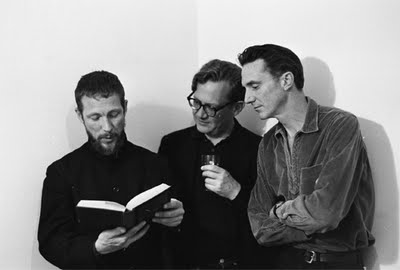 |
| Gary Snyder, Phil Whalen & Lew Welch |
For more Lew stories, check out "Hey Lew." Clew Press, Bolinas, CA,1998.
Audiotape of Lew Welch reading at SF State Poetry Center (via Ron Silliman's Blog).

Audiotape of Lew Welch reading at SF State Poetry Center (via Ron Silliman's Blog).


