Tech Insider is flogging a video version of that annotated Radiolab post (a takeoff of a 2011 BBC production) on the newness of the idea of the word origin for blue by proclaiming: "No one could see the color blue until modern times." Wait a minute! They cite the research of Jules Davidoff, a psychologist from Goldsmiths University of London, on a Namibian tribe. His area of expertise is object recognition, color, naming, cognitive neuropsychology. Not art. Yeah, right. Are we having a leap of logic?
Tech Insider's coffee table video pompously opens with that famous, yet troublesome Homeric image, ἐπὶ οἴνοπα πόντον, epi oinopa ponton, the wine-dark sea. As if that phrase alone were proof-positive that no one in the ancient world could actually see, let alone, name the color blue. They (Grace Raver and Kevin Loria) built a hypothesis upon that harebrained notion:
Zeus had blasted and shattered his swift ship with a bright lightning bolt, out on the wine-dark sea. —Homer, The Odyssey, Book VHomer was using metaphor, or rather, metalepsis—ἐπὶ οἴνοπα πόντον, translated as the wine-dark sea—was not meant to represent blue. It was translated into English from the Archaic Ionic Greek. Things get lost in translation. According to Homer's modern translator, American poet, Robert Fitzgerald, the literal translation is ''wine-faced (or facing) sea.'' From οἶνος wine + ὄψ 'face. But when he translated The Odyssey, Fitzgerald went along with Andrew Lang's 1880s prose interpretation, the wine-dark sea—because it sounded good. And the wine-dark sea has been with us ever since.
Homer, reputed to be blind, named the iridescent metallic sheen of the sea—ερυθρός erythrós, a tawny-red hue of bronze, and the copper-coloured sky, which paired nicely with the wine-faced sea. Homer's literal color palette was named after things of extreme value in the ancient world: bronze, copper, wine. It was about evoking the personification of wealth. Oh, and the Bronze Sea is also an euphemism for the Red Sea (named for its red plankton blooms).
And while we're quibbling, The Odyssey wasn't a book, it was an epic poem from the oral tradition. In ancient Greek, there was κυάνεος kyaneos a dark shade of blue, and γλαυκός, glaukos (or glafkós), pale blue with a pastel hue. (Minos' son, Glaukos, builder of Jason's ship, the Argo, who loved Scylla, ate a divine herb and was changed into a blue-skinned merman with verdigris hair.) Modern Greek also uses thálassi, from the word for the sea, θάλασσα, which stands in for the color blue. So maybe Θάλαττα! θάλαττα! Thálatta! Thálatta! also stood for the color blue and homecoming in Homeric Greek.
Then the Tech Insider (aka Business Insider) video goes on to claim that we—none of humanity—couldn't possibly perceive the color blue until modern times. I'm upping my knee-jerk facepalm reaction to flat-out fisticuffs. Someone please tell Tech Insider and Radiolab: It's linguistics, Stoopid! Or maybe semantics. Or a lack, thereof. Or maybe it's a bad case of Linguistic relativity gone awry. But not the ancient world's inability to perceive or comprehend blueness.
So, fast-forward: according to Tech Insider, the Middle Ages are now Modern Times? OK.... Oh, look! The first written usage of the word Blue dates back to ca.1300 AD. We have: bleu, blwe, etc., from O.Fr. blo "pale, pallid, wan. (Merriman). I won't go into the 98 synonyms for blue, in English alone. But I've compiled a list of some pre-industrial kinds of blue:
sky blue, midnight blue, azure, ultramarine, aquamarine, cobalt blue, bice blue, indigo, woad, sapphire, zaffre, lazurite, ice-blue, slate blue, turquoise, beryl, duck's egg blue, robin's egg blue, peacock blue, smoke blue, cornflower, gentian, hyacinth, periwinkle, madder blue, blueberry, teal, turquoise, cerulean, mazarine, livid (as in black & blue) or dead blue, aka mortuary blue... Pompeii blue, Persian blue, Aegean blue...Who doesn't know Something borrowed, something blue, folkloric devices used to baffle the evil eye. equated with ancient wedding customs—when it was first notated in 1871. "Belief in the evil eye dates back to Classical antiquity. It is referenced by Plato, Diodorus Siculus, Plutarch, Pliny the Elder. In the Aegean, people with green eyes, and especially blue eyes, are thought to bestow the curse. Thus, in Greece and Turkey amulets against the evil eye take the form of blue eyes." (Wiki) Apotropaic charms (nazars), dating from the 6th c. BC, are still used in the Mediterranean, the Levant, Egypt, and Morocco, the Middle East, and Afghanistan, to repel the evil eye. Blue eyes are still painted on the prows of Mediterranean boats. And even on the tails of airplanes.
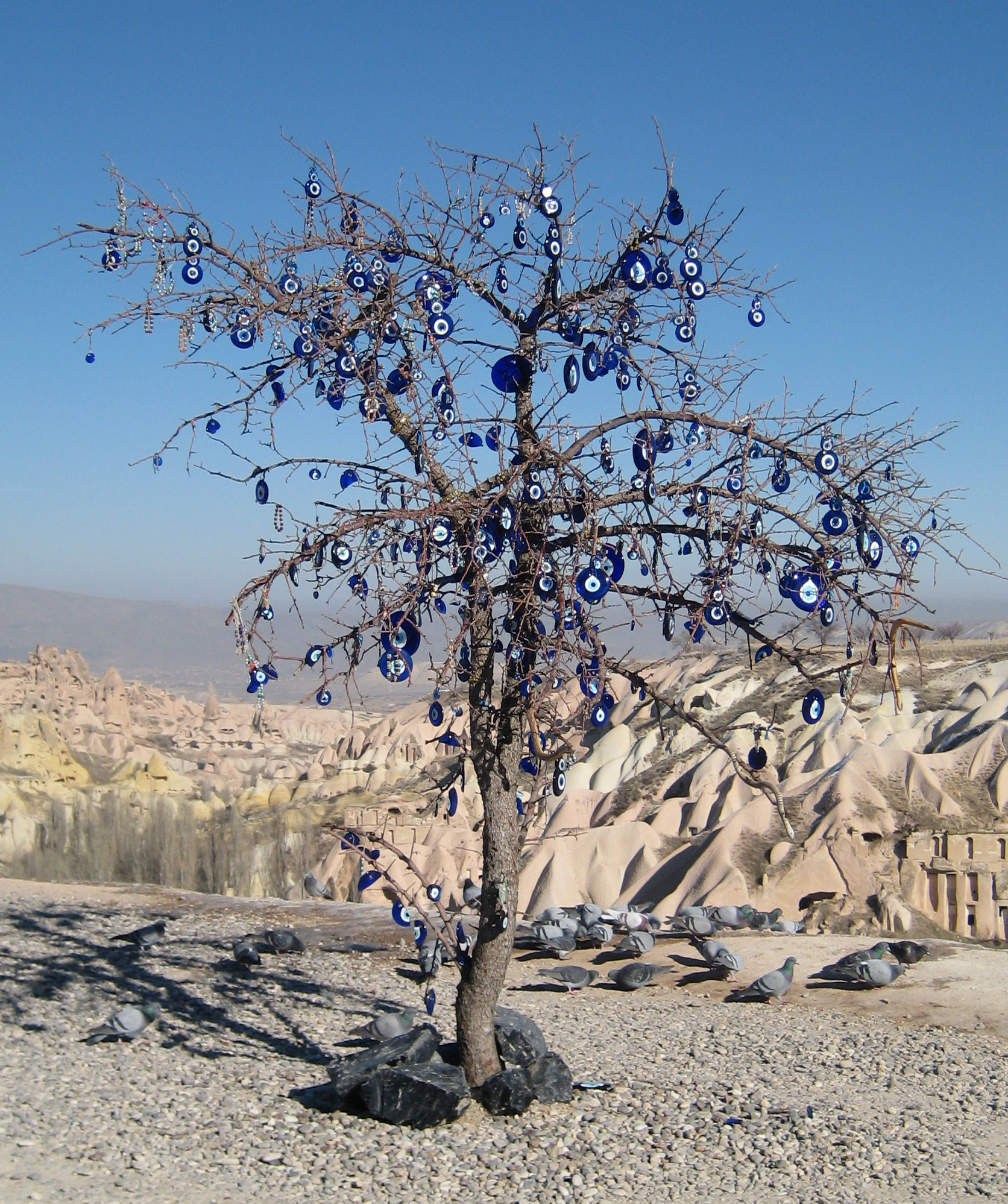 |
| A tree armed with nazars in Turkey. Maybe they should've used goats.—Wiki |
The quest for a stable true blue pigment has been a going concern ever since pre-antiquity, and has been documented since the foundation of Christianity to the 19th century, when aniline dyes were invented, because, you know, the Virgin Mary always wore blue. Always. Byzantine images (ca. 500 AD) of the Virgin Mary depicted her wearing her signature dark blue mantle (usually made of precious lapis lazuli stone, or pigment.)
Keeping the Virgin's mantle blue, or the blue sky—blue—in a fresco or a painting, has been a going technical concern for artists—since like, forever. Apparently it's not easy being blue. Most minerals make unstable, or fugitive pigments. Azurite (copper carbonate) aka mountain blue or Armenian stone, azurro della Magna, blue bice or blue verditer, was commonly used since antiquity. It was the chief source of blue during the Middle Age, but it has a nasty habit of turning green.
Leonardo da Vinci complained mightily to the Almighty about having to use azurite (but it was waaay cheaper). Hans Holbein the Younger painted a field azurite for a blue sky which is slowly turning teal. Teal, I tell you. The mantle of the Madonna in Raphael's Madonna and Child Enthroned with Saints has been turning green over the ages because the azurite is weathering into malachite.
Oil turns azurite green. Bright light, heat, and exposure to air will reduce the intensity of azurite, which can also go completely rogue and turn into black copper oxide. Treatises were written on how to stabilize azurite—or why paintings are varnished. My favorite blue cure—rub garlic on the sky before varnishing it to keep it blue. Would work well for chest colds too. I wonder if the painters were a little peckish.
Michelangelo couldn’t afford ultramarine, and refused to finish his painting The Entombment, because he couldn't get his hands on the prized pigment for love or money. Readily available azurite just wouldn't do. Vermeer mired his family in debt in his quest for the ultimate blue. Lapis lazuli, which literally means somewhere from beyond the sea, which was more valuable than gold.
Azurite was often substituted for ultramarine blue, because "...the lone source of ultramarine was an arid strip of mountains in northern Afghanistan. ...the color was traditionally restricted to the raiment of Christ or the Virgin Mary." —True Blue, Paris Review.
Blue remains a muse precisely because it is a mirage. “Among the ancient elements,” writes William Gass in his treatise On Being Blue, “blue occurs everywhere: in ice and water, in the flame as purely as in the flower, overheard and inside caves, covering fruit and oozing out of clay.”...Eastern spiritualists have long associated deep blue gemstones, such as lapis lazuli, with the sixth chakra, or third eye, the seat of elevated consciousness in the human body. The Egyptian Book of the Dead recognizes lapis lazuli, carved in the shape of an eye and set in gold, as an amulet of inestimable power. Cleopatra, in common lore, wore powdered lapis lazuli as eye shadow.—True Blue, Paris Review.Cobalt blue, used to make imitation lapis lazuli, wasn't cheap either. Cobalt ores were mined in Azerbaijan, Baluchistan, and Rajputana, India, but "Persia was the chief source of cobalt ores in the ancient world until the late Middle Ages; although there are also minor cobalt deposits in the western desert of Egypt south of Cairo." (Cobalt)
In the early Middle Ages, cobalt oxide was used to color the stained glass windows of cathedrals. Cobalt is unique in that it is stable under both low and high heat conditions. Underglaze blue and white porcelain was made in the 8th c. T'ang dynasty; the Ming Dynasty (1400s) was famous for its cobalt underglaze ceramics—precursor to our Blue Willow pattern.
Clearly the ancients had a sense of color, and a real fondness for blue. The Sumerians used rare lapis lazuli on artifacts long before the Egyptians who first developed blue faience (they used copper oxide, not cobalt to color the sintered quartz). Egyptian faience was widely exported to Europe—as far away as Scotland. What was the Picts' favorite color? Blue woad, of course.
Egyptian blue or hsbd-iryt (calcium copper silicate), which means fake lapis lazuli, was the first synthesized pigment (1350 BC) was known to the Romans as caeruleum. The word, derived from cael(um, “sky, heaven” is embedded in the name. Clearly Romans and Egyptians knew what blue was. It was popular until the 4th c. AD.
Another color, the wadjet eye was blue, blue-green, or sometimes the green of the Nile in summer. To suggest that the ancients couldn't perceive blue, (because we assume that they had no name for those colors? or they called it green because they couldn't see the difference?) is preposterously shallow end of the wading pool thinking. They knew what blue was. And they knew how precious it was. The color of the heavens.
Greek and Roman temples and marble statues were painted in gaudy colors, including azurite-based blue. (See the blue-maned lion of Loutraki 550 BC). Ancient Classical mosaic tile murals used blue for sky and water, etc., not for trees. I won't mention Maya blue here because I'm sticking to Old World examples of blue.
The Minoans, who predated the Greeks, were excessively fond of blue. (The Aegean Bronze Age murals, the bull leaping frescoes. the dolphin, or flying fish frescoes, or the Ladies in Blue—lots and lots of blue was used.) Blue fresco colors could shift, but not vitrified blue-glazed pots. Or mosaic tiles. Copper oxide, iron, or cobalt oxide was used. Cobalt glass (smalt) was ground up and used as pigment. Clever use of color stabilization.
Ancient glassware of the Levant was often colored blue. We're not talking of the natural green hue of iron in glass, but real cobalt blue. Ancient Greek κυανός, transliterated as kýanos, means "dark blue". What color is dominant in Greek villages? Green lintels and doorjambs? Nope. Blue, bleu, blau by any other name.
The ancient Greek word kyanos, κύανος means dark blue. Another Greek word for blue is sappheiros, blue stone—which probably meant lapis lazul as the modern word for sapphire is hyakinthos; from the Sanskrit śanipriya, beloved of the planet Saturn (which is bluish in the sky.) The ancient Greeks also used a specific word for pale blue, γλαυκός glaukós, “blue-green, blue-grey” which also appears in Homer. ( Proto-Indo-European *gleh₂w-ko.)
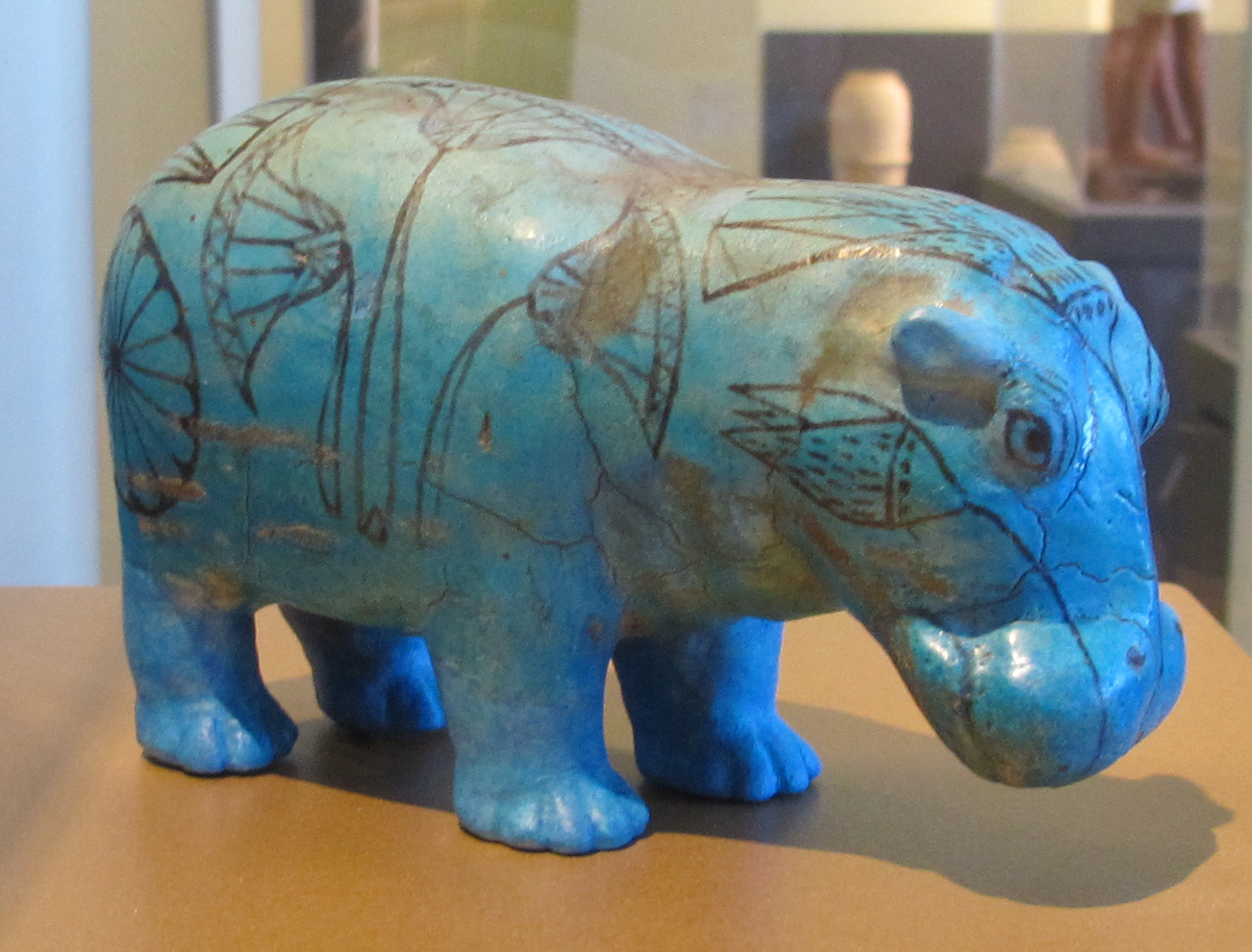 |
| Blue faience hippopotamus, Middle Kingdom (2033-1710 BC)—Wiki |
Clearly the ancients had a sense of color, and a real fondness for blue. The Sumerians used rare lapis lazuli on artifacts long before the Egyptians who first developed blue faience (they used copper oxide, not cobalt to color the sintered quartz). Egyptian faience was widely exported to Europe—as far away as Scotland. What was the Picts' favorite color? Blue woad, of course.
Egyptian blue or hsbd-iryt (calcium copper silicate), which means fake lapis lazuli, was the first synthesized pigment (1350 BC) was known to the Romans as caeruleum. The word, derived from cael(um, “sky, heaven” is embedded in the name. Clearly Romans and Egyptians knew what blue was. It was popular until the 4th c. AD.
Another color, the wadjet eye was blue, blue-green, or sometimes the green of the Nile in summer. To suggest that the ancients couldn't perceive blue, (because we assume that they had no name for those colors? or they called it green because they couldn't see the difference?) is preposterously shallow end of the wading pool thinking. They knew what blue was. And they knew how precious it was. The color of the heavens.
Greek and Roman temples and marble statues were painted in gaudy colors, including azurite-based blue. (See the blue-maned lion of Loutraki 550 BC). Ancient Classical mosaic tile murals used blue for sky and water, etc., not for trees. I won't mention Maya blue here because I'm sticking to Old World examples of blue.
 |
| Ladies in Blue, Palace of Knossos, (Heraklion, Crete) —Wiki |
The Minoans, who predated the Greeks, were excessively fond of blue. (The Aegean Bronze Age murals, the bull leaping frescoes. the dolphin, or flying fish frescoes, or the Ladies in Blue—lots and lots of blue was used.) Blue fresco colors could shift, but not vitrified blue-glazed pots. Or mosaic tiles. Copper oxide, iron, or cobalt oxide was used. Cobalt glass (smalt) was ground up and used as pigment. Clever use of color stabilization.
Ancient glassware of the Levant was often colored blue. We're not talking of the natural green hue of iron in glass, but real cobalt blue. Ancient Greek κυανός, transliterated as kýanos, means "dark blue". What color is dominant in Greek villages? Green lintels and doorjambs? Nope. Blue, bleu, blau by any other name.
The ancient Greek word kyanos, κύανος means dark blue. Another Greek word for blue is sappheiros, blue stone—which probably meant lapis lazul as the modern word for sapphire is hyakinthos; from the Sanskrit śanipriya, beloved of the planet Saturn (which is bluish in the sky.) The ancient Greeks also used a specific word for pale blue, γλαυκός glaukós, “blue-green, blue-grey” which also appears in Homer. ( Proto-Indo-European *gleh₂w-ko.)
True, there were fluid boundaries between blueness to greeness
or even yellowness in many cultures—including Navajo, and Chinese 青 (qīng). But that fluidity is true of many colors. And bruises too. It really came down to context. No one thought the grass and sky were one color. Or that they couldn’t see the difference. That’s myopic thinking on our part.
What evidence is there that blue was a predominant color? Well, let's see, the entire foundation of the Bronze Age was built upon the extraction of copper ore—and copper ore yields azurite, "a soft, deep blue copper mineral produced by weathering of copper ore deposits." They went through many workarounds to stabilize that blue in faience, glass, and pigment.
Of course people could see that color wedged between green and violet. Blue is an integral part of the color spectrum. Rainbows never lie. Sure, Xenophanes described the rainbow with only three bands of color: porphyra (Tyrean purple*), khlōrós (light green), and erythrós (ruddy red). But the Greeks also believed the entire universe was composed of three elements: Air, Earth, Water (Fire was a reaction). Purple and red were considered the most costly of royal colors. Besides, it sounds like Xenophanes was describing the interference pattern of a supernumerary rainbow (pink, purple and blue-green hues).
We tend to conventionally acknowledge seven colors of the rainbow: red, orange, yellow, green, blue, indigo and violet (
Bowing to the ancient Greek sophists, Newton later threw in orange and indigo so it would be analogous to the number of notes in a musical scale (which in turn bowed to the Sumerian love of seven.) Plato was pretty keen on the idea of math and music defining the "harmonies of the cosmos." Natural philosophers were not afraid to shoehorn science into popular thought processes.
German poet and artist Goethe wrote a psychological study on the nature, function, and psychology of color in his 1810 treatise, Theory of Colours. "Blue still brings a principle of darkness with it. This colour has a peculiar and almost indescribable effect on the eye.... As the upper sky and distant mountains appear blue, so a blue surface seems to retire from us. ...light and its absence, are necessary to the production of colour.... Colour itself is a degree of darkness.") (Maria Popova, Atlantic Monthly)
Then
there's the pursuit of royal blue, and later, royal purple in the cloth dying industry. In Mesopotamia, a 7th c. BC cuneiform tablet preserves an indigo recipe for dyeing lapis-colored wool (uqnatu). The Greeks imported ινδικόν indikón, indigo dye from India. The Romans Latinized the term to indicum. Indigo was in high demand across the ancient world. (During the Edo period,
silk was forbidden, so the Japanese dyed cotton with
indigo.) In North Africa, to this day, cloth dyed with indigo signifies wealth.
The Phoenicians of Tyre made an indigo dye from a species of marine snail, but Tyrian purple dye from murex shells was a rare commodity. Phoenicia, from the Greek, phoinós means the land of purple, or, dark red. Tyrian purple was also called Tyrian red. The ancient idea of purple was more of a violet-maroon color. They sometimes over-dyed indigo with purple. There are records of the dye in Ugarit and Hittite texts ca. 14th c. BC, but the Minoans may have invented the process of making Imperial purple ca. 20th–18th c. BC, centuries before the Tyrians (ca. 1570 BC).
Then the silly BBC-sponsored video claims there was no word for blue in Hebrew. Really? A slow news day at the office? What color is the tzitzit on the tallit /prayer shawl again? According to a biblical commandment (15:38), a blue thread—tekhelet (תְּכֵלֶת) must be included in the tzitzit (תכלת), and that blue (or blue-violet) is the same color mentioned 49 times in the Torah. A sea snail, Hexaplex trunculus, produces a blue which could be tekhelet. (But it was excluded from this video as a synonym for blue because it can also represent purple or black.)
In Irish, one of the oldest Indo-European languages, gorm is the word used for the color of the sea, and for blue eyes. (Proto-Celtic *gurmos.) Sometimes glas (green) was also used for blue. Or glastum the color of blue dye extracted from dyer's woad (cabbage family—they also used whortleberries for blue dyes). Glas may refer to grey-blue eyes, or green grass, but not bright dyed green, uaine (uaithne). They combined words for more blue shades: gormghlas for azure, gormuaine for blue-green. They also distinguished between gorm and glas and uaine. (Líath means grey or light blue.) Why? Because there are words for blue.
What color was Krishna again? Oh yeah, blue. Blue symbolizes divinity in many, if not most cultures.
You can see things without specifically naming them. Aren't we really flogging another version that horse, can one think without words? "Steven Pinker notes that we are not born with language, so that it is not likely that we are engineered to think in words alone." But that's another argument.
Yes, Claude Lévi-Strauss wrote extensively about how color patterns were connoted in ancient texts. Light/dark, red/yellow; green, purple. Then blue. But if we look at the light/dark idea, colors tended to be divided along that system, vs. names. Blue can be either light or dark. Maybe instead of looking for ancient words to represent blue, we need to look at synonyms for darkness and light.
The silly video asks: Can you see a color if you don't have a word for it? Apparently certain animals can see blue. Satin bowerbirds and chimps can see blue—even owls and pigeons can see blue. So the ability to see blue predates speciation and also necessarily predates language. The human eye can detect a million colors, (and many women, who have four types of cone cells, tetrachromats, can see even more colors), but the ancients couldn't perceive the color blue in days of yore? Hmmmf. Not buying it.
Then the video claims that blue is exceedingly rare in nature. What?
As it turns out "This striking "experiment" was a BBC dramatization, and the description of its "results" was invented by the authors of the documentary, and not proposed or endorsed by the scientists involved." In other words, bad popular science strikes again. Can you spell FAKE PSEUDOSCIENCE?
Some of this stinking thinking dates back to 1858 when politician (4 x Prime Minister) who championed Irish Home Rule, and Classics scholar, William Gladstone (1809 - 1898) conducted a survey of ancient written languages and noted that the speakers did not name colors precisely or consistently as modern English speakers. In other words, they didn't use the names of colors as abstract nouns. He erroneously concluded that because there was no consistent word for blue in Greek, " ... that the organ of color and its impressions were but partially developed among the Greeks of the heroic age." And apparently we've been parroting that idea ever since.
Winding back to Goethe's emotional equivalences, here's another take on the wine-dark sea:
In The Sea Around Us science writer Rachel Carson wrote:
(An aside: The Greeks were astonished that their clients, the neighboring Celts drank their imported Greek wine neat, (and were thusly barbaric), as civilized people always diluted their wine with water. I've seen Mary Bianchi’s watered down homemade Italian wine turn purple, then blue. Try it sometime with Mogen David wine too. The blueness of the wine might have something to do with the pH of spring water. Oh, and BTW, those green traffic lights are actually azure blue. We just call them green.)
All this talk of blue and I am reminded of Robert Francis's poems:
BLUE CORNUCOPIA
Pick any blue sky blue cerulean azure
cornflower periwinkle blue-eyed grass
blue bowl bluebell pick lapis lazuli
blue pool blue girl blue Chinese vase
or pink-blue chicory alias ragged sailor
or sapphire bluebottle fly indigo bunting
blue dragonfly or devil's darning needle
blue-green turquoise peacock blue spruce
blue verging on violet the fringed gentian
gray-blue blue bonfire smoke autumnal
haze blue hill blueberry distance
and darker blue storm-blue blue goose
ink ocean ultramarine pick winter
blue snow-shadows ice the blue star Vega.
and his
BLUE WATER
Winter uses all the blues there are.
One shade of blue for water, one for ice,
Another blue for shadows over snow.
The clear or cloudy sky uses blue twice-
Both different blues. And hills row after row
Are colored blue according to how far.
You know the bluejay's double-blur device
Shows best when there are no green leaves to show.
And Sirius is a winterbluegreen star.
Robert Francis
Special thanks to Souzana Raphael for proofreading the Greek.
SOME OF MY OTHER POSTS ON COLOR
Some Musings on a Color Thesaurus Chart
No Word for Purple
Horizon: Do you see the same colours as me? BBC TV, 2011. The Himba of northern Namibia - who had never even set foot in a local town - call the sky black and water white, and for them, blue and green share the same word. In having fewer words than us for colour, it seems that their perception of the world is different to ours - it takes them longer to differentiate between certain colours, and so we can determine from this that they see the world a little differently. The tribe found us a bit of an oddity - they hadn't been filmed before - so when I played them back the footage we had filmed they thought it was the most hysterical thing they had every seen.
The Himba and the perception of colour Jules Davidoff "The Himba are an ethnic group from northern Namibia closely related to the Herero. They have 4 colour category names in their language. Recognizing different colours and hues are supposedly universal. What the study attempts to find out is if the Himba truly see the world in a vastly different way or are merely describing what they see differently... What is clear though is that concepts like colour itself and the categories for colour have to be translated and codified in such a way that is intelligible to an English speaking audience."
Himba color perception "These papers, however, only reported that subjects experienced slower reaction times when distinguishing the oddball colour (or made errors regarding the extent of perceptual distance when it crossed one of their language's colour boundaries)... the prism of tv slightly exaggerates the reality… The BBC's presentation of the mocked-up experiment — purporting to show that the Himba are completely unable to distinguish blue and green shades that seem quite different to us, but can easily distinguish shades of green that seem identical to us — was apparently a journalistic fabrication, created by the documentary's editors after the fact, and was never asserted by the researchers themselves, much less demonstrated experimentally." The slowness was due to where the color was placed on the screen.
The Wine-Dark Sea: Color and Perception in the Ancient World argues the point that there is no word for blue, but also discusses synaesthesia, and the fact that some of us have more color receptors in our eyes than others. "...in the Torah [blue] is questioned (there are two words argued to be types of blue, sappir and tekeleth...Homer’s palette limited to only five colors (metallics, black, white, yellow-green, and red), Empedocles, believed that all color was limited to four categories: white/light, dark/black, red, and yellow. Xenophanes, described the rainbow as having but three bands of color: porphyra (dark purple), khloros, and erythros (red)."
OK, I beg to quibble here, but the ancient Greeks were really into reducing everything down into three basic elements (basis for our modern periodic tables: Air, Earth, Water (Fire was a byproduct, an action, not a base element.) Also, since when is sapphire not blue?
Colours in Homer #2: the wine-dark sea A list of color terms in Greek based on surviving texts. There's kyaneos -- conventional translation for blue: porpoises, a swallow's feathers, black hair—a medium grey-blue ranging towards dark shades; not vivid. Porphyreos (in Homer porphyrios) — the 'purple' of flowers and murex dyes; blood, blushing cheeks, and rainbows; the indigo-lavender-violet part of the spectrum. Porphyreos doesn't have an equivalence in English. And glaukos—greyish: the dull blue or green sheen on olives, grapes, vine leaves; (blue) eyes, the sea, a clear sky. Ancient technical descriptions suggest it's a light hue of kyaneos; see Plato. So light blue to dull green, or greenish-grey. Like porphyreos, this term doesn't have a one-to-one equivalence to any English. We use glaucous for yeast bloom on fruit. Chlōros is vivid green, as in leaves, plants; frightened people—also means unripe. In artists' terms, kyaneos would be a shade, and glaukos would be a hue, or pastel.
HOMER'S SEA: WINE-DARK? NY X Scholars have puzzled over ''very odd'' color tones used in classical Greek writing. 'They don't reflect the same division of the color spectrum. Dr. Cattley said the notion of the Greeks' color- blindness to blue was ''patently unlikely'' because the ancient Greeks diluted their wine with water alkaline enough to change the color of wine from red to blue. Dr. Cattley believes the phrase the wine-dark sea was a poetic device. Formulaic stock phrases gave the audience time to absorb information. "Besides, in Greek the phrase wine-dark sea made a perfect flourish at the end of the hexameter line used by Homer. Dr. Cattley dismisses the suggestion that Homer, being blind, made an unreliable witness in such matters. ''It's a tradition, that's all. In fact, some people argue that there was no one person called Homer.'' Robert Fitzgerald, the American translator of Homer, noted that the literal translation is ''wine-faced sea.'' Still, he uses ''wine-dark sea.'' As a romantic expression, he said, it ''can't be improved on.''
Cobalt The earliest known object containing cobalt is a blue glass lump dated to about 2000 b.c.e. from Eridu, in southern Mesopotamia (Garner, 1956, pp. 147-49). Cobalt has also been identified in blue glass from Egypt of the late 16th century b.c.e. (early Eighteenth Dynasty; Farnsworth and Ritchie, pp. 158-61), from the Aegean area at about the same date, and from Roman Pompeii and Syria (Sayre, pp. 4-11), as well as in late Parthian beads from northern Persia (Oda, p. 46). The Chinese were coloring blue glass with cobalt under the Chou dynasty (1122-221 b.c.e.; Ritchie, p. 219). The earliest Chinese cobalt glazes date from the T’ang period (618-907 c.e.; Gettens, p. 29), but perhaps the best-known use of cobalt on Chinese ceramics is the underglaze-blue decoration on blue-and-white ware of the Yüan (1279-1368) and Ming (1368-1644) dynasties (Young, pp. 43-47).
True Blue Paris Review Michelangelo couldn’t afford ultramarine and didn't finish painting The Entombment. Rafael reserved ultramarine for a final coat, his base layers were common azurite; Vermeer proceeded to mire his family in debt for the ultimate blue of blues. Ultramarine is superlative blue, the end-all blue. The name means “beyond the sea”—a dreamy ode to its distant origins. Lapis lazuli pigment was far more precious than gold.
Scientists have found a woman whose eyes have a whole new type of colour receptor Most humans are trichromats, which means we have three types of cone cells in our eyes. Each type of cone cell can see 100 shades, so three cone cells means we can see a million different colours. But there's a doctor who has four cone cell types, taking the potential number of colours she can distinguish up to 100 million colours.
Certainly the 1300s were not considered to be modern times. Yet we have references to blue that date back to the Middle Ages:
Such utter bullshite. First, Homer was using metaphor, wine-dark is not meant to represent blue. It wasn't in a book. It was part of oral tradition. Wine-dark is a stormy sea. He also wrote of the rosy-fingered dawn. Someone please tell Radiolab: It's linguistics, Stoopid! or maybe semantics. Ancient Greek κυανός, transliterated kýanos, means "dark blue". What color is dominant in Greek villages?
What evidence? Of course people could see blue. It's part of the color spectrum. You can see things without naming them.
The Sumerians used lapis and turquoise long before the Egyptians who developed faience. They had no name for those colors? (Or called it green?) I think not. Greek and Roman temples and statues were painted gaudy colors, including blue. Ancient Classical mosaic tile murals used blue for water, etc, not trees.
Then there's the cloth dying industry: indigo was in big demand, and the development of purple among the Phonecians was based on indigo. The word Sapphire means blue stone.
Yes, Claude Lévi-Strauss and Dimuzel (sp) wrote extensively about how color patterns were connoted in ancient texts. Light/dark, red; green, then purple. No word for blue in Hebrew, yet how many times is blue mentioned in the Torah? What color is the prayer shawl again?
Can you see a color if you don't have a word for it? Blue is rare in nature?? What? There's chicory, hydrangea, hyacinth, lobelia, bellflowers, bluebells, blueberries, bluejays, bluebirds, blue buntings, macaws, the ocean, lakes, oh yeah, the sky, too.
Yes. Davdoff's logic is flawed. Based on one tribe who were probably freaking out just looking at a computer monitor... Had they been showed something from their native environment, it might hold some merit.
There’s no way to reach Emma Taggert who went on to repeat the same mistakes without checking her facts. So I wrote to MyModernMet. “In your article on blue, Emma Taggert’s opening statement is based on a grievous error. She bases the entire premise of her article that the Classical World did not see blue based on.a misquoted modern translation. “Homer’s Odyssey, that describes the ocean as a “wine-red sea.” Where to even begin? For starters, Homer never wrote that. Translator Andrew Lang translated “the wine facing sea” as “the wine dark sea.” When Fitzgerald later translated the Odyssey, he liked it so much he left it. Stet. She even managed to misquote the translator. No red involved. it’s a fanciful translation. Poetic license and all that.”
SIGH. MyModernMet trotted out the article again on FB, so clearly nobody’s home. . I wrote. Your basic premise is wrong. And your opening argument example is based on a mistranslation. Does anybody actually bother to vet these articles? Homer never scribed “the wine dark sea.” Andrew Lang translated it thusly, some 2000 years after the idea was coined, and Robert Fitzgerald liked it so much that he kept it. (Neither wrote “the wine-red sea.” ) Homer actually wrote “the wine-facing sea.” You can’t even get the Homeric quote right. Alas, it’s all bull puckey.
“Some scientists believe that the earliest humans were actually colorblind and could only recognize black, white, red, and only later yellow and green. As a result, early humans with no concept of the color blue simply had no words to describe it. This is even reflected in ancient literature, such as Homer’s Odyssey, that describes the ocean as a “wine-red sea”
The Homeric image, ἐπὶ οἴνοπα πόντον, epi oinopa ponton, doesn’t say the wine-dark sea. As if that phrase alone were proof-positive that no one in the ancient world could actually see, let alone, name the color blue.
Zeus had blasted and shattered his swift ship with a bright lightning bolt, out on the wine-dark sea. —Homer, The Odyssey, Book V
Homer was using metaphor, or rather, metalepsis—ἐπὶ οἴνοπα πόντον, translated as the wine-dark sea—was not meant to represent blue. It was translated into English from the Archaic Ionic Greek. Things get lost in translation. According to Homer's modern translator, American poet, Robert Fitzgerald, the literal translation is ''wine-faced (or facing) sea.'' From οἶνος wine + ὄψ 'face. But when he translated The Odyssey, Fitzgerald went along with Andrew Lang's 1880s prose interpretation, the wine-dark sea—because it sounded good. And the wine-dark sea has been with us ever since.
In ancient Greek, there was κυάνεος kyaneos a dark shade of blue, and γλαυκός, glaukos (or glafkós), pale blue with a pastel hue.
The entire hypothesis is wrong, and the basic premise is wrong. There is no scientific evidence that we couldn’t see blue. Ever. Slovenly thinking posing as fact. No anthropological nor scientific evidence. No actual scientific reports cited. It’s pure conjecture.
The only way to test this theory would be a DNA test on early man, as the failure to see certain colors is genetic—and pretty much only males are colorblind as it’s a recessive sex-linked XY gene.
Btw, all many mammals and all primates can see color—because survival depended upon it. All insects and birds can see color. In fact, blue is so important to the bowerbird, it collects blue objects.
Colorblindedness only affects a minute population of (mostly) males, it’s a sex-linked gene defect that affects cones (color receptors) in the eye. Most common color blindness affects red and green. The most common missing color in all four forms of color blindness is the inability to see green, not blue. There is a very rare form of non-sex-linked color blindness, Tritanopia, that only affects blue and yellow cones—and is often caused by blunt force trauma. There’s a quirky blue-purple color blindness too. They can see blue but can’t distinguish between it and purple.
Suggesting that early man was colorblind because of a mistranslation of Homer, is patently absurd.
See the WebMD article, and note the types of color blindness, and what they see.. But if the article’s hypothesis were true, early man couldn’t distinguish red, from green, not blue.
One good thing about the met trotting out the article is that I get new references. This one from a bible thumper screaming at us pagans. “Early humans couldn't see blue? Pagans always have to throw some stupid nonsense to defy God whom in the book of Exodus chapter 24:10 when Moses goes up Mount Sinai to meet Him and shows that under God's feet were stones of Lapis Lazuli as clear and beautiful as the sky.” Cool, now I have a biblical reference for lapis. I said: The premise is garbage, for sure, but early man’s ability, or inability to see blue has nothing to do with the Bible or religion. Nothing to do with paganism either. Your bible quote is a good reference, but it is late on the event horizon of mankind. Lapis, an exceedingly rare stone, only exists in Afghanistan, then known as Bactria, and was always used to paint the Virgin Mary’s cloak. Always.
One reader, Silas from Mallorca, and I entered into a lively exchange. I told him I actually wrote to MYModernMet, they never replied, and then trotted out this article again, so I’m using this space as a soapbox. I think it’s actually a cribbed article from another source, BTW. So it’s not even original thinking. Alors! Will need to research which article came first. Chicken-egg syndrome. I told him my blog post on blue, evolved from my overreaction to a bad TechInsider/Radiolab cribbing of an old speculative science (read hogwash) BBC broadcast. My blogpost also came from comments on a Facebook thread. Lol. Suddenly I was in over my head...and the only way out was through. And so on. Than you for being my guineapig. Cheers y azuelos.
Silas De Corrals did you know that traffic lights aren’t actually green? They’re cyan. At least in the States. I think Japan’s lights are bluer. Yep. has to do with wavelengths and the color of the light source—incandescent light is yellow. And yellow and blue make what color? Think of stage lighting. Those RGB color gels—how light cancels out colors. Reductive light. Not the same as pigment absorbing color, or additive color. The opposite.
And yes, you hit the nail squarely on the head, color blindness almost always affects red and green, not blue.
He sent me a link on the color of traffic lights. I said, yeah, I stumbled upon something that mentioned that. Thanks for the link. I am procrastinating. Need to finish a project. Perfect distraction. Thank you.
Wow, worth the price of admission.
“Back in the early days of railway lights, green originally meant "caution," while the "all-clear" light was, well, clear or white. Trains, of course, take an interminably long time to stop, and legend has it that several disastrous collisions happened after an engineer mistook stars in the night horizon for an all-clear. Thus, green became "go," and for a long time, railways used only green and red to signal trains.”
Mistaking the stars on the horizon for go, or all clear ahead. I once took a train across Nevada, and the stars were like searchlights. Pure poetry.

What evidence is there that blue was a predominant color? Well, let's see, the entire foundation of the Bronze Age was built upon the extraction of copper ore—and copper ore yields azurite, "a soft, deep blue copper mineral produced by weathering of copper ore deposits." They went through many workarounds to stabilize that blue in faience, glass, and pigment.
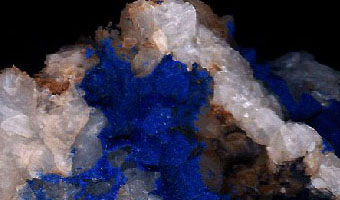 |
| Fresh mined azurite crystals from Špania Dolina, Slovakia —Wiki |
Of course people could see that color wedged between green and violet. Blue is an integral part of the color spectrum. Rainbows never lie. Sure, Xenophanes described the rainbow with only three bands of color: porphyra (Tyrean purple*), khlōrós (light green), and erythrós (ruddy red). But the Greeks also believed the entire universe was composed of three elements: Air, Earth, Water (Fire was a reaction). Purple and red were considered the most costly of royal colors. Besides, it sounds like Xenophanes was describing the interference pattern of a supernumerary rainbow (pink, purple and blue-green hues).
We tend to conventionally acknowledge seven colors of the rainbow: red, orange, yellow, green, blue, indigo and violet (
 |
| Goethe's symbolic colorwheel (1809) —Wiki |
German poet and artist Goethe wrote a psychological study on the nature, function, and psychology of color in his 1810 treatise, Theory of Colours. "Blue still brings a principle of darkness with it. This colour has a peculiar and almost indescribable effect on the eye.... As the upper sky and distant mountains appear blue, so a blue surface seems to retire from us. ...light and its absence, are necessary to the production of colour.... Colour itself is a degree of darkness.") (Maria Popova, Atlantic Monthly)
 |
| Cyanometer Horace-Bénédict de Saussure 1760 Wiki |
 |
| Byzantine Emperor Justinian I in Tyrian purple, 6th-c mosaic Italy |
The Phoenicians of Tyre made an indigo dye from a species of marine snail, but Tyrian purple dye from murex shells was a rare commodity. Phoenicia, from the Greek, phoinós means the land of purple, or, dark red. Tyrian purple was also called Tyrian red. The ancient idea of purple was more of a violet-maroon color. They sometimes over-dyed indigo with purple. There are records of the dye in Ugarit and Hittite texts ca. 14th c. BC, but the Minoans may have invented the process of making Imperial purple ca. 20th–18th c. BC, centuries before the Tyrians (ca. 1570 BC).
Then the silly BBC-sponsored video claims there was no word for blue in Hebrew. Really? A slow news day at the office? What color is the tzitzit on the tallit /prayer shawl again? According to a biblical commandment (15:38), a blue thread—tekhelet (תְּכֵלֶת) must be included in the tzitzit (תכלת), and that blue (or blue-violet) is the same color mentioned 49 times in the Torah. A sea snail, Hexaplex trunculus, produces a blue which could be tekhelet. (But it was excluded from this video as a synonym for blue because it can also represent purple or black.)
 |
| Modern Irish Color chart. Go raibh maith agat for translating Google image @Tuigim |
In Irish, one of the oldest Indo-European languages, gorm is the word used for the color of the sea, and for blue eyes. (Proto-Celtic *gurmos.) Sometimes glas (green) was also used for blue. Or glastum the color of blue dye extracted from dyer's woad (cabbage family—they also used whortleberries for blue dyes). Glas may refer to grey-blue eyes, or green grass, but not bright dyed green, uaine (uaithne). They combined words for more blue shades: gormghlas for azure, gormuaine for blue-green. They also distinguished between gorm and glas and uaine. (Líath means grey or light blue.) Why? Because there are words for blue.
 Post: Edit Post: Edit |
| Scots Gaelic comes from the Irish, note the similarities. |
What color was Krishna again? Oh yeah, blue. Blue symbolizes divinity in many, if not most cultures.
 |
| Krishna, from Sanskrit Kṛṣṇa, dark or dark blue, has jambul-colored skin.—Wiki |
You can see things without specifically naming them. Aren't we really flogging another version that horse, can one think without words? "Steven Pinker notes that we are not born with language, so that it is not likely that we are engineered to think in words alone." But that's another argument.
Yes, Claude Lévi-Strauss wrote extensively about how color patterns were connoted in ancient texts. Light/dark, red/yellow; green, purple. Then blue. But if we look at the light/dark idea, colors tended to be divided along that system, vs. names. Blue can be either light or dark. Maybe instead of looking for ancient words to represent blue, we need to look at synonyms for darkness and light.
The silly video asks: Can you see a color if you don't have a word for it? Apparently certain animals can see blue. Satin bowerbirds and chimps can see blue—even owls and pigeons can see blue. So the ability to see blue predates speciation and also necessarily predates language. The human eye can detect a million colors, (and many women, who have four types of cone cells, tetrachromats, can see even more colors), but the ancients couldn't perceive the color blue in days of yore? Hmmmf. Not buying it.
Then the video claims that blue is exceedingly rare in nature. What?
There are wild blue anemones, agapanthus/lily of the Nile, asters, baby blue eyes, bellflowers, bluebells, blue camas, blue-eyed-grass, bugloss, clematis, columbine, blueberries, borage, brodiaea, ceanothus, chicory, cornflowers, campanula, crocus, delphiniums, false indigo, flax, forget-me-nots, gentian, gilia, hydrangea, houndstongue, hyacinths, irises, indigo, Ithuriel’s spears, larkspur, lilac, lobelia, lungwort, lupine, morning glory, monkshood, nigella, nightshade, periwinkle, phacelia, blue poppies, rosemary, sage, scilla, veronica, violets. And then the birds: bluejays, bluebirds, cerulean warblers, blue buntings, indigo buntings, lazuli buntings, azure tits, blue tits, kingfishers, macaws, quetzalbirds… all the oceans, lakes, oh yeah, and the sky are blue. Rainbows too.Jules Davidoff's logic, such as it is, is either seriously flawed or it's misinterpreted. His study was based on one primitive African tribe who were probably freaking out just by looking at a computer monitor... Cathodes emit a mixture of three color frequencies and trick the eye into assuming other color exists via interpolation. Had the Namibian tribe been showed something borrowed, something blue from their native environment like a Where's Waldo experiment, instead of using a pinwheel on a phosphor screen, then the study might hold some merit. Of course he would need to be fluent in their language and their culture. Not an outsider looking in.
As it turns out "This striking "experiment" was a BBC dramatization, and the description of its "results" was invented by the authors of the documentary, and not proposed or endorsed by the scientists involved." In other words, bad popular science strikes again. Can you spell FAKE PSEUDOSCIENCE?
Some of this stinking thinking dates back to 1858 when politician (4 x Prime Minister) who championed Irish Home Rule, and Classics scholar, William Gladstone (1809 - 1898) conducted a survey of ancient written languages and noted that the speakers did not name colors precisely or consistently as modern English speakers. In other words, they didn't use the names of colors as abstract nouns. He erroneously concluded that because there was no consistent word for blue in Greek, " ... that the organ of color and its impressions were but partially developed among the Greeks of the heroic age." And apparently we've been parroting that idea ever since.
Winding back to Goethe's emotional equivalences, here's another take on the wine-dark sea:
Homer describes the sea as wine-dark following a tragedy. Odysseus mourns the death of his men after a shipwreck, when they’ve been swallowed up by the wine-dark sea. Achilles mourns the death of Patroclus looking out on the wine-dark sea. 'The idea is that the sea is dangerous, it's captivating, it's intoxicating, just like wine', he says. 'It's much more than just the colour, it's more about what the object-metaphor is encouraging us to think about'. Amanda Smith—Were the ancient Greeks and Romans colour blind?About that wine-dark sea—let me reiterate, that's a modern translation, Andrew Lang and Robert Fitzgerald's poetic license. Homer actually wrote: the wine-facing sea. He may have been depicting the sea at sunset, or even a toxic red tide algal bloom—always cause for alarm.
In The Sea Around Us science writer Rachel Carson wrote:
The sea is blue because the sunlight is reflected back to our eyes from the water molecules or from very minute particles suspended in the sea. In the journey of the light rays into deep water all the red rays and most of the yellow rays of the spectrum have been absorbed, so when the light returns to our eyes it is chiefly the cool blue rays that we see. Where the water is rich in plankton, it loses the glassy transparency that permits this deep penetration of the light rays. The yellow and brown and green hues of the coastal waters are derived from the minute algae and other microorganisms so abundant there. Seasonal abundance of certain forms containing reddish or brown pigments may cause the “red water” known from ancient times in many parts of the world, and so common is this condition in some enclosed seas that they owe their names to it — the Red Sea and the Vermilion Sea are examples.What makes this presentist theory, or modern speculation that the Classical world had defective color vision all rather funny is that before Newton's Opticks was published in 1704, even European poetry was a bit bland on the naming of colors. That's why French Surrealist poet, Arthur Rimbaud's 1884 breakthrough poem celebrating colors, Voyelles was such a big hit—it took poetry into the visionary realm of artists.
Blue O, great Trumpet blaring strange and piercing criesAlso, our relationship to the naming of color in literature has changed radically since the 18th c. (coupled with the revolutionary discovery of aniline dyes in 1856 which, for the first time produced a wide range of bright, stable colors—the first color? Purple!).
Through Silences where Worlds and Angels pass crosswise;
Omega, O, the violet brilliance of Those Eyes! —Voyelles
(An aside: The Greeks were astonished that their clients, the neighboring Celts drank their imported Greek wine neat, (and were thusly barbaric), as civilized people always diluted their wine with water. I've seen Mary Bianchi’s watered down homemade Italian wine turn purple, then blue. Try it sometime with Mogen David wine too. The blueness of the wine might have something to do with the pH of spring water. Oh, and BTW, those green traffic lights are actually azure blue. We just call them green.)
 |
| Lapis lazuli, lazulum, stone from heaven's skies. —Wiki |
All this talk of blue and I am reminded of Robert Francis's poems:
BLUE CORNUCOPIA
Pick any blue sky blue cerulean azure
cornflower periwinkle blue-eyed grass
blue bowl bluebell pick lapis lazuli
blue pool blue girl blue Chinese vase
or pink-blue chicory alias ragged sailor
or sapphire bluebottle fly indigo bunting
blue dragonfly or devil's darning needle
blue-green turquoise peacock blue spruce
blue verging on violet the fringed gentian
gray-blue blue bonfire smoke autumnal
haze blue hill blueberry distance
and darker blue storm-blue blue goose
ink ocean ultramarine pick winter
blue snow-shadows ice the blue star Vega.
and his
BLUE WATER
Winter uses all the blues there are.
One shade of blue for water, one for ice,
Another blue for shadows over snow.
The clear or cloudy sky uses blue twice-
Both different blues. And hills row after row
Are colored blue according to how far.
You know the bluejay's double-blur device
Shows best when there are no green leaves to show.
And Sirius is a winterbluegreen star.
Robert Francis
The deeper the blue becomes, the more strongly it calls man towards the infinite, awakening in him a desire for the pure and, finally, for the supernatural... The brighter it becomes, the more it loses its sound, until it turns into silent stillness and becomes white.
~Wassily Kandinsky
Special thanks to Souzana Raphael for proofreading the Greek.
SOME OF MY OTHER POSTS ON COLOR
Some Musings on a Color Thesaurus Chart
No Word for Purple
BLUE COYOTE
MY HANDS, DYED WOAD
WOAD
How Color Came to Be—teaching notes
MY HANDS, DYED WOAD
WOAD
How Color Came to Be—teaching notes
 |
| Werner’s Nomenclature of Colours Patrick Syme |
Color chart by Scottish painter, Patrick Syme, for his Werner’s Nomenclature of Colours: Adapted to Zoology, Botany, Chemistry, Mineralogy, Anatomy, and the Arts. See Syme's entire color chart in previous link. Many of the purples, we would now move to the blue chart. I can't help but think that some of the colors have shifted, as the azures are fugitive colors, as are the red lakes (magentas), while the greens continue to ripen and darken with time. And the yelllows and oranges oxidizing towards brown. So take the color charts with a grain of salt as the colors themselves have shifted over time. I borrowed this particular (public domain) chart from Two Hundred Years of Blue by Maria Popova brainpickings.org where she revisits and updates her 2012 article on 19th-Century Insight Into the Psychology of Color and Emotion that appeared in Atlantic Monthly. See also: Eleven Kinds of Blue: Werner’s Pioneering 19th-Century Nomenclature of the Colors, Beloved by Darwin for more colors.
 |
| A nomenclature of colors for naturalists: a compendium of useful knowledge for ornithologists, Robert Ridgway, 1886. |
FURTHER READING (in no particular order)
No one could describe the color 'blue' until modern times Tech Insider, video by Grace Raver, 2016.
Why Isn't the Sky Blue? Radiolab, 2016.
No one could describe the color 'blue' until modern times 2015, Kevin Loria, Business Insider. BS!
No one could describe the color 'blue' until modern times Tech Insider, video by Grace Raver, 2016.
Why Isn't the Sky Blue? Radiolab, 2016.
No one could describe the color 'blue' until modern times 2015, Kevin Loria, Business Insider. BS!
Humans didn't even see the colour blue until modern times, research suggests from Science Alert. 2015 (BS)
Were the ancient Greeks and Romans colour blind? 2014. (No)
Were the ancient Greeks and Romans colour blind? 2014. (No)
Rare Dyed Fabrics Found in Israeli Cave Analysis of 2,000-year-old pieces of fabric found in the Wadi
Murabba'at caves, had been dyed using a pigment extracted from the murex sea snail,
Colour words in Irish Omniglot gormghlas - blue-green, azure, gormuaine - blue-green
Color term, Irish uses two words for green: glas denotes the green color of plants, while uaithne describes artificial greens of dyes, paints etc. This distinction is made even if two shades are identical.
Original Treatises: Dating from the XIIth to XVIIIth Centuries on the Arts of Painting
19th-Century Insight Into the Psychology of Color and Emotion Maria Popova, Atlantic Monthly, 2012.
Basic Color Terms: Their Universality and Evolution Brent Berlin and Paul Kay’s famous 1969 study: is color cultural, or innate?
Sapir–Whorf Hypothesis. theory of linguistic relativity, by Edward Sapir and Benjamin Lee Whorf
Linguistic relativity and the color naming debate linguistic relativity concerns the relationship between language and thought, specifically whether language influences thought. Among the most popular and controversial theories is the theory of linguistic relativity (also known as the Sapir–Whorf hypothesis).
Colour words in Irish Omniglot gormghlas - blue-green, azure, gormuaine - blue-green
Color term, Irish uses two words for green: glas denotes the green color of plants, while uaithne describes artificial greens of dyes, paints etc. This distinction is made even if two shades are identical.
Original Treatises: Dating from the XIIth to XVIIIth Centuries on the Arts of Painting
19th-Century Insight Into the Psychology of Color and Emotion Maria Popova, Atlantic Monthly, 2012.
Basic Color Terms: Their Universality and Evolution Brent Berlin and Paul Kay’s famous 1969 study: is color cultural, or innate?
Sapir–Whorf Hypothesis. theory of linguistic relativity, by Edward Sapir and Benjamin Lee Whorf
Linguistic relativity and the color naming debate linguistic relativity concerns the relationship between language and thought, specifically whether language influences thought. Among the most popular and controversial theories is the theory of linguistic relativity (also known as the Sapir–Whorf hypothesis).
Sunlight affects whether languages have a word for ‘blue’ 2021, science.org lens brunescence, light exposure, environment, cultural factors (weaving/dying), and occupation (living near lakes) determines language use and words for blue.
Horizon: Do you see the same colours as me? BBC TV, 2011. The Himba of northern Namibia - who had never even set foot in a local town - call the sky black and water white, and for them, blue and green share the same word. In having fewer words than us for colour, it seems that their perception of the world is different to ours - it takes them longer to differentiate between certain colours, and so we can determine from this that they see the world a little differently. The tribe found us a bit of an oddity - they hadn't been filmed before - so when I played them back the footage we had filmed they thought it was the most hysterical thing they had every seen.
The Himba and the perception of colour Jules Davidoff "The Himba are an ethnic group from northern Namibia closely related to the Herero. They have 4 colour category names in their language. Recognizing different colours and hues are supposedly universal. What the study attempts to find out is if the Himba truly see the world in a vastly different way or are merely describing what they see differently... What is clear though is that concepts like colour itself and the categories for colour have to be translated and codified in such a way that is intelligible to an English speaking audience."
Himba color perception "These papers, however, only reported that subjects experienced slower reaction times when distinguishing the oddball colour (or made errors regarding the extent of perceptual distance when it crossed one of their language's colour boundaries)... the prism of tv slightly exaggerates the reality… The BBC's presentation of the mocked-up experiment — purporting to show that the Himba are completely unable to distinguish blue and green shades that seem quite different to us, but can easily distinguish shades of green that seem identical to us — was apparently a journalistic fabrication, created by the documentary's editors after the fact, and was never asserted by the researchers themselves, much less demonstrated experimentally." The slowness was due to where the color was placed on the screen.
The Wine-Dark Sea: Color and Perception in the Ancient World argues the point that there is no word for blue, but also discusses synaesthesia, and the fact that some of us have more color receptors in our eyes than others. "...in the Torah [blue] is questioned (there are two words argued to be types of blue, sappir and tekeleth...Homer’s palette limited to only five colors (metallics, black, white, yellow-green, and red), Empedocles, believed that all color was limited to four categories: white/light, dark/black, red, and yellow. Xenophanes, described the rainbow as having but three bands of color: porphyra (dark purple), khloros, and erythros (red)."
OK, I beg to quibble here, but the ancient Greeks were really into reducing everything down into three basic elements (basis for our modern periodic tables: Air, Earth, Water (Fire was a byproduct, an action, not a base element.) Also, since when is sapphire not blue?
Colours in Homer #2: the wine-dark sea A list of color terms in Greek based on surviving texts. There's kyaneos -- conventional translation for blue: porpoises, a swallow's feathers, black hair—a medium grey-blue ranging towards dark shades; not vivid. Porphyreos (in Homer porphyrios) — the 'purple' of flowers and murex dyes; blood, blushing cheeks, and rainbows; the indigo-lavender-violet part of the spectrum. Porphyreos doesn't have an equivalence in English. And glaukos—greyish: the dull blue or green sheen on olives, grapes, vine leaves; (blue) eyes, the sea, a clear sky. Ancient technical descriptions suggest it's a light hue of kyaneos; see Plato. So light blue to dull green, or greenish-grey. Like porphyreos, this term doesn't have a one-to-one equivalence to any English. We use glaucous for yeast bloom on fruit. Chlōros is vivid green, as in leaves, plants; frightened people—also means unripe. In artists' terms, kyaneos would be a shade, and glaukos would be a hue, or pastel.
HOMER'S SEA: WINE-DARK? NY X Scholars have puzzled over ''very odd'' color tones used in classical Greek writing. 'They don't reflect the same division of the color spectrum. Dr. Cattley said the notion of the Greeks' color- blindness to blue was ''patently unlikely'' because the ancient Greeks diluted their wine with water alkaline enough to change the color of wine from red to blue. Dr. Cattley believes the phrase the wine-dark sea was a poetic device. Formulaic stock phrases gave the audience time to absorb information. "Besides, in Greek the phrase wine-dark sea made a perfect flourish at the end of the hexameter line used by Homer. Dr. Cattley dismisses the suggestion that Homer, being blind, made an unreliable witness in such matters. ''It's a tradition, that's all. In fact, some people argue that there was no one person called Homer.'' Robert Fitzgerald, the American translator of Homer, noted that the literal translation is ''wine-faced sea.'' Still, he uses ''wine-dark sea.'' As a romantic expression, he said, it ''can't be improved on.''
Cobalt The earliest known object containing cobalt is a blue glass lump dated to about 2000 b.c.e. from Eridu, in southern Mesopotamia (Garner, 1956, pp. 147-49). Cobalt has also been identified in blue glass from Egypt of the late 16th century b.c.e. (early Eighteenth Dynasty; Farnsworth and Ritchie, pp. 158-61), from the Aegean area at about the same date, and from Roman Pompeii and Syria (Sayre, pp. 4-11), as well as in late Parthian beads from northern Persia (Oda, p. 46). The Chinese were coloring blue glass with cobalt under the Chou dynasty (1122-221 b.c.e.; Ritchie, p. 219). The earliest Chinese cobalt glazes date from the T’ang period (618-907 c.e.; Gettens, p. 29), but perhaps the best-known use of cobalt on Chinese ceramics is the underglaze-blue decoration on blue-and-white ware of the Yüan (1279-1368) and Ming (1368-1644) dynasties (Young, pp. 43-47).
True Blue Paris Review Michelangelo couldn’t afford ultramarine and didn't finish painting The Entombment. Rafael reserved ultramarine for a final coat, his base layers were common azurite; Vermeer proceeded to mire his family in debt for the ultimate blue of blues. Ultramarine is superlative blue, the end-all blue. The name means “beyond the sea”—a dreamy ode to its distant origins. Lapis lazuli pigment was far more precious than gold.
Scientists have found a woman whose eyes have a whole new type of colour receptor Most humans are trichromats, which means we have three types of cone cells in our eyes. Each type of cone cell can see 100 shades, so three cone cells means we can see a million different colours. But there's a doctor who has four cone cell types, taking the potential number of colours she can distinguish up to 100 million colours.
Certainly the 1300s were not considered to be modern times. Yet we have references to blue that date back to the Middle Ages:
blue c.1300, bleu, blwe, etc., from O.Fr. blo "pale, pallid, wan, light-colored; blond; discolored; blue, blue-gray," from Frankish *blao, from P.Gmc. *blæwaz (cf. O.E. blaw, O.S., O.H.G. blao, Dan. blaa, Swed. blå, O.Fris. blau, M.Du. bla, Du. blauw, Ger. blau "blue"), from PIE *bhle-was "light-colored, blue, blond, yellow." "The exact color to which the Gmc. term applies varies in the older dialects; M.H.G. bla is also "yellow," whereas the Scandinavian words may refer esp. to a deep, swarthy black, e.g. O.N. blamaðr, N.Icel. blamaður 'Negro' " [Buck]. Replaced O.E. blaw, from the same PIE root, which also yielded L. flavus "yellow," O.Sp. blavo "yellowish-gray," Gk. phalos "white," Welsh blawr "gray," O.N. bla "livid" (the meaning in black and blue), showing the usual slippery definition of color words in I.E. From early times blue was the distinctive color of the dress of servants, which may be the reason police uniforms are blue, a tradition Farmer dates to Elizabethan times. Many IE languages seem to have had a word to describe the color of the sea, encompassing blue and green and gray; e.g. Ir. glass (see Chloe); O.E. hæwen "blue, gray," related to har (see hoar); Serbo-Cr. sinji "gray-blue, sea-green;" Lith. yvas, Rus. sivyj "gray.FIRST DRAFT (this itty-bitty piece lead to my treatise on blue.
Such utter bullshite. First, Homer was using metaphor, wine-dark is not meant to represent blue. It wasn't in a book. It was part of oral tradition. Wine-dark is a stormy sea. He also wrote of the rosy-fingered dawn. Someone please tell Radiolab: It's linguistics, Stoopid! or maybe semantics. Ancient Greek κυανός, transliterated kýanos, means "dark blue". What color is dominant in Greek villages?
What evidence? Of course people could see blue. It's part of the color spectrum. You can see things without naming them.
The Sumerians used lapis and turquoise long before the Egyptians who developed faience. They had no name for those colors? (Or called it green?) I think not. Greek and Roman temples and statues were painted gaudy colors, including blue. Ancient Classical mosaic tile murals used blue for water, etc, not trees.
Then there's the cloth dying industry: indigo was in big demand, and the development of purple among the Phonecians was based on indigo. The word Sapphire means blue stone.
Yes, Claude Lévi-Strauss and Dimuzel (sp) wrote extensively about how color patterns were connoted in ancient texts. Light/dark, red; green, then purple. No word for blue in Hebrew, yet how many times is blue mentioned in the Torah? What color is the prayer shawl again?
Can you see a color if you don't have a word for it? Blue is rare in nature?? What? There's chicory, hydrangea, hyacinth, lobelia, bellflowers, bluebells, blueberries, bluejays, bluebirds, blue buntings, macaws, the ocean, lakes, oh yeah, the sky, too.
Yes. Davdoff's logic is flawed. Based on one tribe who were probably freaking out just looking at a computer monitor... Had they been showed something from their native environment, it might hold some merit.
There’s no way to reach Emma Taggert who went on to repeat the same mistakes without checking her facts. So I wrote to MyModernMet. “In your article on blue, Emma Taggert’s opening statement is based on a grievous error. She bases the entire premise of her article that the Classical World did not see blue based on.a misquoted modern translation. “Homer’s Odyssey, that describes the ocean as a “wine-red sea.” Where to even begin? For starters, Homer never wrote that. Translator Andrew Lang translated “the wine facing sea” as “the wine dark sea.” When Fitzgerald later translated the Odyssey, he liked it so much he left it. Stet. She even managed to misquote the translator. No red involved. it’s a fanciful translation. Poetic license and all that.”
SIGH. MyModernMet trotted out the article again on FB, so clearly nobody’s home. . I wrote. Your basic premise is wrong. And your opening argument example is based on a mistranslation. Does anybody actually bother to vet these articles? Homer never scribed “the wine dark sea.” Andrew Lang translated it thusly, some 2000 years after the idea was coined, and Robert Fitzgerald liked it so much that he kept it. (Neither wrote “the wine-red sea.” ) Homer actually wrote “the wine-facing sea.” You can’t even get the Homeric quote right. Alas, it’s all bull puckey.
“Some scientists believe that the earliest humans were actually colorblind and could only recognize black, white, red, and only later yellow and green. As a result, early humans with no concept of the color blue simply had no words to describe it. This is even reflected in ancient literature, such as Homer’s Odyssey, that describes the ocean as a “wine-red sea”
The Homeric image, ἐπὶ οἴνοπα πόντον, epi oinopa ponton, doesn’t say the wine-dark sea. As if that phrase alone were proof-positive that no one in the ancient world could actually see, let alone, name the color blue.
Zeus had blasted and shattered his swift ship with a bright lightning bolt, out on the wine-dark sea. —Homer, The Odyssey, Book V
Homer was using metaphor, or rather, metalepsis—ἐπὶ οἴνοπα πόντον, translated as the wine-dark sea—was not meant to represent blue. It was translated into English from the Archaic Ionic Greek. Things get lost in translation. According to Homer's modern translator, American poet, Robert Fitzgerald, the literal translation is ''wine-faced (or facing) sea.'' From οἶνος wine + ὄψ 'face. But when he translated The Odyssey, Fitzgerald went along with Andrew Lang's 1880s prose interpretation, the wine-dark sea—because it sounded good. And the wine-dark sea has been with us ever since.
In ancient Greek, there was κυάνεος kyaneos a dark shade of blue, and γλαυκός, glaukos (or glafkós), pale blue with a pastel hue.
The entire hypothesis is wrong, and the basic premise is wrong. There is no scientific evidence that we couldn’t see blue. Ever. Slovenly thinking posing as fact. No anthropological nor scientific evidence. No actual scientific reports cited. It’s pure conjecture.
The only way to test this theory would be a DNA test on early man, as the failure to see certain colors is genetic—and pretty much only males are colorblind as it’s a recessive sex-linked XY gene.
Btw, all many mammals and all primates can see color—because survival depended upon it. All insects and birds can see color. In fact, blue is so important to the bowerbird, it collects blue objects.
Colorblindedness only affects a minute population of (mostly) males, it’s a sex-linked gene defect that affects cones (color receptors) in the eye. Most common color blindness affects red and green. The most common missing color in all four forms of color blindness is the inability to see green, not blue. There is a very rare form of non-sex-linked color blindness, Tritanopia, that only affects blue and yellow cones—and is often caused by blunt force trauma. There’s a quirky blue-purple color blindness too. They can see blue but can’t distinguish between it and purple.
Suggesting that early man was colorblind because of a mistranslation of Homer, is patently absurd.
See the WebMD article, and note the types of color blindness, and what they see.. But if the article’s hypothesis were true, early man couldn’t distinguish red, from green, not blue.
One good thing about the met trotting out the article is that I get new references. This one from a bible thumper screaming at us pagans. “Early humans couldn't see blue? Pagans always have to throw some stupid nonsense to defy God whom in the book of Exodus chapter 24:10 when Moses goes up Mount Sinai to meet Him and shows that under God's feet were stones of Lapis Lazuli as clear and beautiful as the sky.” Cool, now I have a biblical reference for lapis. I said: The premise is garbage, for sure, but early man’s ability, or inability to see blue has nothing to do with the Bible or religion. Nothing to do with paganism either. Your bible quote is a good reference, but it is late on the event horizon of mankind. Lapis, an exceedingly rare stone, only exists in Afghanistan, then known as Bactria, and was always used to paint the Virgin Mary’s cloak. Always.
One reader, Silas from Mallorca, and I entered into a lively exchange. I told him I actually wrote to MYModernMet, they never replied, and then trotted out this article again, so I’m using this space as a soapbox. I think it’s actually a cribbed article from another source, BTW. So it’s not even original thinking. Alors! Will need to research which article came first. Chicken-egg syndrome. I told him my blog post on blue, evolved from my overreaction to a bad TechInsider/Radiolab cribbing of an old speculative science (read hogwash) BBC broadcast. My blogpost also came from comments on a Facebook thread. Lol. Suddenly I was in over my head...and the only way out was through. And so on. Than you for being my guineapig. Cheers y azuelos.
Silas De Corrals did you know that traffic lights aren’t actually green? They’re cyan. At least in the States. I think Japan’s lights are bluer. Yep. has to do with wavelengths and the color of the light source—incandescent light is yellow. And yellow and blue make what color? Think of stage lighting. Those RGB color gels—how light cancels out colors. Reductive light. Not the same as pigment absorbing color, or additive color. The opposite.
And yes, you hit the nail squarely on the head, color blindness almost always affects red and green, not blue.
He sent me a link on the color of traffic lights. I said, yeah, I stumbled upon something that mentioned that. Thanks for the link. I am procrastinating. Need to finish a project. Perfect distraction. Thank you.
Wow, worth the price of admission.
“Back in the early days of railway lights, green originally meant "caution," while the "all-clear" light was, well, clear or white. Trains, of course, take an interminably long time to stop, and legend has it that several disastrous collisions happened after an engineer mistook stars in the night horizon for an all-clear. Thus, green became "go," and for a long time, railways used only green and red to signal trains.”
Mistaking the stars on the horizon for go, or all clear ahead. I once took a train across Nevada, and the stars were like searchlights. Pure poetry.


2 comments:
There are many types of flowers that we perceive of as blue—the idea of the scarcity of blue flowers has more to do with the limits of our own eyes than a paucity of blue flowers. Bees see more blue flowers than we do. Apparently of all the flower colors, bees prefer blue hues. There’s a wide range of blue flowers in this list, though some are definitely more purple than blue. About 10% are truly true-blue, the rest are mere imitators. Partial list: indigo, false indigo, salvia, sage, rosemary, woad, cornflower, bachelor's button, gentian, hyacinth, grape hyacinth, periwinkle, madder, forget-me-not, blue lotus, Brunera, Buddleia, Pride of Madiera, houndstongue, glory-of-the-snow, harvestbells, lobelia, birdbill, blue pimpernel/poor-man’s-weatherglass, blue-eyed-grass, ceanothus, crocus, sky lupine, desert bluebells, Himalayan poppy, canterbury bells, harebells, bluebells, bluestars, agapanthus, squill, columbine, flax, sweetpea, veronica, morning glory, nigella, or love-in-a-mist, Iris, blue camas, larkspur, delphinium, lungwort, monkshood, blue daisy, chickory, scabiosa, violets, anemone Ithuriel’s spears, elegant brodiaea, hydrangea, clematis, geranium etc.
From David B.W. who couldn’t directly post a comment.
Hi Mo ... Your article persuaded me and I agree. We've always perceived blue.
I'm now discounting past stories I've seen that talk about a gap in people's
perception. I'm arriving at the conclusion that what has happened, maybe for
ages, is that some people, and even some cultures have seen the distinct blues,
but have described them with indistinct, generic words. My example is when I
took a serious drawing & rendering class and we students had small kits of
Conte crayons. I was dissatisfied with the gray crayon and I went to Flax Store
and viewed their whole array of gray Conte crayons, and located what pleased me
(a'course I'm not referring to the movie). The descriptors I heard from
others in the class were merely gray and "warm gray," and that didn't cover
the area of color I was interested in. Also, I'll tell ya I enjoyed yer
compilation of blue-descriptors, and hadn't heard Robin's-Egg Blue fer years!
And your exhibits are great fun, "blue hippopotamus" is most-excellent.
Good job, nice going ... Regards, David
Post a Comment