DRAFT
Jack Grapes workshop 2014
Writing is about improv and subtext
inspiration will kill you every time if you don't have a craft
talent is your biggest enemy.
Transformation line has it has an I am in it
Birthday cake
Horizontal message
Vertical message
Image//movements
Bookends, action, dialogue seven elements behind each idea
Think of your poem as a set with props with mad characters
the set dressing, the costuming, the thoughts and feelings exposed
Transformation line is a personal statement.
The objective to the super objective the aha moment that's what you're looking for
The props versus being creative versus teaching the fundamental process.
Courage and freedom to make mistakes don't use gimmicks line method writing writing is the inverted pyramid one transformation line to image/moment
Paul Elouard said the difference between pros and the poem is the line it's all about the dual meaning at least in French.
Voice rhythms of your authentic voice shape shapes your poetry and your prose.
The methodology that opens you up to the creative process
Sometimes it it can be crap
The good is the enemy of the best trust your process get the accidents of genius get the authentic voice don't dumb your poem down
Transformative line the body, creative pros, hands, heart, not brain – massage it
Word massage one right about birthday cake to have a horizontal and vertical structure
When my brother walked in I was hiding the birthday cake the transformation get rid of the birthday cake I was hiding
Get lost I got lost I got lost on route to Petaluma which is juiciest
If you think talent is your enemy then is story your nemesis?
Put down the ducky to play the saxophone
Massage your transformation transformation is the answer
What is the story of my life
What is the truth of who I am
You have to be lost in the middle of your life.
Amazing grace
I got lost, I lost my wife I lost my way
Repeating that transformation
The horizontal versus vertical the direct object
I got lost, I lost myself, I lost my way repeat that transformation
Horizontal horizontal versus vertical
Not pyramid death
I got lost, I was hiding, I lost my wife
I'm unattractive
I'm ugly
I'm not a good person
I'm a bad boy my mother locked me in the closet, I no longer an adult I can't shake it that insecure vulnerable objective manipulative manipulative life your voice has to go deeper that's when people will listen that deep still vulnerable vulnerable page turner deep voice the personal tone of voice
The objective is to manipulate your voice in order to go deeper
One head voice that's analytical to report your voice those are facts exposition three deeper voice your mouth your gut your chakra
Get your voice deep that's when people will listen
Deep, still, vulnerable, the page turner, the deep voice, the personal
Tone of voice hooks you into a piece of writing. pay attention
Pay attention
Put down the ducky one I don't feel like try I don't feel
I am always on the lookout for package
Don't miss the line
I'm always on versus look out massage it
Transformation I am always…
I am always late… For stories or process
This process allows you to write out of the drop of a hat. It's okay to be crap. Get rid of your dependency on inspiration. You gotta put down the ducky.
Transition is a bridge versus transformation don't think – see! Please please whatever you do don't think
It ruins poetry.
Image, moment
See is one of the senses to write down what you see image image image three what are we doing with our thinking caps open the floodgates
Write without thinking something will come it always comes
To please others opening to vulnerability don't think, see we're trying for work we're frying bigger fish here
Write from the other side of the same coin
Not opposite
I always take I never give duality stereoscopic view, what's the story of my life
Think of this physiological accuracy the mechanical formula the image and moment
If your mechanics aren't down, your process won't hook work.
Mechanics practice the physics of writing
Image moments is like a cinematic affect the reader sees it and makes it vivid
The idea of a movie versus book which is better is God God? Beckett says I can spell anything less than a minute right that short span of a few seconds between two bookends there's the poem the two slices of bread or Stones in a sandwich one bookend to moment one again bookend action or dialogue doesn't last longer than two seconds nothing can happen between bookends nothing happens between bookends the moment the one to see not even the image the moment the event the story to
Brushing your teeth is an event not an action nor is it a dialogue
Telescoping down the action. Tara what will do rat frankly my dear I don't give a damn major stops stops Casablanca image moments in the film how do we replicate that the cell is seven elements we need to have before those bookends
Visual
One set where are you in the palm? To the set dressing the furniture the character the setting the scene the objects these are permanent items three your props small objects no bigger than the palm of your hand not important to the story a cigarette, a pencil grasses if I'm wearing it then it's costume for mood for the five senses taste, smell, feel something with sound use lighting see used minister versus set directly addressing inanimate go through paperwork numbers one through four again as soon as we do did a person creates a sex soon as we add a person creates a second tap five develop your characters six costume seven commentary backstory exposition thoughts and feelings are backstory
Bologna sandwich bread seven pieces of filling bread bookends shape of poem
This process slows time down
Filmic writing
You were wonders how to respond it's not real time it's his psychological time in the moment
How many sentences you need as much as you want
Show – don't tell Scarlett what would I do show the reader, don't tell Brett frankly my dear I don't give a damn
What most writers are guilty of is telling versus showing. Line
I can't tell you how long to suspend a moment
I can't tell you the order of the elements
You have to feel the rhythm and the pace of the peace each one is worth a certain value
What do you use to stretch your psychological time Jack says words suspended time 100 years of solitude to the white hotel DH Lawrence 400 pages of images and moments the closure only happens at the end
Image expand that image and the moments line number of words
Movie cuts not 24 frames, but 12 you have the subliminal moment which is about a second then two seconds the murder weapon then he lifted the gun and pointed it then you have a lot of action shot
Moment
You want to freeze time the concrete and technical
The golf swing, the boxing, the footwork that for
Writing is specific
We do it into these are our tools art is in the making
The character is not just a character it's a physical attribute character use physical detail simple declarative statements
Use the inverted pyramid write the poem backwards right not conventionally right disconnected image, dialogue trance formation line
I am most at home among the riches I am myself among the hills.
Her shoes clattered on the pavements I heard of ponies or goat hooves
Her shoes clattered on the road
like a herd of goats
the flies practiced vertical ascent in late afternoon
why should I heal on someone else's time?
Where does the self and in the horror horizon begin?
Why is it that we don't that we want to bring order to chaos?
Before she died
My mother said babies are more interesting than cats.
When I hugged Blackie grabbing my small comfort.
The cancer, she said, it came back.
But I didn't hear her and said angry things.
The following Wednesday her heart failed her. .
The truik years growing like small stones
—Maureen Hurley
Inverted pyramid transformation image dialog
Metaphor question dialogue
Image then story
Action exposition how to connect them together without changing it bring it all together
I forgot the urge to rewind time
I wanted to rewind time
I remember what she said, her eyes left to Stevie Wonder. Her ashes to the tide.
I left the box in the closet just like the way she had left me so many times before.
The horses listlessly lips at the hay
It was a season of continuous drought.
No time for tears
The phone rings in an empty room
The whispering of angel wings in the distance, plenty of time for rest
—Maureen Hurley
Don't allow the linear action for the first quarter of the page bring it home
Taking random randomness into meaning. Don't connect the first 6 to 7 lines let them stay there is a that gives the date pan to me like quality to the end of it. The image the moment hooks us into thereaders Louis Simpson don't write well, write truth.
Random into focused
It's not a gimmick it's a way of thinking about your thinking process
Process focus
Out of the unknown not your talent but accidents of your genius
Dawn, dusk, what does it matter, it's winter, the trees bear, the sun edging on the horizon
The roseate it done
Someone sandals
What reread
What we know to be the salmon and the cerulean ripples of Naples yellow, the sky and brooding clouds, the river on fire.
Oct 10, 2014, IONS Lots of mistakes, I was writing fast, then I dictated it. Lots more mistakes, and embedded poems which I need to lift out. And perhaps paraphrase all this, as a lot of it didn't make sense.
Friday, October 10, 2014


Freewrite on my mother's death
DRAFT
I am most at home among the ridges
I am myself among the hills.
Her shoes clattered on the pavements
I heard ponies or goat hooves
Her shoes clattered on the road
like a herd of goats.
The flies practiced vertical ascent in late afternoon
Why should I heal on someone else's time?
Where does the self and in the horror horizon begin?
Why is it that we don't that we want to bring order to chaos?
Before she died
my mother said babies
are more interesting than cats.
When I hugged Blackie
grabbing my small comfort.
The cancer, she said, it came back.
But I didn't hear her and said angry things.
The following Wednesday her heart failed her.
The dark years growing like small stones.
I fought the urge to rewind time
I wanted to rewind time
I remember what she said,
her eyes left to Stevie Wonder.
Her ashes to the tide.
I left the box in the closet
just like the way she had left me
so many times before.
The horses listlessly lipped at the hay
It was a season of continuous drought.
No time for tears.
The phone rings in an empty room.
The whispering of angel wings in the distance,
says plenty of time for rest
From Jack Grapes' workshop
I am most at home among the ridges
I am myself among the hills.
Her shoes clattered on the pavements
I heard ponies or goat hooves
Her shoes clattered on the road
like a herd of goats.
The flies practiced vertical ascent in late afternoon
Why should I heal on someone else's time?
Where does the self and in the horror horizon begin?
Why is it that we don't that we want to bring order to chaos?
Before she died
my mother said babies
are more interesting than cats.
When I hugged Blackie
grabbing my small comfort.
The cancer, she said, it came back.
But I didn't hear her and said angry things.
The following Wednesday her heart failed her.
The dark years growing like small stones.
I fought the urge to rewind time
I wanted to rewind time
I remember what she said,
her eyes left to Stevie Wonder.
Her ashes to the tide.
I left the box in the closet
just like the way she had left me
so many times before.
The horses listlessly lipped at the hay
It was a season of continuous drought.
No time for tears.
The phone rings in an empty room.
The whispering of angel wings in the distance,
says plenty of time for rest
From Jack Grapes' workshop
Thursday, October 9, 2014
Questions for the Medievalists
Did Leonardo daVinci really write backwards in his journals? (Hard to tell from photo)—I heard rumor that he did). Were mirrors offered to decode his writing? What did it really say? Was it really about his cat?
Nice manly buttocks on the carved Italian altarpiece, BTW. Could you add a close-up, for detail on the carving methodology, of course. please?
How on earth did that old oil lamp stand up on its own spindly spider legs (or is a leg missing)—surely it was a fire hazard? Was there enough detail to see the chess game in progress on the salt cellar? What was the next move? Tristan or Isolde's? The actual salt cellar—the bowl's gone missing? Fie. I wonder if it too was as ornate? And what about the spoon? Was it a runcible spoon?
And about that roundtable of King Arthur's, very impracticable table. No one can reach the meat in the middle. Is it suspended in the air, on is it glass, where did they get sheetglass glass way back when, are there small people hiding under the tablecloth ready to serve their lordships? (But then, if they were really small people, then their arms wouldn't be long enough to reach the meat, let alone serve it.) I have so many questions. Signed, The Serving Wench.
And about that roundtable of King Arthur's, very impracticable table. No one can reach the meat in the middle. Is it suspended in the air, on is it glass, where did they get sheetglass glass way back when, are there small people hiding under the tablecloth ready to serve their lordships? (But then, if they were really small people, then their arms wouldn't be long enough to reach the meat, let alone serve it.) I have so many questions. Signed, The Serving Wench.
And I'm only on my first cupp tae. And what about the cafe?
Wednesday, October 8, 2014
Photographing the Eclipse (not)
Monday, October 6, 2014
The Value of Poetry: Pure Gold
After I sent out a zany email to the Press Democrat to cover our upcoming California Poets in the Schools symposium, Voices of Gold, they decided to write a little feature on me instead. Oops. I became the news. Last time the PD did a story on me, the Loma Prieta earthquake struck. The next time I had something big and newsworthy, 9/11 happened—just as I was going out the door to the Marin Poetry Center reading, and the coffee table book I was promoting, Writing the Rails—Best Loved Train Stories (Black Dog & Leventhal), was remaindered before it was released. Third time's a charm? These are my soft notes. It will be interesting to see how it will be shaped. It has a Sonoma County slant as those are the newspaper demographics. It took me two days to write this—like a cat writing my way out of a paper bag. Of course, now that I've sent it in (too late now), I see all kinds of rough segues, errors, and bits in need of revision. It is what it is...
What is the value of poetry?
The doctor poet-William Carlos Williams wrote: 'It is difficult to get the news from poems, yet men die miserably every day for lack of what is found there.” Poetry allows us to examine our emotions and and contemplate our thoughts. Wordsworth scribed: “Poetry is human emotion recollected in tranquillity.” Not that there’s much by way of tranquillity to be had during this day and age. In the process of recollection, poetry gives shape and form and meaning to those constantly chattering voices inside our heads, and renders them into an art form.
What can poetry accomplish that prose cannot?
Prose is to poetry as math is to music—you need both—but prose is analytical, expository, and tends toward the utilitarian. Poetry is like dancing with words. Poetry gives shape to our innermost feelings, and presents them in a tangible art form that others can enjoy, and get the Aha! epiphany. The ancient Greeks dubbed poetry as the mother of all arts. During a poetry lesson on “If…,” one of my kindergarten students at San Miguel School stood up and proclaimed: “If I were king of the universe, I’d dance for a living.” He got the Aha! moment.
Ironically I hated the study of poetry when I was young, because I didn't get it. I have dyslexia—which was part of the problem. But I was looking at form versus content, or meaning. As a writer, I’m not a big fan of metered verse, though we tend to speak in iambic stress. It took me a long time to make that full circle—which is ironic in that I coach high school students to recite poetry for the Poetry Out Loud competition.
CPITS poets create a personalized a standards-based grade level curriculum (California history, the ancient world, water cycles, or health ed.,) and infuse it with magic and mystery, often marrying theatre, music and visual arts with the literary arts.
How does the CPITS program capture—and hold—a child’s interest?
Through the immediacy and approachability of our CPTS poetry lesson plans, we offer poems from the great body of literature, as well as peer student poems, as models. It’s a mirroring process. We write our own poems based on other poems.
Imagine being a student cut off from writing about your feeling and thoughts. With the current state curriculum standards, most student writing is expository, or fill in the dots, and there’s no room for creative self-expression. Then imagine these wild poets who come along, they take language, they damsel it up and shake it all about. Suddenly that stuffy poetry is equal parts theater and soap-box pulpit, coupled with innermost feelings fueled by wild imagination—and suddenly it’s all fun.
Most kids discover that writing their own poetry is liberating—especially those kids who traditionally don’t do well in school, or have trouble accessing the language arts curriculum. Because there’s no right or wrong way to write poetry, it’s a place where they can excel. Then, their poems are published in a school handout or a book—and suddenly poetry matters.
Suddenly you’ve kids with a vested interest in getting every word right, and every simile and comma in its exact right place. It happens like that. I was teaching in a tough East Oakland inner-city school where a fifth grader, Franklin, my star poet, was expelled. As he cleared out his desk, he eavesdropped in on the poetry lesson. He put his stuff down, grabbed some paper out of the trash, and madly wrote an amazing stream of consciousness poem that was later published in our 2012 CPITS anthology, Turning into Stars.
I wish there was a CPITS residency offered when I was in school. Since CPITS was founded in 1964, it could’ve been technically possible. It would’ve changed my entire relationship with school and with poetry. About the time I began to write poetry, I was also diagnosed with dyslexia. There’s a reason why I had so much trouble in school, and why did I have to wait until I was 30 to discover that I loved to write?
When traditional education failed, poetry taught me to think, and I went on to write essays and arts grants—I had seven California Arts Council artist-in-residency grant at Mark West School in Santa Rosa. And I became a feature writer for the Sonoma County Stump as well as for the West Sonoma County Paper (now the North Bay Bohemian.) None of it would’ve happened if I hadn’t discovered poetry.
The reason why I’m in the classroom, is that, as a poet, I’m a role model. I can reach those kids who traditionally fall through the cracks, and show them how they can access their minds. Poetry creates a powerful tool for change and self actualization. A former student from Mark West School, who didn’t think poetry was important, called me up at midnight to read me a poem he’d just written out of the blue. Scott Meisner was a 21-year-old college student with a MBA who finally got the Aha! moment when he realized that poetry matters.
If the program isn’t at my child’s school, how can I help bring it there?
The best way to get poetry into the schools is usually through a parent volunteer, the PTA, or a teacher. At Alexander Valley School, a teacher, Peggy Maddock, brought poetry to the school—and now first grade teacher Shannon Hausman continues the tradition. Since 1991, I’ve taught an entire generation of Alexander Valley kids poetry.
There are numerous school and community funding sources that can be utilized to fund a CPITS residency. We are trained to work with teachers to locate and develop funding sources: including specialized school funds—from gifted and talented, youth at risk, library funds, etc; to state and local arts education resources: the Community Foundation of Sonoma County, and the California Arts Council. We’ve become gifted grantwriters in the process.
During this time of dire funding for the arts, we’ve some great breaking news: thanks to a California Arts Council /Artists in Schools grant, Sonoma County CPITS poets will offer long-term, in-depth poetry writing residencies at four schools in Sonoma County. Contact the Sonoma-Napa CPITS Area Coordinator Meg Hamill, megmariehamill@gmail.com, or the San Francisco CPITS office info@CPITS.org, (415) 221-4201, for more information.
CPITS, a collective of professional poets who bring literary craft into classrooms statewide, is one of the nation’s oldest visiting writers program—and this weekend we’re celebrating our 50th anniversary October 10-12 at IONS Earthrise Retreat on the Sono-Marin border. If you’re an artist and want to work in the schools, or you’re a teacher interested in enriching your language arts curriculum, our CPITS Symposium, Voices of Gold, is an excellent resource and training ground. We’ve ten more spaces open for day-use folks, either Saturday, or Saturday and Sunday. Two more IONS rooms just opened up if they need to stay over. The view from the ridge is breathtaking and the food is fabulous.
Our keynote will be former California Poet Laureate Al Young. On Friday, an intensive “method writing” workshop will be led by Los Angeles poet and screenwriter Jack Grapes. The symposium will also features spoken word artist Josh Healey and visiting poets from around the state who will share proven strategies to deliver hands-on and out-loud poetry in schools.
If you’d like to become involved as a teacher, poet, donor or school, please find us on the web at www.cpits.org to help build the future for young writers in California. Statewide CPITS residencies reach more than 25,000 students, and trained CPITS poets offer time-tested teaching tools to enhance literacy, and foster creative problem solving and self-expression. Poetry workshops are held at public and private schools, juvenile hall, libraries, after-school programs, hospitals, multilingual settings and other community venues.
And if you can’t come to the symposium, you might want to order our inaugural CPITS lesson plan book, “Poetry Crossing: 50 Lessons for K-12 Classrooms.” Edited by former CPITS AC, Phyllis Meshalum of Sebastopol, it’s a large format ready-to-roll writing lesson ideas for all ages.
Sunday, October 5, 2014
Two CPITS Poetry Books Hot off the Press: If the Sky Was My Heart, and Poetry Crossing: 50 + Lessons for 50 Years

IF THE SKY WAS MY HEART: SONOMA COUNTY STUDENTS WIN PUBLICATION HONORS
Sonoma County students sixth grader, Ryan Murgatroyd, 4th grader, Nicholas Voegels, and 3rd grader, Gemma Ahern, of Kenwood Elementary School; 6th grader, Eduardo Lopez, of Cali Calmécac Language Academy, in Windsor; 3rd grader, Gavin Rognlien, of Prestwood School; and the entire Fort Ross School Kindergarten-2nd grade class all have poems in the new poetry anthology, If the Sky Was My Heart, just released by California Poets in the Schools. The book features poetry by more than sixty students from around California, their poems were selected from among thousands of poems written during the past year.
Dawn After Sappho
A moment ago, gold-sandaled
dawn woke me up
with the voice of my mom.
She tells me to wake up
or the bus will leave me.
I get dressed and I put
on my golden-winged
sandals. I brush
my teeth and then
I grab my backpack
and go flying to
the bus stop.
Eduardo Lopez
Grade Six, Cali Calmécac Language Academy,
Windsor, Sonoma County
Richard Meza, classroom teacher,
Phyllis Meshulam, poet-teacher
If the Sky Was My Heart, edited by Blake More, also features poems by Sonoma County CPITS poets Arthur Dawson of Kenwood, Gwynn O’Gara (Sebastopol Poet Laureate), Phyllis Meshalum—both of Sebastopol; Jabez W. Churchill (Ukiah Poet Laureate), and Maureen Hurley. Other Sonoma County CPITS poets in the program include Molly Albracht-Sierra, Claire Drucker, Iris Jamahl Dunkle, Jackie Hallerberg, Meg Hamill, Kyle Matthews, Blake More, and Kathleen Winters.
(The book title If the Sky Was My Heart, came from a poem by one of my 4th grade students Emily Mozzetti of Buri Buri School in South San Francisco. I also have a poem in the anthology, KINDLING).

Sebastopol's Phyllis Meshulam is the editor of another new CPITS book, Poetry Crossing: 50 + Lessons for 50 Years. It’s an anthology of teaching resources chock-full of 50 fabulous creative writing lesson plans, and contains a foreword by Susan Wooldridge, author of Poemcrazy. Said Phyllis: This book is filled with ready-to-go lessons for poets of all ages. It features model poems by award-winning poets and poets laureate, as well as student poems, and bilingual resources.”
Contributors with a California connection include former United States Poet Laureate Robert Hass along with Jane Hirshfield, Brenda Hillman, Ellen Bass, Juan Felipe Herrera, Al Young, Gary Snyder, Francisco Alarcón, David St. John, and other poets who have have donated their poems in order to further the mission of inspiring youth. Poetry Crossing makes tangible decades of CPITS creative writing pedagogy, aimed to stimulate the intellectual curiosity and creative problem-solving skills of today’s students.
A generic statewide press release in the works:
IF THE SKY WAS MY HEART: CALIFORNIA STUDENTS WIN PUBLICATION HONORS
California students from kindergarten to 12th grade are featured poets in the new poetry anthology, If the Sky Was My Heart, just released by California Poets in the Schools. The anthology features poetry by more than sixty students fromSan Diego to Del Norte counties—their poems were selected from among thousands of poems written during the past year.
Dawn After Sappho
A moment ago, gold-sandaled
dawn woke me up
with the voice of my mom.
She tells me to wake up
or the bus will leave me.
I get dressed and I put
on my golden-winged
sandals. I brush
my teeth and then
I grab my backpack
and go flying to
the bus stop.
Eduardo Lopez
Grade Six, Cali Calmécac Language Academy,
Windsor, Sonoma County
Richard Meza, classroom teacher,
Phyllis Meshulam, poet-teacher
 |
| The book title If the Sky Was My Heart, came from a poem by one of Maureen Hurley's 4th grade students Emily Mozzetti in South San Francisco. |
If the Sky Was My Heart
If the sky was my heart
the birds would be my voice.
If the river could talk
it would tell me to swim
until the end of time.
If the wind was my breath
the sky would be my soul.
If our galaxy was a rollercoaster
there would be a line
running through the Milky Way.
If I was the sun
I would be the king of light.
If my heart were the world
it would be filled with love.
Emily Mozzetti
Grade Four, Buri Buri Elementary School,
South San Francisco, Sam Mateo County
Ms. Moussa, classroom teacher
Maureen Hurley, poet-teache
If the Sky Was My Heart, edited by Blake More, also features poems by CPITS poet-teachers.
If the sky was my heart
the birds would be my voice.
If the river could talk
it would tell me to swim
until the end of time.
If the wind was my breath
the sky would be my soul.
If our galaxy was a rollercoaster
there would be a line
running through the Milky Way.
If I was the sun
I would be the king of light.
If my heart were the world
it would be filled with love.
Emily Mozzetti
Grade Four, Buri Buri Elementary School,
South San Francisco, Sam Mateo County
Ms. Moussa, classroom teacher
Maureen Hurley, poet-teache
If the Sky Was My Heart, edited by Blake More, also features poems by CPITS poet-teachers.
Saturday, October 4, 2014
INDIAN SUMMER
During the dry heat of Indian summer,

toad families crawled out from their dens
along the earth bank above our house.
Because they cried like babies,
I put them in the wicker crib that
corralled three generations of family.
If I picked the toads up wrong
or scared them, they'd pee on me,
gazing at me with gilt-rimmed eyes
the color of dry summer grass,
as I weighed their squat mossy
coolness in my grubby hands.
as I weighed their squat mossy
coolness in my grubby hands.
It was a time of little water, our spring,
reduced to a trickle, meant no baths,
our bodies became rough as toadskin.
reduced to a trickle, meant no baths,
our bodies became rough as toadskin.
What brought them out? Hunger?
Thirst? Anticipation of rain?
I'd carefully place them back
I'd carefully place them back
by their gopher hole burrows
not thinking of the water I'd stolen.
Little hogan earth dwellers, they'd tuck
back into the cool darkness,
waiting for a safer time to migrate
down to the creekbed and lay
their beaded strings of pale eggs.
back into the cool darkness,
waiting for a safer time to migrate
down to the creekbed and lay
their beaded strings of pale eggs.
10/4/2014
Published in Bay Area Generations 15, Nov. 24, 2014
Published in Bay Area Generations 15, Nov. 24, 2014
 |
| Western toad, A. Boreas —Wiki |
2nd draft: Late summer, the toads would come out. Because they cried, I put them in the old wicker baby crib that corralled three generations of children. If I picked the toads up wrong or scared them, they'd pee on me. It was a time of little water. What brought the toads out? Thirst? But I always put them back by their reclaimed gopher hole burrows. Little earth dwellers.
Thursday, September 25, 2014
Rain rain rain rain rain
Rain rain rain rain rain rain rain rain rain rain rain a light rain. Petrichor.
It's little more than garúa, a heavy mist, but rain's gurgling in the gutters.
Not quite Limeño garúa, but close. Not real raindrops falling on my head,
but at least it's wet outside. Love the sound of rain in the storm gutters.
Runoff's pretty foamy. Wouldn't want to save it. Drought, or no.
It's little more than garúa, a heavy mist, but rain's gurgling in the gutters.
Not quite Limeño garúa, but close. Not real raindrops falling on my head,
but at least it's wet outside. Love the sound of rain in the storm gutters.
Runoff's pretty foamy. Wouldn't want to save it. Drought, or no.
BY-THE-WIND-SAILORS
Adrift.
By wind, and by sea
flotillas of Velella velella set sail
& the skin of the ocean is their home.
Offshore pelagic dreams will beach them
on distant shores where people will puzzle
over their cobalt mantles and glassine sails.
They will make odd metaphors and similes,
reducing them to jellyfish—or man-of-wars,
not realizing that their strange uniqueness
makes these small by-the-wind-sailors
a singularity in the animal kingdom
that defies simple classification.
& they'll set sail into the void
to lodge in the flotsam
of the mind.
Voices of Gold: California Poets in the Schools Celebrates 50 Years of Poetry, Oct. 10-12 at IONS Earthrise in Petaluma

Poets, teachers, poet-teachers, and plebeians who want to become poets in the schools: join us October 10 -12, for our 50th Anniversary celebration, Voices of Gold Symposium at IONS in Petaluma. If you haven’t yet marked this on your calendar, do it now. Good job! Now, if you can't attend the whole the weekend, then come for Saturday's fabulous festivities. You'll get to spend the day or the entire weekend participating in innovative writing workshops and partying like rockstars with kindred poets, of course.
Did we mention that many California poets laureates, and civic poets laureates are/were CPITS poets—including Jane Hirshfield, Celia Woloch, Molly Fisk, John Oliver Simon, and our latest California Poet Laureate, Juan Felipe Herrera, have gone on to win huge accolades? Yep. Poetry is us. Jane Hirshfield credits CPITS as that “superb and still thriving program” that gave her first job as poet teacher; she said CPITS instils in young writers a passion for poetry, allows freedom of mind and offers the open-ended “writing invitation.”

LA poet-actor-playwrignt Jack Grapes, publisher of ONTHEBUS, will lead a deep writing intensive on Friday, Oct. 10. His Method Writing Approach teaches us to listen deep within ourselves. Celebrate and honor the elders of CPITS with a banquet, and welcome newcomers with special festivities.

Saturday, Oct. 11 former California Poet Laureate and CPITS board member, Al Young will give a keynote address, followed by four sets of workshops that embrace themes of poetry & sound, poetry & visual art/media, poetry & movement, and poetry performance—we'll be joined by special guests, performance poet-activists Josh Healey and Jason Bayani.
California poet teachers—from San Diego to Del Norte—will lead ab-fab workshops. CPITS workshop leaders include Amanda Chiado, Phyllis Meshulam, Karen K Lewis, Claire Blotter, Tree Bernstein, Jim Cartwright, Karen Benke, Dan Zev Levinson, Julie Hochfield, Prartho Sereno, DanaTeen Lomax, Blake More, Margo Perin, Kathy Evans and Sally Doyle.
More cool workshops on Sunday morning, including poetry & yoga, poetry & art—and don't forget to leave extra time to say those long goodbyes with newfound friends.
WHERE: at IONS Earthrise Retreat Center in Petaluma—right off Hwy 101, at San Antonio Creek. The beautiful campus is nestled in the Northern California foothills. You will dine on sumptuous organic meals while engaging in a multitude of interactive poetry workshops that will enhance your own writing or teaching in the classroom.
Please visit https://www.cpits.org/events.htm for registration information and complete workshop descriptions or contact Tina@cpits.org, better yet, just call Tina 415-221-1401 to register. See you there!
Friday, September 19, 2014
Procrastination Syndrome
Yesterday, I was procrastinating over an important writing job I needed to finish, but kept putting off, so I read old blog posts instead. I meant to correct one small typo on a piece I'd written on St. Brendan in the Faroes Islands, and then just get on with it. Some 14 hours later, I was still at it, revising—hammer and tong. It occurred to me as I utterly destroyed my bloggy bit on St. Brendan, that:
a) I really, really should've saved a copy of the first draft, at present, it's unrecognizable, and
2) The joy of writing is having the temerity to turn a piece into a dog's breakfast, knowing that eventually I'll have to rewrite my way out to the other side—having uncovered all kinds of connections that wouldn't otherwise have happened, had I played it "safe."(Sheesh, I can't even think linearly within any given system: a), b). I had to change points mid-stream: a), 2). What's with that?) Oh look, shiny!
Out of destruction and chaos comes... But now I have to really fix the demolished post..it's all over the place.(Or at least hide it from the web crawlers). But I'm stalling. Again. Procrastination. Again. Shun's the operative word here.
So far, this morning, I've mopped the floor, organized my hair bands and postage stamps, shuffled piles of horizontal files, uncharacteristically hung up his clothes, I also uncharacteristically rearranged his closet, cleaned out old emails from three different accounts (not an easy thing as I'm an obsessive reader, and need to read everything before I delete it), I beheaded basil flowers, thus disturbing the leafhoppers.
I thought about those bugs, wondering how many of them we accidentally eat, without knowing it, and about making pesto with sunflower seeds because I'm fresh out of pine nuts and they're too expensive anyway. Pesto would the perfect last hurrah before summer's end. But I'm fresh out of garlic. Phew. Sidestepped that one.
Meanwhile, I've got one thoroughly garbled post that needs mending. Or nuking. And that other thing I was avoiding yesterday. And today as well. Apparently.
With that, I bring you, Dear Reader, a little distraction for our reading pleasure: an article from the Atlantic Monthly, on writers and procrastination!
Why Writers Are the Worst ProcrastinatorsSee, I too am an inveterate procrastinator. This morning I posted Facebook messages to a classmate whom I hardly knew, and haven’t seen in at least four point five decades... we took a spin down an unpaved memory lane. I also marvelled with childhood friend Micaela who found a photo by Brett Weston, of her mother Rosalind Sharpe Wall, in Bixby Canyon. That's how I "met" that old classmate.
The psychological origins of waiting (... and waiting, and waiting) to work. (Which is adapted from Megan McArdle's The Up Side of Down: Why Failing Well Is the Key to Success.)
I talked like a pirate about John Malcovich's stunning role as Blackbeard the Pirate (Edward Teach) in CrossBones—sadly cancelled after one season. I suggest that you watch all nine episodes today, it's international Talk Like a Pirate Day. Arr and avast, ye maties! Teach invented the pirate flag. I bet you didn't know that.
I even rewrote a Peter Piper tongue twister on Adair Lara's wall... If Peter piper (shouldn't that be a capital P, or should I use commas?) picked a peck of pickpocket-proof pants, was he peckish for pound notes? It's all her fault. She shouldn't have posted that cool Instagram photo. My mind was off and racing like the ponies at Golden Gate Fields. What about California Chrome, anyway?

Yes, I do procrastination quite well. Layers upon layers, embedded so deep, that I can no longer tell which particular task I'm avoiding. Or for what reason. And who among us doesn't suffer from "imposter syndrome"? I've been faking it for decades. So far, so good. Do you think they know?
I agree with that author Megan McArdle that among writers procrastination "is a peculiarly common occupational hazard." I wonder what other foibles writers use to distract themselves from themselves.
I agree with that author Megan McArdle that among writers procrastination "is a peculiarly common occupational hazard." I wonder what other foibles writers use to distract themselves from themselves.
For example, I wonder if the incredibly prolific Maria Popova of Brain Pickings ever procrastinates? What is Adair Lara's particular, peculiar anti-writing vice? Besides posting photos of her new pickpocket-proof pants.
I know Eugene O'Neill liked to sharpen a dozen no. 2 Ticonderoga pencils to weapons-grade perfection before he arranged them just so, on a dozen yellow legal-sized writing pads fanned out on the living room rug. By then, it was time for drinkies all around.
O'Neill did not view alcohol as a performance-inhibiting drug. Nor did Steinbeck, Hemingway, F. Scott and Zelda Fitzgerald, or Styron. When novelists sober up, they usually dry up. Drinking is good for inhibiting the "imposter syndrome." There are sober coffee-table books, fergawdsakes, on writers and their favorite tipple.
O'Neill did not view alcohol as a performance-inhibiting drug. Nor did Steinbeck, Hemingway, F. Scott and Zelda Fitzgerald, or Styron. When novelists sober up, they usually dry up. Drinking is good for inhibiting the "imposter syndrome." There are sober coffee-table books, fergawdsakes, on writers and their favorite tipple.

Monday, September 15, 2014
Straddling the Continental Divide (photos)
Our last day at Estes Park we decided to take the long way back to Denver, via Rocky Mountain National Park, with its breathtaking views. We stopped to hike the Old Ute Trail, on the aptly named boulder-studded trail along Tombstone Ridge, a glacial moraine, or glacial toe, on the Continental Divide, in Colorado. As we stood on an overlook we could hear elk bugling in the valleys.
At Timberline Pass we turned around to go back to the trailhead. I thought of the thousands of years the Ute trail had been used since the Ice Age. Myriad travelers.
Knee braces on both knees kept me safe. I was slowly recovering from knee surgery. But I wasn't about to let that deter me. The landscape was sublime. I didn't want to turn back, and was feeling euphoric at that height.

We gazed down into the deep valley, Estes Park in the distance. The Arapaho who lived around Mary's Lake, during the summer called the valley "the Circle," and built eagle traps atop the 14,259 foot Long's Peak. The Utes came to hunt bighorn sheep. There were the inevitable clashes. The Arapaho ousted the Utes. In the fall the bull elk still run the town. There's even a bull run, as in running with the bulls. A risky business as they're unpredictable creatures.

Missourian John Estes settled in the valley in 1859, and raised cattle, but saw potential for a dude ranch. However, Anglo-Irish peer, The 4th Earl of Dunraven, tried to take over the valley in a huge land grab, as his exclusive hunting preserve, most of which, is now the Rocky Mountain National Park.
The Earl of Dunraven, a journalist by trade, opened the first resort, the Estes Park Hotel, which later burned down. But the stage was set. Tourists arrived in Stanley Steamers, and the iconic Stanley Hotel, featured in The Shining, still holds a commanding presence. All work and no play.... We stayed at the incredible YMCA of the Rockies. I was sad to leave the beautiful valley.
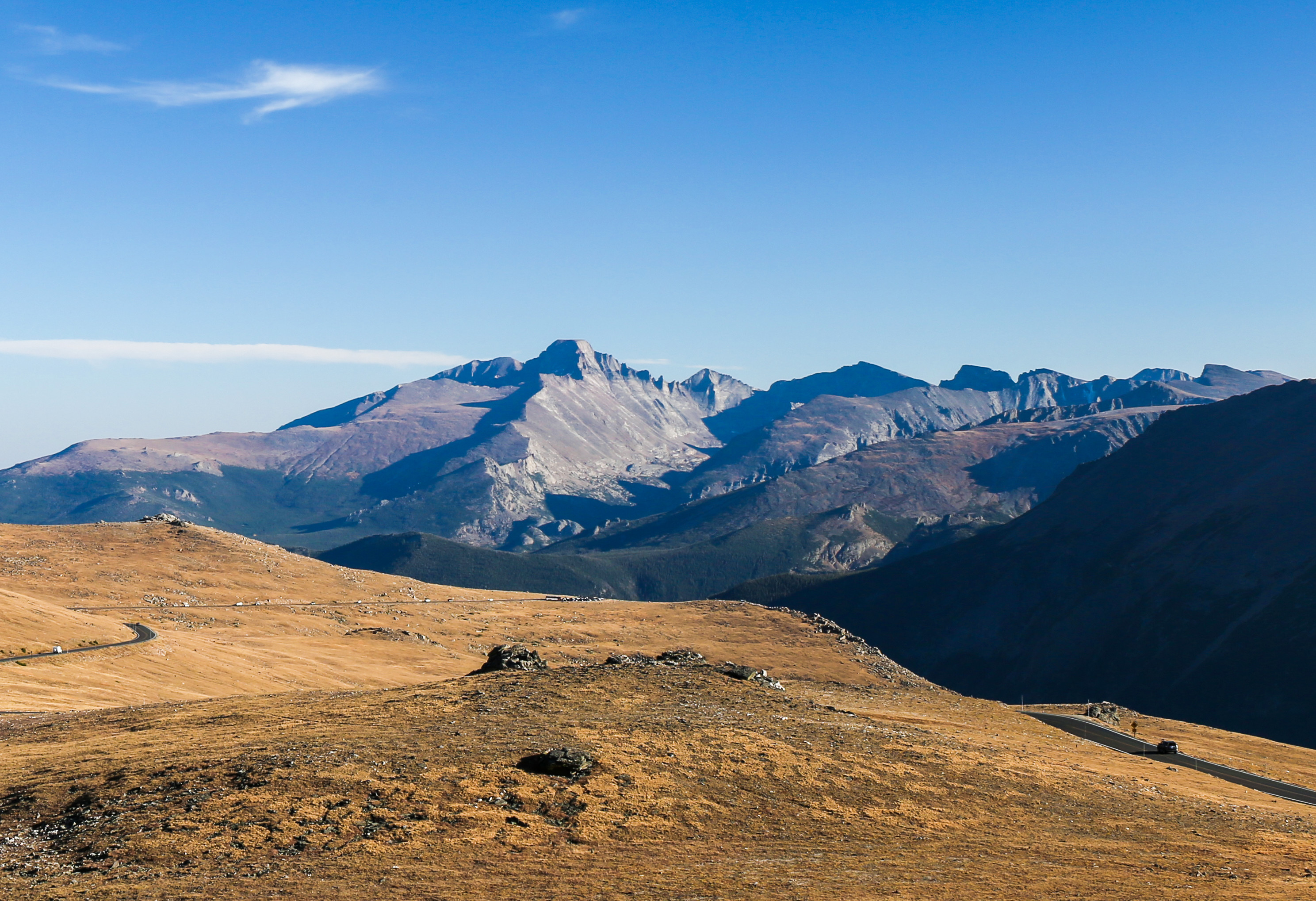 |
| Trail Ridge Road and Longs Peak —Wiki |
Clouds were rolling in. Storm brewing. Time to head back to the car. Then, on the way back down the trail, I tripped over a rock, and fell flat on my face. I fell correctly, I fell soft, and protected my face with bent right arm, but a smooth glacial cobble embedded in the trail sucker-punched me between nose and lip.
Good news. I didn't break a tooth, but my upper teeth were numb. Bad news. My nose didn't fare so well.
Now I get why people use walking sticks. Not for sissies at all.
I made Neil run back to the car to grab some ice from the ice chest while I pinched my nose, tilted my head back, and tried to eye the trail for boulders as I walked back toward the car. I was amazingly calm, considering that I was being gagged by a bucketload of blood.
All that horse training and vet stuff paid off. Body check. Breathe. Can you walk? No broken bones? Then, get outta Dodge. Or Tombstone, in this case. Fastest way to get rescued is to rescue yourself.
Neil was the one in need of focus. No EMT potential there. I had to scream at him to go get the fucking ice. We were about a half a mile out from the trailhead, on Highway 34,aka Trail Ridge Road; at 12,183 feet, we were well above timberline. Incredibly beautiful alpine tundra dressed in fall colors.
Good news: no concussion. Bad news: I donated copious amounts of blood to the trail. And I looked like hell.
But Justine the park ranger at the First Aid Station at the Alpine Visitors' Center, was awesome. The Visitors' Center, on the other side of Trail Ridge, and Sundance Mountain, was a long ten miles down the road. She ushered me right in, and examined me like a pro, flashlight in eyes, usual trick questions, etc. and concluded that I didn't have a concussion. Miracle of miracles.
I was intimately reminded that the word Colorado means red, or blush. It was a long way to the first Advil. I iced my face the entire way over the Continental Divide. I looked out over Wyoming in an altered state of reality.
I felt like I had a bad hangover. Sound was cottony, light was twinkley, and and I couldn't look down for fear of bleeding. But we were on top of the world and it looked like the Swiss Alps.
I was pretty angry with myself for tripping over a submerged trail rock, as this place was clearly a ten out of ten bucketlist destination. Considered one of the Top 10 Hikes in Rocky Mountain National Park, and I had to go and smash my face in. To make matters worse, Neil blamed and berated me for smashing my nose, it was my stupid knee braces that caused the fall... I couldn’t pick up my feet properly, and tripped over a rock. As if I already wasn’t feeling bad enough.
This was the secret natal grounds, the homeland of the Colorado River. And water draining to both sides of the Continental Divide. To the Sea of Cortez, or to the Gulf via Old Muddy. Something most holy about that. In my case, my blood was straddling both sides of the Divide. I donated heavily at the sublime office.
No Advil until we got to Grand Lake, a long ways off.
I boarded the plane home that evening looking like a street brawler, with two shiners. Neil was afraid that people thought he beat me up. No, the mountain did. It exacted a trespass fee. The blood pooled under one eye and left a red track, like an after image of the Colorado River down my cheek. Vampire blood trails under the skin that no amount of washing could remove.

Thursday, September 11, 2014
Late summer in the Rockies (photo)

Me solving the great ram’s horn puzzle on the continental divide in Colorado. Late summer in the Rockies, a snowstorm brewing over Estes Park. Neil was being a right arse that day, we quarreled all they way up the mountain. It was such a relief to be out of the car. He was so volatile. I later paid for it by doing a face plant on a rock on the old Ute Trail, on Tombstone Ridge, a glacial moraine. I was wearing double knee braces, as I was still recovering from knee surgery. Then he had the audacity to blame me for stumbling and smashing my nose, it was my stupid knee braces that caused the fall. If ever a man lacked empathy....
Tuesday, September 9, 2014
Tombstone Ridge
Traversing the Continental Divide I got a wee Glesga Kish! I walked out on the pass, listened to elk bugle in the valleys, I watched snow turn to rain, I saw blue gentian and sky pilot on the tundra, pure magic. And then I tripped and fell on my nose right before I go back to the car. Let's just say the Rockies made a real impression on me face with a murderous left hook. I now get why people use walking sticks on uneven terrain. Just call me Rocky Graziano. Singing Paul Simon's The Boxer right about now...
I busted up my nose hiking on the Continental Divide. My blood spilled on both watersheds. Not a place where I wanted to take my last stand, on Tombstone Ridge. Believe me, I was calling myself Maureen the moron on a glacial moraine, I didn’t need extra help from Neil in the chastisement department. I had it covered. I yelled at Neil to get me some ice from the cooler. He was useless in a crisis. No EMT potential there. So, I was really on my own on that long walk back down the ridge to the car park.
It was a long half mile back to the car. As I walked, I tilted my head back, propping my neck and head with one arm, pinching my nose with my other hand. I was trying hard not to swallow blood, the last thing I wanted to do was hurl, my stomach was bilious. It was a challenge to avoid all the little fucker tombstone rocks jutting up on the trail, using peripheral vision to navigate, as I couldn’t hold my head upright without gushing blood.
Not the first time I’ve busted my nose, I know the drill. Alas, I found out that Neil was useless in a crisis. So ironic as this is where we entered into this relationship, me administering first aid to him, possibly saving his life, when his nose and face were busted up in a car crash, when he was gushing blood.
It didn’t help that we were fighting all the way up the pass. I was so glad to get out of the toxic environment of the car, and to be at one with nature, and then the landscape punched me. Irony, much? Such capricious gods of fate. I guess it’s payback time. I won't mention the buckets o' blood sacrifice I left in Colorado—which means red. Duh. No need for metaphor, here. Too literally inclined, I guess. Erm, make that—declined. Reclined?

Home, now, mirror is not my friend. You might say that I’m working on the lying Pinocchio/unicorn horn look. Maybe this time I really will have to get my nose fixed. Not. Lots of ice on the hour & Advil every three hours like clockwork. Not too bad looking now. Some raccoon eye, and weird blood tracks under the skin, but not too bad, considering... just can't touch my nose or sneeze.
I spend my days icing the schnozz. I have this really good idea for a kickstarter—a svelte patch you can contour to your injury and freeze it. Like a fleecy molybdenum ice pack. The commercial ones are awful. I made one out of a flannel bath mitt. I soaked it and then froze in in the shape of my nose. Pure dead brilliant. I've been diligent with ice and heat. I don't look too bad, considering. Just can't wrinkle my nose, etc. Upper lip is no longer swollen, it's itchy. Lower lip still a bit swollen. My big honking nose saved my front teeth, I'm sure. Clean bill of health from the doctor. No concussion, but it's like having a hangover. Light and noise are excruciating.

Day 10—My nose is still swollen, looks a little crooked too, but at least the black raccoon eyes are gone. I can wrinkle my nose a bit, but it still feels like somebody else's face is super-imposed on mine. I made the mistake of taking a selfie with a smacked nose. Agh! Think I'll crawl under a rock. Definitely not ready for my close-up, Mr. DeMille. It's hard enough to take decent selfie w/o looking self-conscious or like you're in a prison line-up. (some of it's because of parallax issues with the 2.2 wide-angle lens). Think I should go back to my squirrel portrait on Facebook. Or maybe a rock portrait. After all, that's how I got into this mess. OOF! Icing my nose now. Off Advil since Mon. as I was having issues with it and didn't want to barf!
Someone suggested that next time I land on my can. I don't have a lot of padding on my bum, or my nose either. At least I managed to protect my injured knee, next time, I'll happily choose the bad knee to fall on, trust me...
from a Facebook memories post, revised and rearranged for clarity, added 9/21. I was glad to find this particular post because I could not focus, or write coherently about it after the fact.
Friday, September 5, 2014
Bull Elk in Estes Park (photo)

Bull elk thrashing the bushes and bugeling. Rutting season. Incredible song of the wilderness. Huge animals just off the road, we're in ElkTown...
The Shining, Estes Park (photo)

Who remembers The Shining? All work and no play makes Jack a dull boy. The very haunted Stanley Hotel, Estes Park. Don't go into room 217.
Thursday, September 4, 2014
Facebook conversation on Lagunitas with Pete Sutton while in the Rockies (oral history) (photo)
 |
| Outside my window...YMCA of the Rockies. Petrichor! |
Mo: YMCA of the Rockies is pretty amazing. Like summer camp. We landed in Denver, went thru Aurora—yes, that Aurora. Got supplies before heading into the Rockies.
Pete Sutton: Mo, do you ever stay still? Very nice photo.
LOL! Wanderlust at an early age—look at it this way, when I was four and a half and had to walk a mile from Barranca Road to Sir Francis Drake Blvd., I rarely made it in time to catch the bus. Had an equally hard time making it back home on my own steam but your mom Chuck was pretty cool about the little gatecrasher. PB&J sandwiches, and sometimes even a ride home. Still wandering. Er, hobbling...icing the knee now.
Rockies are socked in the AM. Rain last night. Divine petrichor! We're here for the Long's Peak Highland Games—Neil wants to get on the menu for next year. Never been to Colorado before. Wyoming, Idaho & Montana, yes. Saw elk the size of horses down by the Fall River last night. Had bacon for brekkie and thought of you and The Kev. Lots of folks fishing. You'd love that. Thinking a lot of Thano Johnson right now. I ran into his ex-wife, and he wrote me a nice, long, lovely letter about living in Colorado...I was in a horrific car accident and never wrote back. Still feeling guilty. Wonder if he's even still alive? (Musician Kevin McConnell)
Pete: Thanks for the kind story of my mother. I of course, do not remember such antics but am very glad you do. I hope that I played with you. Thano was a tough old son of a bitch - he's probably still dodgering around although i doubt it. Colorado s a favorite state of mine. My dad left us in '64 and we started visiting him in Aspen in '65 - nice place , this was before the fucking rich people found it. Why do they always fuck places up by moving there?
Note Bene: Pete’s das was the famous stride pianist Ralph Sutton. Chuck, or Charlene, was friends with Grover Sales, and probably poet Lew Welch (as was my mom).
Mo: Yeah, it's hard not to get pissed off...lots of bullshit estates and luxury homes here—juist like what happened to Marin. Yeah you played with me...sort of...sometimes you ditched me and Nick when Jeff was around... I absolutely adored Chuck. Is she still alive? When did you move to Lagunitas? I remember visiting you a few times there but that was a long way from home—until I got the horses.
Pete: We moved to Lagunitas to the Hawaiian Princess's house on Corona Ave across the SFD blvd divide from Weaver's mountain top enclave during 3rd-4th grade- between Miss Lenz and Mrs Raddick's class. We used to yell over to the Weaver's from time to time.. "Hey Weaver!" and one of them would yell back, "Hey Sutton!" and so forth. I scandalized Mrs R because I read 'The Rise and the Fall of the Third Reich' brought to yours truly by Arrow Scholastic Books. Any way I met the Woodacre crew in her class. Mom died in 2012, May 24th I believe. Then some sonofabitch invents a beer and names it after my home town. Pretty good beer I must say. Not really my home town but what the hell...
Mo: Great story, Pete. So sorry to hear about your mom. I don't even know the names of the roads we played on—I rode them all... Tell me more about the Hawaiian' princess? I remember going inside that house. Like the Argentina House that was TR's old hunting lodge.
Pete never answered my last question. And then, weirdly, deleted all his comments on my Facebook thread. I am glad I saved them here. Research is required. But the Hawaiians came to Marin and Sonoma counties. There was a cane chair factory in Lagunitas, at the old cafe,, and another in Forestville, I think. We had three cane chairs from Lagunitas. Each one had a different patterned bottom of stamped wood. The Hawaiians were called Kanakas.
Wednesday, September 3, 2014
Tea vs Chai—if by Land, or Sea

Currently I'm stranded in a lost republic between teas (any old tea won't do—most of the organic designer teas are fancily packaged hogwash). My mainstay, Trader Joe's, changed its Irish Breakfast tea a while back, leaving me adrift in a vast sea of peaty mediocre teas. I have a drawer-full of straw-flavored teas that I periodically recycle into iced tea, which is more forgiving on the taste buds than hot tea.
T.J.'s new twin packs of Irish Breakfast tastes suspiciously like Tetley's English Breakfast teadust dregs. The round teabags also look suspiciously like Tetley's. I can't tell them apart. I miss the old square bags of Trader Joe's Irish Breakfast tea. It made for a good cuppa tea.
Besides, I have issues with the idea of English Breakfast—politically incorrect in our household—no matter how similar they are. Who can taste the difference between English Breakfast and Irish Breakfast teas? I take that back, after a taste test, I concluded that there is a difference, English Breakfast is often more perfumy. I can't stand teas that smell like a flower stall.
Besides, I have issues with the idea of English Breakfast—politically incorrect in our household—no matter how similar they are. Who can taste the difference between English Breakfast and Irish Breakfast teas? I take that back, after a taste test, I concluded that there is a difference, English Breakfast is often more perfumy. I can't stand teas that smell like a flower stall.
At UC Berkeley's 1991 Celtic Colloquium Conference I was in charge of making the morning tea for our elevenses. I made real black tea, brewed in china pots—none of that tepid metallic urn water dumped into a mug with bagged tea that Americans are so fond of.
Because the thirsty scholars were swilling tea (or free whiskey) faster than I could pour it, I opted for Tetley's bagged tea. A British scholar promptly dubbed the Tetley's tea as "chimp dust."
When she saw my puzzled look, she explained that whatever was left over in the tea packing room, the cartoon chimps swept up afterwards and repackaged it as Tetley's. In other words, it wasn't the good stuff. But now, even the Tetley's chimp dust is also no longer as good as it used to be.
I do like PG Tips, McGowan's, Lyons, or Barry's Irish Breakfast—when I can get it. But the tea's pricy and hard to get in bag form. T.J.'s Irish Breakfast tea was a real bargain at $2.99 a box. And it made a right good cuppa tae. OK, potta tae. I drink it by the potful.
I can hear you tea purists sniffing now: bagged tea? Unfortunately, I don't do mornings well. I'd need a strong cup of tea in order to make that pot of loose leaf tea first thing in the morning—or I'd be in danger of scalding myself.
Morning tea should be nice and black. None of that pale amber stuff. Tea should be strong enough for mice to skittle across its surface. I guess salted yak butter tea qualifies. Never tried it. But milk and sugar will do.
So when someone posted a Facebook link to a blog, The Language of Food, about the origin of tea, I nearly swooned.
Tea if by Sea from The Language of Food: a Linguist Reads the Menu. By Dan Jurafsky
We drink a lot of tea in San Francisco—I guess you should expect no less for a city originally named Yerba Buena, after a local wild herb in the mint family (Satureja douglasii) used as an herbal tea....
The Language of Food is a delightful romp through the history of tea. It focuses on real tea, not herbal tea, though tea itself is an herb—a fermented Camellia sinensis leaf native to north Burma and southwest China.
During the Shang Dynasty, tea, or t'u, was used medicinally. The Chinese character for tea is 茶, originally written as 荼 (pronounced t'u.) The earliest records of tea consumption date back to the 10th century BC, and Chinese legends attribute the invention of tea to Shennong, ca. 2737 BC. A 3rd century AD, medical text by Hua Tuo, stated that: to drink bitter t'u constantly makes one think better. Bitter is better. With butter?
When tea arrived to Europe by sea via the Portuguese in the 16th c., it was called chá. Somewhere along the line, it was changed to tea, probably by the Dutch. Tea is pronounced differently in various Chinese languages: chá in Mandarin; zo / dzo in Wu Chinese; or ta / te in Min Chinese. Other Chinese words for tea: jia, she, ming and chuan. (—Wiki). Dan Jurafsky follows a compelling linguistic thread to include the word chai traveling overland via the Mongolian to Persian route.
Jurafsky writes:
During the Shang Dynasty, tea, or t'u, was used medicinally. The Chinese character for tea is 茶, originally written as 荼 (pronounced t'u.) The earliest records of tea consumption date back to the 10th century BC, and Chinese legends attribute the invention of tea to Shennong, ca. 2737 BC. A 3rd century AD, medical text by Hua Tuo, stated that: to drink bitter t'u constantly makes one think better. Bitter is better. With butter?
The Portuguese sailors introduced tea to Europe in the 16th c. In 1660, the Portuguese wife of King Charles II of England, brought the tea habit to Great Britain. Tea was not readily available to the masses in Britain until the 18th c,. so smuggling was rampant, and its importance led to the Boston Tea Party and led to the end of British dominion in America. The Brits should've just let everybody have their cuppa tae in the end.
 |
| Tea plant (Camellia sinensis) from Köhler's Medicinal Plants |
When tea arrived to Europe by sea via the Portuguese in the 16th c., it was called chá. Somewhere along the line, it was changed to tea, probably by the Dutch. Tea is pronounced differently in various Chinese languages: chá in Mandarin; zo / dzo in Wu Chinese; or ta / te in Min Chinese. Other Chinese words for tea: jia, she, ming and chuan. (—Wiki). Dan Jurafsky follows a compelling linguistic thread to include the word chai traveling overland via the Mongolian to Persian route.
Jurafsky writes:
These tea words ("tea", "cha", "chai", "matcha", "laphet") are players in an unusual linguistic story, in which two differing pronunciations of a word reflect the two ways that Europe and Asia have traded over the last 500 years: by land or by sea.
Jurafsky goes to great lengths to prove that if tea arrived overland across the Eurasian Steppes (via the Silk Road), then it was called chai.
The very first written mention of tea in Europe in 1559 is as Chiai, with an -i, by the Venetian travel writer Ramusio describing the Persian traveler Chaggi Memet...However, I do have a very minor linguistic quibble with the basic premise of the article tea by sea as the Portuguese sailors who brought it to Europe in the 16th c., called it chá. They definitely didn't go overland, and their Chinese contacts were strictly maritime.
The second group of languages describes tea with a word pronounced something like "tey"—the way our English word tea used to be pronounced. This group includes western European languages like French (thé), Spanish (té), Italian (tè), and Dutch, German, Danish, Swedish, Welsh, Irish, and Hungarian. And, mysteriously, the very much non-European languages Indonesian and Malay.I'm not sure if I'm buying the linguistic aspect of the entire tea- vs chai- arrival theory. Both the T- and CH- sound are too closely related. It really comes down to a matter of spelling from two different languages (or dialects, depending upon which army), Southern Min (in Taiwan), vs. Cantonese. I am reminded of the H.L. Menkin quote: There is always an easy solution to every problem—neat, plausible, and wrong.
CH- is a modern Western orthographic approximation of a non-Latinate language system. Using modern Latinate orthography on an aural interpretation of a non Indo-European language family, is, at best, a slippery slope of an argument to convey pronunciation of the word tea. It depends on the listener/recorder's native language.
For example, Manx and Irish are closely related dialects—you'd never know it, as English orthography was used to transcribe Manx, and Latin was used as the base language to convey Irish.
In addition, in several IE languages, there are both soft and hard consonants: t/ch. What determines hard/soft (slender) sound is the vowel. Tea/chai. Also, Persian is an Indo-European language, like Hindi, not Turkic. "La" is another story altogether.
I do love Dan Jurafsky's poetic statement: "chai if by land, tea if by sea." And it's probably more or less true. But it is a minor accentual difference. Like bags vs begs, or park/pahk in Boston. Or Ha ha ha vs Ja ja ja (same sound, different languages.)
What it really comes down to is this: the (Latinate-speaking) Portuguese traders of Hong Kong and Macao heard the word as chá, and the (Germanic-speaking) Dutch traders in Indonesia and Java heard it as tea.
What it really comes down to is this: the (Latinate-speaking) Portuguese traders of Hong Kong and Macao heard the word as chá, and the (Germanic-speaking) Dutch traders in Indonesia and Java heard it as tea.
Yes, in Irish, Té follows those "tey" rules, but that's a slender, or soft T sound, more like CHI. Full circle—except for the extra Persian case ending of -i, of course. But Jurafsky notes that extra i in cha-i is an alternative ending. "Persian nouns ending in long -â have alternative forms ending in -i." That makes it chaayi? In Ireland and Scotland, it's usually pronounced tae, as in the River Tay, not tea (tee).
So, how did the Persians really pronounce tea? Cha? (Wiki says the Persian چای is chay, derived from the Cantonese 茶 chá. So, chay rhymes with the Hibernio-English pronunciation of tae. Apparently the English word "tea" (tee), comes from Teochew Chinese "teeh".)
And of course, Starbuck's, in a rare tautological move, has chai tea on the menu—tea-tea. Like the River Avon (river-river), you might say something got lost in the translation.
And of course, Starbuck's, in a rare tautological move, has chai tea on the menu—tea-tea. Like the River Avon (river-river), you might say something got lost in the translation.
Oops! My cup's emp-ty. Think I'll have another cuppa tea with me potta tae.
As my grannie would say: tea makes you pee.
As my grannie would say: tea makes you pee.
Subscribe to:
Posts (Atom)

