Wednesday, October 23, 2013

No Word for Purple


We all seem to love purple in our family. Someone always quips, "the color of royalty." A saying that spans generations. I remember my grandmother, who was from Bantry, telling me how purple was made in Rome with Mediterranean murex sea snail shells, but in Ireland—there were no murex shells, so the color purple wasn't the same. Closer to a drab brownish maroon.

She said that the sea snails had a little purple sack that was used, she also said that the tiny purple tips of certain seashells were ground up. I can't remember if she was talking about the Romans or the Irish. When I was in Baja, I found zebra murex, and they do have a tiny purple spot embedded at the tip of the shell. Whatever the method, it took a lot of seashells to make a small amount of purple dye.

Roman imperial purple (purpura) was called corcur in Irish. Plosive P was avoided, it shifted to hard C (k) in ancient Irish. My grandmother also mentioned that lichens were used to make a purple. In the Highlands, a claret color, or "corcur"–was traditionally made from a rock lichen that was steeped three months in urine, and fixed with alum.

Spiny dye murex, Bolinis brandarus —Wiki

Imperial purple was also known as Tyrian red, or Phoenician purple. Not much is known about the method for making murex dye. A "blackish clotted blood" color was most prized—perhaps by overdying the cloth—double-dipping it in two different species of murex dye vats. As early as 1570 BC, the ancient Phoenicians had the murex trade under wraps. Phoenician purple was a more vibrant color that intensified with age. And:
4th-century-BC historian Theopompus reported, "Purple for dyes fetched its weight in silver at Colophon" in Asia Minor.[1] Wiki
My grandmother was born before aniline tar-coal dyes were invented, before there was nylon! The aniline age of coal changed the way we think of color.

What we think of as purple today was not the warm-hued purple of the ancients‚ which was closer to dried blood. Most reds and rose madder magentas were fugitive colors—they quickly faded with age. So a color that was stable, was highly sought after.

Saffron was also used to overdye cloth red, but it was an unstable color that faded to yellow. "In medieval Ireland and Scotland, well-to-do monks wore a long linen undershirt known as a léine, which was traditionally dyed with saffron." —Wiki

How on earth did the ancients discover how to make purple? The story goes that when Heracles was walking his dog along the coast of the Levant, the dog was snacking on sea snails and Heracles noticed that the dog's mouth was stained purple from chewing on sea snails. Luckily for Heracles, the pooch wasn't snacking on poop.

It seems the Minoans also knew a thing or two about purple dye as well. During the 20th–18th cs. BC, murex dye was found in Minoan clay pots in Crete, Asia Minor, and at Coppa Nevigata in southern Italy.

Byzantine Justinian I, in Tyrian purple 6th c.—Wiki

There's been much made of the eww factor associated with the ancient method of making purple. Thousands of shellfish were thrown in vats and either left to ferment or were boiled for days (skimming the critters out) to reduce, and extract the color. Much ado has been made of the seafood stinkum stew with urine added as a fixative. I think one would hardly notice the crisp ammonia smell of urine with all that rotted shellfish.

Though the making of purple was a closely guarded secret, Pliny the Elder described the production of Tyrian purple in Natural History: (NB I've shortened the rather wordy Wiki translation considerably).
The most favourable season for taking these fish [shellfish] is after the rising of the Dog-star, before spring….  the vein is extracted, to which salt (is added)… to every hundred pounds of juice.… leave them to steep for three days, and no more, for the fresher they are, the greater virtue there is in the liquor. It is then set to boil in vessels of tin [or lead], and every hundred amphoræ boiled down to five hundred pounds of dye, with moderate heat; …the liquor is skimmed. About the tenth day,… a fleece…is plunged into it … until the colour is found to satisfy… the liquor is kept on the boil. The tint that inclines to red is inferior to that which is of a blackish hue. The wool is left to soak for five hours, and then, after carding it, it is thrown in again, until it has fully imbibed the colour. —Wiki
Note that the only added color mordant (fixative) seems to be salt. During the long boiling process, mineral salts from the tin cauldrons would've leached out—tin is also a mordant. TIn, alum, copper, chromium, iron are all used as mordants on protein-based fabrics (wool, silk, parchment, leather). Other fixatives include urine (inorganic salts), tannic acid, iodine, potassium, and metallic salts. TIn is harsh as a mordant, it makes cloth brittle, so it's often used in conjunction with other mordants.

Fixatives set dyes on cellulose-based materials (cotton, flax, hemp) include: alkaline (base) fixatives; sodium, baking soda, cream of tartar, lye, and washing soda; and acidic fixatives: urine, tannin, vinegar, and lemon juice. Most modern accounts describe the use of urine to fix, or set the color but it was probably a mordant. A mordant chemically binds color to fabric (or pickles).

I know that plant woad dye is made with urine. My neighbor George, a rare rug restorer, received a present from a friend. Richard Beebee gave him some indigo flowers steeping in a jar of urine, we didn't ask whose (it's supposed to be camel piss). So George put his special rug-mending yarn in the jar and left it in the sun to ripen months to make indigo blue yarn. Ripen it did. Only thing is, when he took the yarn out, it didn't turn blue upon exposure to air and sunlight—as there were no indigo flowers in it. Alas, poor George was the victim of a perverse practical joke.)

Wool and silk can absorb both acid and base fixatives. Here's the thing, I doubt urine, or uric acid, was used as a fixative on silk as uric acid rots the silk quickly. Silk was far too precious to dye purple, then have it shred by next season. The ancients would've had to use another fixative. Flax, cotton, wool can handle uric acid, or potash as a fixative. But not silk. Wool, silk and parchment are protein-based—like our skin and hair, and so, require different fixatives. Alas, the recipe is lost.

Purple Byzantine silk from Charlemagne's tomb.
     *      *      *

Tuesday, October 22, 2013

Portmanteau words & oddities

Deep sarchasm: 
a comment that sends you 
over the edge.


Sometimes it's good 
to be downwind of yourself.


Bluebellied lizards 
doing push-ups on fenceposts
in summer sunshine.


handleless dustpan
tossed into the garbage can
Ironic ending.

Sunday, October 20, 2013

Milestone Blogger stats


Wow, sometime during the rewriting and revision of eleven elderly bloggy-bits—mostly orphan draftsgleaned from Facebook from July to September, my blogspot counter rolled over from 999,945 hits to 100,000 hits.

Caveat: about 2000 of those Traffic Sources this last month are from spam trawlers (Vampirestats 1050 and adsensewatchdog 154 hits) that play havoc on the counter. On Oct 21, I had 1046 hits from spambots. That's a lot of spamminess considering my all time hits from Vampirestats are 1573. But it's undergone mitosis and there are now TWO. I foolishly clicked on the links. There'll be hell to pay.

Sort of like watching the odometer roll over. How many of us waited with baited breath for the magical number to roll over—all those paisleyed or maybe palsied nines becoming zero goose eggs all over again? The anticipation. I'm flummoxed.

Of course, I probably hit 100k ages ago, as the Blogger counter app info suggests that it was added ca. July 2007, according to Blogger stats. But I know it was MUCH later than that as I wasn't even retroactively adding old blog posts until the end of August 2007. Retroactive stats? But it's still nice to measure progress.

Not bad for 647 random posts with no apparent theme or structure. And countless more unpublished drafts in the wings. Once I aimed for 365 posts a year, and immediately fell off the wagon; now I aim for 100 posts a year, 104 would be two posts a week but I can't seem to manage that, so I've taken to lifting chunks of Facebook posts and resurrecting them into blog pieces. Sometimes it works….

I admire people who can manage to crank out a post a day. Some of my longer posts take weeks to finish. They're more like treatises—I know, that completely goes against the tenant of a blog post (500 words or less). I spend a lot of time revising—especially if there's research involved.

I still have many unfinished posts in the wings from 2011 and 2012, to resurrect. And 2010 could use some fluffing too. Stale work to do. TIme to comb old journals. I was surprised to find several poems I had missed from 2009, so my year's output is 116, and climbing. All poems are now labeled as poem, and have CAP TITLES. Huge undertaking. My head hurts. My head hurts.

I always try & post recent pieces as close as I can to original date. So many older blog posts get missed by the pesky web crawlers and spiders. That's OK by me. Vampirestats more than makes up for a lack of readership.

The purpose of this blog is to keep me interested in writing, and to stretch my boundaries. It's not neat, nor thematically organized. I began blogging in earnest in August of 2009 (and back-posted old material in 2007-08—I created it in January of 2007.

Though I began to blog a bit in August of 2007, the blog pretty much lay fallow for two years. That meant I had two years-worth of storage space for my old work. But there's also current work mixed in there too—especially the prose pieces). From 2008: November is Novel Writing Month My goal is to write a blog a day instead of a novel. (Plotless memoir). I only had 3-4 blogs written for all of 2008.

As for organization, at first, I was filing thematically by month, but not by year. That worked when I had 300 pieces. Now it's more than doubled. So I try and capitalize titles of all poems, and use the label feature—which I avoided for years. I add the word poem in the label so I/you/they can click on the word poem on the word list index to the right and see them as a collection—a mini blog. But nobody reads poems.

Now, I'm waiting for my Viking Redhead blog to hit 30,000. Soon, but not tonight. Why these posts are so popular is a mystery. At first I thought it was the Hot Posts app, but I changed it, and even took it offline, and it didn't affect the rating of all-time top posts. It's a blogger counter mystery.

KUBLAI KHAN DOES LA

KUBLAI KHAN DOES LA
World's first live 'wireless opera' baffles commuters at L.A.'s Union Station 
  
Italo Calvino's novel, Invisible Cities, 
a tale of Marco Polo in 13th century Mongolia, 
is now an interactive opera score, 
staged like a flashmob, delivered wifi style— 
only there is no stage, there are no seats, 
no separation between performer & audience—
only surreal groups of singers, dancers & art 
patrons dressed to the nines, with wireless head
phones, wandering the station to and fro
listening to a grand central motherboard.
In the Art Deco halls of Union Station, 
every seat is the best seat in the house—
only there are no seats. None.
It's a standing room only affair.
Opera buffs, smiling beatifically, touch
their ears, wade through a nervous crowd
to find the deep end of the score,
or the soprano's disembodied aria.
At the old ticket booth, an orchestra tunes inward,
plays invisible music for itself, not the audience.
And the fourth wall is never broken. Each holds.
There is, however, a fifth wall of baffled LA commuters
who thinking they're trapped in a medieval realm movie,
or held prisoner by a possessed karaoke video game—
probably feel they're in need of some air,
or perhaps the hair of the dog—
or maybe a bloody fifth of that damned dog
to recover from the bizarre experience
of seeing Kublai Khan singing opera
and dancing solo in a station of the metro.
No pleasure domes. No cities of desire.
But it adds a whole new level to
Marco.
          Polo.

All aboard?

10/20/13 

Friday, October 18, 2013

A Fowl Run-in with Mercury Retrograde

My Mercury Retrograde began a little early. Because of the BART strike, the roads were jammed—I was in Silicon Valley for a tech conference. Because traffic on Highway 280 to 92 was snarly as a hungry lion, I stopped off at the least exit in Foster City and bought a lovely Costco roast chicken, and waited out the worst of the traffic jam. 

Crossing the San Mateo Bridge under full moonlight was worth the wait—pure magic—platinum trail of moonlight on the indigo velvet of the bay. I thought I could see the after effects of the lunar eclipse, the moon looked a little lopsided on top. But I was imagining things. 

All was serene, it was as if I was inside a Maxfield Parrish painting. Hunter's Moon and eclipse. In the rearview mirror, the sunset was a dragon's blood glow, and Venus to the west, a beautymark. I was basking in all this glorious gloaming. Until an idiot in a SUV cut in front of me.

I stopped short, the chicken decided to fly the coop as if to get to the other side of the road. At least it didn't hit the window. The roasting pan lid popped off on the descent, and the damned chicken landed upside down inside my backpack and drooled on my brand-new skinny cuff jeans. 

They were the last pair in my size, and on sale for only $10. Costco pants rarely fit—I usually buy three pairs, keep one, return the others. In fact, that's why I was in Costco, to begin with—to return a pair of jeans. I really couldn't think of how I could possibly return these jeans smelling like a chicken roast-off. They'd better fit is all I can say.

Luckily I had a premonition beforehand and moved my gorgeous new purple and magenta silky down vest to the back seat. Apparently the premonition wasn't strong enough for me to consider putting the chicken on the floor of the car, shackled with snow chains, instead of in a shopping bag on the passenger's seat. Wish I had thought to move my cameras from the bottom of the bag as well. Nothing like chicken schmutz to lube the LCD screen. Of course, it completely missed the baby bagels.

So while driving with a greased gearshift, I grabbed the slippery sucker by a leg and shoved it back into the roasting pan and set it on the dashboard. Mopping up what mess I could reach with toilet paper, I felt like the lubricated inside of a BBQ basting pan.  

When I got home, I went to transfer that errant chicken back into bag. It leapt out of the roasting pan to take a roll all over my faux suede car seats, splashing chicken juice and fat into my eye and hair. And judging the look on Neil's face when I walked in the door—apparently I was modeling a Something About Mary coiffure. And how was your conference, dear?

Can I please have a pass? I already did my Mercury Retrograde time. Or was it full moon time? Oh, the car smells foul, the jeans do fit but they keep clucking and cats follow me wherever I go.

Tuesday, October 15, 2013

WHISPERING TO THE PAGE

It was a standing-room-only concert.
I buffaloed my way in on shaky press credentials
so I felt obliged to write something, anything—
though I had no place in mind to publish.
As I was free-writing, following flights of fancy, 
hoping to glean some interesting lines,
an old man sitting in the last row complained—
He could hear my pen whispering to the page. 
I was amazed by his acute hearing.
We were both rather irritated. I felt thwarted.
But I liked the unexpected metaphor.

10/15/13

Thursday, October 10, 2013

Squirrel & Nut


A decent photo through a dirty window covered with a mesh screen is not optimal, but you get the picture. Will keep trying.

My resident red squirrel has taken to leaving me acorn prezzies in the bottom of his water dish (really a tall faceted glass wedged in the fencepost for the thirsty bees and the tiny nectar wasps that pollinate my flowers).

I'd put a cork in the glass to rescue the nectar wasps that tend to drown if they take on too much water. Perhaps the squirrel was leaving me acorn gifts in exchange for water? Making similes? The acorns and cork do look similar. Both come from oak trees.

Last spring, the neighbor replaced our decrepit ivy-covered fence with a wide wooden one, replete with a cap-rail. It's now a kitty and squirrel highway. 

At first I thought it was the cats knocking off my old blue pots artfully aligned along the top of the fence. So I spaced the surviving pots farther apart to accommodate little cat feet. Still more pots came crashing down on both sides of the fence. Then I thought it was the hoodlum rats or hood 'possoms running the rails during the night, but this was clearly a daytime crockery crashing affair. I needed to adjust my sights.

Then I caught the red squirrel in action lapping water from the tall glass like a cat. Too cute. As he skittered back to safety, I noticed that he had a completely different leaping criteria with all that tail fluff and drag. When he leapt up, his tail went down, and vice versa. A counterweight, not a balancing pole. Not at all like a cat.

With all that crashing crockery, and bouncing blue tin cups, it's a wonder the squirrel braved the trek to the watering hole. So I put all the pots (what was left of them) closer together, so it's now one giant leap for squirrelkind. No more pots knocked off the ledge. They're close enough for the cat to leap over too. 

Thirsty hoolighan squirrels smashing all my blue pots never crossed my mind. The critters come up from the trees on the other side of the street by the freeway. Then I realized there's no fresh water for them anywhere in the urban jungle. So now I water the plants, the bees and the squirrels. The little coast live oak acorns were a surprise.

I now know that acorns sink to the bottom of a cup. Squirrel nuts anyone? Fresh delivered daily. No zippers. Yet.


NutDate 10.4 Think I'll blow the squirrel's mind by leaving some super jumbo-sized valley oak acorns in the glass.

NutDate 10.15—Nuts planted along the top of the fence and inside pots. Very large acorn fills one little pot. Wonder what will happen when Squirrel sees that one?

NutDate 10.16—Some small acorns are gone. Big ones untouched.

NutDate 10.17—Think I'll leave some small avocado pits mixed in with the big acorns.

NutDate 10.18—Squirrel left me one measly acorn in the bottom of the glass but took all the avocado pits. You'd think he'd at least leave the big acorns considering I've upped the ante. The thought of Squirrel trying to force an avocado pit into his cheek pouches is too funny for words. But both? He probably looked like a pair of furry dice or dogs bollocks with teeth.

NutDate—Like whatever. After weeks of ignoring the rest of the avocado pits (but they steal the tiny unripe avocados from our neighbor's tree, and eat them when they're hard as rocks), our squirrel finally got it. But I had to remove said acorn from said pot on fence and move it half-way down the fence where he could find it. He ran right past it again as he was headed up toward the water glass. But on the return trip back down to the road, he finally spotted the nut, grabbed it, and then promptly fell off the fence. I guess it weighed too much. I could hear his feet sliding down the fence. He landed with a squawk and proceeded to scold me, the nut, the fence, the ground. The ingrate. I learned that squirrels are always in a hurry, they don't see the forest for the trees, or, rather, the nut on the fence, they don't have the agility of a cat, and they certainly don't have very good eyesight. Or hindsight. But they have excellent swearing skills. No translation needed.

Next year sometime: Squirrel has taken to marking the entire length of the fence as his turf, like a cat scentmarking. He lays his front end down on the fence and, using his hind legs, he scoots and propels himself along in a ridiculous manner, like a otter sliding down a mudbank, wiping his jowls along the entire length of the railing. Not one more acorn has appeared but he is ever hopeful. I also found out that he is an Eastern red squirrel. Not European at all.

Sunday, October 6, 2013

English evolved from Scandinavian?

"The English language brings out the best in the Irish. They court it like a beautiful woman. They make it bray with donkey laughter. They hurl it at the sky like a paint pot full of rainbows, and then make it chant a dirge for man's fate and man's follies that is as mournful as misty spring rain crying over the fallow earth." T E Kalem —from Brendan Behan's play, Borstal Boy
A Science Daily post from Nov, 2012 suggests that English evolved from Scandinavian. Two professors in Norway make an interesting hypothesis that English evolved from Old Norse, making English North Germanic rather than West Germanic.
Jan Terje Faarlund, professor of linguistics at the University of Oslo said: "What is particularly interesting is that Old English adopted words for day-to-day things that were already in the language. Usually one borrows words and concepts for new things. In English almost the reverse is true—the day-to-day words are Scandinavian, and there are many of them," says Faarlund.
Here are some examples: anger, awe, bag, band, big, birth, both, bull, cake, call, cast, cosy, cross, die, dirt, dream, egg, fellow, flat, gain, get, gift, give, guess, guest, hug, husband, ill, kid, law, leg, lift, likely, link, loan, loose, low, mistake, odd, race, raise, root, rotten, same, seat, seem, sister, skill, skin, skirt, sky, steak, though, thrive, Thursday, tight, till, trust, ugly, want, weak, window, wing, wrong. Linguist Makes Sensational Claim: English Is a Scandinavian Language
I nearly snorted and circular breathed in my cuppa tea when I read that headline. I can hear the linguistic shit hitting the fan now.

Awww, there goes Beowulf!

So, let me get this straight, Everyone in the British Isles loved the Norse so much,   (they refused to have much to do with the invaders), that they couldn't even say Gimme an egg, Sister! in their own language(s) before the arrival of the Vikings? (It was mainly the Anglo—Saxons vs the short-lived Viking Danelaw (50 to 100 years of rule); most of the Britons were holed up in Wales or Brittany.

Sister and egg aren't even loan words ferhevinsakes! I'm no linguist but even I can poke holes in this argument. People usually borrow words and concepts for new things like computer, floppy disk, USB. Not for things they already know, or already have.

What would Bede say? All this splitting infinitives and hairs sounds like the Scandinavians are once again being culture pirates. A vikingr the academics will go.

Their hypothesis: English evolved out of Old Norse several centuries later? Not congruently? What about language drift, or convergent evolution—or even being closely related via the Indo-European continuum? It's like saying English (or Irish) evolved from Sanskrit because there are parallel words in both languages.

Sister is a prime example from the Proto-Indo-European continuum: *swésōr is recognizable and sounds familiar enough to be merely a dialect, rather than another language. No matter how many dialect armies and navys are conjured up, I'm fairly certain that Old Norse did not exist during the era that PIE was evolving. And then there's egg—clearly a very close word in Proto-Germanic:
From Middle English egge, from Old Norse egg (“egg”), from Proto-Germanic *ajją (“egg”).
Well, maybe egg isn't such a good example as Chaucer uses both ey, and egg. That could be a case of Norse and Anglo-Saxon eggs side by side. One could argue that that hard gg vs soft jj sound was borrowed from the Norse. I won't mention bull eggs here. (But you can look that world up if you like).

I wonder why outlaw wasn't on that list? That and law, and penny, schilling, etc.

The article was daft. (Not as daft as the eejit who recently posted that English has always existed in Great Britain. (MJ Harper, ‘The History of Britain Revealed’) The Belgae in Gaul and Britain were Celts, not Germans, ya twit. (It reads something like How the Martians Saved Civilization.) English ain't the mother tongue. Really.) Whose tongue was in what neither cheek?

Then there's the syntax argument:

•(subject/verb/object), SVO vs. Old English verb endings. Just to liven things up, Irish is VSOP. Good initials for brandy too. The Vikings, though they settled in Ireland too, had almost no impact on Irish other than town words, nautical terms, jarl, and window.

•Prepositions at the end of a sentence (a very good thing they didn't look at Irish!)

•My personal favorite: genitive (plural)s (The Queen of England's hat).

•Split infinitives (I promise to never laugh again). Well, there are no infinitive verbs in Irish, but we're not talking Irish here.

I admit I'm shaky on syntax. I know by doing. (By writing, that is). But since I had to go and make that strange segue, apparently the Norse absorbed more Irish words than the Irish themselves did of Old Norse words: "bachall (staff, crozier) >bagall; capall (horse) > kapall; lám (hand) > lámr; tarb (bull) > tarfr; and teine (fire) > dini.

Perhaps most surprisingly of all, one Norse word for a ship lung is taken from the Irish long." —Medieval Review Ó Muirithe, Diarmaid. From the Viking Word-Hoard: A Dictionary of Scandinavian Words in the Languages of Britain and Ireland. Dublin.

I'm sure I could argue some silly string theory that Gaelic impacted Old Norse, as spoken by Vikings, who, were, after a generation or two, no longer even Norse, but Norse-Irish, and Norse-Scottish. Irish and Scottish were pretty much the same people in those days as there was no Kingdom of Scotland yet. I can't use the term "one people" because nobody was unified.

Viking men did not bring any Norse women with them when they settled new turf. They just kidnapped Irish and Scottish women—and women are the bearers of language and culture—they taught their kids to speak Irish. And to a lesser degree, Norse British/Anglo-Saxon, mix, etc. (Iceland and the Faroes have a higher Irish/Scottish mDNA, than Norse yDNA but I already wrote about that).

So why would Old English suddenly die out, leave a linguistic void, and Old Norse suddenly take its place, and then evolve into modern English? Old habits die hard. We won't mention the other four English dialects that concurrently existed in the British Isles. Who has read Beowulf, or Sir Gawain in the original dialect? Or Blind Harry's Wallace?

OK, so the "Pearl Poet" author of Sir Gawain was from ca. the 14th c., as were Blind Harry, and Chaucer a little before that, and Beowulf was written in the late 10th or early 11th c., but the texts do serve to demonstrate that several different Middle English dialects survived, Not Old Norse. BTW, Beowulf was translated into late West Saxon from an older English dialect.

Clearly this is a case of lunatic fringe instead of Celtic Fringe. Like I said, those Norse academicians are cultural pirates! I don't think anyone was hypothetically sober at the time. Bring on Monty Python's version of Njall's Saga! Skol pafiskin!

Saturday, October 5, 2013

Olaf the Peacock's Irish Mother


Heiðarvíga saga, story of the heath-slayings

  The Icelandic sagas are prose histories of the Norse —and Celts—who settled in Iceland during the 10th - 11th centuries. The sagas, capturing an earlier oral tradition, were probably set to writing during the 13th and 14th centuries.

"Some of the richest and most interesting writings from medieval Europe come from one of its furthest corners: during the 13th and 14th century Icelanders began to write down the stories they had collected orally from previous centuries. These sagas would cover events in Iceland and elsewhere, going back to the days when the island was first discovered and settled back in the ninth century. They are stories of family feuds, outlaws and the occasional monster lurking somewhere the uninhabited stretches of the Iceland.' —Medievalists.net 

The only problem with this post narrative (above) from Medievalists.net is that when the Viking Norse "discovered" an "empty" Iceland, and Norse colonists arrived ca. 870-930 AD—there were already Northern European settlements dating from ca. 400-500 AD. And the other problem with Medievalist's statement is that those Icelanders were not wholly Norse, their slaves and concubines were often Irish or Scottish. Of course, viking means pirate, so I guess pirating of history itself is fitting.

Naddod was a Faroese Viking (by way of Shetland) who is credited with the discovery of Iceland. Grímur Kamban became the first to settle ca. 825. Grimur was either Irish/Scottish or Norse Irish, with a Gaelic nickname. 

Garðarr Svavarsson is credited as the first Scandinavian to have lived in Iceland one winter. He was was married to a woman from the Hebrides. A Hebridean woman would be Irish/Scottish, not Norse as the Norse did not bring Norse women with them. They took Celts as slaves. The Vikings were NOT the first Northern Europeans in the Faroes, and Iceland. (Not to mention, the Inuit.) Unless, of course, one were to definitively define Icelanders (and Faroes Islanders) as half-Scandinavian and half-Celtic.
The medieval chronicler Ari Thorgilsson said Ingólfr was the first Nordic settler in Iceland, but mentioned that "Papar" – i.e. Irish monks and hermits – had been in the country before the Norsemen. He wrote that they left because they did not want to live amongst the newly arrived pagans.  Ingólfr Arnarson —Wiki
Hjörleifr had been murdered by his Irish slaves because of his ill-treatment. Ingólfr hunted them down and killed them in the Westman Islands (Vestmannaeyjar, named after the slaves).
This tidbit's significant as you will see from the excerpts of the tale posted below, the Laxdaela Saga. The sagas seem to be "fictionalised distortions of real societies.…" and 'family sagas' of Icelandic literature are quite distinct, the overall network of saga society is consistent with real social networks." It's a strong possibility the Icelanders were following in the tradition of Irish recording of oral tradition, though a few centuries later. They could also have had Irish scribes living among them.

(BTW, what is this skewed fascination with Vikings anyway, and why is most everything we associate with Vikings, is plain old wrong? Like (Celtic) horned helmets? Where did we pick up this romantic ideal fraught with bogus information? Does it date back to Hitler, and his search for the "pure" Aryan race? Or is it an earlier Victorian hangover? But I digress.)

The ceremonial Waterloo Helmet is the only existing Celtic bronze horned helmet —La Tène  c.150–50 BC. —Wiki

The word "viking" was first popularised at the beginning of the 19th century by Erik Gustaf Geijer in his poem, The Viking. Geijer's poem did much to propagate the new romanticised ideal of the Viking, which had little basis in historical fact.    —Vikings  

A romanticised picture of Vikings as noble savages began to take root in the 18th century, and this developed and became widely propagated during the 19th-century Viking revival.

Norse myths were religiously adopted by Germanic Neopaganists in Germanic countries during the early 20th c., and in most of the the English-speaking world during the 1960s. It's probably during that latest Neopagan adaptation that most of our Viking misconceptions were spawned.

There's an Irish oral tradition that a Tralee mariner Brendan the Navigator visited Iceland and the Faroe Islands circa 400 AD. Bantry's (where my family is from) patron saint is Brendan. (Based on an immram, or voyage tale, the Brendan Voyage tale was transcribed in Latin in 800 AD.) The description of Brendan's "insulae" (islands) is remarkably similar to the Faroe Islands.

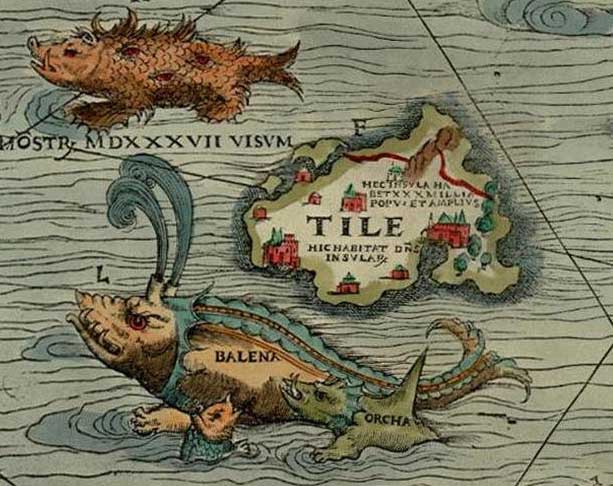
One fanciful name for these mythical northern islands was Thule, which was reported to be "a six days' sail north of Britain, and near the frozen sea." (There was persistent belief that islands to the west of Great Britain recorded as early as 330 BC. Whether fact or fiction, it fed the questing beast)  

The Irish Tír na-nÓg (Land of the Ever-young) was another mythical island to the west. Reason enough to set sail—because they were there. "The Icelanders' own records mention about 400 original settlers "with mostly Celtic nicknames" who were living in Iceland previous to Norse colonization. (Clements). The significant part of that statement is that settlers were there previous to Norse discovery.

Thule or Tile on the Carta Marina of 1539 by Olaus Magnus, located northwest of the Orkney islands, with a "monster, seen in 1537", a whale ("balena"), and an orca. —Wiki

My Bantry grandmother told me that the Irish monks brought sheep to the Faroes, and the name, though Nordic, means sheep islands. And sheep islands do figure into the Brendan tales.

St. Brendan described the largest island as the Island of Sheep (Streymoy?) A bay in the southern part of Streymoy, is called Brandansvik (St. Brendan's Bay). His "bird paradise" might be the island of Mykines. There are several Faroe places named after the Irish monks (papar) including remote caves. —Faroe Islands Review History
The Faroes were part of a trade network with Dublin as a hub, and many Irish women made their way there as wives or slaves. DNA analysis shows that 84% of Faroese females are of Irish or Scottish descent.  —Faroe Islands Review History
(NB: contrary to modern belief, Irish monks were NOT celebate.)

Dicuil, in the 2nd half of the 8th century, wrote of "heremitae ex nostra Scotia" ("hermits from our land of Ireland"—Scotia was Ireland, not Scotland!) who lived on the northerly islands of Britain for a hundred years until the arrival of Norse pirates. An Irish nickname of Faroe islanders, Na Scigirí, possibly refers to the Eyja-Skeggjar (land of bearded men).

Northern European settlements (whether Irish, Scottish or Pictish) in the Faroes have been archaeologically dated to ca. 400 AD.
“There is also good evidence that they [the Celts] had sails: there is a model boat from Ireland that dates from about 100 BC that has a mast, which could be a model for Celtic boats more generally,” Jennings said. “There is not so much evidence of sails in Norway until as late as 700 AD. It is therefore more likely that these early Faroese settlers came from the British Isles.” —Andrew Jennings, Nordic Historian
The Vikings settled in the Faroe Islands before they went to Iceland, ca. 800 AD. Then, 60 years later, Iceland was supposedly "discovered" by the Norse. That's the equivalent of three generations in the Faroes before the Norse shoved off to Iceland. Plenty of time to hear about those Celtic settlements in Iceland. During the settlement of Iceland, the Faroes, the half-way mark, was the only provision stop for grain, meat and water.

The Faroe Islands, a remote North Atlantic archipelago, stepping stones half-way between Scotland Norway and Iceland, were inhabited 500 years before the Vikings arrived. Archaeologists taking "scientific samples for environmental archaeological analysis from the medieval Viking settlement,“ did not expect to find evidence of a previous culture.

Archaeologists Mike Church and Símun V. Arge said: “We uncovered some burnt peat ash containing barley grains under the Viking longhouse. It was not until we had it dated that we realized what we had found.” Barley is not indigenous to the Faroes, and there were "old field systems that didn’t seem to tie into later settlements." Church concluded, “There is evidence of Irish hermits sailing into the North Atlantic islands in a passage by an Irish Monk called Dicuil in 825AD.”
Many other islands lie in the northerly British Ocean. One reaches them from the northerly islands of Britain, by sailing directly for two days and two nights with a full sail in a favourable wind the whole time … Most of these islands are small, they are separated by narrow channels, and for nearly a hundred years hermits lived there, coming from our land, Ireland, by boat.
Here's the rub: Icelanders have maintained that they were purely Scandinavian, and that they lived in genetic isolation for 1200 years. Note that there were no Irish mentioned in the equation. The Irish were expunged from Icelandic oral tradition and there's almost no mention of the Irish in the Icelandic sagas that were recorded around the 13-14th centuries—with the exception of the Laxdaela Saga, and Burnt Njáll—whose name sounded suspiciously like the Irish Niall. (Kin to 5th c. Niall Nóigiallach, whose middle name was randy: he dinna wear pants; his Y-DNA genes got around. M222 sub-clade rools.) But in the 1970s, my English professors insisted there was NO relationship—merely coincidence. Icelandic peoples were Scandinavian.

Then the human genome mapping project got up to speed. Lo, there were chinks in the Viking armor. Iceland had relative genetic isolation, yes, but their preferred bedfellahs of choice were Irish captives—who did not come or go gentle unto that good night. And who were the real transmitters of culture? The Icelandic-Irish women who spoke to their children in Irish, and in some cases, gave them Irish names. And we know this because they just happened to turn up in Icelandic sagas.

New genetic studies in Iceland uphold a deep Irish connection in that the DNA genome tests reveals that 20% males and 63% females are of Irish ancestry (Irish Roots in Iceland). "The population of the Faroe Islands appears to have the highest level of asymmetry in Scandinavian vs British Isles ancestry proportions among female and male settlers of the archipelago." mDNA analysis shows that 84% of Faroese females are of Irish or Scottish descent. Mitochondrial DNA is passed from mother to offspring. (Then there is the mystery of the Celtic sheep in the Faroes.)

Burnt Njáll the lawyer, and Erik the Red(head) had prodigious tempers. (I'm gathering that when the omens were bad, the Vikings burnt all the lawyers.) All that loose Irish DNA might explain some of those Viking redheads too. Tróndur í Gøtu of the Færeyinga Saga, was described as having "a shock head of red hair, and…freckled of face and right grim of look", features which were inherent to Faroese, who are said to have descended from Thorstan the Red's daughter. (I bet she was Irish). The appearance of red hair and freckles were exotic enough to be recorded in the sagas. By contrast, most Norse were dark-haired, not blond.

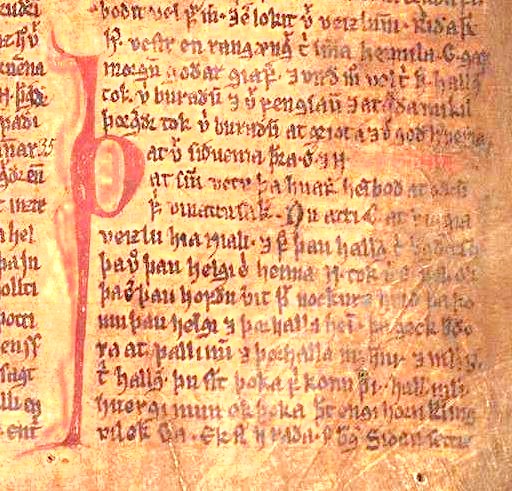
Excerpt from Njáls saga (Möðruvallabók AM 32 folio 13r cia. 1350). —Wiki

At least 60% of the Icelandic and Faroese.maternal gene pool hails from Ireland and Scotland. And the Viking contribution: "mtDNA lineages from Scandinavia to the populations of Iceland, Orkney, the Western Isles, and the Isle of Skye are 37.5%, 35.5%, 11.5%, and 12.5%, respectively." The mDNA study shows that the majority of female settlers came from the British Isles, "whereas ~80% of male settlers were Scandinavian." This data confirms Irish oral tradition. 

The study also notes that "the Gaelic contribution to the Icelandic mtDNA pool may have been at least as large as that from Scandinavia." (mtDNA and the Islands of the North Atlantic). That means there were almost no Scandinavian women emigrating form Norway. Norse-Irish women from Dublin and the Hebrides, yes.

I found interesting research on Iceland where "genealogy is an integral part of the culture — 80% of all Icelandic people who have ever lived can be traced on family trees." The country is isolated geographically, with little migration from other places ever since a few hundred Vikings and some Celts arrived almost 1200 years ago. (Decodeing Iceland's DNA). Note the acretion: "and some Celts," and these Celts are?

Islandia map by Abraham Ortelius ca 1590 —Wiki

Contrary to what we've been led to believe, Iceland was not an isolated Norse settlement unto itself. There's also a slew of Icelandic-Irish names which is curious as Vikings were more conservative naming boys than girls: Njáll/Njála, Brjan/Brjánn, Dufniall/ Domnall, Konall, Kjartan, Kjallakr, Kaðall, Kormakr, Meldun, Melpatrikr, Oskar, Patrek, Brigit. 

An Icelandic village, Patreksfjörður, is Padraig's Fjord. Vestmannaeyjar means "Irish Island." Írafell, and a mountain called, Írafellsbunga (are Éire (Irish) Fell, and  Éire Mountain, respectively), and Kjaransvík (Ciaran’s Bay) in the Westfjörðs, which seems to have been an Irish-Icelandic stronghold.

Of particular interest is the placename, Melkorkustaðir, once home to an irate Irish slave girl, Melkorka (see my story below), who was mother of Olaf the Peacock, a prominent character in many Icelandic sagas. None of this proves the Irish were in Iceland beforehand, it just proves they were there right alongside the Norse—in the thick of things. It also strongly suggests the sagas are based on historical fact.

Recent archaeological digs in the Faroes and Iceland note that there were Northern European settlements from ca. 400 to 800 AD, that definitely predate the Norse settlements. Archaeologists are reluctant to suggest as to who these people actually were. Chances of finding burials and intact DNA are slim to none. 

Also, Vikings often built on top of the older sites—which means their either integrated, or wiped the other settlers out. We know the earlier settlers raised barley, cut peat turf, and built soil beds with ash and seaweed—like Aran Islanders.

Another fact that seems to get buried in the Viking version of history is that female Icelandic settlers; slaves and concubines were predominantly Irish. Aud the Deep-minded, (Unn, or Auðr, daughter of Ketil Flatnose (ruler of the Hebrides)—he kicks off Laxdael Saga). Aud/Unn/Auðr, wife of Olaf the White, King of Dublin (853 AD), brought Irish slaves with her to Iceland from Dublin (by way of Caithiness). (Clements). She may not have been Irish, but it's possible that her father was Norse Irish, (and the chances of her mother being Irish?) which makes her…

At any rate, Aud/Unn/Auðr was a singularly unViking woman: she secretly built a ship in the forest (Scandinavian women were not allowed to own ships; had fewer rights—unlike Irish women who were on equal footing with men); she sailed to Orkney; married off one of her granddaughters; and then set sail for Iceland. She then freed all her Irish slaves in Iceland. Another reference noted she had a child with an Irish slave. I guess the attraction worked both ways. Fiercely independent Aud sounds similar to 15th c. Irish pirate queen, Gráinne Ó Máille ( c. 1530 – c. 1603).

Olaf the Peacock's grandfather, Höskuldr Dala-Kollsson's mother was Thorgerd Thorsteinsdottir, daughter of Thorstein the Red, who was son of Olaf the White, King of Dublin, whose father was Hiberno-Norse warlord Ingjald Helgasson. I won't even mention that several these Icelandic and Norse characters who settled the Hebrides, or came from there, before emigrating to Iceland, were also Norse-Irish. (And no you won’t be tested  on this.)

Ketill Bjǫrnsson, aka Flatnose (Old Norse: Flatnefr), was a 9th c. (Irish?) Norse King of the Isles—who led raids AGAINST Norway. (Orkneyinga Saga). However, Irish genealogy recorded that Aud's father was also Irish King Aedh. (Annals of Ulster). It could be a scribal error, or there was more than one outrageously uppity Norse woman named Aud. And Aud sounds a lot like Aedh. A female version of Hugh? 

Ketill sounds suspiciously like Kaðall/Cathal, and Flatnefr may be a phonetic corruption of Find (white). Scratch the surface—most emigrating Norsemen had Irish mothers, their children had Irish nicknames. (Jennings and Kruse).

The sagas of Iceland's colonization attempted to expunge all record of any Irish presence, but the Laxdaela saga-maker captured an Irish family pedigree—probably because the story wouldn't work without the Irish connection. Unique among Icelandic sagas, the Laxdaela Saga seems to have a feminine hand—recording matrilineal lineages in both Norse and Irish; perhaps it was composed by a woman, in Western Iceland, ca. 1230-1260.

Excerpts from the Laxdaela SagaChapter 21:

Wednesday, October 2, 2013

TALKING FISH & SEA WHISPERERS


The sounds that fish make
when no one is listening
in the koi pond, do they mouth
& baise-moué l'ail to the sky
and dream of swimming among the stars?
But in the depths of the ocean,
there's a piscean clack & growl,
the sonic boom and tump of black drumfish
travels up canals through bedroom walls—
their song akin to water-boarding, or a hydraulic engine.
At Strawberry Cove, the first high tide after the full moon,
we'd wait for the grunion run, they'd crawl out of the sea,
the only fish that must be caught by hand.
But the town drunks and Asians gathered them up in buckets
In a bioluminescent sea, we heard shoals of herrings
fart out a Morse code—like an angry army of Jimmy Choos
let loose in Grand Central Station at rush hour.
Those droning toadfish, those heavy metal rockers
sitting by the dock of the bay, no Country Joe & the Fish
singing We don't give a damn, drive Sausalito houseboaters
stark-raving-mad on warm summer nights.
Cusk eels jackhammering in the key of sea,
force sleep-deprived oceanographers inland.
We listened to miked pirañas, castenetting
like SETI radars in the Steinhart Aquarium.
Runaway seahorses, chirping clownfish,
yellow croakers, pistol shrimp, cod & haddock
thrumming up an aquatic din—
fishily belting it out in the name of love.
From Ensenada to Point Lobos
fish are chorusing a grand stadium "wave."
No passive acoustics, they sing the body electric
with a cacophony of barks and grunts
worthy of a Liberian ship engine with thrown rods.
Midshipmen looking for love in all the wrong places,
might have stumped Aristotle and sailors alike.
But no one has ever heard a butterfly fish make a sound.
Merely a whisper and sigh of fin and wing, like rustling leaves.

10/2/2013

OCTOBER POLKA


In the car overnight, she left Polish
dogs meant for Aunt Jane & Toddy's dinner.
We make jokes: did the dogs bark in Polish?
Almost. And the car stank like Hell's Kitchen.
What if they were dressed in sauerkraut gowns?
Then they would wildly dance to the polka.
At least she brought in garlic & onions.
There is no telling what would've happened
to the Polish dogs & onions—alone,
snuggled in the back seat, unchaperoned.
You know: one polka leads to another.
The wolfish accordions unleashed &
keyed up, they would howl at the Hunter's Moon;
& then the frenzied music would take flight
upsetting bright stars in the steadfast night.


10/2/2013


POLKA GLOSS

No, it's not quite a sonnet,
no couplets held in time
not much by way of rhyme
nor a good volta in the 8th line;
trains of thought were overturned
at every whimsey and whim
but in every line, ten syllables,
yes, count them, one and all,
not iambic, but a veritable sonnet,
so Shakespearean, plus one.

See Keats' Bright Star
abab-cdcd-efef-gg

Tuesday, October 1, 2013

10,000th TWEET

10,000th TWEET

Fitting that my 10,000th tweet
was in tribute to Seamus Heaney:
for 10,000 birds have taken flight
across the dark shoulder of the night.


10/1/2013

PROSE POEM

Remembering Séamus Heaney at UC Berkeley


Tribute to Séamus Heaney at UC Berkeley. Featured readers were UC professors (Heaney taught at Berkekey) Robert Hass, Robert Tracy, Peter Dale Scott, Morton Paley, Geoffrey O'Brien, C.S Giscombe, Catherine Flynn, Eric Falci, James G Turner, plus many from the community including Vice Consul Kevin Byrne, Neil O'Neill, Leslie Cody, Shay Black, and myself.

Someone read Digging, another read Oysters (two of my favorites—nearly committed to memory. The Burren is another.) Several read selections from Station Island: IV was brutal, Dantesque, about The Troubles. Neil read Sloe Gin.

We told Seamus stories, the poet's job was to explore the marginalia of life, and since I'd studied medieval Irish mss at UC, I read The Glosses. Three poems of kites, it became a theme. Someone read from Heaney's Beowulf, then Dante, another read pithy literary criticism notes.


And stories, yes, the stories. There's no such thing as a short whiskey or a short poetry reading. Bob Hass recounted what Heaney told him: "Sex is in its infancy in Ireland." Our homework was to read Heaney's Irish erotic poem, The Skunk, of course.
 
Among the storytellers were my favorite seanchaí professor and Joyce scholar, first translator of Osip Mandelstam, Bob Tracy who testified at Lenny Bruce's obscenity trial. I think he testified at Joyce's too.

Fellow Marin poet and longtime friend, Bob Hass read from The Apple Trees of Olema—my home stomping ground. At an Occupy Cal demonstration at UC Berkeley, Hass was hit in the ribs by a police officer with a baton. His wife Brenda Hillman was shoved to the ground. There's a YouTube video of it. Bob got back. He wrote about it in a New York Times opinion piece, "Poet-Bashing Police." 11//19/2011.

Both Bob Hass and Geoffrey O'Brien took part in Occupy Cal. O'Brien spoke out to a police officer who was hitting a Berkeley student because he would not break his link in a human chain. The police officer then hit O'Brien in the ribs, a reaction he would later call "brutal."  

So many new faces (at least to me). Lovely man, Peter Dale Scott. Some may know his Coming to Jakarta: A Poem About Terror.  And Eric Falci, C.S Giscombe whose work has appeared in Callaloo, Another Chicago Magazine, Hambone, New American Writing, o.blek, Obsidian, River Styx, Situation and Samizdat.  

Irish VIce Consul, Kevin Byrne

Our new Irish Vice Consul, Kevin Byrne, a Dublin man. His first event in America? A Séamus Heaney tribute. Seamus Heaney would've enjoyed it.
 
The Maude Fife Room temperature was 110°—due to an electrical eruption this AM at UC Berkeley, nobody could figure out how to turn off the heat. It was a real Dante's Inferno—so we held the memorial tribute to Seamus Heaney in the hallway at Wheeler Hall, UC Berkeley—t'was like a longship cathedral of poetry. Perhaps it was the feast Hall, Herorot. Beowulf was invoked in both languages. Dante too. It was a real poetry roast. Heaney would've like that.

It was so hot even in the hall, we shed what clothes we could, my silk scarf became an impromptu podium cloth. By the time the reading began, there were chairs all the way to the far end of the hall.

At first they thought the electrical explosion was a bomb. Huge fireball. Someone stole copper wire from an underground utility station. The entire campus was w/o electricity for most of the day. Instead of cancelling classes, students took out their smartphones as a source of light, and carried on.

So the least we could do, was to carry on ourselves. Even with every window and door on the 3rd floor open, cross ventilation, the room was like an oven—a bit like standing in front of the glory hole of a big glass kiln.

An amazing turnout. Even if we were all nearly broiled in the process. It was hot as a crematorium. A smithy's forge. The Goibniu, Himself was in attendance. 

 Afterwards, we ate and drank and told stories—we spread a little joy. Bob Hass sad to take the leftover food from the reception, and as we walked down Telegraph, so many homeless. So we gave a shoutout to Occupy Telegraph with a poet's funeral feast. And so we fed about 20 folks on the street. Poco a poco, that's how it's done. There's a poem embedded in this somewhere.

Ta to Bob Hass & Christopher Miller for an abfab event.

Fitting that my 10,000th tweet was in tribute to Seamus Heaney: for 10,000 birds have taken flight across the dark shoulder of the night.

Noli timere!
 a Shéamus! Rest in peace.