It's certainly been a month chock-full of fantastic celestial events: A supermoon on May 5th, an annular eclipse on May 20th, another supermoon and lunar eclipse on June 3rd, and the Transit of Venus on June 4th.
All this celestial grandeur—and solar maximums—stunning aurorae, meandering meteorites, lunar and solar eclipses galore, the Transit of Venus—the likes of which few will have ever witnessed in their lifetime—sans apocalyptic mayhem.
Like the Rapture, remember that? The Mayan calendar didn't predict the end of the Fifth World—either someone calculated the astronomical alignments all wrong, or something was lost in translation. The date's been moved up to December 12, 2012. We'll see about that. The last Transit of Venus was in 2004, the next one is in 2117. The Venus transits come in pairs. I don't think any of us will be around for the next Transit.
My attempt to view Monday's super lunar eclipse was eclipsed by clouds. The supermoon looked good at 2 AM, all the coyotes in Nicasio thought so too. (Note to self: the coyotes on the ridge above Halleck Creek either need tuning, or take singing lessons. Two-note yips is not a song. Their Sonoma cousins have a full vocal range that spans octaves. I wonder if the piano doctor can fix them?)
My cousin Sinead and I had plans to go out to Nicasio Reservoir and take photos of the lunar eclipse over Elephant Mountain. But the sky was socked in by 4 AM and spitting pure drizz by 5 AM, but then it got nice and cozy-dark. The pitter-patter of unseasonal June rain on the roof punctuated the end of my eclipse chasing intentions. Not that there was anything to see. Snyxxx! I was out like a light. The birds shut up their dawn yapping too.
 |
| That tiny beauty mark is not a fly on the paper, it's Venus! |
I did manage to witness yesterday's Transit of Venus. Or maybe it was the transvestite of Venus. It's really a reverse image projected on a TJ's envelope. Upside-down and backwards. Think Camera Obscura. Like the one at the Cliff House at Ocean Beach, in San Francisco.
I once watched an upside-down sunset unfold over the Pacific from the Camera Obscura—which merely means a darkened vaulted chamber, or room. Waves rolling in upside-down where the sky should be, was unnerving.
I've seen the camera obscura phenomenon in the wild (so to speak). I was once stuck in the nasty dark bellows of an overcrowded accordian-hinged double bus in Leningrad and watched upside-down color images of Nevsky Prospekt whizz by on a baffle bend in the wall like an old-timy movie. I nearly shrieked when I realized what I was seeing. OMG! Pinhole camera. But who was I to tell? The Russians weren't interested.
They say that the Bedouins were the first to notice this phenomenon, the endless Sahara replete with camels on the back walls of their tents. What did they make of it? But Leonardo da Vinci was the one who was credited with the invention of the camera obscura.
This photo is based on a similar principle. I used a silver-lined beach umbrella for my vaulted darkroom. Trying to track the sun upside down and backwards through binoculars (also upside down—or at least, backwards) without looking through the lens was challenging. I had to move opposite to what was intuitive to find the image.
Then I had to get the angle and distance of the paper right to bring it all into focus. But every time I got everything lined up and in focus in order to take a photo, the bloody sun kept racing across the paper—it was more like chasing the mass-transit of Venus. So things aren't exactly in focus, I had too many factors to juggle, including the wind niggling the paper. Using a digital camera to record the camera obscura image was a new twist on the process.
OK, so it didn't help that the binocuars were broken—one lens fell off at a benefit concert for Mimi Fariña ages ago, so duct tape was my bestest friend—I slapped it back onto the body but the imprecision of alignment made it hard to focus. I finally resorted to ductaping the entire binoculars to a tripod as it was so hard to keep everything all lined up. Far too many variables to keep track of. I could only focus one lens at a time.
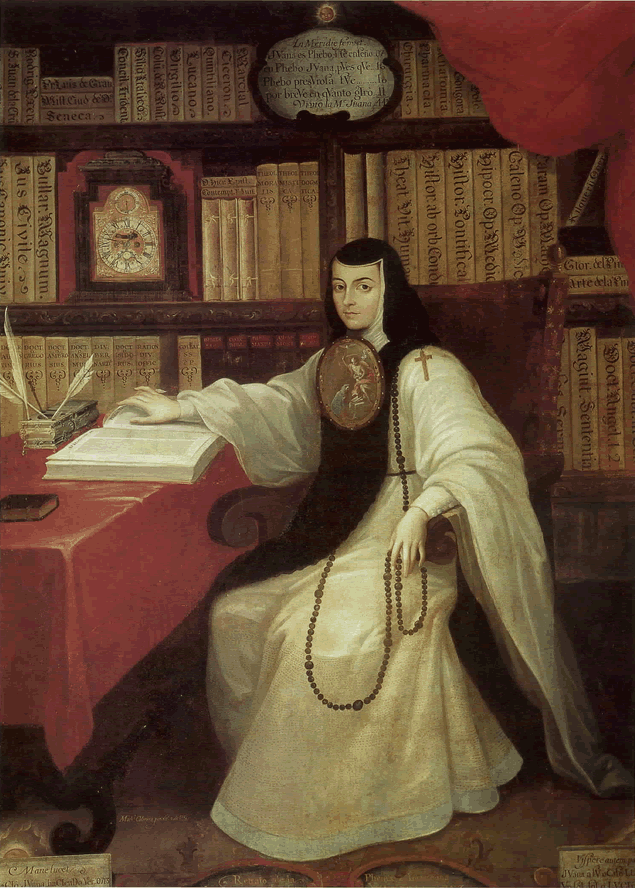 |
| Sor Juana Inéz de la Crúz by J. Sánchez. 17th c.. Wiki |
I felt like a modern-day Sor Juana de la Crúz (1651-95), the scientist-poet of New Spain (Mexico's first poet) during the Age of Enlightenment, tracking celestial phenomenon with very faulty equipment. I bet she would've killed to have access to binoculars and duct tape. A digital camera would've seemed like pure magic.
Sor Juana tried to disguise herself as a man so that she could attend university—denied an education (girls were forbidden to read), by age 15, she had read all 5,000 books in her uncle's library, and taught herself Latin, Greek, Nahual, math and science. She became a nun, rather than being forced to marry, and she crusaded for a woman's right to an education—for which she was punished and silenced. The Age of Enlightenment had no place for women.
Neil insisted that the small black dot on my envelope really wasn't Venus, that it was merely a bit of dirt on the lens. So I kept cleaning the lens of cruft, until I realized I wasn't looking at white light on the page, I was actually looking at the silhouette of Venus. That white light was the sun itself with sunspots erupting and sinking and occasional solar flares in living color! Wow. Double wow (it was a bi-nocular event.)
Besides, even if there was cruft on the lens, it wouldn't project with a sharp line. I've scratched camera lenses that work just fine—sometimes there's a bit of shadow, but otherwise the lens obliterates the mar. Yep, it was Venus all right.
Besides, even if there was cruft on the lens, it wouldn't project with a sharp line. I've scratched camera lenses that work just fine—sometimes there's a bit of shadow, but otherwise the lens obliterates the mar. Yep, it was Venus all right.
I love the way the binocular lens is also a prism, splitting the rainbow—red on one side, cyan on the other side. This is how Sor Juana's contemporary, Sir Isaac Newton (1642-1727), threw off the shackles and plough of farming, and tracked and divided light which gave us Opticks (1704), the scientific treatise on refracted light and the visible spectrum. All this thought strayed from the frayed edges of eyeglasses throwing little diffracted rainbows in a darkened room.
Newton proved that white light was made of all the colors of the rainbow. All that talk of color set the poets off, (Pope, Keats, Blake, Shelley, Wordsworth, Breton), and poetry itself changed—for the first time poetry was filled with images of color for color's sake. Call it Newtonian poetry.
OK, so Sir Isaac, the inventor of calculus and other beefy things, became rather loony toward the end of his life, mysticism having occluded his lens. They say he has Asperger's Syndrome, but that doesn't fit the profile. Besides, the mere thought of calculus makes me rather loony.
For me the proof in the pudding was watching pale golden sunspots erupting and sinking over and over like little eyes, and Venus, a mouth, or maybe more appropriately, a celestial beautymark on the face of the sun. Transit of Venus.
Puts us all into another perspective.
Newton proved that white light was made of all the colors of the rainbow. All that talk of color set the poets off, (Pope, Keats, Blake, Shelley, Wordsworth, Breton), and poetry itself changed—for the first time poetry was filled with images of color for color's sake. Call it Newtonian poetry.
OK, so Sir Isaac, the inventor of calculus and other beefy things, became rather loony toward the end of his life, mysticism having occluded his lens. They say he has Asperger's Syndrome, but that doesn't fit the profile. Besides, the mere thought of calculus makes me rather loony.
For me the proof in the pudding was watching pale golden sunspots erupting and sinking over and over like little eyes, and Venus, a mouth, or maybe more appropriately, a celestial beautymark on the face of the sun. Transit of Venus.
Puts us all into another perspective.


