 |
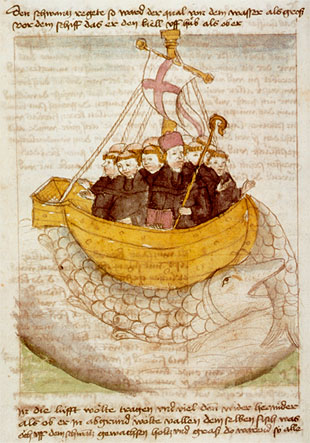
| Saint Brendan & the whale—from a 15th-c. German manuscript. Wiki |
There is an Irish oral tradition that the Irish settled in the Faroes, during the pre-Viking era, and the descriptions in the Voyage of St. Brendan, of "insulae" (islands) sounds remarkably similar to the Faroe Islands. There was a persistent belief that islands to the west of Great Britain existed as early as 330 BC. One fanciful name for those northern islands was Thule, which was "a six days' sail north of Britain, and near the frozen sea."
My Bantry grandmother told me that Irish monks brought sheep to the Faroes, and the toponym, though Nordic, means sheep islands. And sheep islands do figure heavily into the Brendan tales. There are several stories from the Navigatio of St. Bréanainn of Clonfert.
Some say Brendan (c. 484 – 577), was born to Finnlug (Fair Lugh) and Cara of the Altraige tribe, of the Ciarraige Luachra, the people of Ciar, who gave their name to County Kerry, on Fenit Island, near Tralee. I don't know if Tralee and Bantry both claim Brendan as he's also Bantry's patron saint. Galway, too clams Brendan. All have one thing in common—they are all seaport towns.
We do know Brendan was a real Irish sailor.His name in Irish: Broen-finn, or 'fair-drop', Naomh (St) Breandán. In Icelandic, it keeps the Latin, Brandanus.
We do know Brendan was a real Irish sailor.His name in Irish: Broen-finn, or 'fair-drop', Naomh (St) Breandán. In Icelandic, it keeps the Latin, Brandanus.
After sailing around the Irish, and the Hebridean islands, he set sail into the void from Kerry.
Brendan built a currach—a leather boat. The boat frame was woven from hazel and willow wattles, he covered the naomhóg the "little holy one", with cowhides tanned in oak-bark and softened/waterproofed with bog butter. He added a mast and a white linen sail. And he was set to go—with either 14 or 16 of his bestie apostles. It must've been one very crowded, smelly vessel.
 |
Broighter boat, c.100 BC, National Museum of Ireland, Dublin. |
The gold Broighter boat is a model of an Iron Age Irish boat from 100 BC, replete with 18 golden oars, rowlocks, benches, a paddle rudder for steering, boathook, a yardarm, tools, and a mast for a sail. “There is also good evidence that they [the Celts] had sails: there is a model boat from Ireland that dates from about 100 BC that has a mast, which could be a model for Celtic boats more generally,” Jennings said. “There is not so much evidence of sails in Norway until as late as 700 AD. It is therefore more likely that these early Faroese settlers came from the British Isles.” —Andrew Jennings, Nordic Historian The Norse word for a ship lung is from the Irish word long." —Medieval Review
The boat, a votive offering in the La Tene style, was found by two ploughmen near Loch Foyle in 1896; compare it to the 15th c. German drawing at the top of this page.
The Brendan immram Voyage tale was transcribed from Irish into Latin in 800 AD.) Old Irish Immrama (from iomramh-voyage), or voyager stories, depict a hero's sea journey to the Otherworld, (with a Christian overlay); they date to ca. the 3rd c. AD.
The Otherworld is always to the West. Tír na-nÓg (Land of the Ever-young) was another mythical island to the west. Reason enough to set sail—because they were there. In his legendary quest, St. Brendan was seeking the Isle of the Blessed (Saint Brendan's phantom Island), which may have been the Faroe islands.
Northern European settlements in the Faroes have been archaeologically dated to ca. 400 AD. Some 500 years later, the Vikings arrived in the Faroes, enroute to Iceland, and it looks like they may not have destroyed all evidence of Irish settlement in the Faroes. There is malted barley grain carbon-dated older than the Viking era—Barley is not indigenous to the Faroes—and old field systems that didn’t fit into later settlements.
There are also placenames of two Faroe settlements are Irish saints' names (Patrick & Brigit), survive—albeit with a Norse spelling. There might be other embedded Irish words. The Norse who settled in the Faroes were probably Norse-Irish from Dublin, not Norse from Scandinavia.
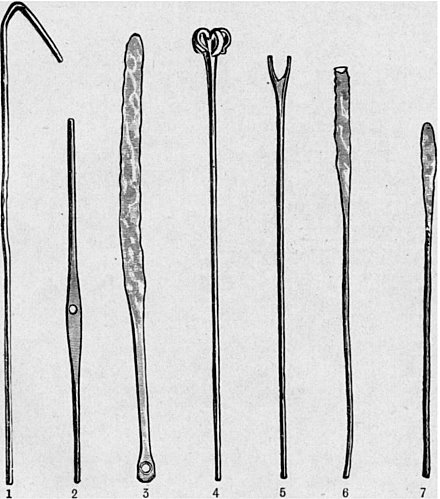 |
| Broighter boat,1.Boat hook 2.Mast yard 3.Steering oar 4.Small grappling iron 5.Forked implements 6.Square ended oars 7.Oars. —Wiki |
The boat, a votive offering in the La Tene style, was found by two ploughmen near Loch Foyle in 1896; compare it to the 15th c. German drawing at the top of this page.
.JPG) |
| The Broighter boat —Wiki |
The Brendan immram Voyage tale was transcribed from Irish into Latin in 800 AD.) Old Irish Immrama (from iomramh-voyage), or voyager stories, depict a hero's sea journey to the Otherworld, (with a Christian overlay); they date to ca. the 3rd c. AD.
The Otherworld is always to the West. Tír na-nÓg (Land of the Ever-young) was another mythical island to the west. Reason enough to set sail—because they were there. In his legendary quest, St. Brendan was seeking the Isle of the Blessed (Saint Brendan's phantom Island), which may have been the Faroe islands.
Half-way to Iceland, the Faroes are the first stepping stone across the North Atlantic.
St. Brendan described the largest of the Faroe Isles island as the Island of Sheep (Streymoy?) A bay in the southern part of Streymoy, is called Brandansvik (St. Brendan's Bay). His "bird paradise" might be the island of Mykines. There are several Faroe places named after the Irish monks (papar) including remote caves. —Faroe Islands Review History
The Faroes were part of a trade network with Dublin as a hub, and many Irish women made their way there as wives or slaves. DNA analysis shows that 84% of Faroese females are of Irish or Scottish descent. —Faroe Islands Review History
(NB: contrary to modern belief, Irish monks were NOT celebate.)
There are also placenames of two Faroe settlements are Irish saints' names (Patrick & Brigit), survive—albeit with a Norse spelling. There might be other embedded Irish words. The Norse who settled in the Faroes were probably Norse-Irish from Dublin, not Norse from Scandinavia.
Medieval chronicler Ari Thorgilsson said Ingólfr was the first Nordic settler in Iceland, but mentioned that "Papar" – i.e. Irish monks and hermits – had been in the country before the Norsemen. He wrote that they left because they did not want to live amongst the newly arrived pagans. Ingólfr Arnarson —Wiki
According to the Færeyjar Saga, an Icelandic Christian conversion story, one Faroe islander was "Tróndur í Gøtu, a descendant of Scandinavian chiefs who settled in Dublin, Ireland." And "Icelanders' own records record that 400 original settlers "with mostly Celtic nicknames" were living in Iceland previous to Norse colonization. (Clements). The significance of that statement is that European settlers were in Iceland and the Faroes long before Norse discovery.
In the 2nd half of the 8th century, Irish monk-geographer, Dicuil in "De menura orbis terrae" wrote of "heremitae ex nostra Scotia" ("hermits from our land of Ireland") living in the Faroes. (Scotia referred to Ireland, not Scotland!) They lived on the northerly islands of Britain for a hundred years until the arrival of Norse pirates. An Irish nickname of Faroe islanders, Na Scigirí, possibly refers to the Eyja-Skeggjar (land of bearded men).
Dicuil’s geographical book describes islands that aren't mentioned in any other writing of the time:
According to the Færeyjar Saga, an Icelandic Christian conversion story, one Faroe islander was "Tróndur í Gøtu, a descendant of Scandinavian chiefs who settled in Dublin, Ireland." And "Icelanders' own records record that 400 original settlers "with mostly Celtic nicknames" were living in Iceland previous to Norse colonization. (Clements). The significance of that statement is that European settlers were in Iceland and the Faroes long before Norse discovery.
In the 2nd half of the 8th century, Irish monk-geographer, Dicuil in "De menura orbis terrae" wrote of "heremitae ex nostra Scotia" ("hermits from our land of Ireland") living in the Faroes. (Scotia referred to Ireland, not Scotland!) They lived on the northerly islands of Britain for a hundred years until the arrival of Norse pirates. An Irish nickname of Faroe islanders, Na Scigirí, possibly refers to the Eyja-Skeggjar (land of bearded men).
Dicuil’s geographical book describes islands that aren't mentioned in any other writing of the time:
Many other islands lie in the northerly British Ocean. One reaches them from the northerly islands of Britain, by sailing directly for two days and two nights with a full sail in a favourable wind the whole time … Most of these islands are small, they are separated by narrow channels, and for nearly a hundred years hermits lived there, coming from our land, Ireland, by boat.
Archaeologists now believe Dicui was referring to the Faroes. Faroe or Føroyar means sheep in Norse. When the Norse arrived, there were already sheep there. So, who brought the sheep? The puffins?
Immrama, or voyage stories, are different than echtrae or adventure stories. The hero's faith is challenged—often with a multitude of pagan motifs. In this case, with herds of black sheep and white sheep on a disappearing island shrouded in fog.
THE VOYAGE OF BRENDAN SYNOPSIS (Chapters are relative depending on version,There are over 100 manuscripts of the Brendan story, not counting translations.)
On medieval maps, Brendan's fabled misty Isle appeared in various locations (including west of the Canaries—the Azores?). And on Christopher Columbus's maps—most notable is Martin Behaim's Erdapfel of 1492—known as La isla de San Borondón or isla de Samborombó. Borondón and Samborombó is St. Brendan in Spanish.
A reoccuring theme of the immrama is that you can't go home again—ever...certainly never to return the same person as when you left. Sort of like going on the Camino. Enlightenment was always sought and invoked on far distant shores. Apparently sheep were also somehow involved. Brendan's Feast Day is May 16. A good day to eat sheep.
Immrama, or voyage stories, are different than echtrae or adventure stories. The hero's faith is challenged—often with a multitude of pagan motifs. In this case, with herds of black sheep and white sheep on a disappearing island shrouded in fog.
THE VOYAGE OF BRENDAN SYNOPSIS (Chapters are relative depending on version,There are over 100 manuscripts of the Brendan story, not counting translations.)
In chapter 8 or 9 of the Navigatio, Brendan's sailors discovered an island of sheep, ate some lamb, and stayed on for Holy Week (before Easter). NB—the Irish celebrated Eater as late as mid-May. Let's just say there was a major difference of opinion with Rome as to when Easter was on the calendar. (In The Voyage of Mael Duin, monks also visited an island of sheep.
The following year, (chapter 14) they returned to the islands of Sheep, Jasconius, and the Paradise of Birds. (So we know there were at least three islands, and lots of birds and whales.) A bird said they had to repeat their journey seven years before they were holy enough to reach the Island of Paradise. They discovered a "coagulated" sea (icebergs?), sea monsters, more whales and fish, an island of grapes, magic (lethe?) water, griffins, seals, otters, an island of angry blacksmiths throwing hot slag at them, and more volcanoes.
In chapter 28, they returned to the island of Sheep, Jasconius, and the Paradise of Birds, before finding the Promised Land of Saints. They returned home, where St. Brendan died. -Wiki synopsis.
Some excerpts:
Some excerpts:
Perambulantes autem illam insulam invenerunt diverses turmas ovium unius coloris id est albi ita ut non possent ultra videre terram prae multitudine ovium.
On the island we found flocks of white sheep—we could not see the land, for the multitudes of sheep. (They sacrificed an ewe lamb. Loaded up the boat with mutton.)
Sanctus Brendanus illum quomodo potuissent oves esse tam magnae sicut ibi visae sunt. Erant enim majores quam boves. Cui ille dixit: «Nemo colligit lac de ovibus in hac insula nec hiemps distringit illas sed in pascuis semper commorantur die noctuque.
Brendan said the sheep were larger than cattle. "No one collects milk from sheep in this island or winter pastures them, they live in accordance with day and night. (So the sheep are feral, and the sailors drink sheep's milk.) They set sail.
Erat autem illa insula petrosa sine ulla herba. Silva rara erat ibi et in litore illius nihil de arena fuit.
The island, however, was rocky, without grass. The forest was rare and there was no sand on the shore. —from Navigatio Sancti Brendani Abbatis
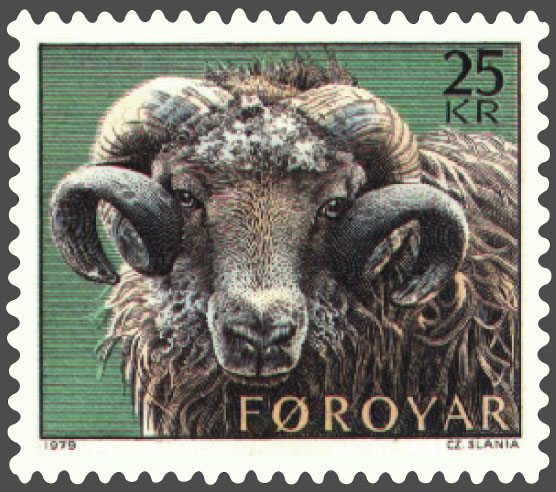 |
| So what about them sheep? Small N. European short-tailed sheep, related to Icelandic sheep, not inclined to hang out in herds. Hardy. No birds of a feather flock together philosophy for them. |
On medieval maps, Brendan's fabled misty Isle appeared in various locations (including west of the Canaries—the Azores?). And on Christopher Columbus's maps—most notable is Martin Behaim's Erdapfel of 1492—known as La isla de San Borondón or isla de Samborombó. Borondón and Samborombó is St. Brendan in Spanish.
A reoccuring theme of the immrama is that you can't go home again—ever...certainly never to return the same person as when you left. Sort of like going on the Camino. Enlightenment was always sought and invoked on far distant shores. Apparently sheep were also somehow involved. Brendan's Feast Day is May 16. A good day to eat sheep.


