Whenever I find myself getting longwinded on Facebook, I save my rambling comments because they're always potential fodder for a blogpost. Lawd knows people make a dubious career of writing about less titillating drivel.
Trouble is, my Facebook comments are stacking up fast and furious, never to be transcribed to my blog because I'm lazy, and because that would require even more work to whip them into shape. A beginning, middle and end. You know, a framework? Not to mention polishing the dubious merit of the content.
The fun part is how I find myself writing about absurd things I would never otherwise dream of as appropriate fodder—like the judicious use of jockey's batons on horse’s butts in races, for example.
One Facebook reader, Luke Broadbent liked my point and wrote: "Thank God someone knows what they are talking about!" Well, you know that only spurred me on. Wait. The subject was riding crops. These spurs were made for jangling....
Using the baton is allowed on young horses everywhere—even in Norway, where the crop has been otherwise banned for use on older racehorses who are a little more track savvy. And two-year olds do need that abrupt form of communication—especially on the turns—to prevent pile-ups. They're dumb as fenceposts. Sometimes they even think they're fenceposts. I didn't even mention the horses' quirky personalities and running styles...or that most are stud colts with plenty attitude.
But even mature racehorses horses aren't always savvy judges when it comes to making split-second decisions: hugging the rail, threading the needle, or getting out of a tight knot of hoses packed in on the turn.That's where the jockey comes in. One misstep, and they all go down, ass over tea kettle—with dire consequences.
Jockeys have to read the track and the situation, often astride an unfamiliar horse. It's a high speed strategies game. Enter the riding crop. Think of it as a turn signal. And a good jockey can save the life of his horse.
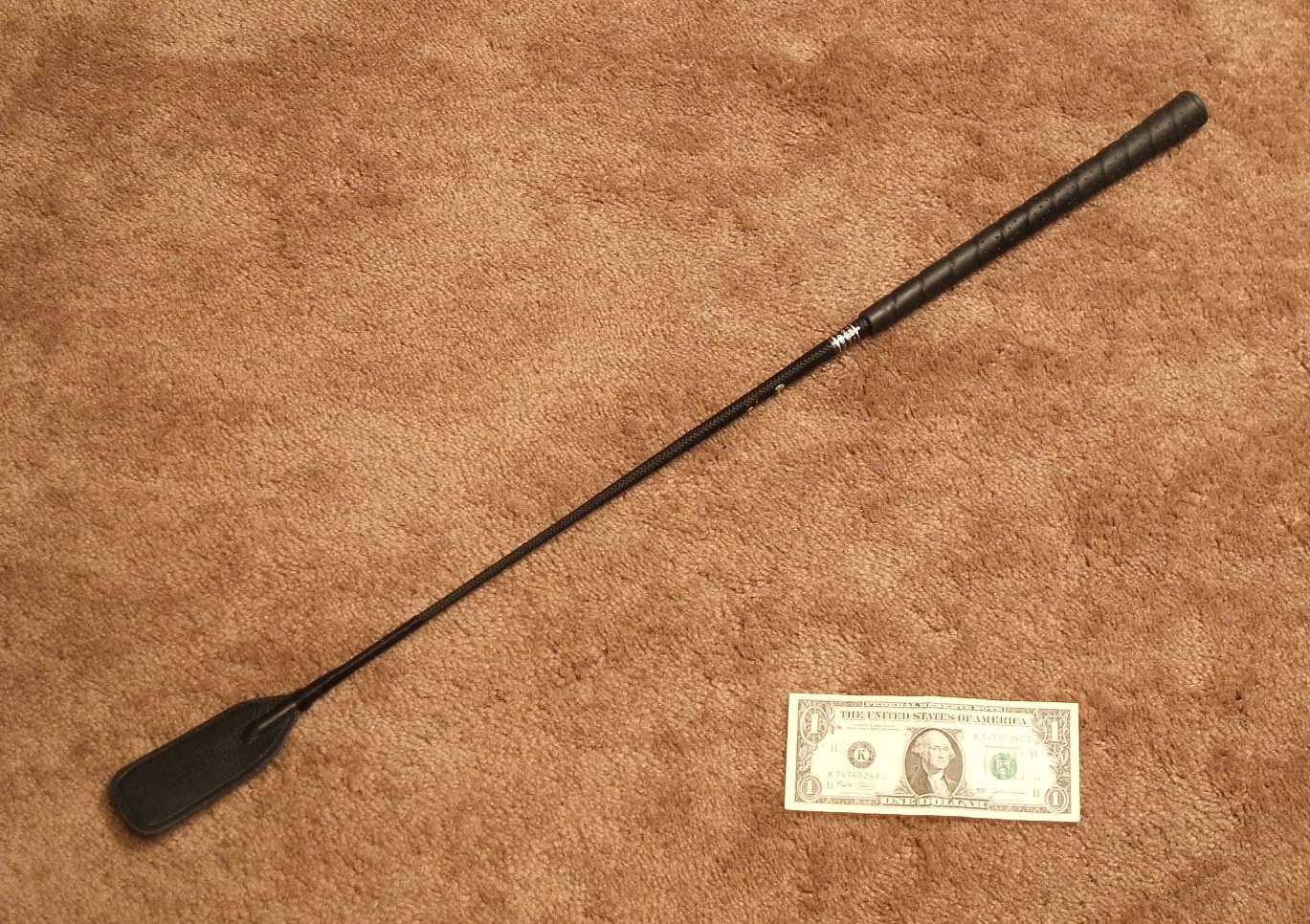
Most people envision the whip as something used to inflict maximum pain for corporal punishment, like a cat-o-none-tails‚ not to be confused with the House Whip. Dressage whips, a true whip, are strictly used for signaling, and hunting whips aren't even used on the horse, but for opening gates. A riding crop, or baton, made of fiberglass, has a flat leather tongue, or keeper. The baton stings if used wrong, but it's more about the POP factor. There are two flat leather padded parts at the end that snap together, like a quirt. It's more like a loud hand clap.
In Britain, a maximum of five strokes can be used during the last furlong or from the final obstacle, or seven strokes total. Improper or excess usage gets jockeys sanctioned, or even banned from racing. Apparently there's a groundswell to ban using the bat at all—not because it's inhumane, but because it looks bad, and the betting public is what feeds horse racing. A PR nightmare.
(See this ABC video: A jockey knocked from his mount mid-race manages to leap back in the saddle—to win the race at the last second.)Well, that Kiwi horseracing video brought out all the bleeding hearts who perceived the race as a perfect exemplar of animal cruelty. They whinged, whined, and condemned every jockey within a 3-million-mile radius, for using a riding baton, so, naturally I wrote back:
A jockey perched atop a horse has zero leg contact with the horse at all. Only reins and his riding crop. At that speed, voice commands are useless. He can't use his legs to communicate. The popping sound of the riding crop, or baton, is often his only form of communication with the horse. And there are so many variables. Also, a jockey may not be familiar with his mount, and effective communication is needed.A riding crop is also used as a communication tool—to move right, left, change leads, etc. Even buggy whips are not used to whip a horse, they're used for steering, and for the noise factor]. If a horse doesn’t want to run, it won't run. They can be real headcases. You can't make a horse win a race by whipping it. The horse has to want to win. Seabiscuit is a case in point. It's a partnership.
One Facebook reader, Luke Broadbent liked my point and wrote: "Thank God someone knows what they are talking about!" Well, you know that only spurred me on. Wait. The subject was riding crops. These spurs were made for jangling....
Another reader took umbrage at my statement, and said," I call BS on "using the crop properly". She said, "My horses preformed beautifully on voice commands and hand cues. Never had to touch her with anything. We did barrels."
Well since the bullshit was flying fast and furious anyway, I asked Kristina, "Do you sit deep in a western saddle when barrel racing? Do your legs touch the horse's sides, do you use leg or hand commands? Do you ride an unfamiliar horse for each race? I sure used leg commands when I barrel raced. A jockey has no leg contact at all. He's up there on top like a human fly. With only reins and crop. At that speed, trust me, voice commands are useless."
Someone else with a modicum of common sense piped in: "Why would you use a crop barrel racing? Your analogy makes no sense." And Mike Childers, who rode a mount called Charlie Horse to victory at Churchill Downs, said to her, "I don't remember you winning the Kentucky Derby." I had to laugh.
Another commenter needed a serious horse anatomy lesson. I said: Jockeys don't whip the horse in the flank, or belly, that would be near impossible (and illegal) to do, no matter how long the crop was. Besides, a jockey is sanctioned for improper usage of the baton. The racing industry is well regulated.
Using the baton is allowed on young horses everywhere—even in Norway, where the crop has been otherwise banned for use on older racehorses who are a little more track savvy. And two-year olds do need that abrupt form of communication—especially on the turns—to prevent pile-ups. They're dumb as fenceposts. Sometimes they even think they're fenceposts. I didn't even mention the horses' quirky personalities and running styles...or that most are stud colts with plenty attitude.
But even mature racehorses horses aren't always savvy judges when it comes to making split-second decisions: hugging the rail, threading the needle, or getting out of a tight knot of hoses packed in on the turn.That's where the jockey comes in. One misstep, and they all go down, ass over tea kettle—with dire consequences.
Jockeys have to read the track and the situation, often astride an unfamiliar horse. It's a high speed strategies game. Enter the riding crop. Think of it as a turn signal. And a good jockey can save the life of his horse.
Most people envision the whip as something used to inflict maximum pain for corporal punishment, like a cat-o-none-tails‚ not to be confused with the House Whip. Dressage whips, a true whip, are strictly used for signaling, and hunting whips aren't even used on the horse, but for opening gates. A riding crop, or baton, made of fiberglass, has a flat leather tongue, or keeper. The baton stings if used wrong, but it's more about the POP factor. There are two flat leather padded parts at the end that snap together, like a quirt. It's more like a loud hand clap.
Also, appearances can be deceiving. It may have looked like American Pharoah's jockey Victor Espinoza, was beating the stuffing out of his mount at the 2015 Kentucky Derby, his arm was whirring like a helicopter. But post-race analysis showed that he was hitting the horse's saddle towel. The Blood-Horse writer Steve Haskin, who condems whip overuse, said that Espinoza "did a lot of waving with the whip" and may not have actually hit the horse as many times as it seemed." Espinoza did not use his whip at all in the Preakness, and the horse still won.
 |
| Triple Crown winner, American Pharoah, first horse to win Grand Slam |
So, because of all this controversy, of course I had to Google the pros and cons of using the riding baton. Oh, how kinky! No, wait, I mean, it looks like the jockeys are striking back against Australia’s animal rights activists, literally. I found an article on the proper usage of the bat, with a jockey spanking a reporter's hands to demonstrate how it didn't hurt. I kid you not. So of course I had to post that link. Now, to kick back and wait for the uproar to commence.
Aren't you glad you asked? And today, because I wrote a comment about jockeys, I was flagged with a Facebook ad for a job as a wagering assistant at Golden Gate Fields. Coinciodence? I think not. Now Facebook is spying on the content of my comments as well? Maybe I need to flog Facebook. With a cat-o-nine-tails. Kinky!
Other horsey bits
Becky Dart: Born to Run
Kiger mustangs carry rare Iberian Sorraia mtDNA
The jockey's baton
B/G Sandwich Shops plate, or the tale of Ralph Moody
Eating the Wind
Helgar the Horrible
Letter to Sigrun in Iceland (Helgar the Horrible)
The Little Shits
Shetlandish Escape Artists
Shetland foal, H.M.S. Salt
Horse Chestnuts
Sitting Deep
While Reading Essays by Robert Hass
There is so Much We Save from Childhood
FIRST SWIM
NEW MOWN HAY, RAISED BY HORSES, ODE TO STEPHANIE,...
AFTER THE SOLSTICE, MACHU PICCHU
WILD HORSES IN THE RAIN
LATE HOUSEWARMING POEM TO WM.T.WILEY
HORSES RUNNING THROUGH THE STREETS OF ZENIA AT NIGHT
Sad news
Hall of Fame jockey Victor Espinoza, his body broken by one fateful fall, is holding on for dear life "On a July Sunday morning (15) at the famed seaside Del Mar race track, Espinoza was riding Bobby Abu Dhabi in workout when their worlds literally disappeared from underneath them. Bobby Abu Dhabi suddenly collapsed of an apparent heart attack. Espinoza suddenly found himself riding on air. The giant horse immediately died. The 5-foot-1, 112-pound man flew into the dirt and broke his neck."
Other horsey bits
Becky Dart: Born to Run
Kiger mustangs carry rare Iberian Sorraia mtDNA
The jockey's baton
B/G Sandwich Shops plate, or the tale of Ralph Moody
Eating the Wind
Helgar the Horrible
Letter to Sigrun in Iceland (Helgar the Horrible)
The Little Shits
Shetlandish Escape Artists
Shetland foal, H.M.S. Salt
Horse Chestnuts
Sitting Deep
While Reading Essays by Robert Hass
There is so Much We Save from Childhood
FIRST SWIM
NEW MOWN HAY, RAISED BY HORSES, ODE TO STEPHANIE,...
AFTER THE SOLSTICE, MACHU PICCHU
WILD HORSES IN THE RAIN
LATE HOUSEWARMING POEM TO WM.T.WILEY
HORSES RUNNING THROUGH THE STREETS OF ZENIA AT NIGHT
Sad news
Hall of Fame jockey Victor Espinoza, his body broken by one fateful fall, is holding on for dear life "On a July Sunday morning (15) at the famed seaside Del Mar race track, Espinoza was riding Bobby Abu Dhabi in workout when their worlds literally disappeared from underneath them. Bobby Abu Dhabi suddenly collapsed of an apparent heart attack. Espinoza suddenly found himself riding on air. The giant horse immediately died. The 5-foot-1, 112-pound man flew into the dirt and broke his neck."


No comments:
Post a Comment