Friday, October 7, 2011

2 FREEWRITES WITH PICASSO


GOD IS IN THE CRACKS

In a world of no
there is no room for conflagration
astral core samples, the hunger to know.
In the beginning was the crenulation of the brain.
What came first, the universe or the blackhole?

A psalm story
Earth-based spirituality
Dogs speaking from the other side.
Death is an illusion, or so people say
Heaven is a place that cannot be found.
God is in the cracks, a tiny crack
that separates this world from the next.
7/8 of everything there is is invisible.
Your feet know the way to the other world.
You can't just chase the invisible.

There is only one thing we all equally possess,
and that is our loneliness.
Like fortitude, the struggle with the angels,
where would the words go, the strength of mind,
will, or choice, what we represent.
We are here for the the lesson of fate, or of passion,
what arises out of consciousness
and oppression is art. Solely art.


AH, PICASSO, PICASSO

Ah, Picasso, Picasso,
painting is just another way of keeping up,
another way of keeping a dark circle
on the head of the horse rendered
in dappled beauty while the dancers take flight.
On the table, a frugal meal is laid out,
a white potato, an apple. Some wine
for La Celestina.

A scarf, the laying of the brush.
Oh death and las damseilles.
Azure landscapes with two figures.
Every act of creation is too strong
of an act of destruction.

Painting is a form of magic
designed as a mediator
between the strange and hostile world.

Picasso said: it took me four years
to paint a rock like Rafael
but I know how to paint something.
When I paint I feel that all art
is in the past.

Let's go dancing, it's in the cards,
she said, the city folds in on itself.
The sound of an empty room.
After she left, they were thick as thieves
at the circus.

She pulls the self-portrait over her lips,
his eyes follow her every move,
but the viper was just a pipe,
it's in the cards, she said.

A small blue door,
two women running on the beach
22 breasts adrift in the breeze.
Such blue to contend with,
such monumental flesh,
Ruben's women turned to stone.

Picasso said: Art is never chaste.
A nude in the garden, and green cats.
Portrait of Dona Maar
the hands, tuberous clusters.
Weeping women in red dresses.
Art is that which makes us realize the truth.
Said the weeping women.

A cat and a bird, an unequal war.
Art is something of the senses,
a weapon of self defense against the enemy,
the symbolization of women
in the studio in Algiers.

Picasso said: painting is stronger than me.
It makes me want what it wants.
Oh the Women at Dachau and the Minotaur,
finally the Minotaur, the bullfight,
the disembodied horse, a goat skull,
an empty bottle, the candle of war,
and of course, Guernica,
that is the dissolution of life, of art.

transcribed and revised, 10/17/14
 

Wednesday, October 5, 2011

APPLE CORPSE

"I want to put a ding in the universe."
iClouds take note.


I put an apple pie in the oven
and then sat down to Twitter
when I got the news
and then I burnt the pie
it was an apple corpse
a curious carboniferous death notice.

RIP Steve Jobs 1955-2011

A small part of history

Today John Butcher reminded me of the story I told him about bringing the first Apple to the CCCP. He said, You were truly part of history, Mau!

Actually it was a Mac II—not even a SE, no hard drive. Floppy floppies. After I picked it up from Apple, I had to go to the airport and get an affidavit signed from the military in order to take it to the USSR. It was the first Mac ever in the Ukraine—as far as I know. I heard rumor of one in L'Vov, but it wasn't confirmed. So I had to keep track of it as it was still considered somewhat "classified," if, not somewhat obsolete. Soviet city officials kept trying to abscond with it—so I went on record—TASS and radio, as well as local news venues to announce that the Mac was a Sister City gift from Santa Rosa to Cherkassy. That finally worked. What was a scream, was that no one could read/understand the English—and I had to learn PC-speak to explain how it worked. We tried changing the resident ROM Chicago font for a Cyrillic font—which didn't work. Every time we rebooted it reverted to Chicago. That led to a trip to Apple R&D—which eventually kicked off the development of the multi-orthographic Mac interfaces we know today. Yes, I guess we were a small part of that history.

A big bite out of the Apple


The pop artist Jonathan Mak Long is a 19-year-old living in Hong Kong. Other than an egomaniac who refers to himself in the third person, Jonathan is also a self-proclaimed designer, photographer, and philosopher. He is, in short, a liar. Ask him anything. Logo was adapted August 26, 2011.


From Rob Griffiths: Steve Jobs brought us the iPhone/3/3G/4/4S; the iPod Touch; the App Store; the MacBook Air; the Mac mini; the iPad/2; and more…: All in 7 years—after his 2004 cancer diagnosis.


From the man who taught us to Think Different! said, I want to put a ding in the universe, did just that. His mantra: Stay Hungry. Stay Foolish. Option Shift K. 

A friend’s son who works at Apple posted a photo of flags at half mast. RIP steve Jobs 1955 - 2011. May you rest in the iClouds. “Oh, and one other thing... I have an app for that."

Monday, September 26, 2011

CPITS 2011 Symposium New Writing

The fire lilies were thinking of you
all in their crimson splendor
they turned toward the sun
The heart knows what it wants
the way the foot knows the path to the barn
the horses all waiting
each one knickers in welcome
helping us load the hay into the feedbin
and how in early morning we rose
sneaking out before the dawn
to saddle up for the trail ride
the sky streakes with carmine and gold
the horses eager, snorting with each breath
anticipating the day
the lomg glide of woodpeckers from pine to oak
raucus musicians laughing in deep woods
as I imagine you now
your olive eyes flecked with green


(revised)                            —for Stephanie Stone

The fire lilies were thinking of you
aflame in their crimson splendor
as they turned toward the sun
like horses in the stable, tracking the hay

The heart knows what it wants
the way the foot treads on the path to the barn
the horses waiting, eagerly nickering welcomes
helping us to load hay into their troughs

I remember how, in early morning we rose
sneaking out before the dawn
to saddle up, the sky streaked with carmine & gold
our mounts eager, snorting with pleasure
each step, each breath, niggling at the bit,
dancing, they could barely contain themselves
such was their joy

But the long glide of woodpecker's wing from oak to pine
and that raucous laughter in deep woods
reminded us that we will never pass this way again

Too soon you left me at the starting line
racing toward that distant horizon
from which no traveler returns

You will never know the ache of old bones
the failing of eyesight
nor the fading of memory
that slow erasure of the past
nor the parting of childhood
but all that came of the new-mown doubts
the shifting of psyche

I am left with is the sudden silence of the woodpecker
the way darkness ate at your bones
devouring the marrow until the shone
with the ephemera of catscans and isotopes of hope

9/9/11

Steve Kowit's workshop   Recall one incident, find the emotional charge, conjecture about their fate. The real task is to write a mourning poem, a poem that will move the reader (transformation). Use assonance/dissonance, metrical patterns, repetition.  15 lines  (OK so I sucked at the 15-line part).

Sunday, September 25, 2011

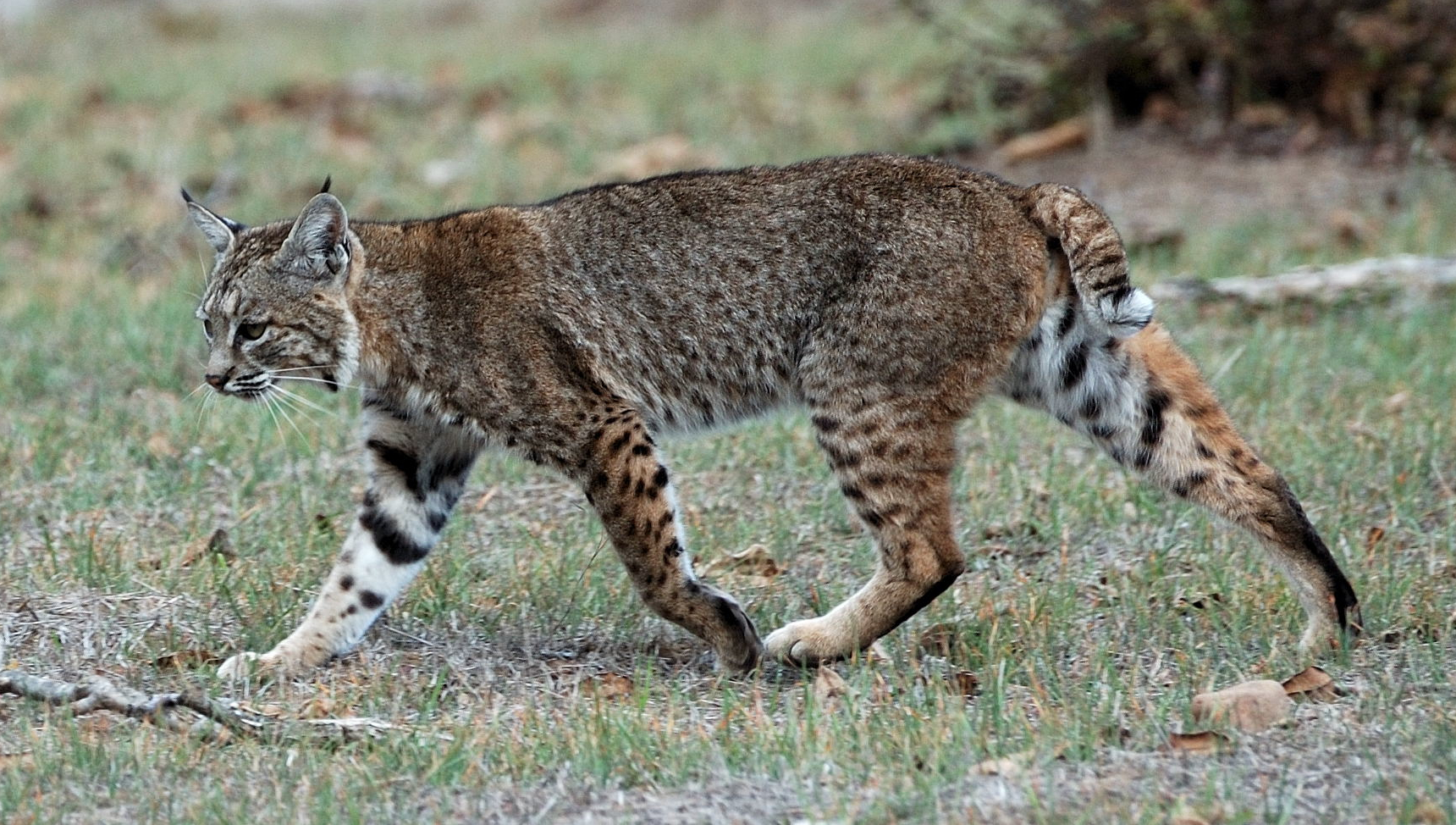
Bobcat in Ojai backcounty

Bobcat, Calero Creek Trail, San Jose, CA—Wiki commons pix

When the L. rufus californicus sprinted across the road in front of us near Lake Casitas as we were enroute to Ojai, I was struck by how it resembled a cheetah—a lean greyhound body built for running, jacked up higher at the rear end than most cats—a sprinter. Gorgeous black, rufus and clouded spots, long tufted ears with black points—but little by way of a tail. Not like a cheetah's yard-long tail. Wrong continent.

But I once surprised a caracal in the trashbin at dawn. And it surprised me. It rose up, impossibly slender like Baast, the Egyptian cat god, and looked me in the eye. We stood transfixed, then it melted into the morning fog.

I didn't know what it was other than an exotic cat—but I was taking a class at Sonoma State later that morning—so I sculpted it out of clay and Dorothy recognized it and we later identified it as the escaped African cat from the Forestville Preserve.

The rangers came to to see if they could find the escaped caracal—they said she was once someone's pet—declawed, and she was pretty hungry, but tame enough. I was struck how the caracal and the bobcat resembled each other in size.

The Ojai bobcat passed so close to us as we were sitting in the rental car (we had slowed down so I could take a photo of the lake), I could see into its golden eyes for one brief instant—as it crossed the highway to the lake for its evening drink.

The photo I never took. An American lynx, a Californian subspecies. My third sighting in a lifetime. That peculiar intersection of crossed paths and time— and for a moment, the day stood stock-still.

Tuesday, August 23, 2011

Odd Facebook conversation


Odd Facebook memory post. Said my old UC Berkeley Celtic Studies friend, writer and poet, Jasmine Donahaye, who lives in Ceredigion, Wales, to a friend, Kevin Delaney, So I've asked my friend Maureen Hurley wot lives in northern CA if you can pick her brains about work/arts/poetree etc - she's an artist and poet and works in arts education. Also she's quite mad. She said yes, so go find her. If you dare.

Kevin said: oh no! am I going to have to learn to speak British for this...?

Jaz said: Well, she's Eirish, you know. So American might serve you better. 'Quite' and 'mad' in the British sense, of course. Scuse us, Kevin.

I’ve no idea what she asked me....if she asked me. She must’ve asked me. But the question has fled the scene of the crime. But I said: LOL! Yer a right fyne one to talk, Blodeuwedd! Probably the last conversation I had with her. So naturally I asked, Wot was the question? some nine years later.

From a Facebook post, added 8/20

Saturday, August 20, 2011

Today I met Jerry—a former high school student of Frank McCourt's


Today I met Jerry—a former high school student of Frank McCourt's! We exchanged banter over the curried chicken and Tuscan melon. Teacher Man, Angela's Ashes & 'Tis. What he told me about self-evaluation was particularly helpful after a customer ripped me a new arsehole for no real reason at all—other than he could. Several women in line went over to the manager and vouched for me, several wanting to come to my rescue but were at a loss as to how. Fecking bully. He couldn't believe I had the audacity to say "I don't need this." And all the frabulous lines I composed in hindsight—alas, he broadsided me.

Thursday, August 11, 2011

Speck McAuliffe's Bar Burned Down


Lagunitas Lodge 1910

Someone on the Facebook Lost Marin page posted a new photo of Speck McAuliffe's bar that I'd never seen before. When Speck's bar burned down in January of 1983, an institution was lost.


My family knew Frank "Speck" McAuliffe from way back when in San Francisco days. He was a retired cop, or was it fireman? His wife bought the place with a nest egg she had saved up after the Depression, my grandmother said.  


As a baby, I crawled on the mahogany bar—and on the disgustingly dirty floors, and ate cigarette butts. I graduated to Shirley Temples, then Irish coffee. It was my family's watering hole. They had been friends with Speck—that is, Frank—for 2 generations. His daughter Loretta, was my godmother. Her sister Pat Decker, was one scary bartender.

We don't know who owned the bar or what it was called before Frank bought the Lagunitas Lodge. But we have a photo of my uncle Feilim on Tangerine the blue-eyed pinto, in front of Mariposa Pavilion (a dance hall) that was behind the tavern. It must've burned down before I was born.


Or perhaps a part of it was turned into Speck's home. But I think their home was the 2nd story over the lodge itself. You can see it in the top photo. What's amazing is that part of the old rock pillar fence from 1910, survives to this day. My grandfather bought three lots in Lagunitas, so he would've been familiar with this bar, ca 1910.

Feilim on Tangerine ca 1940, he died ca. 1945, Mariposa sign is to the left

There was a livery stable out back as well. Our family boarded the livery stable horses over the winter and my aunts and uncles rode them in summer. Baby Snooks and my glue factory horse, Chiquita, were refugee horses from the livery stable that spanned two generations.

I remember Old Pete Stone, the last real cowboy, used to ride Lightfoot, his strawberry roan down to the Forest Knolls Lodge (the misnamed Papermill Creek Saloon as it's on the San Geronimo/Creamery Creek, not Papermill Creek) for a drink at the Forest Knolls Lodge, and he could roll a cigarette one-handed. 

That horse was decked out in a heavily tooled saddle and bridle loaded with pounds of silver. Pete was something to behold. His lariat was made of plaited horsehair. Was he a rodeo rider at one point? Geoff Davis said: Pete Stone was a teamster and a mule skinner. My dad told me that he liked real people, he liked your granny a lot. Genuine article, at any rate, just like Frank.

Geoff later added: Yes, Pete Stone, he was a sailor [earing] and a mule skinner, his painting/ relics burned when MT torched Speck’s.

Old Pete took care of the rental horses. When they were all sold off, he lived in an old Slipstream trailer hidden in the greasewood out back of the lodge. He made Pat Decker's daughter, Maryanne a thin ring out of an old silver dime, but he was also a dirty old man, always wanted to "play house" with Maryanne and me. We were warned off of him by Maryanne's mother, Pat.

For a short time, when my family was a real modern fifties unit, replete with mother father, child, we lived next door to Pat Decker in Frank's apartments over the Lagunitas post office. Pat was Frank's daughter, and Frank's main barkeeper. Pat's sister, Loretta, my absentee godmother, who looked a little bit like Elizabeth Taylor, lived in San Anselmo.

Lagunitas Lodge, and boarding house , ca 1910

Pat was married to George Decker, who was a powder monkey out at McNear's rock quarry. First time I ever saw sticks of dynamite was in the trunk of George's car. He'd come home all covered with rock dust, looking like an animated cement statue with bloodshot blue eyes. George was from Arkansas so he talked funny. They later moved to Woodacre and Maryanne and I grew apart.


Someone said the post office and the apartments burned down in early '70's, I was living in Forest Knolls. You'd think I would've remembered that. But Roberta Tanzi said 1972 or 73 was the second time that place caught fire, and the 3rd time was the night before Easter, 1988. Anthony Chatham, who lived in one of the apartments, said the fire was right before Christmas, in 1972.

The apts. also burned in 83, we lived in the far right one. Roberta Tanzi photo

However the fire started (Joey Tanzi has a different story), there was already a string of arsons where all the historic buildings in Lagunitas and Forest Knolls were torched. We definitely had a firebug. The old saloon and ice cream parlour in Lagunitas was amazing. We have some of the Hawaiian Kanaka cane chairs from it. Huge carved gilt mirror, mahogany bar. Rumor has it that when Barbara Scott owned it, it was torched for the fire insurance.

Half of the downtown Forest Knolls (across from the bar) was a series of wooden buildings with a roof overhang and wooden sidewalks that creaked. Even hitching posts outside. Very western. Very authentic, and very flammable. My childhood history went up in smoke—a restless firebrand who just couldn’t leave it alone.


I lost touch with Maryanne years ago. We spent so much time at Speck's bar, it was a home away from home. All cinder and ash now. 

Speck McAuliffe's Irish Coffee  by F M Palinski, 1984

This was from rough notes, and was extensively revised 8/24/2015, but the original impetus came from 8/11/11, so I filed it here. I need to come up with a better name, or perhaps combine the two blog posts. Meanwhile.... minor revisions 12/17

See also
Speck's Bar: Family Watering Hole (2014)

Thursday, July 28, 2011

Remembering Nick Valentine & Phil Osborn at The Paper

Nick Valentine, 1941-2011. 

Where to begin? I find myself wandering incoherent as a cloud, woolgathering attempting to trick myself into writing this obit in medias res with a mea culpea to you, Dear Reader, and to two newspapermen I once knew, as well as to the end of an era. 
What I really want to say to my blog is: Not today, Dear, I have a headache. Gutting closets, tearing the house apart and whatnot has left me stiff and the raging headache is a byproduct of—or rather, a result of old car injuries acting up. To begin my morning with tea and advil. And bad news. Ugh. If i don't just start writing—warts and all—it'll never happen. The self-imposed dreadline.
Today the bad news just kept on coming: an old friend, photographer and writer, Simone Wilson, emailed me that our mentor and newspaper legend of The Paper (now the North Bay Bohemian), editor Nick Valentine died on June 25, in Brisbane, Australia (1941-2011).

And hard on the heels of that sad news, Simone told me that Phil Osborne (1938-2011) the photographer who trained me in the darkroom arts, also died in July 15, in Cloverdale, CA.

Perhaps it's not so strange that these two men died within weeks of each other. For over a decade, Nick & Phil were the backbone and ribs of an alternative weekly tabloid newspaper owned by Elizabeth Poole that we worked for during the 1980s and 1990s. What I learned about photography and writing—I owe to these two great mentors who taught and encouraged me, and allowed me to develop my own style. Godspeed.

Editor Nick Valentine 1941-2011 ©1991 Jesse Valentine

Nick Valentine was founding editor of The Paper: West Sonoma County's Independent Voice (1979—1993). The Paper was where I learned my varied and sullen craft: writing and photography.  Jazz pianist Bob Lucas was The Paper's first publisher, he paid the bills. Shortly thereafter, Bob sold it to Elizabeth Poole whose family owned a string of newspapers back east. So you could say Elizabeth was born into the newspaper business.
One story has it that Guerneville resident Stan Buck was credited with generically naming it The Paper—the place where people got their local news. But the other story has it that when Elizabeth Poole came to work with Nick as an intern from Sonoma State, an Abbot and Costello Who's on first conversation followed. And the paper became The Paper.
During that time, The Paper evolved from a mimeographed flyer to a tabloid. Nick was editor-in-chief for ten years, focusing on local news, with in-depth political and environmental coverage pertinent to West county. Nick had a finely-honed sense of justice and strong working class ethics—he kept a sharp lookout for the rights of the little guy. Perhaps his short stint with The Russian River News—then owned by the Santa Rosa Press Democrat, sharpened his political awareness. 
"Poole bought the financially struggling Paper that year and kept it alive with her family’s money through the 1980s, when at its peak it was printing 15,000 copies a week. After Poole sold it in 1990 The Paper evolved into The Independent and moved to Santa Rosa where it became the Northbay Bohemian." —Frank Robertson, Sonoma West Times & News. 7/27/2011.
The financially strapped Paper offices bounced up and down the Russian River: Monte Rio, Guernewood Park, Guerneville, Forestville. When The Paper morphed into The West Sonoma County Paper, it made a break with the River and moved to the tiny hamlet of Freestone. Then it moved to urban Santa Rosa, it tried to grow up and lose its hippie duds, and then it became the The Sonoma County Independent ca. 1993 (publishers Boland-Carroll Inc.).

The Paper, 1989
Ironically, one of my writing students from Mark West School, Gabe Meline, is now the editor of the North Bay Bohemian. I must've taught him something, it's improved greatly under his tenure. Here is a link to a 25-year retrospective of The Paper from the Bohemian's rather flat lens.Then, The Paper was rebranded The North Bay Bohemian  when it was purchased by Metro Newspapers (Rosemary Olson, publisher). By the time it became the Bohemian (when was that 1996?), and Greg Cahill was editor, the paper no longer had any West County roots to speak of, and I was unceremoniously kicked to the curb. 

NICK VALENTINE

Nick Valentine died in Brisbane, Australia, at the age of 69 from pneumonia—complications of a lung disease. Most likely emphysema. To my way of thinking, Nick died too young. A bearded bear of a man, Nick never did take very good care of himself. Svelte dark Virginia Slims cigarettes and Coca-Cola were his mainstay.


Nick was one caf-fiend Coke-swigging smoking chimney of an editor during Wednesday-night-cum-Thursday morning production drop deadline. When the Coke ran out, Nick switched to leftover coffee sludge, spiked with condensed milk and sugar, and kept on working. I think he only missed the printer's deadline once.

Brother Toby of the Starcross community in Annapolis challenged the notion that AIDS was solely a "gay" disease by offering shelter to AIDS infected orphans. His story shepherded AIDS into mainstream consciousness.


Putting the paper to bed in the wee hours meant that we—the paste up crew, and the darkroom tech (me)—pulled many all-nighters working against time itself in the ramshackle offices above the store. Many's the time I drove home to Forestville along River Road in my VW Bug, with dawn nudging the reluctant stars out of the sky. A few times I delivered the flats to the Healdsburg printer at daybreak.

Nick Valentine, the Oak Leaf, May 1976.


PHIL OSBORN

Sunday, July 24, 2011

California Poets in the Schools 47th Symposium in Santa Barbara 9/9-11, 2011

BREAKING NEWS: We have several "commuter" spaces available—attend the entire conference for only $200/150 for Sat only) and sleep off campus. All the single rooms are gone—but there's usually two beds per room. You could also risk it and show up—there will probably be space available somewhere. If not, then Motel 6 is your BFF. We are also negotiating for more rooms at Casa de Maria. Meanwhile, if you know a poet who is attending, you can always ask if you can share a room.

There are a few slots open for Steve Kowit's fabulous writing workshop on Friday afternoon as well. Call or email Tina ASAP to reserve a slot. info@cpits.org or 415-221-4201.
BREAKING:

Are you going to The Ballgame? Giants vs. Phillies? It's a very SPECIAL event for CPITS. The SF Giants will hand SF CPITS Area Coordinator Susie Terence and 12 Jr. Giants a big check for $10,000 to bring poetry workshops into the classrooms. Be there. Take pix, and post them on Facebook. Go Giants! Go Susie! Take me out to the ballgame...

DEADLINE TO REGISTER IS AUGUST 12. CONTACT CPITS ASAP IF YOU'D LIKE TO ATTEND

CPITS' 47th annual poetry workshop & symposium, "Writing Ourselves True," 9/9-11, 2011 @ Santa Barbara's La Casa de Maria retreat and conference center.

CPITS' annual poetry workshop & symposium is one of the most sublime and inexpensive writers' conferences in the nation. Poets, artists and teachers are welcome. Sign up for our action-packed weekend, "Writing Ourselves True," on 9/9-11, 2001 at the idyllic La Casa de Maria retreat, a former convent in Santa Barbara. Oh, and the food's divine too. 
Double click to enlarge


Visit http://www.cpits.org/events/ev​ents.htm or email Tina@CPITS.org to sign up.

Thursday, July 21, 2011

Across the Road from Mickey Hart

August 5: Mickey Hart at Napa Valley Opera House

In the 1980s and 1990s, I lived across the road from Grateful Dead and New Riders of the Purple Sage drummer Mickey Hart in Forestville. He is somewhat of an unsung celebrity.

When his book (co-authored with Fredric Lieberman) and the accompanying CD, Planet Drum—a musical atlas of World Beat music came out in 1998, we all trekked to Copperfield's for the booksigning and reading because he was part of our community. Not because he was famous, but because it was an intensely exciting time.

I remember the book cover made for a pretty cool T-shirt. You could always spot Mickey wearing one of his album cover T-shirts walking down Main Street in Sebastopol.

Sometimes musicians would show up en masse at Mickey's place on Mirabel Road. Talk about a harmonic convergence. Especially around the Summer Solstice. It was like a Ken Kesey VW bus cavalcade meets a Star Trek convention. Locals shuffled over to join in on the fun. The surviving members of the Grateful Dead were jammin' again at Mickey Hart's place.

All manner of exotic music would take flight in the night air. Not just New Riders of the Purple Sage/ Grateful Dead music. (Evan Morgan from NRPS was my neighbor.) But traditional folk musicians showed up too.

Mickey Hart is an unsung celebrity—not because of his fame as NRPS and Grateful Dead drummer—but because few know that he is also an avid ethno-musicologist who produced dozens of ethnic and indigenous music albums. (Mickey just donated his entire collection to The Smithsonian Folkways Recordings. See SFR on Facebook).


One time I just stood in the driveway at twilight listening to the music, wild roses in my hand, too shy to go in and crash the party. It was probably far more interesting to stand in the middle of the dirt road and listen to the music from afar than to be inside. 

The comforting crunch of gravel underfoot, the air redolent with night-blooming jasmine, wild Damascus roses, and the myriad warblings of a small creek for symphony. What I remember was the intensity of the indigo sky and Venus hovering on the horizon. 

Ironically, I thought of another near neighbor from Freestone—Tom Waits' calliope music—Innocent When You Dream. Not his street-punky tough guy Romeo is Bleeding music but the way carousel music sounds in the distance, leaving me waltzing alone in the dust at dusk, and filled with an intense longing of something unnameable and undefined. Like a long-forgotten memory rising to the surface. Of a time that you never lived. But remembered through a veil as if escaped from dreams. Something in the air. The music of a vanishing world.

Smithsonian Folkways Recordings

Planet Drum: A Celebration of Percussion and Rhythm by Mickey Hart, Fredric Lieberman and D. A. Sonneborn (Aug 1998)


Drumming at the Edge of Magic: A Journey into the Spirit of Percussion by Mickey Hart, Jay Stevens and Fredric Lieberman (Dec 1998)


Top Albums by Mickey Hart (See all 16 albums)

Friday, July 15, 2011

This is Your Life

My great-grandmother Briget Reilly from Arva, Co. Cavan, Ireland, came to Hollywood to appear in the television show, This is Your Life.

The O in O'Reilly is a scribal error—the Express Staff reporter didn't know that her son, John changed his last name to O'Reilly—one story has it that he changed it to evade the law in order to become a policeman—thus splitting the family tree.

Another story has it that when John came through Ellis Island from Ireland, the admittance officer changed it to O'Reilly because he'd only heard of O'Reillys, not Reillys. And he assumed that John didn't know any better.

The rest of us are all Reillys. My grandfather and his siblings in San Francisco also traveled down to LA to be on the show.They were all Reillys, of course. It must've caused some confusion on the air.

I don't know if her daughter Ann Reilly Duffy from Ireland came—I doubt it. It would've given away the element of surprise. But her daughter might've traveled with her as she was old. The article used the spelling "programme" so I suspect it was an Irish newspaper—from the tone. Also the use of hanging paragraphs.

I'm trying to find out when the program aired. There's nothing to identify it in the news clipping but This is your Life with Groucho Marx was a popular television show that was on during the '50s. But there wasn't much on. The Three Stooges, Laurel and Hardy, Truth or Consequences, Queen for a Day and Western movies.

I want to say it was around 1950—before I was born. But the Wiki article states that the show began in 1952. Laurel and Hardy were on the show December 1,1954. I suspect Briget' Reillys appearance was before that as their show was filmed.

My grandfather came to San Francisco before the 1906 earthquake. 1904 or so. John came to America later. How much later, I don't know. I was trying to work it out via the dates: John was 31 years in America before he saw her. Of course, he could've gone home for a visit before then. No date on the article.

I'd give my eyeteeth to see the footage. If there was any. That was back in the days of live TV.

They gave Briget all kinds of appliances—a modern stove, a washing machine, an iron—even a refrigerator—none of which actually made it back back to Ireland. Apparently the show crew robbed the poor woman blind.

Of course Briget lived in a thatched cottage in the tiny village of Arva—no electricity, no running water, an outdoor bog. So the appliances were useless.

Saturday, July 9, 2011

WALKING ONION


Whenever an onion sprouts in my pantry,
I admire it for a long while—
especially the purple ones
with tender jade shoots
clasped as if in supplication.

On the top of my fridge
an ichibana still life sprouts
and bends towards the light.
At the point of no return,
I stick it in a pot and let-er-rip.

Only this onion didn't R.I.P.,
it flourished, and grew long tendrils,
longer than my arms, which in turn blossomed—
or so I thought. Not blossoms,
but bright purple bulbils.


The more it tried to flower,
the more bulbils grew in its stead.
So they, in turn, flowered—or so I thought.
Soon, it was a mad daisy-chain of sprouting onion bulbs
4 generations long—all in one season
and nary a true blossom in sight, only papery husks—
It was like an Egyptian walking onion nightmare on LSD.


I wrestled down the wandering hollow stems
crowned with small onion heads
sprouting forked tongues like Medusine snakes.
Then it struck me. I've tended a Monsanto monster
genetically modified not to produce seeds.


But it seems nature's veritas found a workaround.
I'll plan the bulbils to see if they'll grow. And so on.
Take that to the afterlife, Monsanto.
Weigh it up with a feather. See where it lies.
O brave new world.

Sunday, July 3, 2011

Parrot Joke Redux

© Maureen Hurley 2010
Awk! I couldn't find the version of the swearing parrot joke I liked—so I wound up rewriting it. The ones posted on the internet were pale (if illiterate) shades of the version I once heard—from my mom's cousin, Ranger—Big Ed Walsh. But Ranger could tell a story like no other. This pales by comparison.

So this fellow Bill inherited a particularly foul-mouthed parrot from a crusty uncle that swore so much he could make a seasoned sailor blush. He couldn't get rid of the parrot because he had promised to take care of it the rest of its natural life or forfeit the inheritance.

The parrot was so foul, the poor fellow couldn't invite anyone over. It was ruining his social life. Not to mention, his nearly non-existent love life. Once, Bill invited the parish priest over for tea. As he steeped the tea, the parrot let loose a string of invectives so vile that the priest fled, covering his ears in anguish, never to return, muttering something about his harbouring the devil incarnate.

Bill tried everything he could think of to break the crochety old parrot's nasty habit, to no avail. He tried offering savory treats as reward for good behaviour, he withheld sunflower seeds when the parrot was bad. He played it Mozart and Brahms. He slipped it tranquilizers. Nothing worked. If anything, the parrot began swearing even more!

In desperation Bill locked the parrot in the cupboard as he had a young lady coming over for dinner. The parrot thrashed around breaking the crockery while cursing a rather inventive string of invectives. The results were always the same. No matter what he did, or how he tried to explain it, his guests all fled in horror—whether it was from the parrot's words or because they thought Bill was odd locking up the parrot like that—we'll never know.

Finally in desperation, after a particularly searing swearing session, he stuck the blasted bird in the freezer to cool him off. The parrot banged around and swore a royal blue streak. Then, he was silent as the grave. The guy was quite worried, he thought he might have killed the parrot, so he opened up the freezer door.

The parrot cautiously stepped out, made a quaint little bow, and said, "Begging your most humble pardon, good Sir William. I have seen the light and I endeavor to mend my most errant ways. I will never let another foul word cross my beak again." The guy was amazed at the transformation.

Then the parrot asked, " By the way, may I most humbly inquire as to what the chicken said?"

Saturday, July 2, 2011

An Irish Blessing

A friend, Centa Theresa, posted An Irish Blessing on Facebook—and because she had a bungled version of it, a little research was in order. That got me thinking: what was the original version?

So I let my lazy fingers do the walking through the web instead of hauling my ass over to the UC Berkeley Library to properly look it up in the folklore archives as my professor, Alan Dundes taught me to. Version? Origin? It boils down to a matter of time. You might ask: What's time to a pig? as the punchline to an old joke goes out the door and innuendo.

Anyway, I realized I had the makings of a wee blogín so I posted it here, warts and all—for your esoteric reading pleasure. This is all rather exploratory, in that I'm posting information I've uncovered as I go, but that's how THE IRISH REDHEAD GENE MYTH blog post began: an email that grew in spurts and bits and pieces. I may continue to expand this as I uncover more information or I may abandon it by the side of the road if I lose interest. (Or if I have to go to work—which is very soon!)

AN IRISH BLESSING 

May the road rise up to meet you, 
May the wind be ever at your back. 
May the sun shine warm upon your face
And (may) the rain fall softly on your fields.   [may, soft]
And until we meet again, 
May God hold you in the hollow of his hand.

A variant for the second line could scan: And a soft wind blow gently on your back. The fourth line needs a "may" added—and the rain falls soft, not softly.

Google has a… well, a field day with the Irish version of that line: Rain fails to gently smooth your field.

That second to last line really clunks: And until we meet again... It's either a fragment and not a line on its own, or something really was lost in translation. So it probably means that the language itself is suspect. Google Translate: And together we met again. That suggests that and if we should ever meet again. Or When we meet again... There's a lot of IF in that line.

I found two Irish-Gaelic versions. They were probably re-translated back to the Gaelic from the English that was cobbled from the Gaelic and back again to the Gaelic. Got that? Think of it as a linguistic version of the game telephone tag.

This one sounds best in Irish. (There's another version posted below).

Go n-éirí an bóthar leat.
Go raibh an chóir ghaoithe i gcónaí leat.
Go dtaitní an ghrian go bog bláth ar do chlár éadain,
go gcuire an bháisteach go bog mín ar do ghoirt.
Agus go gcasfar le chéile sinn arís,
go gcoinní Dia i mbosa a láimhe thú

Google Translator's attempt at, well, translation:

Good luck the road with you.
That the wind be always with you.
That the sun shine gently on your program flowerfaces,
Rain fails to gently smooth your field.
And together we met again,
that appointments to hand mbosa God in you

And for  the second Irish version Google came up with:

Go n-éirí an bóthar leat
Go raibh an ghaoth go brách ag do chúl
Go lonraí an ghrian go te ar d'aghaidh
Go dtite an bháisteach go mín ar do pháirceanna
Agus go mbuailimid le chéile arís,
Go gcoinní Dia i mbos A láimhe thú

Good luck the road you
The wind was ever at your back
That the sun shine warm on your face
In the rain dtite smoothly on parks
And mbuailimid together again,
Appointments to God in you hand mbos A


Adds a whole new meaning to Poetry is what gets lost in translation. Methinks Google Translator cheated and cribbed lines two and three from English versions but completely lost it on the following lines. Translation is never a straightforward process—especially with poetry. And translating from the Irish—a highly inflected language with complex grammar rules—is harder still.

The popular version we all know and love (not) was probably composed in English; cobbling together bits and pieces of various old Irish blessings lifted from early medieval manuscripts during the rage of the Celtic Twilight.

I've always sniffed a rat with the authenticity of the popular version that's plastered on tiles and tea cozies and laden with tawdry illustrations of standard Irish clichés: shamrocks, leprechauns, rainbows and pots o gold. My grannie must've said something derrogatory about the popular version to me because the one we had on our wall was:

May the road rise up to meet you.
May the wind be always at your back
May you be in heaven a half -hour
Before the Devil knows you're dead.

That last line in Irish is: Go raibh tú leathuair ar Neamh sula mbeadh a fhios ag an diabhal go bhfuil tú marbh.

Another friend of Centa Therea, Stephen Pino, posted one he learned from his Irish mother: "May the road rise to meet you and may you die in bed and be in heaven half an hour before the devil knows you're dead." This is eeking closer to the original.

The original Gaelic blessing might have been written in the form of a triad: three lines/phrases—that's the formal poetic art form—sort of like a long-winded Irish haiku. That's how we know the other version is a fake (as it were).

Of course, there are fierce board posts on the mistranslation of that famous first line—on whether or not a road can rise up to meet you—no equal translation is possible. It means success or luck. (My favorite mistranslation of the English: Out of sight, out of mind—in Russian, it became: Invisible lunatics.)

I did find this: Go n-éirí leat: Good luck to you. (That things will rise to you). You can see that the verb to rise up is indeed in the original. It conveys how language meaning and intent shifts over the ages.


Since I really didn't mean to write this, I didn't save all my links, but I did visit these sites:

The Daltaí Discussion Board has several threads. Another example: "Go n-éiri an bothar leat" IS the phrase that is mis-translated as "may the road rise up to meet you". The misunderstanding arises because the primary meaning of "éirigh" is to rise or get up. "D'éirigh mé go moch ar maidin" - I got up early in the morning. But "eirigh le", which at first glance would seem like it means "rise with", actually means "succeed". So although the phrase LOOKS like it would mean "may the road rise up with you", it actually means "may you be successful along the road."

A Touch of Gaelic An Ancestry.com appendage, but it has some interesting linguistic bits on that first line.

Irish Gaelic Translator also had this version. But what came first? Chicken or Egg? Probably also a back translation from the English.
Go n-éirí an bóthar leat
Go raibh an ghaoth go brách ag do chúl
Go lonraí an ghrian go te ar d'aghaidh
Go dtite an bháisteach go mín ar do pháirceanna
Agus go mbuailimid le chéile arís,
Go gcoinní Dia i mbos A láimhe thú

Yahoo! Answers has some interesting gleanings.

Island Ireland has many related Irish blessings:

May the rains sweep gentle across your fields,
May the sun warm the land,
May every good seed you have planted bear fruit,
And late summer find you standing in fields of plenty.

May there always be work for your hands to do.
May your purse always hold a coin or two.
May the sun always shine on your windowpane.
May a rainbow be certain to follow each rain.
May the hand of a friend always be near you.
May God fill your heart with gladness to cheer you.

May the frost never afflict your spuds.
May the leaves of your cabbage always be free from worms.
May the crows never pick your haystack.
If you inherit a donkey, may she be in foal.

May the good earth be soft under you
when you rest upon it,
and may it rest easy over you when,
at the last, you lay out under it,
And may it rest so lightly over you
that your soul may be out
from under it quickly,
and up, and off,
And be on its way to God.

May the blessing of the rain be on you—
the soft sweet rain.
May it fall upon your spirit
so that all the little flowers may spring up,
and shed their sweetness on the air.
May the blessing of the great rains be on you,
may they beat upon your spirit
and wash it fair and clean,
and leave there many a shining pool
where the blue of heaven shines,
and sometimes a star.


May your day be touched
by a bit of Irish luck,
brightened by a song in your heart,
and warmed by the smiles
of the people you love.

May neighbours respect you,
Trouble neglect you,
The angels protect you,
And heaven accept you.

I posted many Irish blessings here in order to show you that there are numerous variations on the form itself. May, or Go (be) + preposition. That which will never be... You really get a sense of the culture—what was important.

See their
 
Irish Toasts page as well. Check out their Irish-English proverbs link. Some are even posted in the Gaelic too. (Hard to find.)

Here's an interesting aside on The Compilation of Triads (and full text here) by John F. Wright. I am still searching for an article on triads in verse. Be patient. Be forewarned. Problem with this link is that all that neo-druid nonsense has to be sifted through in order to find the pearls among the dross.

The Wiki definition Welsh Triads may be more to the point. "The triad is a rhetorical form whereby objects are grouped together in threes, with a heading indicating the point of likeness. For example, "Three things not easily restrained, the flow of a torrent, the flight of an arrow, and the tongue of a fool"

And a Wiki link to ninth century Irish Triads.

Trí gena ata messu brón:
gen snechta oc legad,
gen do mná frit íar mbith fhir aili lé,
gen chon fhoilmnich.

Three smiles that are worse than sorrow:
the smile of the snow as it melts,
the smile of your wife on you after another man has been with her,
the grin of a hound ready to leap at you.   —9th c.


Go n-éirí leat!

May the Road Rise Up to Meet You - the story behind the traditional Irish blessing has an interesting take on the symbolism.